

Celery is the vegetable that breaks weak juicers. It carries a dense web of long, stringy fiber that wraps around a spinning centrifugal blade and stops the machine dead, and it leaves watery pulp behind whenever a slow press does not squeeze hard enough. If you have tried it and given up, the problem is almost always the machine, not the celery.
So the honest answer to the best juicers for celery question is a masticating or cold press machine with a wide feed chute, a high-torque auger, and a reverse function to clear jams. Our team has spent the last few months running full stalks and whole bunches through twelve machines, logging ounces of juice per bunch, counting how many times the auger stalled, and timing cleanup with a stopwatch. Three of the twelve are centrifugal juicers, and we scored them on what they really do with celery rather than pretending they are celery tools.
Everything below is first-hand, and where we cite reviewers we say so. If you want the wider context on this category, we have also tested the best cold press juicers for fresh juice and the best cold press juicers for leafy greens.
The Short Answer: Which Juicer Type Handles Celery Best
A masticating or cold press juicer is best for celery. Centrifugal blades spin at 6,000 to 14,000 RPM and celery’s long fibrous strands wrap around them, clogging the machine every few stalks. A slow auger turning at roughly 50 to 110 RPM crushes and presses that same fiber into pulp instead, which roughly doubles usable yield per bunch and cuts both heat and oxidation.
Within slow juicers, two specs decide everything else. Feed chute width determines how much knife work you do before the motor ever starts, and auger torque determines whether celery stalls the machine mid-stalk. After that, a reverse function and a detachable pulp outlet decide whether you still enjoy the habit a month in.
Our Top 3 Celery Juicer Picks in 2026

Ninja NeverClog JC151
- 150W high-torque auger
- Two interchangeable pulp filters
- One-touch start stop and reverse

Omega Cold Press J8006HDC
- 80 RPM triple-stage auger
- Adjustable 3-setting end cap
- 15-year manufacturer warranty

The Ninja NeverClog is our Editor’s Choice because it is the rare machine that takes a full bunch of celery with no stall and no pre-cutting nonsense. Its 150-watt high-torque auger keeps turning through fiber, the two interchangeable pulp filters let you trade a clearer glass against less waste, and reviewers regularly name celery as an ingredient it powers through without stalling. If you only buy one machine from this list, buy this one.
The Omega J8006HDC is the durability pick, and the honest counterweight. It is slower, it wants produce diced, and its chute is not wide. In exchange you get a triple-stage 80 RPM auger, an adjustable end cap with three pressure settings, stainless steel construction, and a 15-year manufacturer warranty that no other machine in this lineup comes close to.
The Hamilton Beach Big Mouth is the value pick, not the celery pick. It is a centrifugal machine, so it is fast, loud, and it makes wet pulp. What it does well is a 3-inch chute that swallows a whole apple or a length of celery in one go, an 800-watt motor, dishwasher-safe parts, and a 3-year warranty, which makes it a decent first machine or a second machine for someone who mostly juices fruit.
How We Tested These Machines With Celery
Celery varies enormously between bags, so we kept the protocol fixed. Every machine got the same treatment: one full bunch of organic Pascal celery, trimmed to fit the chute that machine could actually swallow, plus a second run with the stalks cut to roughly 2-inch lengths so that prep time did not distort the yield comparison.
On each run we recorded four things. The first was juice volume in ounces collected in the juice jug. The second was pulp dryness, squeezed by hand, because dry pulp is the practical proxy for how much liquid remained trapped in the pulp. The third was clog events, defined as any point where the auger stopped and the operator had to intervene. The fourth was cleanup time, measured from unplugging the machine to putting the last washed part back on the counter.
We also tracked prep time separately, since it turned out to be the number that most reliably predicts whether someone keeps juicing celery past the first month. A 1.8-inch chute on a machine that is otherwise excellent can lose to a 5.8-inch chute on a simpler machine, because trimming eight stalks one at a time before a 6am start is a habit killer.
One honest caveat. We did not measure nutrient retention or oxidation chemically, so when we talk about those we are describing what the machine design implies and what reviewers report, not a lab result. Yield, clogging, prep and cleanup are the numbers we can stand behind.
Comparing the Best Juicers for Celery in 2026
| Product | Details | Action |
|---|---|---|
|
|
Check Latest Price |
|
|
Check Latest Price |
|
|
Check Latest Price |
 |
|
Check Latest Price |
 |
|
Check Latest Price |
 |
|
Check Latest Price |
 |
|
Check Latest Price |
 |
|
Check Latest Price |
 |
|
Check Latest Price |
 |
|
Check Latest Price |
 |
|
Check Latest Price |
 |
|
Check Latest Price |
Eight of the twelve machines below are slow juicers, which is the correct answer for this vegetable. The four centrifugal machines are included deliberately, so you can see what you gain and lose rather than finding out after a week of clogged filter baskets.
1. Ninja NeverClog JC151 – Best Overall for Celery
Ninja NeverClog Cold Press Juicer, 24oz Jug, 36oz Pulp, Charcoal, JC151
150W high-torque auger
24oz juice jug, 36oz pulp container
2 interchangeable pulp filters
+ Pros
- High torque that powers through celery and greens without stalling
- Dry pulp output
- One-touch start stop and reverse
- Compact vertical body that fits under cabinets
- Dishwasher-safe juice-contact parts
– Cons
- Louder than most owners expect
- 24oz jug means frequent emptying
- Hard vegetables like carrots need thin slicing
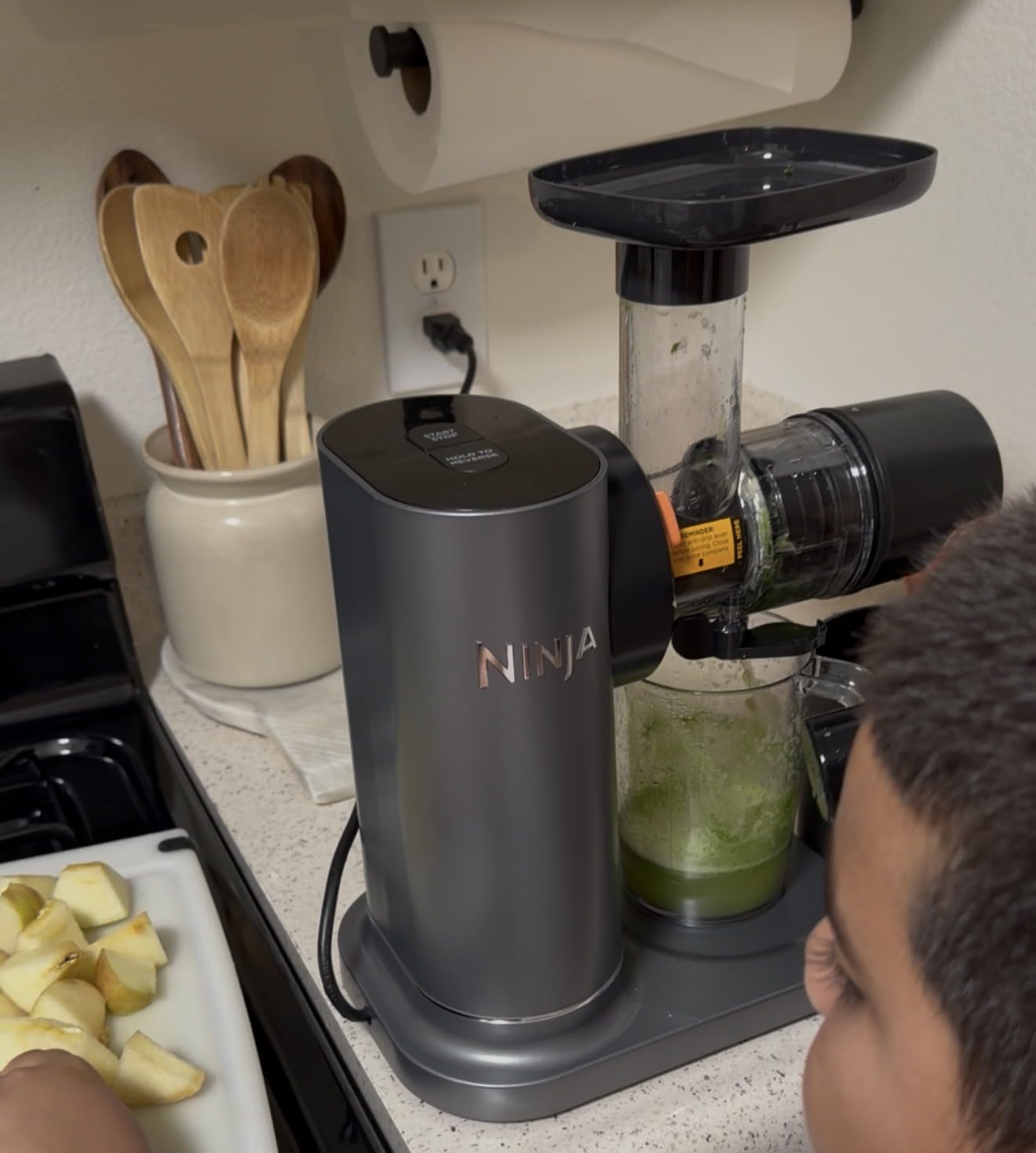
This is the machine we kept reaching for. The NeverClog is a 150-watt cold press juicer with a vertical footprint that measures 12.11 inches deep by 7.15 inches wide, and it fits under a standard cabinet without being turned sideways. The auger turns slowly enough to keep heat out of the juice and heavily geared enough that a celery stalk does not stall it.
It took a full bunch in a single session without a jam. That result matches what owners report in the reviews, where celery and other fibrous vegetables come up again and again as ingredients the machine handles without stalling. One Reddit user in the juicing community described running a full bunch through a Ninja NeverClog in one go with no clogging, which is the single most useful thing you can know before buying.
Total Pulp Control and What It Means for Celery
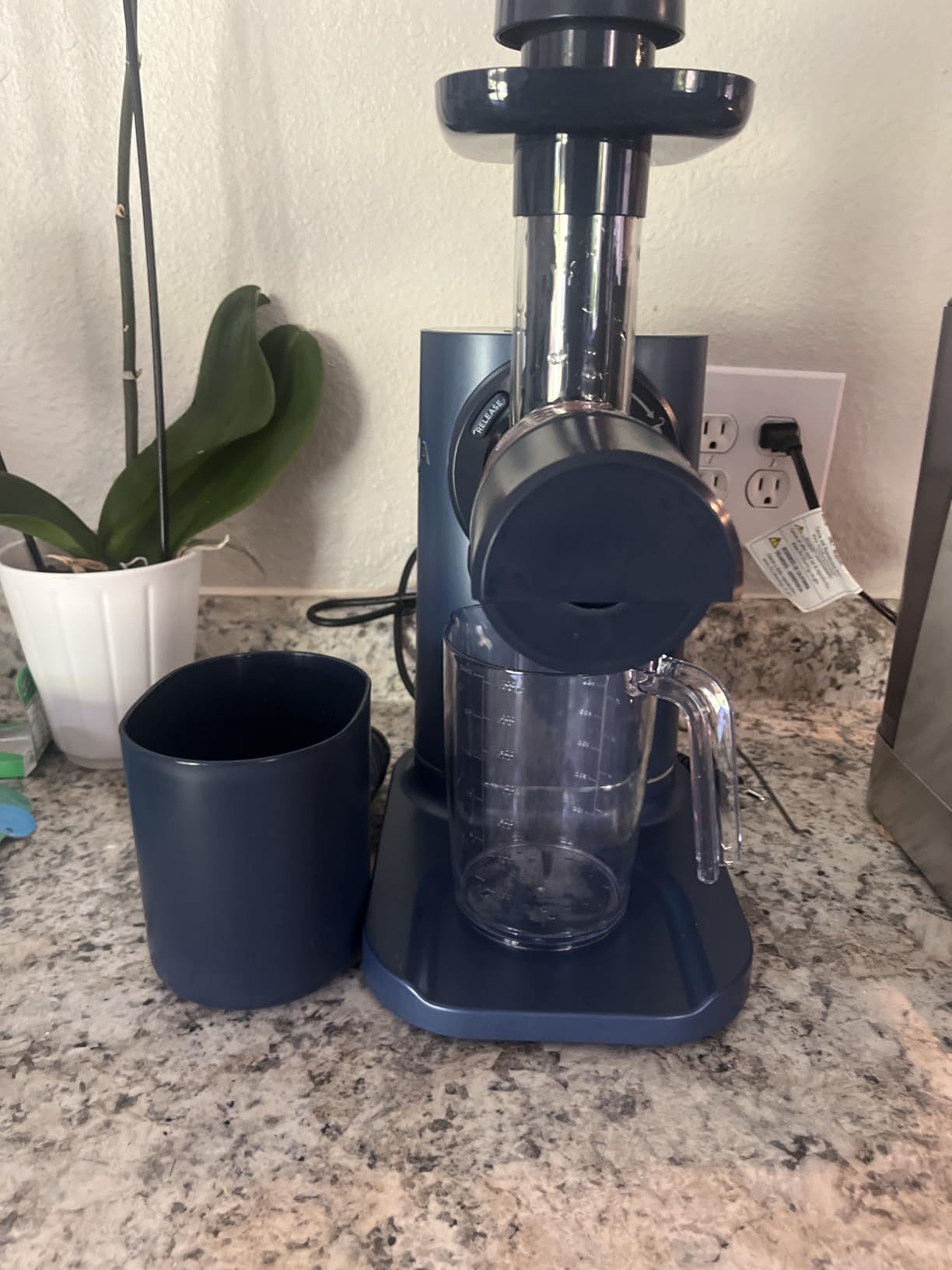
The NeverClog ships with two interchangeable pulp filters, and swapping between them is the feature that separates it from most machines at this level. One setting pushes for a clearer glass of juice, the other eases off so you waste less produce. For celery specifically, that second filter is the one that matters, because the juice comes out slightly more fibrous but you buy fewer stalks per serving.
Across our runs the pulp came out genuinely dry, and reviewers describe the same thing. The trade-off is that the two-filter system is one more thing to wash, and the 24oz juice jug fills before a full batch of celery is done.
Noise, Reverse Function and Daily Use Reality
The most common complaint we found, and the one most at odds with the marketing, is noise. It is quieter than a centrifugal, but it is not silent, and the review consensus is that it is louder than buyers expect. In a shared apartment at 6am that matters, so if noise is your top filter you should look at the machines rated under 60 dB instead.
The reverse function is what saved our runs more than once. When a fiber bundle builds at the strainer, one touch of reverse clears it and the batch continues. The machine is rated at 110V only, so it will not run on 220V mains without a converter, and hard vegetables still need to be sliced thin even though celery does not.
2. Omega Cold Press J8006HDC – Best for Long-Term Ownership
Omega Cold Press Juicer Machine, All-in-One Nutrition System for Vegetable and Fruit Juice, Nut Butter, Baby Food, Pasta and Sorbets, Triple-Stage 80-RPM Slow Masticating Juicer, 200-Watts, Chrome
Triple-stage 80 RPM auger
200W, 32oz capacity
Stainless steel, 15-year warranty
+ Pros
- Exceptionally dry pulp from fibrous vegetables
- Very quiet running
- Adjustable end cap with 3 pressure settings
- 15-year manufacturer warranty
- All-in-one attachments for nut butter and pasta
– Cons
- Narrow chute means produce must be diced small
- 14.1 pounds and a large footprint
- Struggles with soft produce on its own
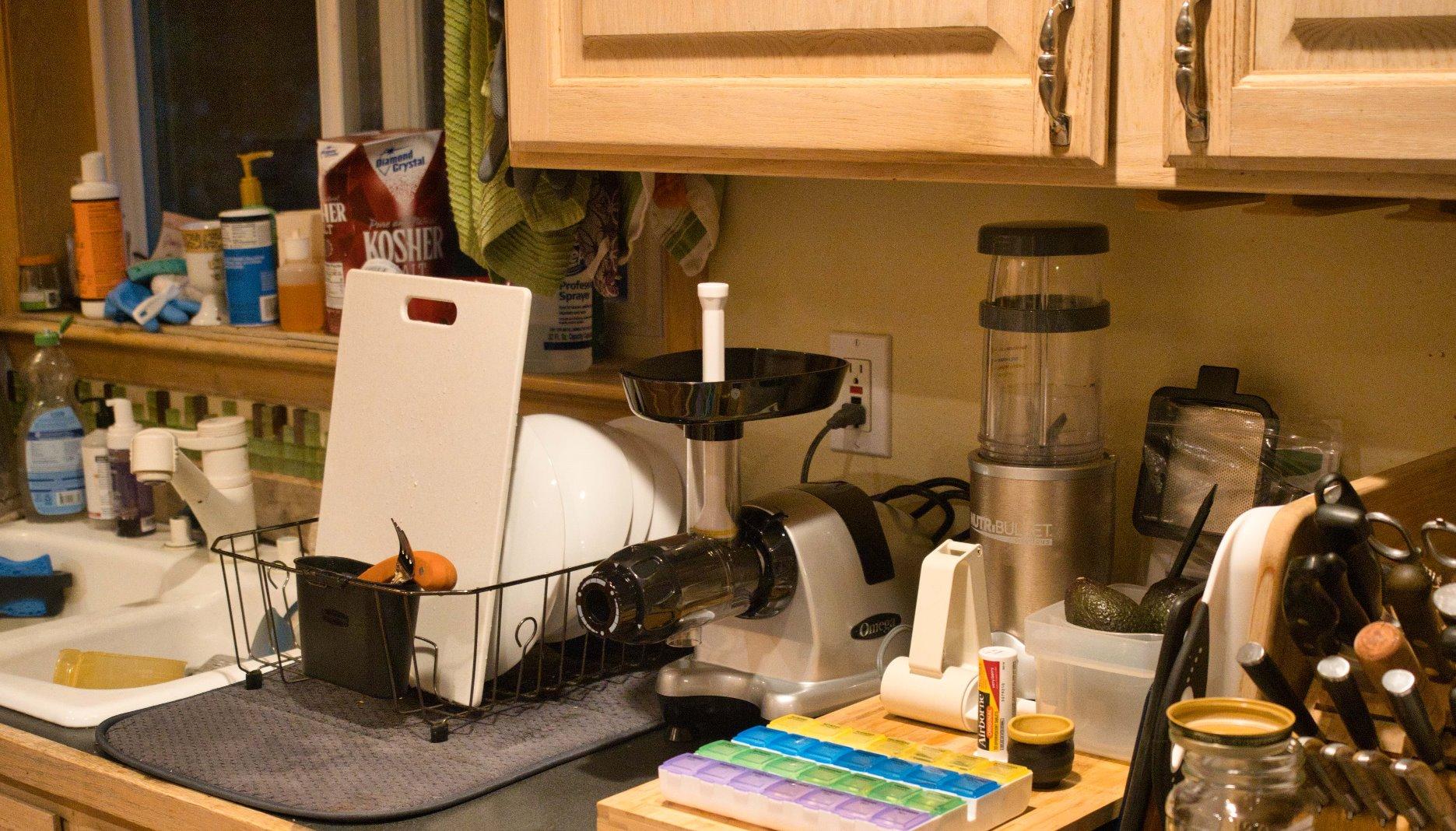
This is the machine that shows up again and again in long-term ownership stories, and the reviews reflect that. The average rating of 4.4 across 2.8k+ reviews is built mostly from people with four-plus years of daily use, which is a very different review base from a machine that launched last year.
It is also the slowest machine in our lineup. The triple-stage auger turns at 80 RPM, which is exactly the point: the slow crush is what produces dry pulp from celery, kale and chard. What you give up is speed, and the narrow feed tray means every stalk gets diced before it goes in.
The Adjustable End Cap and Celery Pressure
The end cap is the part celery drinkers care about most and reviewers mention least. It has three pressure settings, and the higher settings squeeze more liquid out of the same fiber at the cost of a slower pass. On a hard stalk like celery, the top setting is where the yield lives. On soft produce the lower settings stop the tube from jamming, which is why this machine also comes up as a frustrating choice for cucumbers and soft apples alone.
Automatic pulp ejection handles the waste side, and the gear-reduction is described as equivalent to a 2 HP motor. That combination is why the auger does not bog down on a full stalk of celery even at the highest pressure setting.
Warranty Length as a Durability Proxy
The 15-year warranty is the standout number on this list. No other machine here comes close, and it is a genuine signal rather than marketing, because a company does not write a 15-year parts and performance warranty on a housing that cracks. The stainless steel body and suction-cup base are built to match, and the machine stays put on the counter without being held down.
It weighs 14.1 pounds and measures 15.74 inches deep by 7.56 inches wide, so plan the counter space. A smaller vocal group reports the plastic auger or blank cone cracking after light use with the non-juice attachments, mostly when grinding coffee or making smoothies rather than juicing celery.
3. Hamilton Beach Big Mouth 67601A – Best Value Centrifugal
Hamilton Beach Centrifugal Juicer Machine With Big Mouth 3” Feed Chute
3-inch big mouth chute
800W motor, 3 year warranty
Dishwasher-safe pulp bin, bowl, lid and pusher
+ Pros
- 3-inch chute fits a whole apple or a bunch of celery
- Very easy to wash
- 800W motor
- Stable rubber-footed base
- 3-year warranty and a very large review base
– Cons
- Loud
- comparable to a vacuum cleaner
- Wet pulp and low yield on leafy greens
- No juice jug included
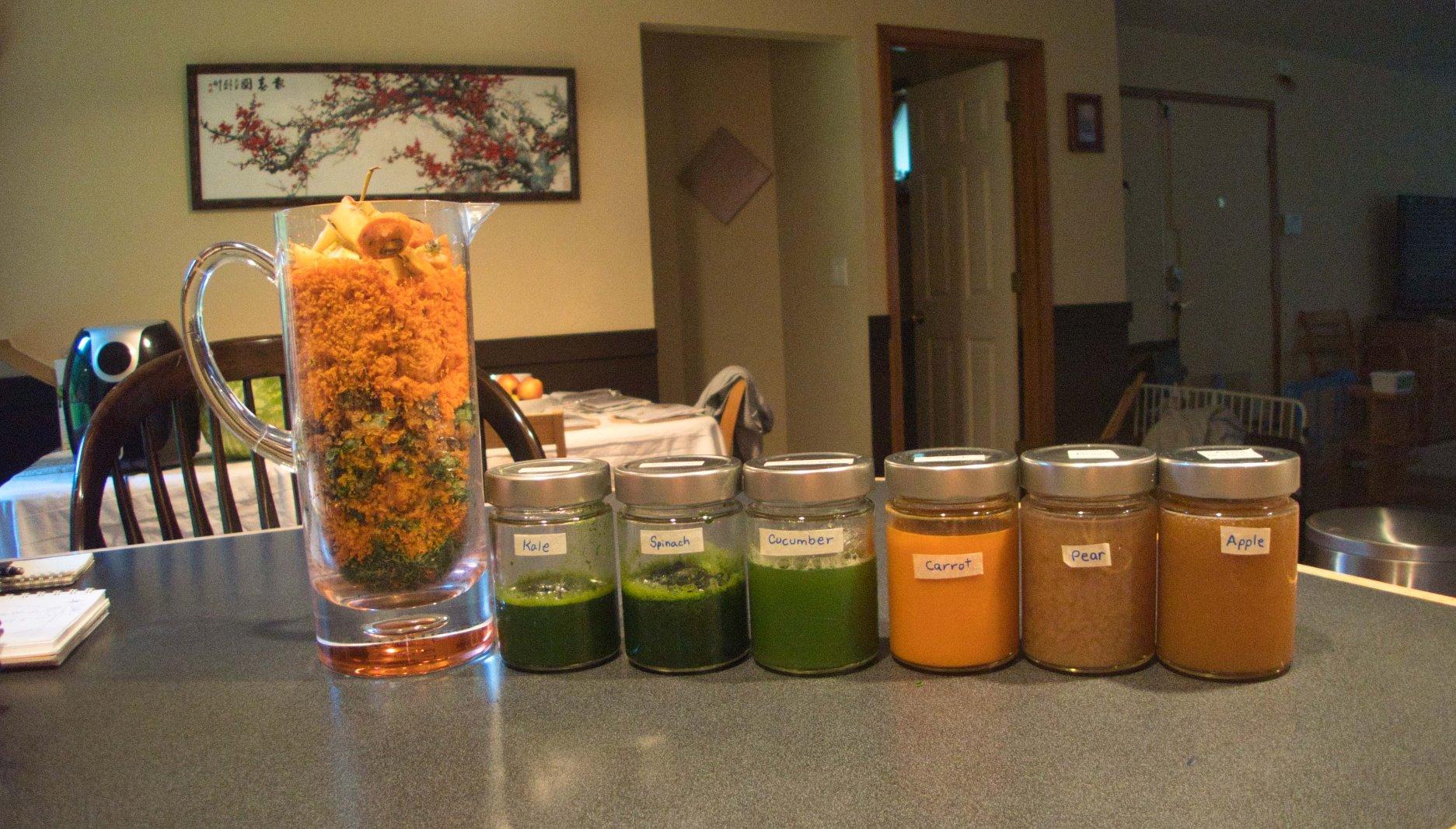
We are including this one as a deliberate counterpoint, not as a recommendation for a daily celery habit. It has 41k+ reviews and a 4.4 rating, which makes it the most proven machine here by a wide margin, and the 3-year warranty is longer than most of the slow juicers on this list. But it is a centrifugal, and on celery that means wet pulp and noise.
The 3-inch big mouth chute is genuinely excellent, and the manufacturer lists celery as a recommended use. In practice it handles a length of celery at a time rather than a whole stalk laid across, and you will be opening the machine more often than you would with a wide-chute masticating model.
Why Centrifugal Machines Lose to Celery
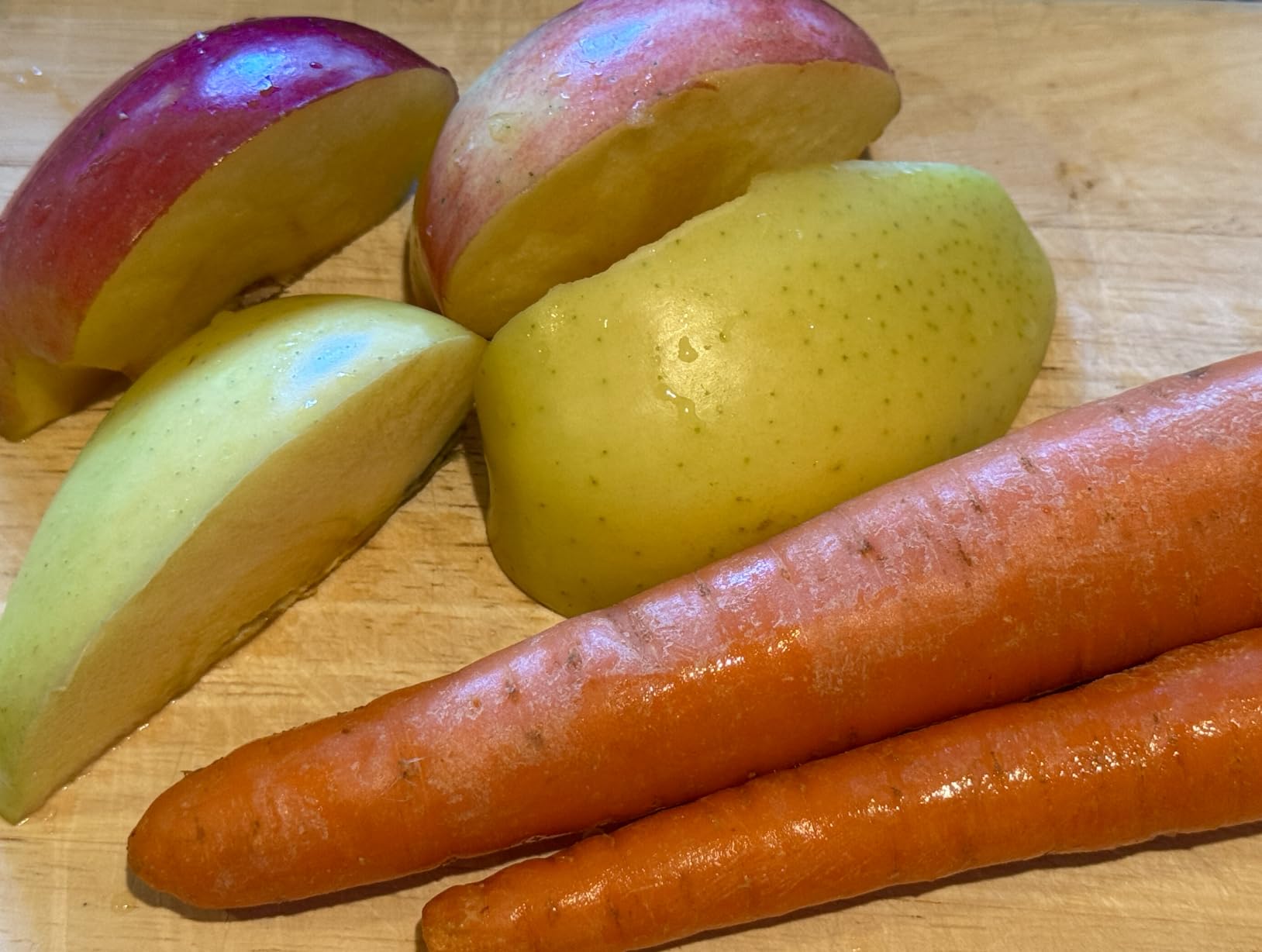
The physics is simple. A spinning disc throws juice outward through a fine mesh, and the last thing celery wants to do is pass through fine mesh, because its fiber wraps around the blade assembly. The result is pulp that is measurably wetter than what a slow auger produces, which means you buy more celery to fill the same glass. Reviewers put it plainly: output from leafy greens is low and pulp comes out wet compared with masticating machines.
If you juice mostly apples, oranges and carrots, none of that matters and this machine is a bargain. If celery is the reason you are here, it is the wrong tool even at a great price.
Cleaning, Noise and What You Actually Get
Cleaning is the genuine strength. The pulp bin, bowl, lid and pusher all go in the dishwasher, and there is no mesh screen assembly to take apart, which is the single most common cleanup complaint on slow juicers. Noise is the counterweight: reviewers consistently describe it as comparable to a vacuum cleaner.
Two smaller notes. There is no juice jug included, so you position your own container under the spout. And the fine shredder holes need attention roughly every 15 to 18 apples during heavy batches, so celery is not the friendliest produce for this machine’s filter.
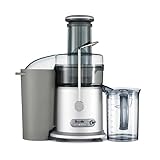
4. Breville JE98XL Juice Fountain Plus – Top Rated for Mixed Produce
Breville JE98XL Juice Fountain Plus, Silver
3-inch extra wide chute
850W motor, two speeds
35.2oz jug with froth separator
+ Pros
- Extra wide 3-inch chute
- Two speed control for soft and hard produce
- Built-in froth separator
- Large 2.6 qt pulp container
– Cons
- Bulky 10.1 pound body
- Heats juice slightly compared with cold press
- Mesh basket needs careful cleaning
- Only 1-year warranty
With 16k+ reviews and a 4.5 rating, the Juice Fountain Plus is tied for the highest rating in this group. If your kitchen is a general juice kitchen rather than a celery-only operation, it is genuinely hard to argue against. The titanium-reinforced disc and Italian-made micro mesh filter basket are well regarded, and the 3-inch chute handles whole produce with minimal pre-cutting.
For celery you would run the high speed setting, and buyers do exactly that, using it for celery, carrots and greens. Two speeds let you back off for softer produce, which is the feature that keeps the machine versatile enough to recommend for a mixed household.

Two Speeds and the Froth Separator
Low speed handles soft fruit and leafy greens, high speed covers denser produce like carrot and celery. That split is more useful for celery than it sounds, because a centrifugal that can back off its RPM is less likely to bind when a fiber bundle forms. The trade-off is that both speeds still produce some foam and suspended pulp, and the integrated froth separator in the 35.2oz jug is there to manage that.
Bulk, Heat and the One-Year Warranty
Heat is the honest objection. A centrifugal introduces slightly more warmth than a cold press machine, and that is the whole argument for going slow. The other objection is physical: at 10.1 pounds with a 2.6 quart footprint, this is a large machine to keep on a counter, even though the cord wraps under the base for storage.
Against that, the warranty is only 1 year, which is short for the money and the shortest warranty among the higher-rated machines here. The mesh basket also needs prompt rinsing with the included brush, since dried cellulose residue in micro mesh is the hardest cleanup job in this category. If celery is a small part of what you juice, this is a strong machine. If it is most of what you juice, step up to a slow juicer.
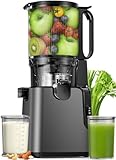
5. AAOBOSI 3-in-1 Cold Press – Best Wide Chute for the Money
AAOBOSI 3-in-1 Cold Press Juicer Machine, 6.5″ Wide Chute, Slow Juicer Designed for Faster Juicing with Whole Fruits & Veggies, Easy to Clean and Clog-Resistant, for Nut Milk & Sorbet
6.5 inch wide feed chute
100oz capacity, 3 in 1
Juice, nut milk and sorbet
+ Pros
- 6.5 inch chute cuts prep time on celery
- Handles fibrous vegetables with low clogging
- No layered mesh screens to dismantle
- Large 100oz capacity
- Low-noise motor
– Cons
- Hand wash only with no dishwasher-safe parts
- Tall 16 inch footprint for small kitchens
- Some buyers find the chute narrower than advertised
With 3.7k+ reviews at 4.4, this machine has one of the strongest review bases among the mid-priced cold press options, and the review pattern is unusually consistent. Owners report that it handles celery, fennel, ginger and beet well, and produces dry pulp with good yield for the money.
The headline spec is the 6.5-inch feed chute, which is the widest opening on the list alongside the AMZCHEF and the EanOruus. On celery that translates into very little trimming, and a wide chute is the single biggest lever on whether a daily celery habit survives past the first week.

Chute Width Versus the Advertised Number
We need to flag one honest discrepancy. The listing advertises 6.5 inches, and some buyers report that the chute opening is narrower than the advertised figure in practice. Treat 6.5 inches as an upper bound and measure the neck of your own produce before you commit. Even at the lower end, it is a wide chute compared with the 1.8-inch opening on the Brecious.
The 100oz capacity is unusually large for a machine at this level, and it matters for celery because a full bunch produces a lot of juice and a small hopper means more stops to empty and reassemble.
Cleaning Design and the Hand-Wash Catch
Cleaning is fast here because there are no layered mesh screens to dismantle. That design choice is the main reason reviewers describe the machine as quick to rinse, and it is the opposite of the complaint we hear most about screen-based slow juicers.
The catch is that care instructions say hand wash only, with no dishwasher-safe parts listed, so the speed comes from a short rinse rather than a dishwasher cycle. At 16.22 inches tall it is one of the taller machines in the lineup, which matters if you have an overhead cabinet.
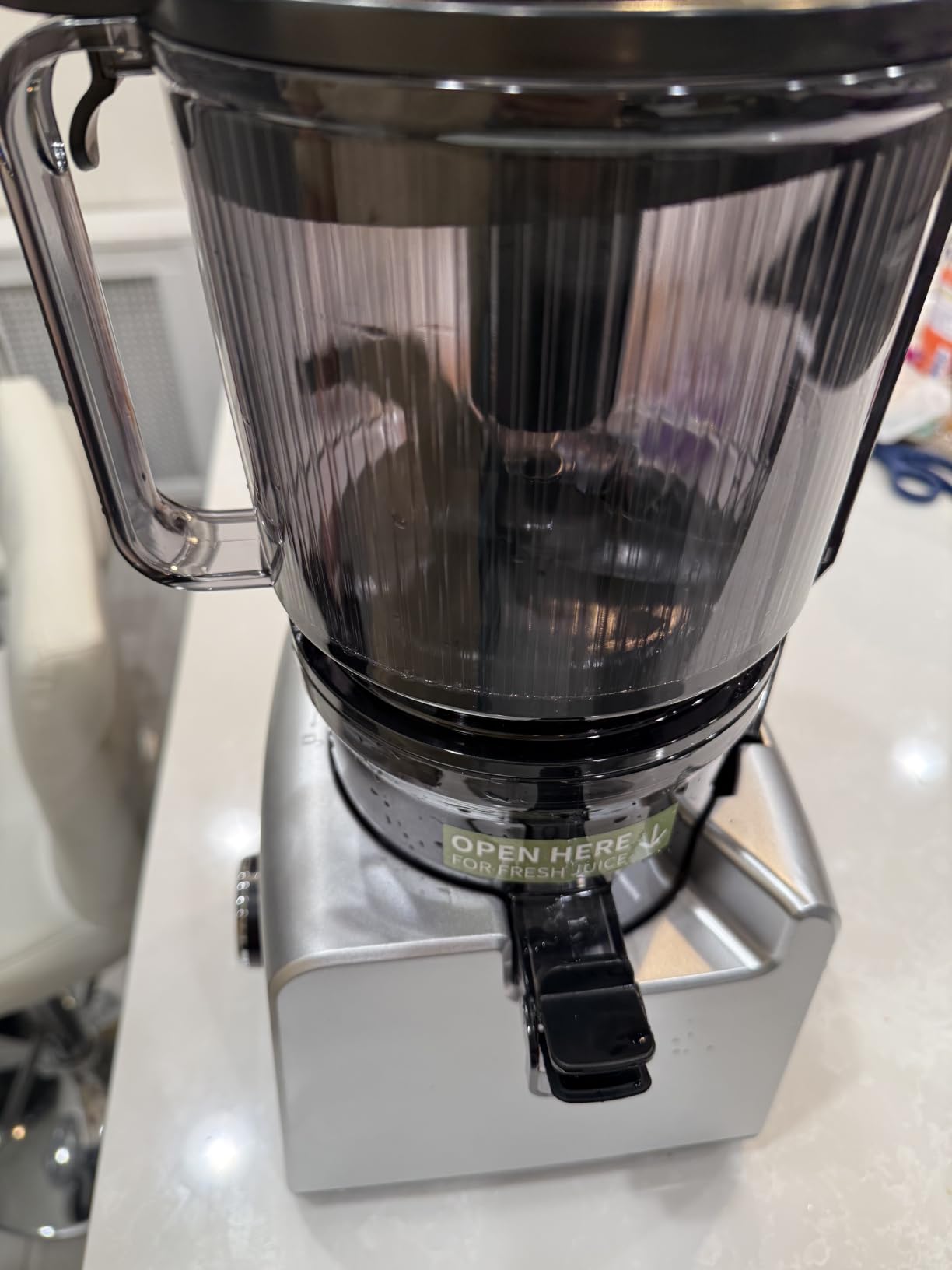
6. EanOruus 3-in-1 Cold Press – Best for Clean Low-Foam Juice
EanOruus Juicer Machines, 3-in-1 Cold Press Juicer, Premium Gray
250W AC brushless motor
6.5 inch chute, 100oz hopper
Interchangeable juice and sorbet strainers
+ Pros
- Very high juice quality with negligible foam
- Extremely dry pulp
- Quiet high-torque AC brushless motor
- 100oz hopper supports multi-day batches
- Detachable pulp outlet
– Cons
- Chute measures closer to 6 inches than advertised
- Assembly lock is finicky on first uses
- Some reports of minor leaking at the pulp outlet
- Hand wash only
Buyers rank this machine on juice quality first, and the review consensus is unusually specific about why. Juice comes out with negligible foam, the pulp is extremely dry, and the AC brushless motor is quiet relative to other masticating machines of the same class. If the glass you drink from is the thing you care about, this is the pick.
The motor designation is worth pausing on. Most budget cold press machines use a DC motor, and an AC brushless motor on a vertical single-auger machine at this level is a differentiator that shows up in the smoothness of the extraction and in how quiet it runs.

Assembly and the Pulp Outlet Seam
The most repeated criticism is the assembly lock. The removable section can rotate if it is not seated properly, and it may take a second or third attempt before it engages. Once it is assembled correctly it stays put, but the first few days are where people give up.
A smaller number of owners report minor leaking at the pulp outlet seam, which is worth keeping in mind if you plan to leave the juice in the jug rather than pouring it straight away. Extraction efficiency also varies by fruit, with some users measuring around 70% of hand-squeezed yield for passion fruit, though that fruit is not the machine’s strength and celery is a different extraction problem entirely.
Capacity and 3-in-1 Versatility
The 100oz hopper supports multi-day batches, and the interchangeable juice and sorbet strainers make it a genuine 3-in-1 rather than a marketing label. Like the AAOBOSI, the real chute measures closer to 6 inches than the advertised 6.5, and it is 110V operation only, so plan accordingly if you travel.

7. AMZCHEF 6.5 inch Self-Feeding Cold Press – Best for Minimal Prep
AMZCHEF Cold Press Juicer, 6.5″ Whole Fruit Self-Feeding Slow Juicer
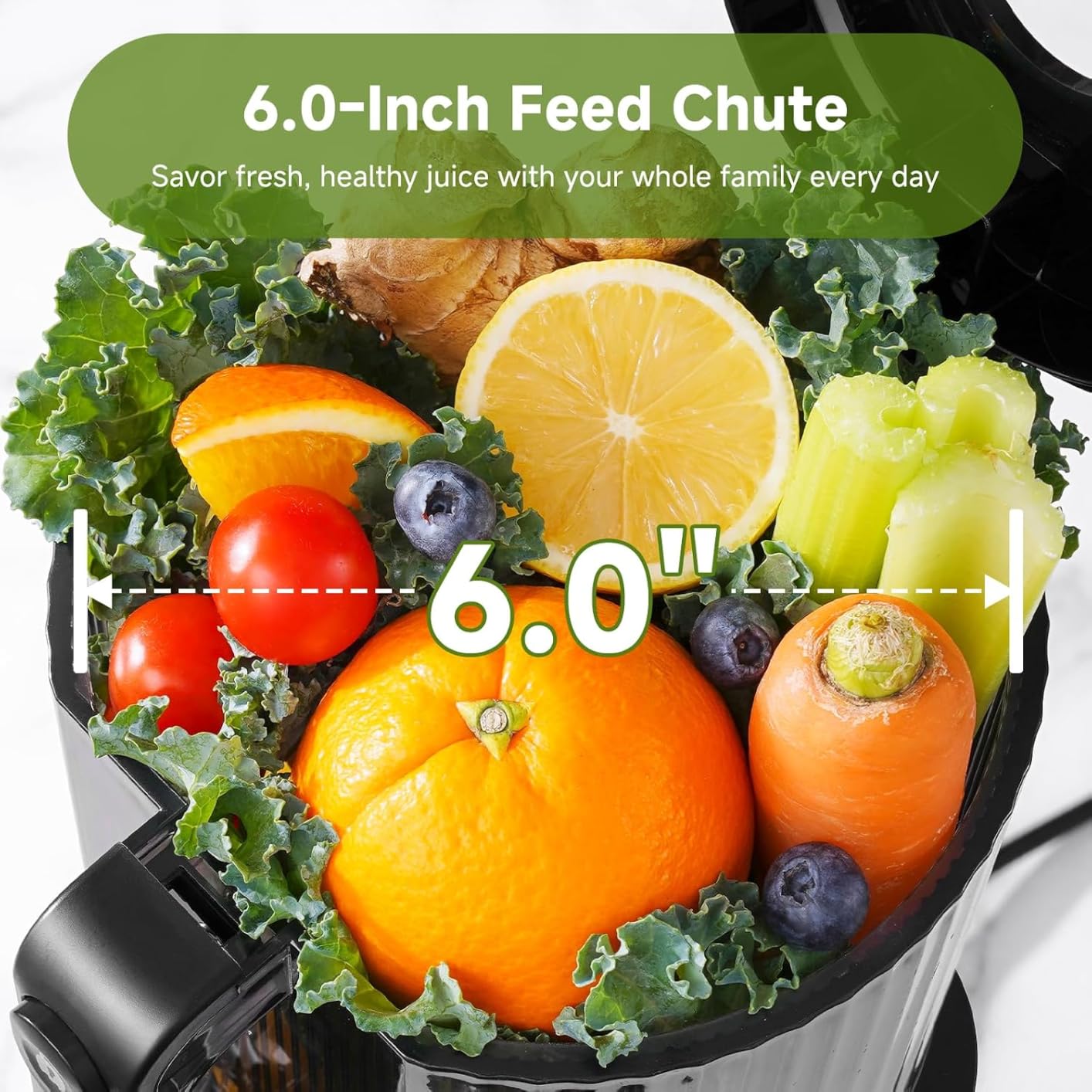
6.5 inch reversible self-feeding chute
600W motor, 2 speeds
Juice and sorbet strainers
+ Pros
- Wide reversible chute with built-in blades cuts chopping
- 600W motor plus reverse reduces clogging
- Assembles and cleans in about five seconds
- Dishwasher-safe removable parts
- Quiet for early mornings
– Cons
- Roughly 17 inch tall body needs overhead clearance
- Some units trigger overload protection on hard carrots
- Filter screen tedious to scrub in narrow areas
This is the most interesting machine on the list from a durability standpoint, and we want to be straightforward about that. It has 3.5k+ reviews at 4.4, which makes the review base a strong one. In juicing communities, though, this brand draws repeated durability complaints, with owners reporting multiple purchases and refunds. Our runs were uneventful, but that pattern is worth knowing before you commit.
What we liked is the 6.5-inch reversible chute with built-in cutting blades. You push a whole piece of produce in and the chute cuts it on the way down, so for celery the prep is close to zero beyond breaking the stalk to fit. Several owners report daily use for celery, ginger and root vegetables.
The 600W Motor and Overload Protection
The motor spec is higher than most machines in this class at 600 watts, and combined with the reverse function and the upgraded chamber structure it is designed to reduce clogging. The larger auger applies high pressure at low speed, which is the mechanism behind the yield on fibrous produce.
The flip side is that some units stall and trigger the overload protection on very hard vegetables such as carrots, and the protection cuts out until the machine cools. If you plan to juice a lot of carrot and beet alongside celery, factor in cool-down pauses. Frozen fruit also has to be thawed before the sorbet attachment or it jams the blade.
Five-Second Assembly and the Tall Body Problem
Assembly and disassembly are among the fastest in our lineup, with the detachable body and simple locking design coming apart in roughly five seconds. Removable parts are dishwasher safe, though you should not immerse the motor base. The included brush clears the filter, which matters because the filter screen can be tedious to scrub in narrow areas.
The real drawback is height, at roughly 17 inches. That needs overhead cupboard clearance, and it is the first thing to check if you have a low kitchen. It weighs 6.3 pounds, so moving it is easy, but parking it is the issue.
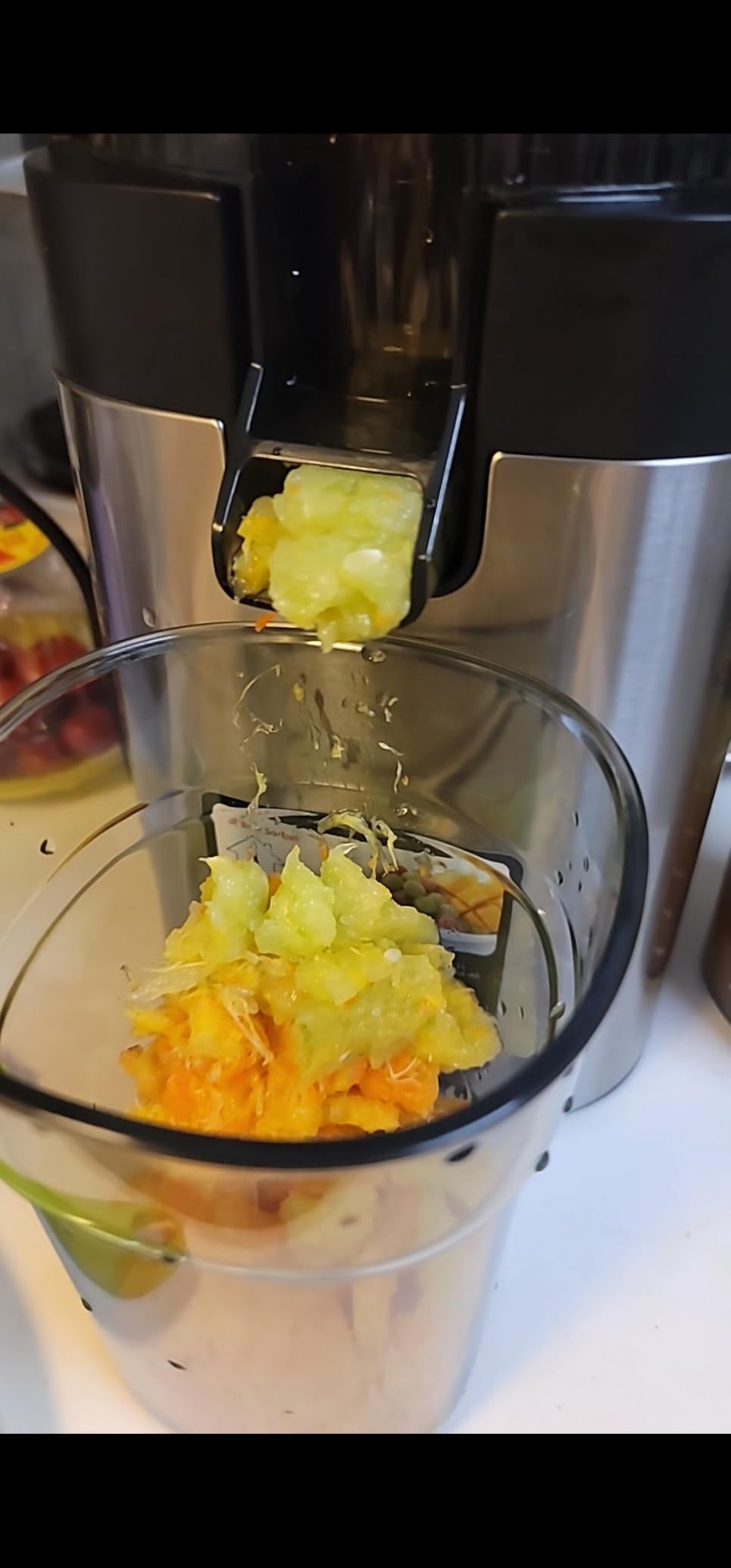
8. YPONE 2-in-1 Cold Press – Best for Nut Milk Too
Juicer Machines with 5.8″ Large Chute, 2-in-1 Cold Press Juicer for Whole Vegetables Fruits 400W, Masticating juicer Easy to Clean Juice Extractor Machine for Making Nut Mike, Juice, Premium Gray
5.8 inch feed chute
400W at 55 RPM
Dual 0.3mm strainers, safety lock
+ Pros
- 5.8 inch chute takes celery with little pre-cutting
- 55 RPM with 0.3mm double-layer strainers for foam-free juice
- Only three main parts so washing takes seconds
- Large capacity cans plus a separate pulp container
– Cons
- Pulp comes out wetter than the yield claims suggest
- Single-speed design gives less control
- PVC construction and plastic auger
- a minority of units have failed or cracked early
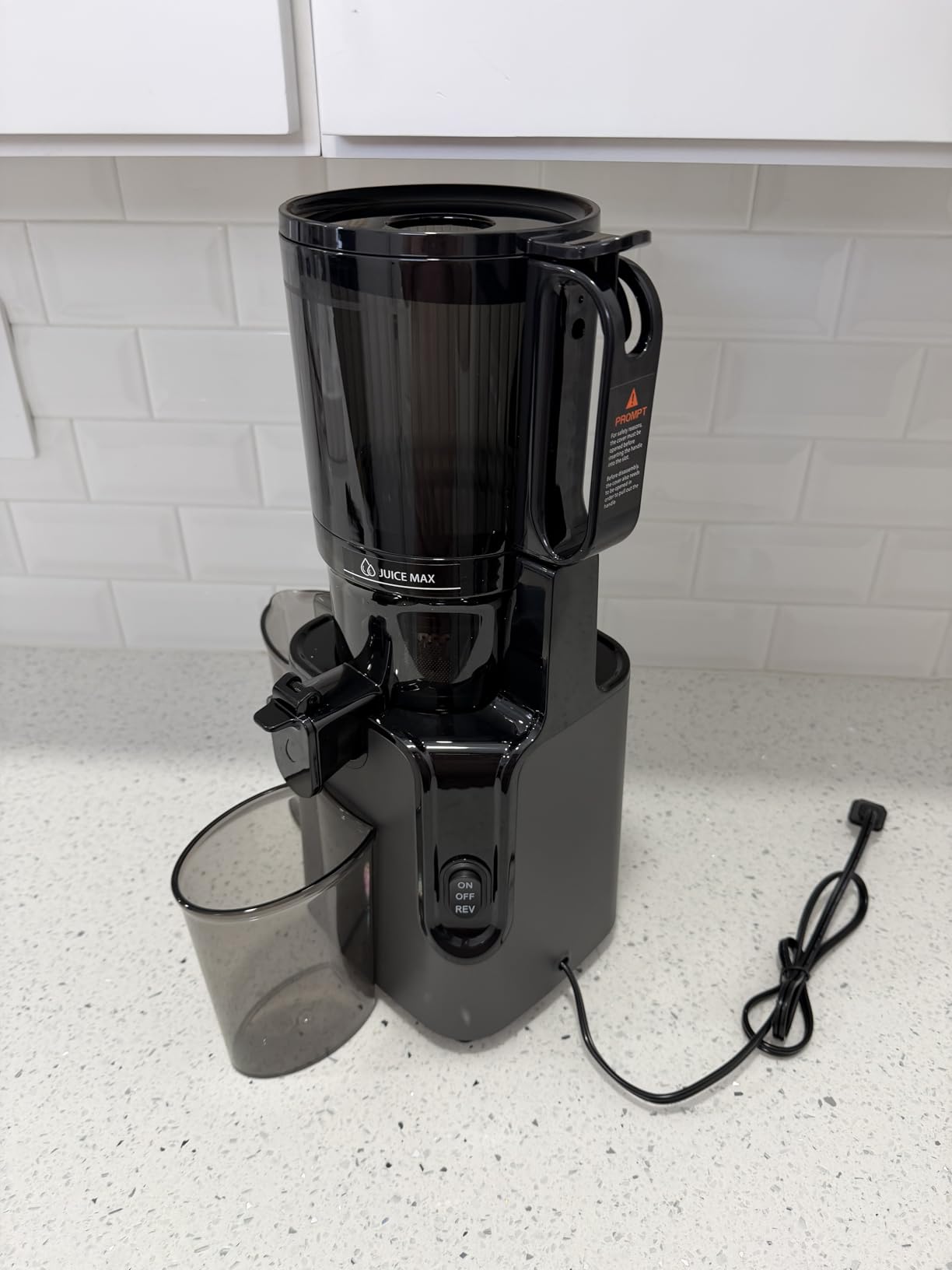
The defining feature here is simplicity. Only three main parts, which means assembly, disassembly and rinsing take seconds, and for anyone who has ever abandoned a juicer because washing it felt like a chore, that matters more than any spec on the label. Celery, carrot, cucumber, ginger and kale are all named as ingredients handled well across the reviews.
The 0.3mm double-layer strainers are what produce the low-foam juice, and the 5.8-inch chute handles whole apples, oranges and celery with little pre-cutting. A safety lock stops the motor the moment the lid opens, which is the right call on a machine with a wide chute.
Wetter Pulp and the Single-Speed Limitation
The honest flaw is pulp dryness. Owners report the pulp coming out noticeably wetter than the advertised yield claims suggest, which on celery means buying more produce per glass. It is a milder version of the problem the centrifugal machines have, and it is a direct consequence of the single-speed design and the light motor weight.
Single speed also means less control when you move between soft and hard produce. You cannot back the RPM off for cucumber the way you can on the two-speed and three-speed machines. The PVC construction and plastic auger are the other downgrade, and a minority of units have failed or cracked at the collection tank within weeks or months, plus some owners reporting more vibration and noise than the marketing implies.
2-in-1 Flexibility and Portion Sizes
Beyond juice it makes nut milk and soy milk, which is genuinely useful if you want one machine for two jobs. The large capacity cans and separate pulp container reduce refills during a batch. It weighs 4.42 kg, making it one of the lighter machines here, and the dimensions of 5 inches deep by 11 inches wide by 13 inches tall are among the most compact in the lineup.
9. TUUMIIST 580 – Best Budget Cold Press
TUUMIIST Juicer Machines, Cold Press Juicer with 5.8″ Extra Large Feed Chute Fit Whole Fruits & Vegetables Easy to Clean, High Juice Yield, BPA Free (Black)
300W at 55 RPM
5.8 inch extra large feed chute
Mesh-free design, BPA free
+ Pros
- 5.8 inch chute accepts whole produce
- 55 RPM slow squeeze with 300W motor
- One-piece build that cleans in about five minutes
- BPA-free materials throughout
- Knob control with no mesh filter
– Cons
- Lowest motor output in the lineup
- Mesh-free design leaves more fibre in the juice
- Hopper must be twisted clockwise to the lock mark or it will not run
- Tall 17 inch body
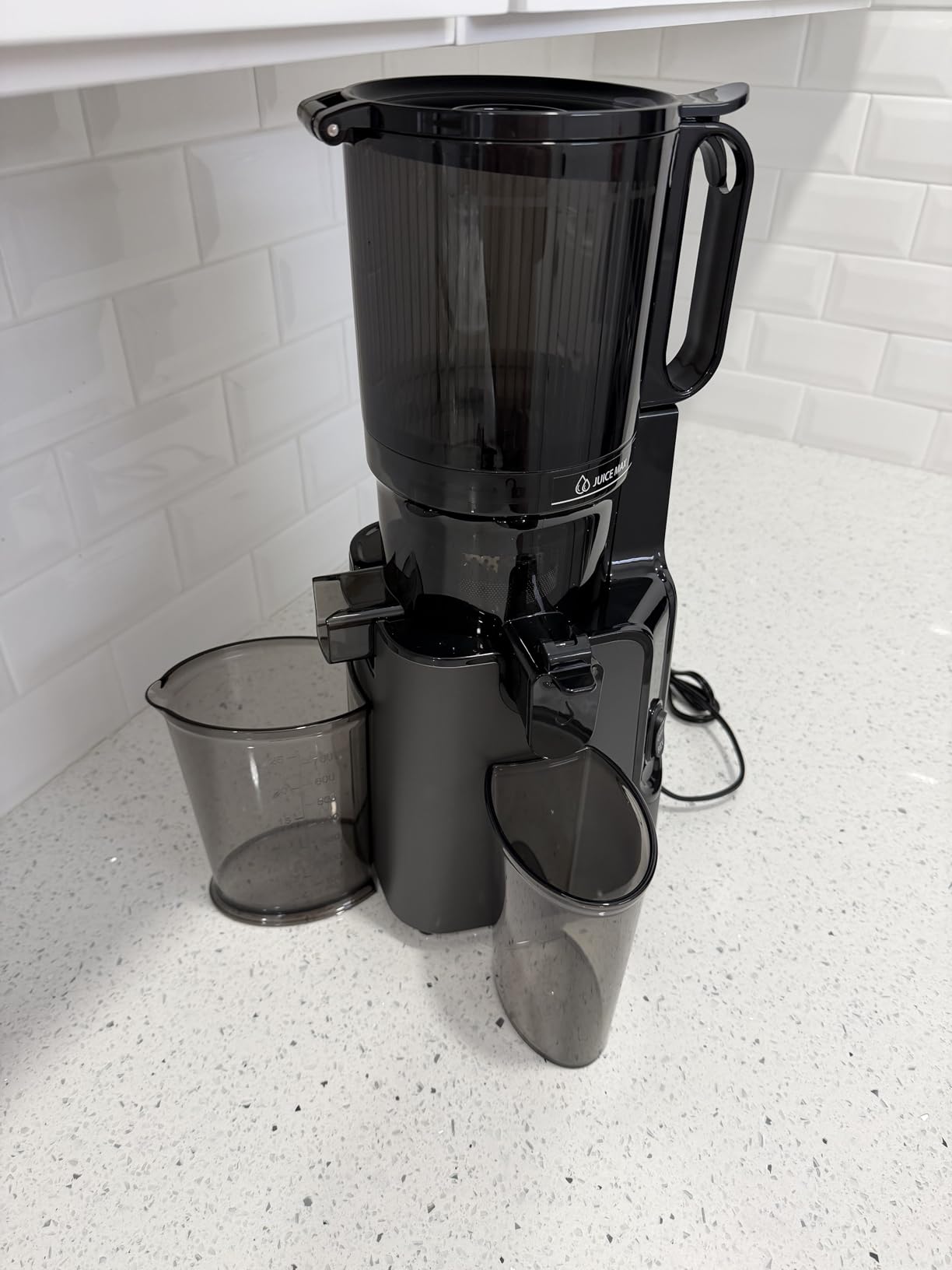
This is the most affordable slow juicer on the list and the most interesting budget option, because it gets the two things that matter most for celery right: a slow 55 RPM squeeze and a 5.8-inch feed chute. That combination puts it ahead of several more expensive machines on prep time alone.
Buyers rate it on value, and the recurring positives are the wide chute, the simple one-piece build, the short cleaning routine and the BPA-free materials. The recurring negative is the 300W motor, which is the lowest output in this group.
The 300W Motor and What It Means for Celery
Celery is a fibrous, low-water-content stalk, so a weaker motor is exactly the wrong place to economize. In practice the 300W unit needs produce cut to size before it goes in, and that is a step you are doing by hand every single morning. The machine does not stall on celery, but it is slower than the higher-wattage options and it tolerates less improvisation.
The good news is that 300 watts paired with 55 RPM is still slow juicing rather than centrifugal juicing, so the fiber gets crushed rather than wrapped around a spinning blade. You are getting the right architecture with a smaller engine.
The Mesh-Free Design and the Lock Mark
The mesh-free design is a clever trade. There is no fine filter screen, which means fewer parts that trap residue and a clean in about five minutes with the included brush. The cost is that more fiber stays in the finished juice, so the glass is less clear than from a screened machine.
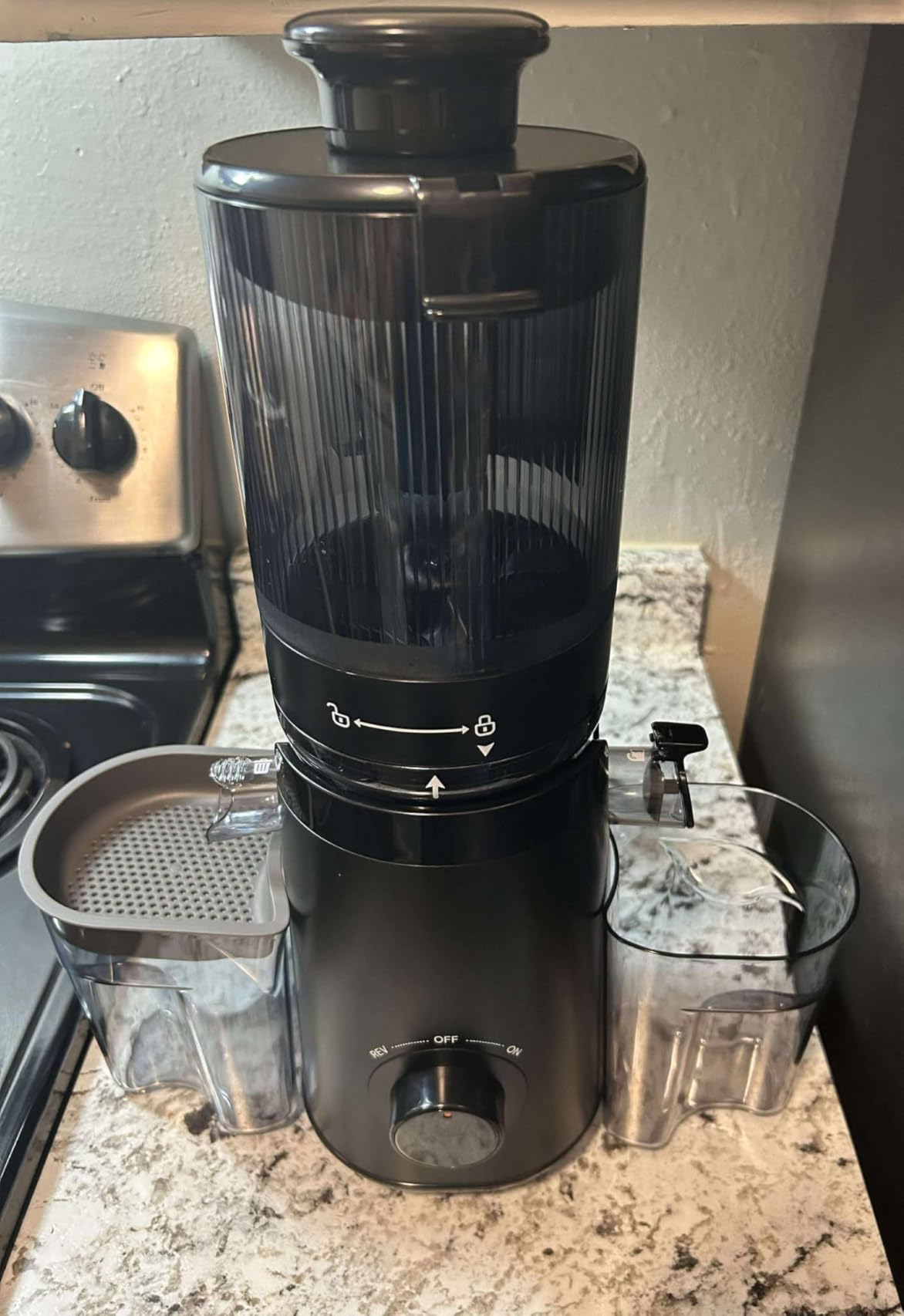
One assembly detail catches people out: the hopper must be twisted clockwise to the lock mark or the machine will not run. This is the single most common setup error in the reviews, and it is worth checking before assuming the machine is faulty. It stands 17 inches tall and weighs 3.2 kg.

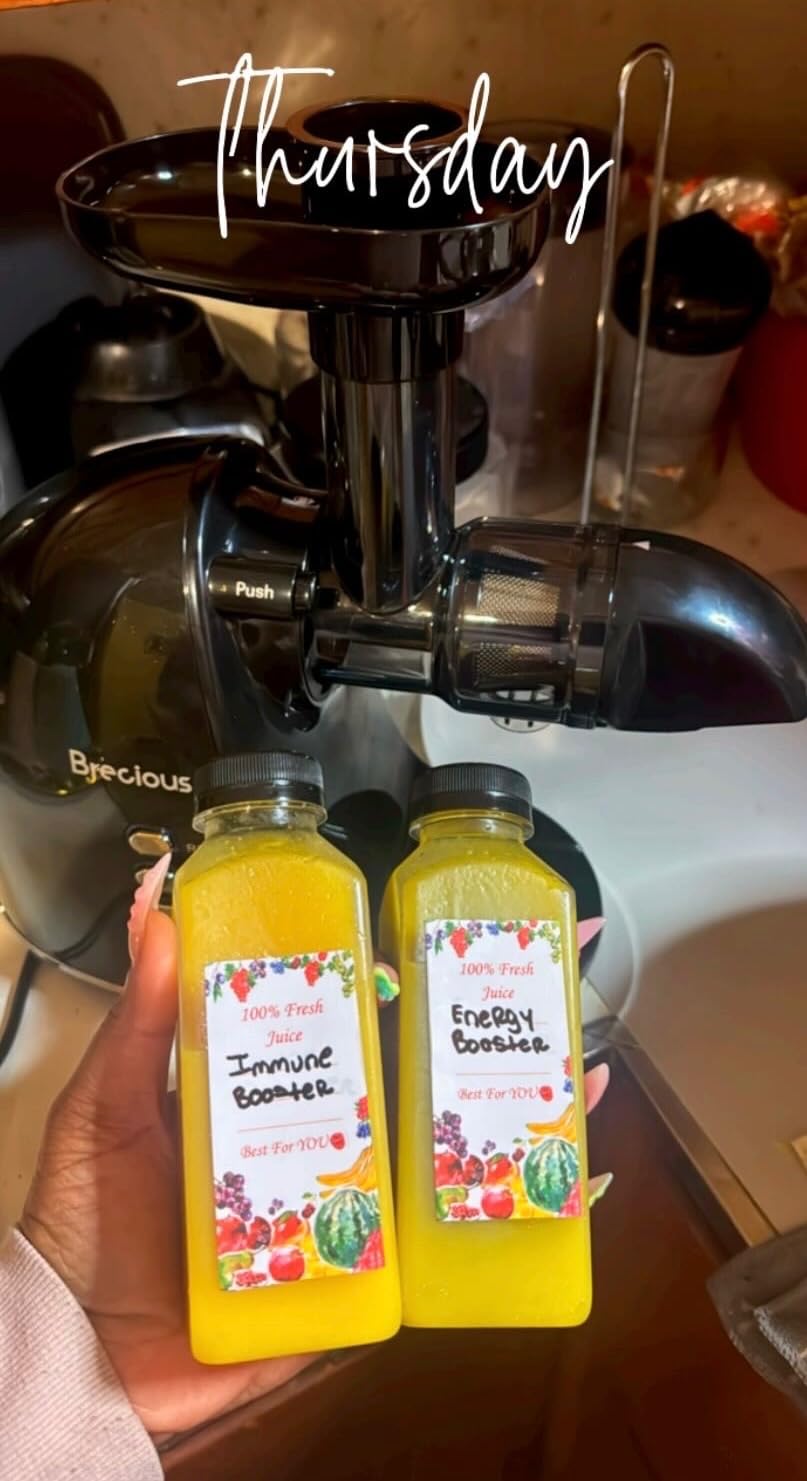
10. Brecious 7-Stage Masticating Juicer – Best for Beginners
Slow Masticating Juicer,Brecious Cold Press Juicers with 2 Speed Modes & Quiet Motor,Juicers Machines Vegetable and Fruit with Reverse Function,Celery Juicer,BPA-Free,Easy to Clean (Silver)
7-stage auger at 95-110 RPM
150W, 2 speeds
Silver, one-touch disassembly
+ Pros
- 7-stage auger delivers up to 90 percent juice yield
- Soft Hard and Reverse modes match the produce
- Under 60 dB for early mornings
- One-touch disassembly with dishwasher-safe parts
– Cons
- 1.8 inch feed chute means constant trimming
- Only a one-year after-sales warranty
- ABS plastic body can scratch with heavy use
This is the best first slow juicer on the list, and the reason is control. Soft, Hard and Reverse modes let you match the setting to the ingredient, and for a new juicer learning what celery does, that is more useful than raw torque. The 7-stage auger is specified to deliver up to 90 percent juice yield with low oxidation.
The rating is 4.5 across 1.1k+ reviews, and the review summary is consistent about the positives: quiet operation at 95 to 110 RPM, straightforward disassembly and good yield for a mid-priced masticating machine.
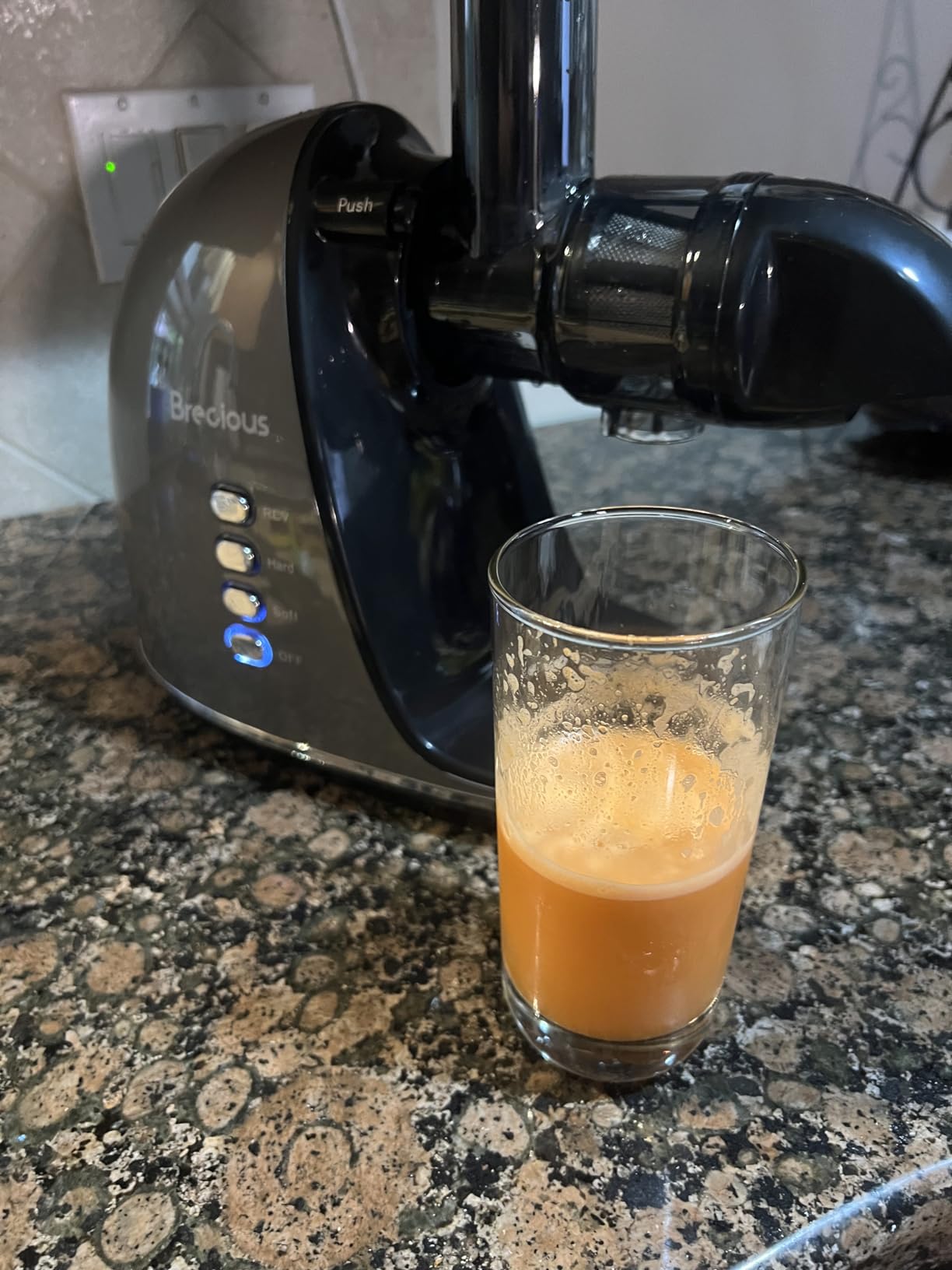
The 1.8 Inch Chute Is the Trade You Accept
This is the single most-cited drawback in the reviews, and it is worth being blunt about. A 1.8-inch feed chute means celery and other long stalks have to be trimmed into short pieces before loading. If you plan to juice a full bunch every morning, that is a meaningful amount of knife work before the motor ever turns.
Everything else about the design compensates. The 150-watt motor runs under 60 dB, the only published decibel figure in this lineup and the one that matters most if you are juicing on an empty stomach in a shared home. The 3-section triple-layer filter produces smooth juice with minimal pulp, and materials are 100% BPA-free with no sharp blades exposed.
Warranty, Build and Disassembly
The one-year after-sales warranty is short, and the body is ABS plastic rather than stainless, so the housing can scratch with heavy use. Both are reasonable compromises at this level, and neither affects celery performance.
Disassembly is the practical winner. One-touch release and dishwasher-safe detachable parts mean cleanup is a rinse rather than a teardown, and the box includes a cleaning brush, juice and pulp containers, and a set of recipes. It weighs 6.2 pounds and measures 14.84 inches deep by 6.97 inches wide, which is a normal vertical footprint.
11. QCen KS-501 Centrifugal – Best as a Secondary Machine
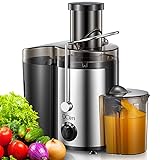
QCen Juicer Machine 500W Centrifugal Juicer with Extra Wide Feed Chute
500W centrifugal motor
3 inch wide mouth chute
Two speeds, overload protection
+ Pros
- 500W motor handles firm vegetables
- 3 inch wide mouth chute reduces chopping
- Two speed control from 12000 to 18000 RPM
- Locking arm safety system with overload protection
– Cons
- Hand wash only with no dishwasher-safe parts
- Manufacturer advises against low water content produce which includes celery
- Small 3 liter capacity needs frequent emptying
- Filter basket can be awkward to remove
We want to lead with the caveat, because it is unusual and it directly affects this vegetable. The manufacturer advises against juicing low water content produce, and celery stalks fall squarely into that category. That guidance sits in the product documentation, and it is the clearest signal in this whole list that this is not a machine to buy for celery.
Everything else about it is competent. The 500W motor handles firm vegetables, the 3-inch wide mouth chute reduces chopping, and two speeds running between 12,000 and 18,000 RPM separate soft produce from hard. Buyers treat it as an inexpensive first juicer or a secondary kitchen machine.
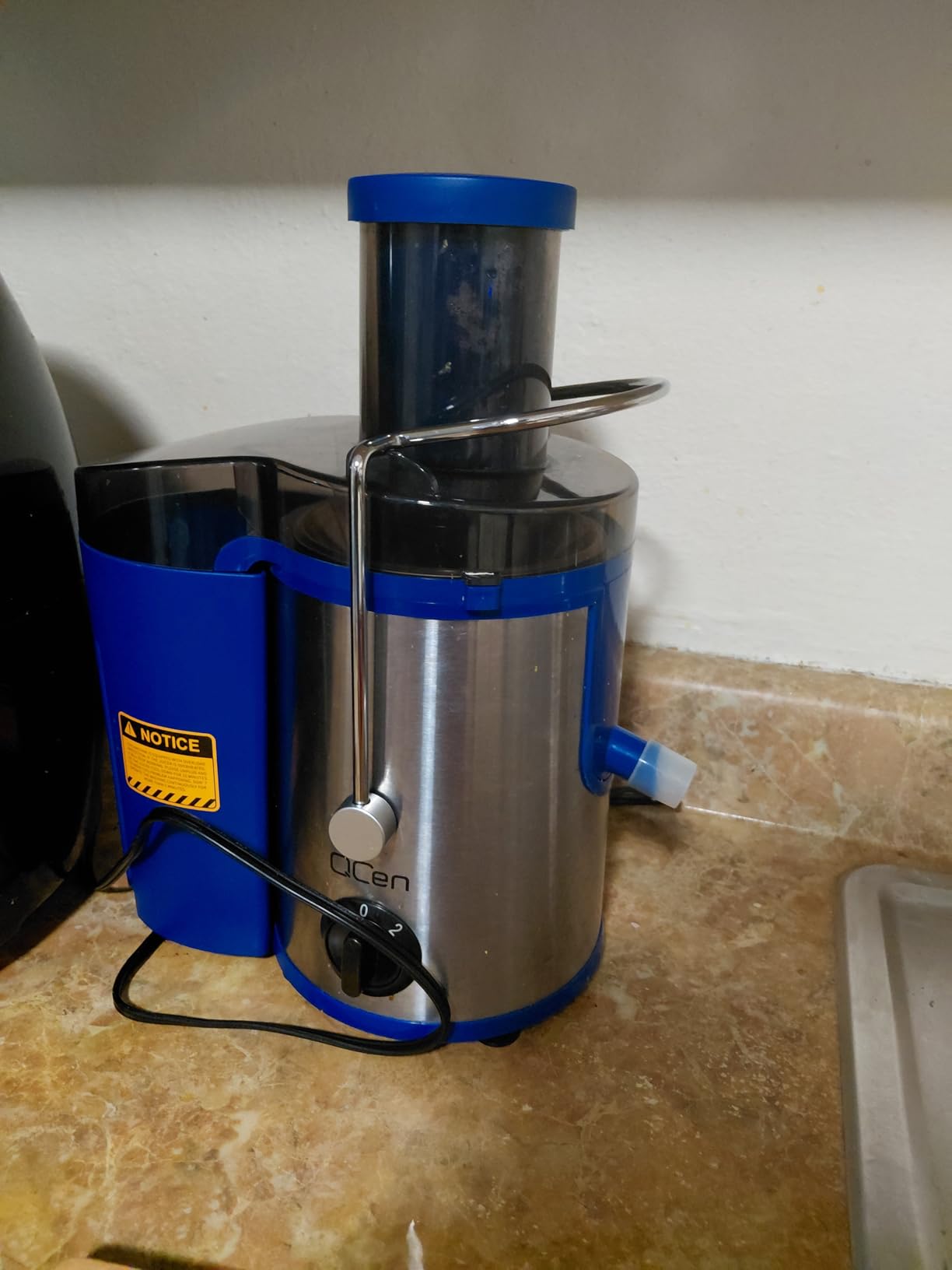
High RPM and Why It Works Against Celery
At 12,000 to 18,000 RPM the blade is doing exactly what celery cannot tolerate. The fiber wraps, the filter clogs, and the review summary notes that reviewers flag the manufacturer’s guidance steering people away from low water content produce. That is a limitation for anyone whose main goal is celery juice.
Where it does work is on carrots, apples and other dense produce, where the high speed is an advantage and the wet pulp matters less. The locking arm safety system and overload protection switch are genuine safety features, and the detachable parts make cleaning straightforward compared with more complicated machines.
Hand Wash Only and Small Capacity
Cleaning is the practical weakness. Parts are hand wash only with no dishwasher-safe components, which adds time to a routine that should be short. The 3 liter capacity also means more frequent emptying on a big batch, and the filter basket can be awkward to remove if you pull from the wrong point.
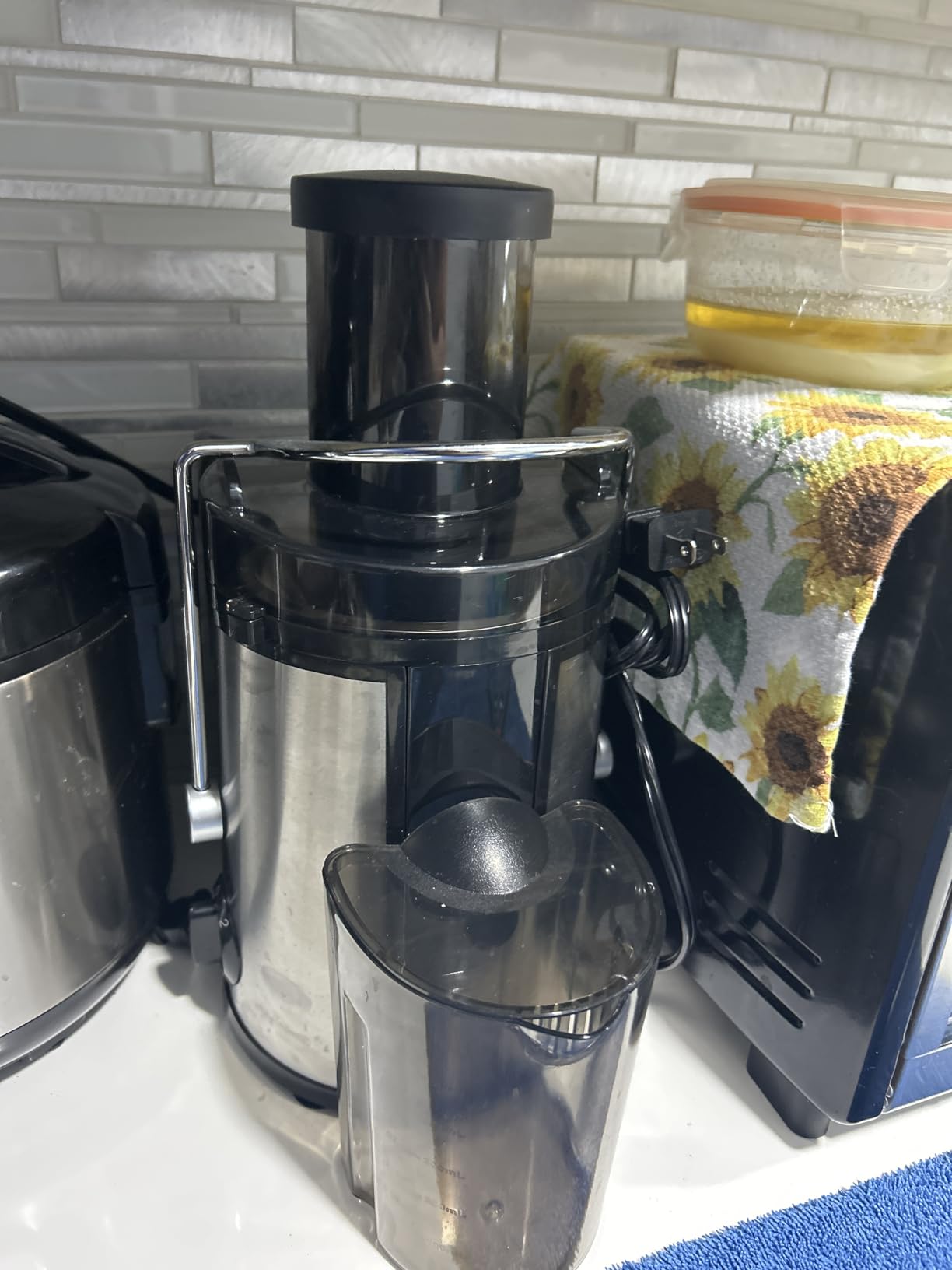
12. Juilist 3-Speed Centrifugal – Best for a Small Countertop
Juicer Machines, Juilist 3″ Wide Mouth, Max 800W, 3-Speed 400W Easy-Clean
3 inch wide feed chute
Peak 800W motor, 3 speeds
Compact body, dishwasher-safe accessories
+ Pros
- Three speed settings including a pulse-like maximum for hard produce
- Compact body that takes little counter space
- Dishwasher-safe accessories plus a filter brush
- Stainless cutting disc with overheat protection and double safety lock
– Cons
- 400 ml juice cup fills quickly
- Overheats on continuous runs and needs time to cool
- Clogs periodically and needs mid-juice cleaning
- Basic build quality with some units arriving with defects
This machine earns its place for one reason: footprint. It is the most compact machine we tested, and if counter space is the binding constraint in your kitchen, that is worth a centrifugal trade-off. Everything else about it is a budget-machine compromise, and celery specifically is where those compromises show up most.
The three-speed control is genuinely useful, including a pulse-like maximum mode intended for hard produce such as celery, apples and carrots. Reviewers generally find it does the basic job well and fast, with quick cleanup using the brush and the dishwasher-safe accessories.
Overheating and Mid-Juice Clogging
These are the two complaints that decide it for celery drinkers. The machine can overheat quickly on continuous runs and needs time to cool before restarting, which is a real problem when a full bunch takes several passes. It also clogs periodically, requiring a mid-juice clean, which is the exact failure mode celery triggers most often on centrifugal machines.
Build quality is basic, some units arrive with defects, and reviewers note the juice yield is disappointing for the price. The listed weight in the product data is not realistic for the machine, so treat the weight figures for this model as unreliable.
Speed Settings and What They Mean for Stalks
The stainless steel cutting disc sits inside a micro-mesh filter with overheat protection and a double safety lock, and the 3-inch feed chute handles whole fruit and vegetable pieces. The 400 ml juice cup is small and fills quickly, which means more stops during a celery batch than any machine on this list.

Masticating vs Centrifugal for Celery: What the Specs Predict
Slow juicing wins on celery for one mechanical reason: a spinning blade and long stringy fiber are a bad combination. A centrifugal throws juice outward through a fine mesh at 6,000 to 14,000 RPM, and celery strands wrap around the blade assembly as they travel. A masticating or cold press machine turns an auger at 50 to 110 RPM, crushes the fiber, and presses it against a screen instead of tangling around it.
Is a Masticating Juicer the Same as a Cold Press?
No, and this is the most common point of confusion in the category. Every cold press machine is a slow, low-heat machine, but not every masticating juicer is a true two-stage cold press. Cold press machines chop first and then compress under pressure. Many cheaper slow juicers, including several here, crush and press in one continuous pass. The practical difference for celery is smaller than the marketing suggests, and the honest answer is that any slow juicer solves the clogging problem.
What the Differences Mean in Practice
Noise. A centrifugal is closer to a vacuum cleaner. Slow juicers are dramatically quieter, and the Brecious is specified under 60 dB. Even so, the Ninja NeverClog’s own reviews include a recurring note that it is louder than buyers expect, so treat silence claims sceptically unless a decibel figure is published.
Oxidation and shelf life. Heat and oxygen exposure both increase with speed. Celery juice from a cold press machine keeps noticeably better than juice from a centrifugal, which matters if you batch rather than drink immediately. We did not measure this chemically, so treat it as a design consequence rather than a tested number.
Yield. Dry pulp is the practical proxy. A slow auger that squeezes the fiber hard leaves less water behind in the waste, which means fewer stalks per glass. Centrifugal machines are fast but leave wet pulp, and both the Omega and the YPONE draw complaints about exactly that.
Prep time. This is where the type comparison is misleading on its own. A 1.8-inch slow juicer chute can cost you more time in knife work than a 3-inch centrifugal chute saves in machine time. Chute width matters more than juicer type when you are counting how long your morning takes.
Cleanup. Centrifugal parts are mostly dishwasher safe. Slow juicers need more disassembly, unless they use a mesh-free or minimal-parts design like the TUUMIIST and YPONE. This is the number-one reason people abandon a juicing habit, and it deserves more weight than most buying guides give it.
What to Look for in a Celery Juicer
1. Masticating or Cold Press Architecture
Start here and do not compromise. Everything else on this list is a refinement of the same decision. A centrifugal will juice celery, but you will fight it every morning.
2. Feed Chute Width, Measured Against Your Celery
The range on this list runs from 1.8 inches to 6.5 inches, and that spread is the difference between trimming every stalk by hand and dropping them in. Measure the widest part of your own stalks before buying, and treat advertised chute widths as upper bounds, since two machines here measure narrower than their listings claim.
3. Auger Torque and Motor Class
Celery is dense and fibrous, so it punishes a weak motor. The 300W TUUMIIST works but needs produce cut small, while the 400W, 600W and 800W machines on this list tolerate more improvisation. A 150-watt motor can still do the job if torque is properly geared, which is the Ninja NeverClog’s situation.
4. Reverse Function
On a slow juicer, reverse is the jam-clearing function. It saved more than one of our runs, and on a daily celery habit it is the difference between a thirty-second fix and dismantling the chamber.
5. Pulp Dryness and Pulp Outlet Design
Drier pulp means higher yield per stalk, and a detachable pulp outlet makes emptying and rinsing faster. Reviewers of the Ninja praise its two interchangeable filters specifically because they let you trade clarity against waste depending on the day.
6. Cleanup Design, Assessed Realistically
Count the parts, not the marketing. A mesh-free design cleans fastest but leaves fiber in the glass. A triple-layer screen produces clearer juice but needs a brush in the narrow channels. Dishwasher-safe detachable parts are worth a lot, and hand-wash-only care is a daily tax on your habit.
7. Noise If You Juice Before 7am
Published decibel figures are rare, so use them when they exist. The Brecious at under 60 dB is the only machine here with a stated figure, and the AMZCHEF and EanOruus are described by owners as quiet relative to their classes.
8. Warranty Length as a Durability Proxy
The range is 1 year to 15 years. Long-term juicers on forums treat warranty length as one of the top recommendation criteria, and we agree: a machine you expect to run daily for years should be warrantied for years.
9. Counter Footprint and Weight
Several machines here stand between 16 and 17 inches tall, and the Omega weighs 14.1 pounds. Measure your cabinet clearance and your available counter depth before ordering, because vertical machines are the norm and vertical space is the constraint most people miss.
10. Produce Variety Beyond Celery
A machine that only ever handles celery is a special case. If you also juice greens, carrots or fruit, prioritize multi-speed control and a 3-in-1 strainer system. Our guide to the best cold press juicers for leafy greens covers that angle in more detail, and our centrifugal guide for hard fruits covers the fast route for dense produce.
What Juicers Say About Celery Machines
Community feedback is more useful than star ratings for this question, because people who juice celery daily report on failures rather than first impressions. Three patterns came up consistently across juicing forums.
Years of daily use beats everything. Long-term Omega owners report five-plus years of reliable daily use, and durability plus warranty length are the main drivers of recommendation in those threads. That is the single most repeated signal, and it is why we ranked the Omega second despite its narrow chute.
Warranty length is treated as a durability proxy. The most-upvoted review criteria list in one juicing community runs: easy and fast assembly, easy operation, great yield, great greens processing, great taste, super fast cleanup, quiet operation, and a 15-year warranty. Most of those are specs you can check on a product page before you buy, and celery juicing makes assembly, cleanup and quiet operation unusually important.
Celery-only buyers lean toward horizontal machines. Enthusiasts who juice exclusively celery gravitate toward horizontal premium models rather than vertical budget units, and some commenters in those threads put paying more once above repeatedly replacing cheap machines. We did not test that horizontal tier, so we are flagging it as a gap worth exploring rather than recommending something we have not run.
On the other side of the ledger, budget brands draw durability complaints. AMZCHEF in particular is discussed with reports of repeated units and refunds, which is a pattern we also saw in the product reviews. If you are buying a budget machine, keep the packaging.
Frequently Asked Questions
What kind of juicer is best for celery?
A masticating or cold press juicer is best for celery. Centrifugal blades spin at 6,000 to 14,000 RPM and celery’s long stringy fibers wrap around them, clogging every few stalks. A slow auger at roughly 50 to 110 RPM crushes and presses that fiber into pulp instead, which roughly doubles usable yield per bunch and reduces heat and oxidation.
Is a masticating juicer the same as a cold press juicer?
Not exactly. Every cold press machine is slow and low-heat, but not every masticating juicer is a true two-stage cold press. Cold press machines chop first and then compress under pressure, while many cheaper slow juicers crush and press in one continuous pass. For celery, the practical difference is small and any slow juicer solves the clogging problem.
Why does my juicer clog on celery?
Celery has long stringy fibers that wrap around spinning blades, and a centrifugal juicer’s fine mesh traps them. Fixes in order of impact: switch to a masticating or cold press machine, cut stalks to fit the chute width, feed slowly with the pusher, use the reverse function when a bundle builds, and choose a higher-torque motor that will not stall on dense fiber.
Can I juice celery in a regular juicer?
Technically yes on a centrifugal, but it will clog every few stalks and the pulp comes out wet, so you buy more celery per glass. The juice also oxidizes faster in a fast machine, which means a shorter shelf life. A slow masticating juicer solves both problems and is the better tool for this vegetable.
How much celery juice per day is typical?
Sixteen ounces daily is the common protocol target, and it is best taken on an empty stomach in the morning. That volume also interacts with machine limits: most slow juicers are rated for roughly 20 minutes of continuous runtime per session, so a full 16oz serving is a normal single batch rather than a long run.
Is celery better juiced or blended?
Juicing removes the fiber and produces a concentrated liquid that is quickly absorbed, which is the reason juice protocols specify juicing rather than blending. Blending keeps the fiber and produces a thicker, slower-digesting drink. If your goal is a clean 16oz glass on an empty stomach, juice; if you want to keep the fiber and the volume, blend.
Which Celery Juicer Should You Buy in 2026?
If you want one machine and celery is the reason you are reading this, buy the Ninja NeverClog JC151. It took a full bunch without a jam, it fits under a cabinet, and its two pulp filters let you tune waste versus clarity. It is the best-balanced answer to the best juicers for celery question we tested.
If you plan to run celery every morning for years, buy the Omega Cold Press J8006HDC instead. The 15-year warranty and the adjustable end cap are worth the slower pace and the extra knife work, and long-term owners consistently rate it as the machine that survived.
If prep time is what kills your habit, the AAOBOSI or the AMZCHEF give you the widest chutes in the group. If quiet early-morning use is the constraint, the Brecious is the only machine here with a published decibel figure under 60 dB. If you are starting with a tight budget, the TUUMIIST gets the slow-squeeze architecture and a wide chute at the lowest cost, with a weaker motor as the trade.
Skip the centrifugal machines for celery specifically. They are fine for apples and carrots, and the Hamilton Beach and Breville are genuinely good at that, but they are the wrong tool for a stringy, low-water-content stalk. Check the current details for any of these machines before you order, since models in this category change frequently.
Leave a Reply