
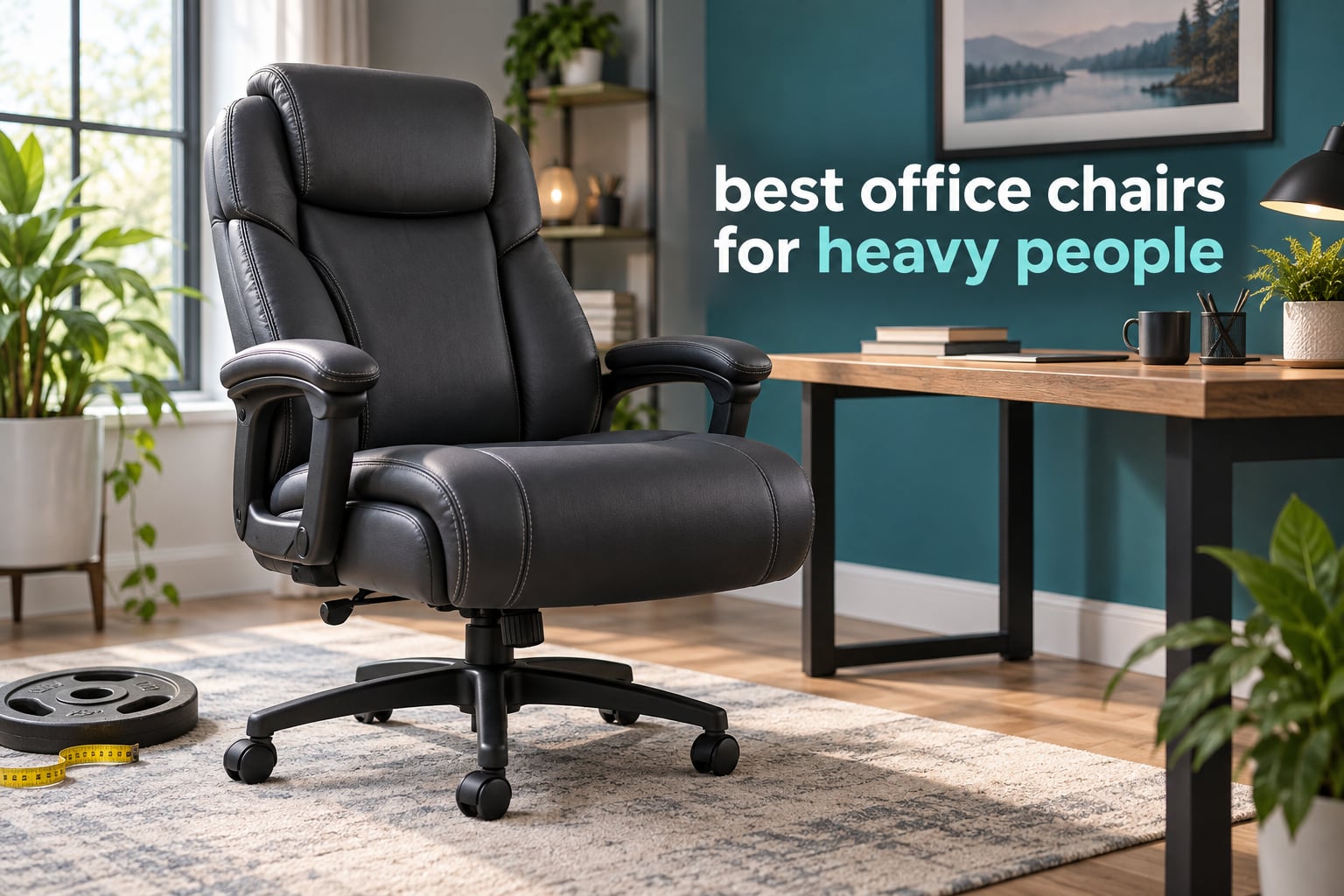
Short answer: buy a chair rated 50 to 100 pounds above your body weight, built on a certified Class-4 gas lift, a metal base, and a seat at least 22 inches wide. That headroom rule is the whole decision. Everything else on this page exists to help you verify a listing actually delivers what the capacity number claims.
Most chairs sold as office seating are rated for a 220 to 275 pound average user. That is not a design flaw. It is a design target, and once you are past it the failure sequence is remarkably consistent: the chair sinks a little by mid-afternoon, the armrests start to wobble, the seat foam compresses into a thin pad within months, and the lumbar support that felt right in the first week drifts toward the middle of your back.
Four parts carry the load, and they are the parts that fail. The gas lift cylinder is the first to give up, because a Class-3 cylinder rated for 220 to 275 pounds slowly bleeds pressure under a sustained heavier load. The foam is next, since low-density sponge compresses and stops rebounding. Then the base, where thin aluminum cross-sections develop micro-fractures at the weld points. And the seat pan itself, which on many standard chairs is only about 20 inches wide, forcing you to perch on the front edge where the seat edge digs into the backs of your thighs.
I spent several weeks working through this category with published seat measurements, base materials, lift class, and warranty terms in front of me, and the pattern that emerged is that capacity numbers are a filter, not a decision. The decision is fit. Two chairs both rated 400 pounds can feel completely different, because one has a 22.5 inch wide seat pan and the other has a 29.9 inch wide overall footprint with a 20.5 inch backrest. We explain how to read that difference below, and we tell you who should skip each chair.
If you also sit for very long stretches, our guide to the best ergonomic office chairs for long hours covers adjustability in more depth. If heat is your problem, the mesh chair roundup is worth a look. And if your back is the main complaint rather than your weight rating, start with chairs built for lower back relief.
Our Top 3 Verified Picks for Bigger Bodies (October 2026)
These three came out ahead because each one publishes the load-bearing details that matter, and each covers a different part of the weight range. The leader has the deepest review history in the group by a wide margin. The second is the widest-executive option with published dimensions and BIFMA compliance. The third is the value pick that still holds a full 400 pound rating.

GTPLAYER 400lb Big and Tall Gaming Chair
- 400 lb capacity
- 3-level gas lift
- 90-150 degree recline
- spring lumbar and 3D saddle seat

Amazon Basics 350lb Big and Tall Executive
- 350 lb capacity
- 30.25 inch backrest
- roller-knob lumbar
- BIFMA compliant

COMHOMA 400lb Wide Recliner with Foot Rest
- 400 lb capacity
- pocket spring lumbar
- 150 degree recline
- integrated footrest
Comparing Every Heavy-Duty Chair We Reviewed in 2026
The table below lists all ten chairs in the order we recommend reading them. Capacity figures are the manufacturers’ own stated ratings, which is not always the same as the rating that appears elsewhere on the listing. We flag that in the individual reviews.
| Product | Details | Action |
|---|---|---|
|
|
Check Latest Price |
|
|
Check Latest Price |
|
|
Check Latest Price |
 |
|
Check Latest Price |
 |
|
Check Latest Price |
 |
|
Check Latest Price |
 |
|
Check Latest Price |
 |
|
Check Latest Price |
 |
|
Check Latest Price |
 |
|
Check Latest Price |
A note on reading the table: two entries carry a rating mismatch worth understanding. The BOLISS listing headline says 400 pounds while the product detail field says 300 pounds, and the HESL listing headline says 400 pounds while a feature bullet cites a 350 pound base rating. Both are common patterns in this category and both are worth asking the seller about before you commit.
1. GTPLAYER Big and Tall 400lb Gaming Chair – Our Pick for Most Bigger Users
GTPLAYER Big and Tall Gaming Chair 400lbs Heavy Duty Office Chair with Foot Rest & Ergonomic Pocket Spring Lumbar Support, High Back 3D Saddle Shaped Cushion for Back Pain Relief, Matte-Black
400 lb capacity
22 inch seat depth
41.5 lb build
90-150 degree recline
1 year warranty
+ Pros
- Enlarged headrest and wrap-around winged back
- Spring lumbar and 3D saddle-shaped seat
- Three-level gas lift on a metal frame
- Embossed PU leather wipes clean easily
- Assembly in about 15-30 minutes
– Cons
- Seat cushion is very firm
- Low-quality casters are the most common upgrade request
- Footrest support tubes feel flimsy under load
The number that made this our first pick is not the 400 pound rating, it is the review history. With more than 34000 ratings behind it, this is the only chair in the group where we can look at long-term owner reports and see a consistent pattern rather than a handful of early adopters. Owners across that history describe the same thing: a wide seat that lets you actually sit back, and a chair that still holds its position after months of daily use.
The saddle-shaped seat is the detail I would point a first-time buyer toward. Rather than one flat slab of foam, the cushion is segmented so that pressure is distributed across the lumbar region and the hips separately. For a user who is sitting down for eight to ten hours, that segmentation matters more than the foam thickness, because the failure mode of a flat cushion is a pressure point that you feel in your lower back by hour four.
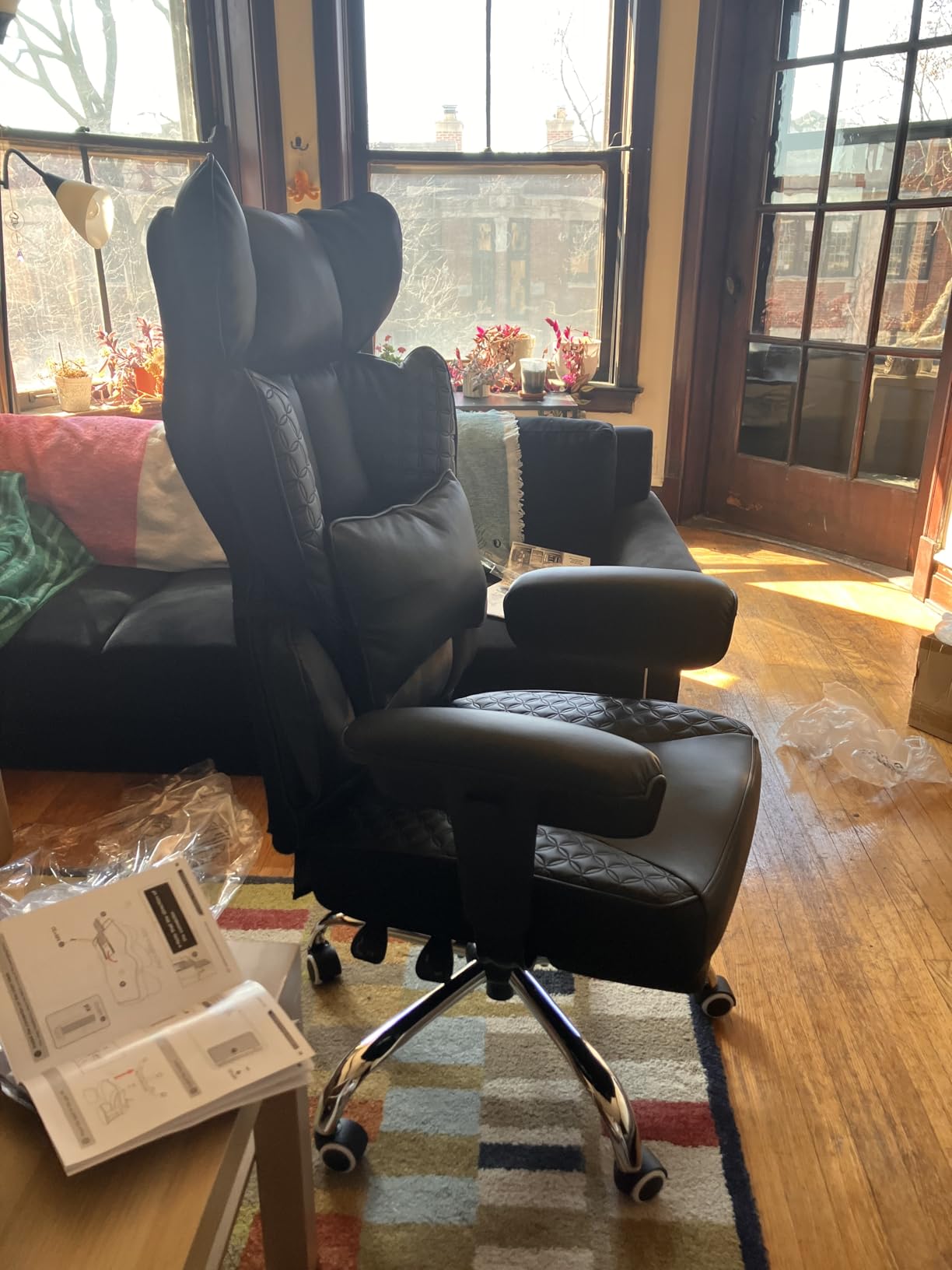
Worth understanding clearly: this is a gaming chair in a category where most of its competitors are task chairs. The 22 inch seat depth and 30.31 inch interior backrest height are among the largest figures in the group, which is exactly what a 6 foot 2 inch user wants and exactly what a 5 foot 6 inch user will find excessive. Measure before you order.
Why the Winged Back and Enlarged Headrest Are Not Just Styling
High side wings on the backrest do something specific for larger frames. They create a shallow cradle that resists the outward drift that happens when a heavier user sinks into a wider seat and their knees angle outward. On a flat-backed task chair, that drift pushes your lower back off the lumbar support and into an unsupported slouch. The wings here keep the spine inside the backrest envelope.
The enlarged headrest follows the same logic. Standard gaming headrests are sized for average shoulder width, so on a bigger frame the head rests against one edge or falls below the skull. This one is scaled up, which is why the reclined positions in particular get called out positively in owner feedback.
Recline Range and the 3-Level Gas Lift
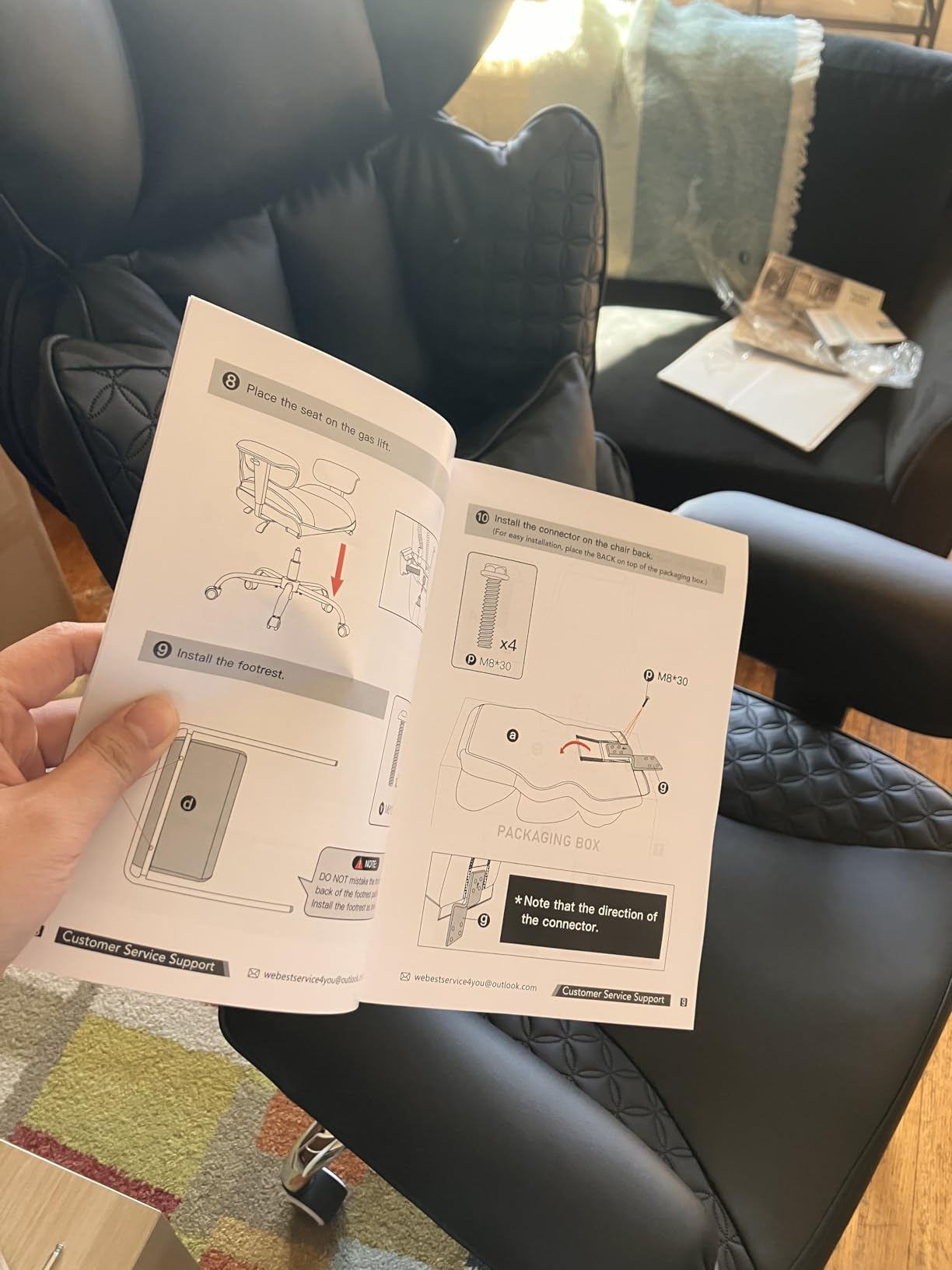
The recline runs from 90 to 150 degrees across two positions. A gaming chair recline is not the same as an ergonomic tilt, because the backrest and the seat move together as a single shell, but at 130 to 150 degrees this chair genuinely functions as a rest position, and the pull-out footrest makes that usable rather than theoretical.
The three-level gas lift is the mechanical piece that earns the 400 pound rating. Three levels of seat-height travel spread the load across a range of extension, rather than concentrating the full load at maximum extension where cylinders are most likely to fail. On cheaper chairs, that first failure shows up as a chair that starts high in the morning and ends noticeably lower by evening.
Where It Falls Short
The seat cushion is described by owners as very firm, and at the top of the weight range that can be a problem. Firm foam that does not compress means less conformity around the hip bones, and users near 400 pounds often add a memory foam pad. If you are in that range, budget for the pad rather than expecting the stock cushion to shape around you.
The casters are the most frequently requested upgrade, and the footrest tubes are described as flimsy under load. Both are replaceable parts rather than structural failures, and the seller’s one year warranty covers damaged or defective parts with a 30 day quality window. If you need a footrest you can lean real weight into, this is not it.
The lumbar and head pillow attach with an elastic strap that owners find awkward to reposition, and the headrest can sag out of position over time. If you expect to adjust your support several times a day, factor in the friction.
2. COMHOMA Big and Tall 400lb Recliner – Best Value for a Sofa-Style Seat
COMHOMA Big and Tall Office Chair Heavy Duty Wide Ergonomic Gaming Chair with Deluxe Embossing Designed Leather with Foot Rest,150°Reclining Adjustable Armrests Pocket Spring Back Support and Pillow
400 lb capacity
19.68 inch seat depth
44 lb build
150 degree recline
12 month warranty
+ Pros
- Generously wide seat that allows cross-legged sitting
- Pocket spring lumbar support
- Height-adjustable armrests
- Three recline positions with 150 degree reach
- Integrated pull-out footrest
– Cons
- Seat cushion is firm rather than plush
- Handmade construction means minor part variations
- Lumbar support is fixed and not tilt-adjustable
This is the chair people describe as a sofa that happens to swivel, and that is not a criticism. Several owners specifically mention being able to sit cross-legged, which no task chair in this group accommodates. For anyone whose work involves long, unstructured reading or research sessions rather than typing, that flexibility is worth more than fine-grained adjustment.
What earns it a place high in this list is the combination of a full 400 pound stated rating with a 12 month manufacturer warranty, which is longer than most competitors in this category offer. The pocket spring lumbar support is a different construction approach from the memory foam used in most of the group, and owners tend to describe the feel as springier and more resilient over long sessions.
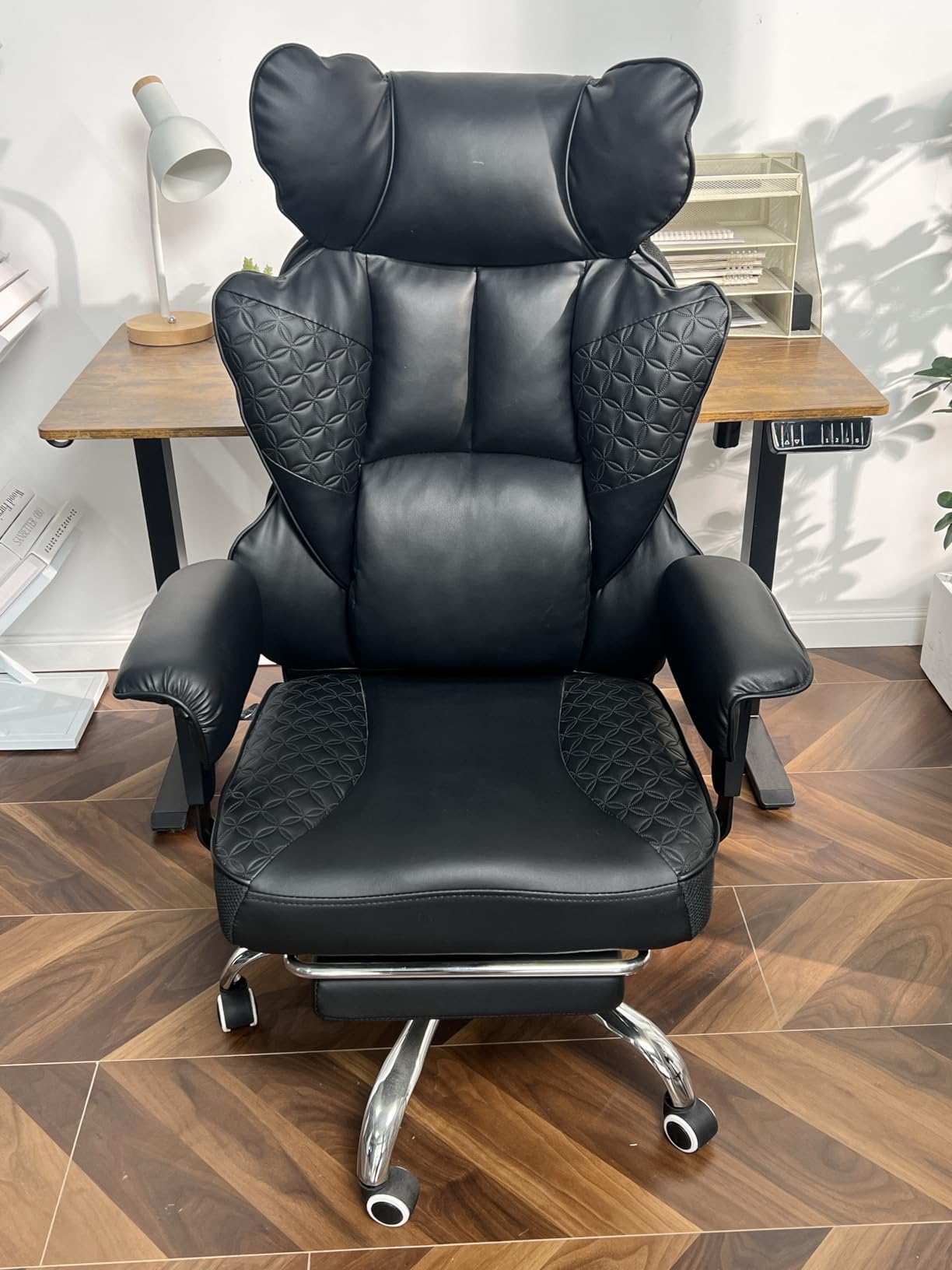
Three Recline Positions and a Real Footrest
Three lockable positions up to 150 degrees is more granular than the two-position recline on the chair above, and it makes the transition from working to resting smoother. The footrest pulls out from under the seat rather than attaching to a bracket, which means it does not add a permanent protrusion that would catch on a desk edge.
Height-adjustable armrests are singled out repeatedly in owner feedback as a genuine upgrade over fixed-arm models. The arm height difference between chairs is often 3 to 4 inches, and on this model the arms actually move rather than being a fixed reference point your body has to work around.
Size, Fit and Desk Clearance
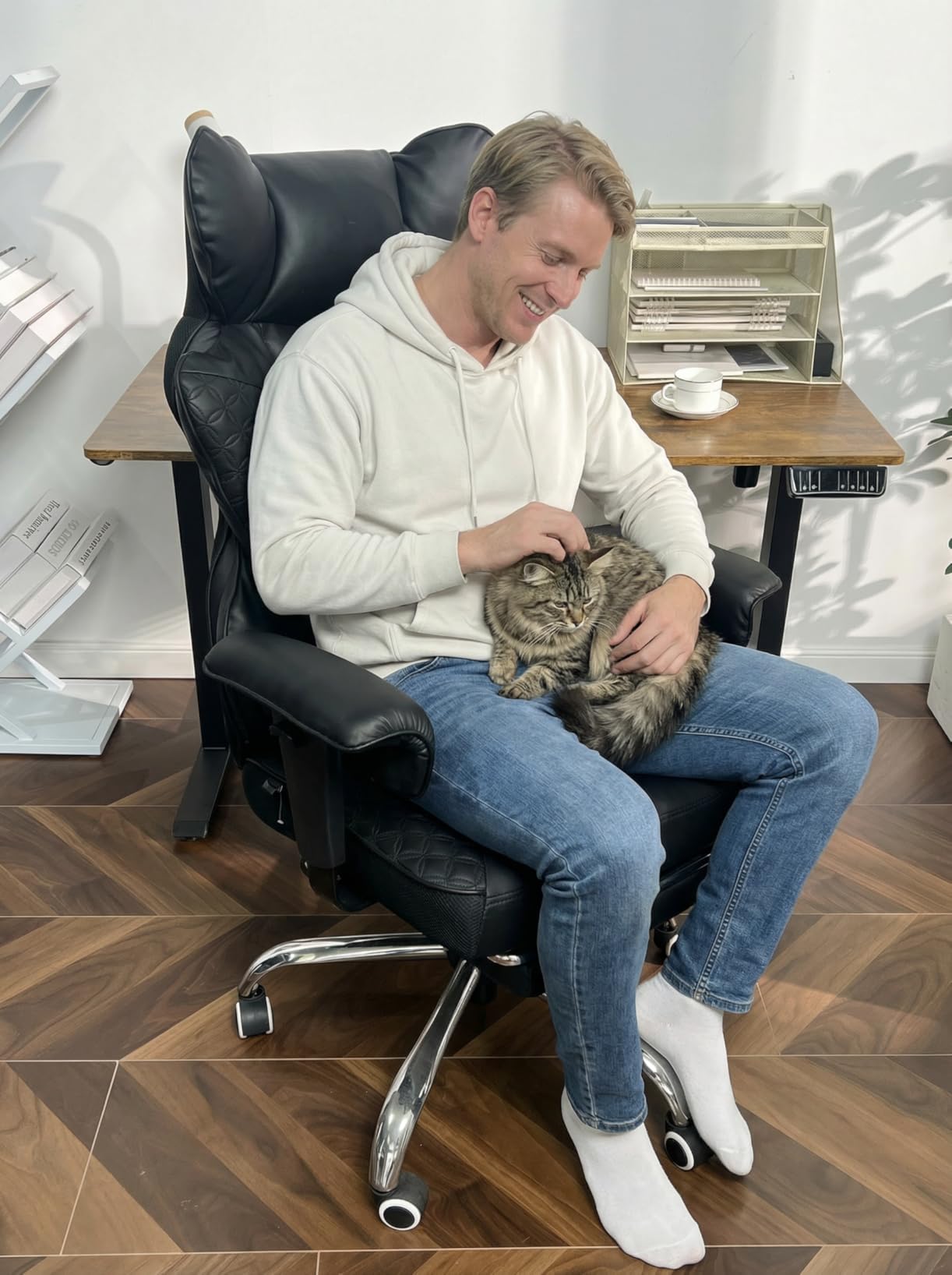
The overall dimensions are 19.68 inches deep by 22 inches wide by 45.1 inches tall, with a 19.68 inch seat depth and a 22 inch backrest width. That seat depth is shorter than several others in this roundup, which matters if you are tall. A shorter seat pan pushes the back of your thighs against the front edge under load, which is the exact pressure complaint that shows up in forum discussions about this category.
The 45.1 inch overall height also means this is a taller chair than most standard desks comfortably work with. If your desk is at a typical 29 to 30 inch height, check that the arms clear the underside before ordering, or plan to work with the chair slightly raised and your feet flat.
Where It Falls Short
The lumbar support is fixed rather than dialed. If you spend the day in one position it is fine, but there is no height or depth adjustment to respond to changes in posture, and that is a real limitation for anyone managing a back condition.
The brand notes that each chair is handmade, and a small share of reviewers report build inconsistencies consistent with that note. Expect minor variations in the curves and pieces. The seat cushion is also described as moderately firm, so the same top-of-range consideration applies here as on the first pick.
3. Amazon Basics Big and Tall Executive 350lb Chair – Best Genuine Big and Tall Sizing
Amazon Basics Big & Tall Executive Office Chair with Lumbar Support, Adjustable Height, 350-Pound Capacity, 28.5″D x 30.25″W x 47.9″H, Black Pewter Finish
350 lb capacity
30.25 inch backrest
47.5 lb build
BIFMA compliant
Bonded leather
+ Pros
- Very wide 30.25 inch backrest and roomy seat
- Roller-knob adjustable lumbar support
- Height
- tilt and lumbar adjustments
- 360 degree swivel with smooth casters
- Extra hardware bag and well-made hex key included
– Cons
- Arm and base parts are painted plastic
- Bonded leather is not breathable
- Arms can block the desk at lower seat heights
- Long-term reports of cushion flattening and leather flaking
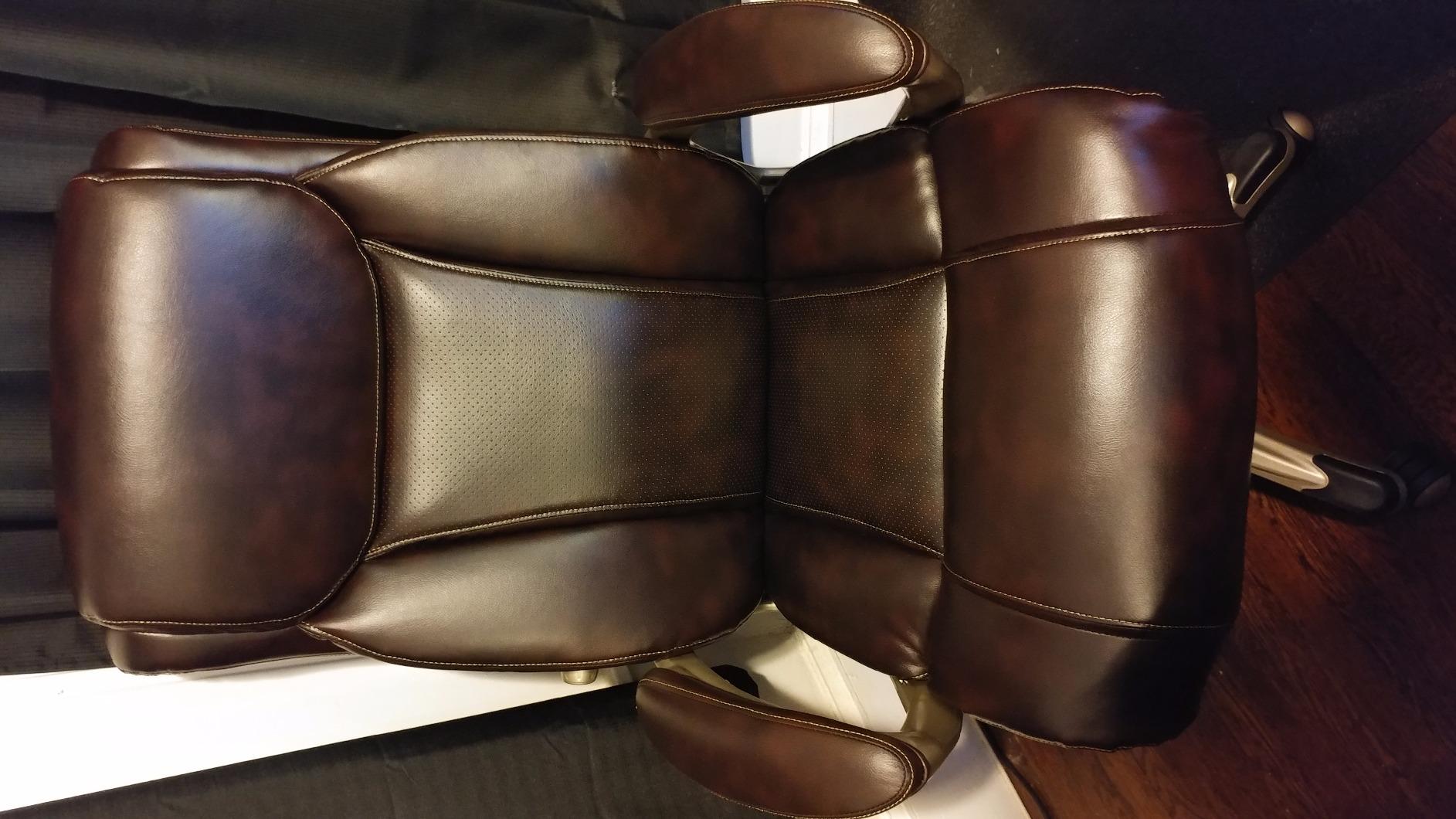
Of everything in this roundup, this chair publishes its dimensions most honestly and complies with BIFMA. That is not a small detail in a category where capacity claims are frequently marketing rather than measurement. A 30.25 inch wide backrest is the second widest figure we saw, and the actual roomy usable seat is what heavier users mention first in owner feedback.
The roller-knob lumbar support is a feature that heavier buyers specifically look for and rarely find. Most of the group offers a fixed or strap-mounted pillow; this one has a control you can turn to push support forward as you recline, which is the adjustment that matters during long afternoon sessions.
BIFMA Compliance and What It Tells You
BIFMA is a furniture industry safety and durability standard, and a chair that lists compliance has been tested against defined seat and back loads and cycles. It is not a weight certification in the sense that a gas lift certification is, and it does not replace checking the lift class. But it is a meaningful signal in a category where many listings carry no third-party testing at all.
The seat height sits at 22.44 inches with an adjustable range from 44.75 to 47.9 inches across the overall back height, and the base swivels a full 360 degrees. That height is high. Owners below roughly 5 foot 10 inches report not reaching the floor, which is a clearance problem rather than a quality problem, but it is a real one.
Bonded Leather: Easy to Clean, Not Breathable
Bonded leather wipes clean and holds up better than cloth, which is a genuine advantage if you eat at your desk. The trade-off is heat. The material does not breathe, and in a warm office you will feel it. If you are somewhere with long hot summers, our mesh chair guide covers the alternative more directly.
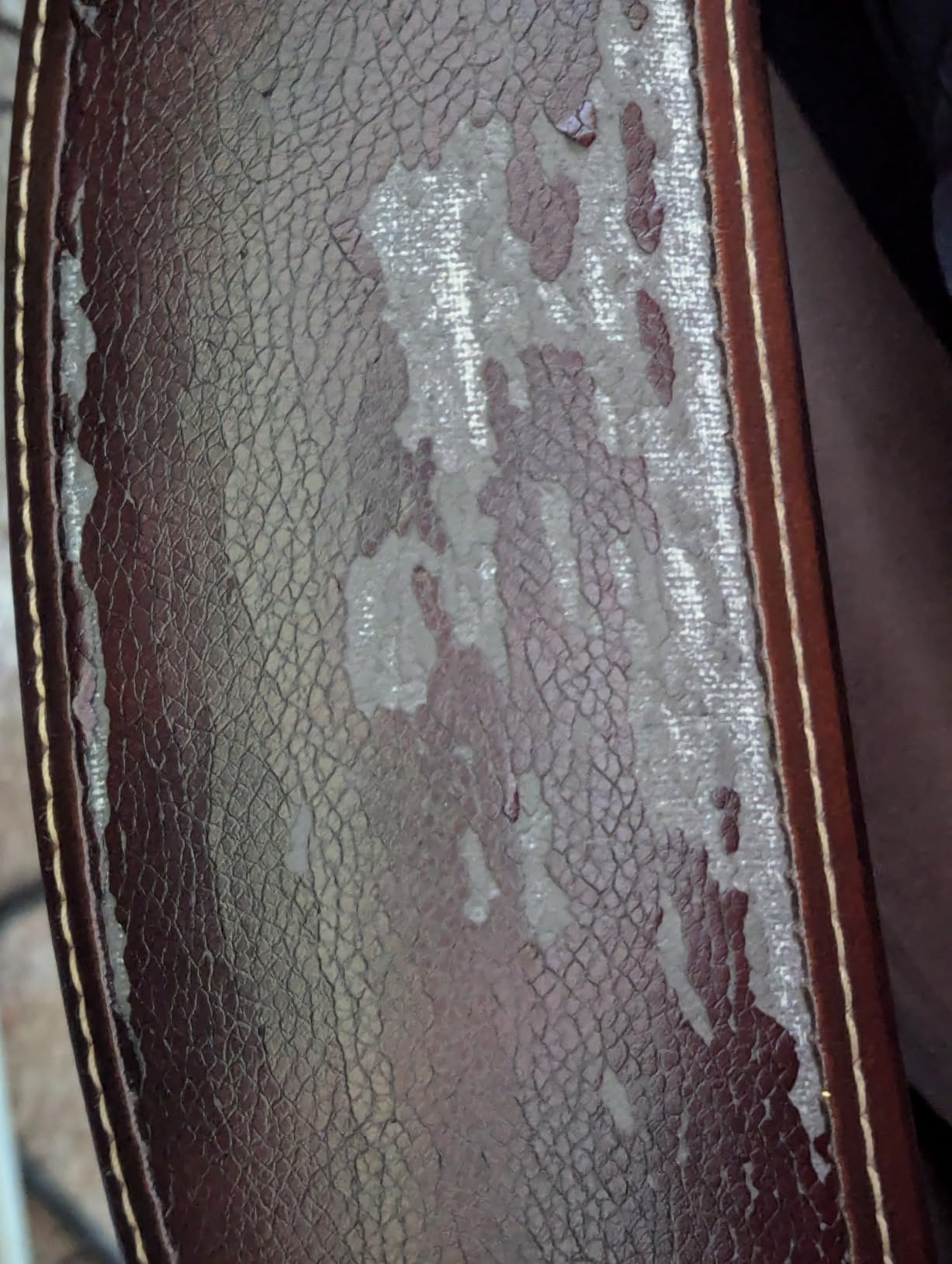
Long-term durability is the weak point in owner reports spanning a year or more: cushion flattening and the bonded leather beginning to flake. Over a 350 pound rating, the load on each foam pocket is high, and this chair does not use spring reinforcement the way the first two picks do.
Where It Falls Short
The arm and base components are plastic with a metallic paint finish that can rub off at contact points. At a 350 pound load that is worth knowing, because the arms are the part you push against when you reposition.
Several reviewers also note an assembly detail: bolts should stay partially loose until all of them are set, then tightened in sequence. Skipping that step is the most common reason owners report a chair that sits unevenly. The extra hardware bag and hex key included with the chair make the process easier than it would otherwise be.
4. Serta Fairbanks Big and Tall Executive 350lb Chair – Most Cushioned
Serta Ergonomic Big and Tall Executive Office Chair Lumbar Support, Leather
350 lb capacity
22.5 inch wide seat
46.3 lb build
Layered memory foam
1 year warranty
+ Pros
- 22.5 inch wide seat with 28.5 inch contoured backrest
- Layered memory foam designed to resist flattening
- Padded armrests
- seat and body pillows
- Cushioned headrest for neck relief
- Metal base with 360 degree swivel
– Cons
- Seat height does not go low enough for users under about 6 feet
- Armrests have no height adjustment
- A persistent chemical odor is reported on some chairs that takes months to fade
- Reports of wobbling seats and cracked base plates over time
This is the chair owners most often compare favorably against far more expensive alternatives, and the comparison is usually about cushioning rather than structure. The layered memory foam is the most generous padding in the group, spread across the seat, the armrests, and the two body pillows. If your issue with chairs has been pressure rather than support, this is the one to look at first.
Memory foam is also the material most resistant to the flattening problem that dominates complaints in this category, because it recovers rather than staying compressed. The seat depth of 18.75 inches is short by the standards of this roundup, and that is the single biggest reason this chair is not higher in the ranking.
Seat Height Is the Deciding Spec Here
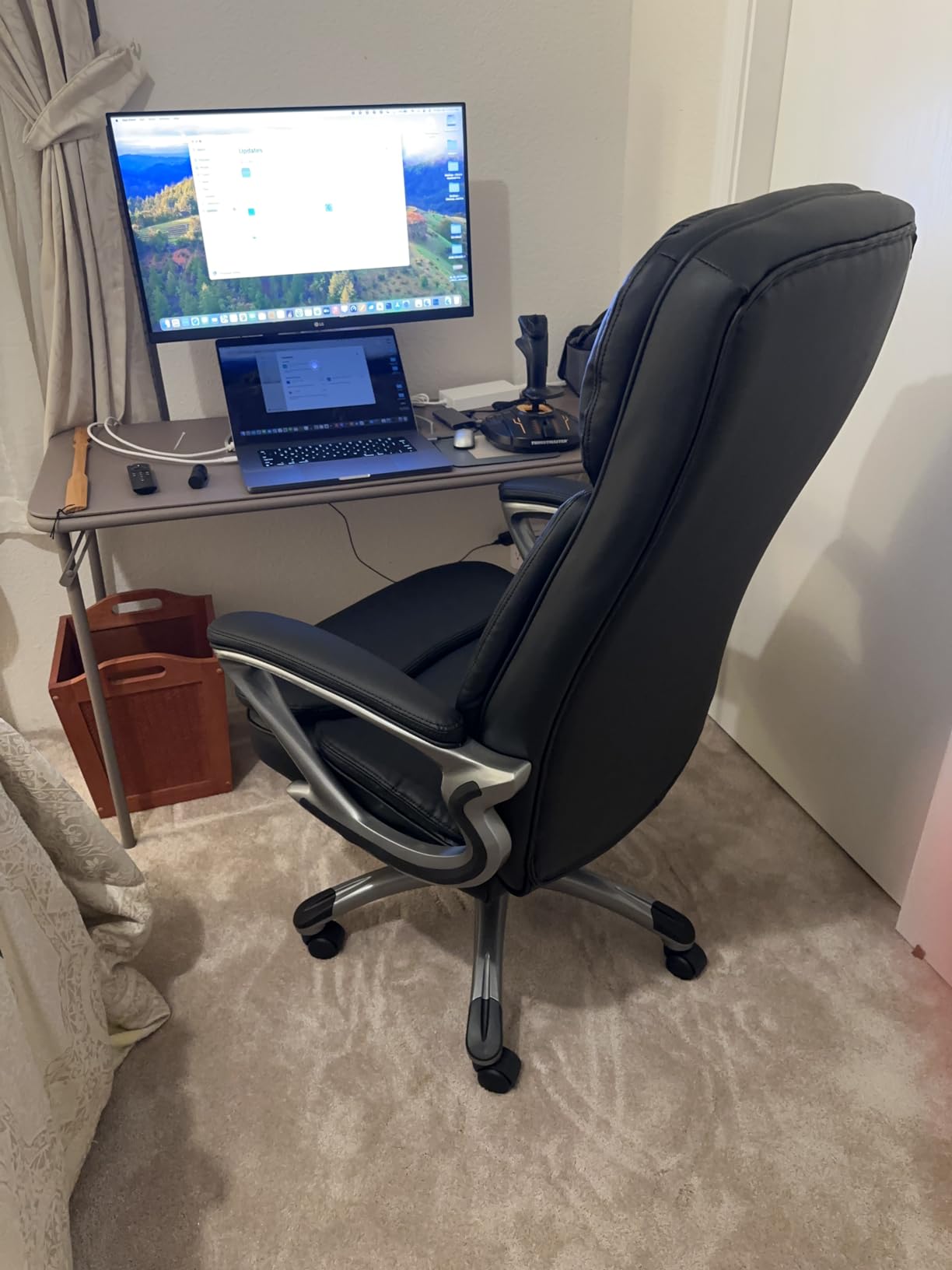
The seat sits at 25 inches. That is the highest fixed starting point of any chair we reviewed, and it creates a hard floor on who can use this chair well. If you are under about 6 feet, your feet will not reach flat, and the workaround everyone finds is sliding forward, which undoes the lumbar support entirely.
This is the exact pain point that comes up repeatedly in forum discussions about buying chairs for bigger frames: a chair can be technically well rated and still be wrong for your body if the seat cannot get low enough for your legs to be at ninety degrees. Before any capacity number, check whether the seat goes low enough for you.
Armrest Padding Without Armrest Adjustment
The armrests are described as pillow-top and generously padded, which is a different proposition from the height-adjustable arms on the second pick. If your desk is a fixed height, non-adjustable arms that sit at the right level for you are perfectly fine. If you change position through the day, you cannot fine-tune the arm relationship to your shoulders.
The cushioned headrest is a genuine advantage over the mesh chairs in this group, none of which have one. For shorter breaks during the day, that support is worth something. The backrest, at 28.5 inches, is a full contoured panel rather than a mesh, so it holds a shape rather than letting you sink past it.
Where It Falls Short
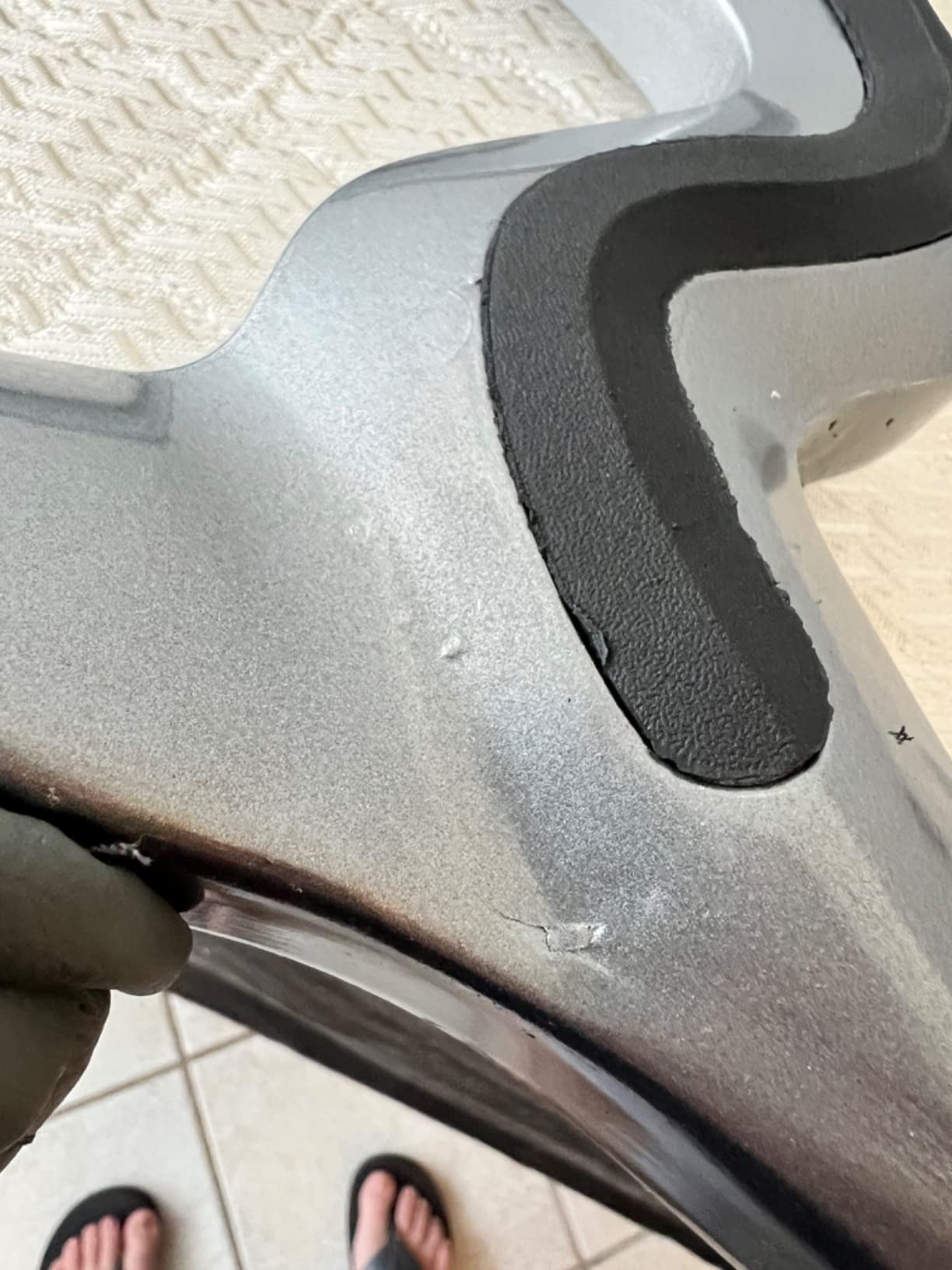
Beyond the seat height, the recurring long-term reports are a wobbling seat and base plates that crack or snap within one to three years. Those failures are structural rather than cosmetic, and they show up more often in a smaller share of owners than the comfort complaints, but they are the reason this chair does not carry an editor’s choice badge.
A small number of owners also report a persistent chemical odor that takes months to fade, which is a common trait of bonded leather and synthetic foam in enclosed rooms. The recline is a single position, and the chair can feel tippy at full extension, which is worth checking if you plan to lean back as part of your work rhythm.
5. BOLISS Ergonomic Mesh Chair – Best Pick Around the 300 Pound Mark
BOLISS 400lbs Ergonomic Office Chair Soft Thick Seat with Mesh Back (Black)
300 lb listed rating
20.5 inch seat width
5 inch foam seat
30.6 lb build
1 year warranty
+ Pros
- 5 inch thick high-density molded foam that holds shape
- 20.5 inch wide seat with real freedom of movement
- Breathable nylon mesh back keeps the back cool
- Height-adjustable padded armrests with tilt tension
- Quiet PU casters that work on hard floors and carpet
– Cons
- No headrest
- Armrest padding flattens and replacements are hard to find
- 18 inch seat depth is short
- Needs more desk clearance than a typical office chair
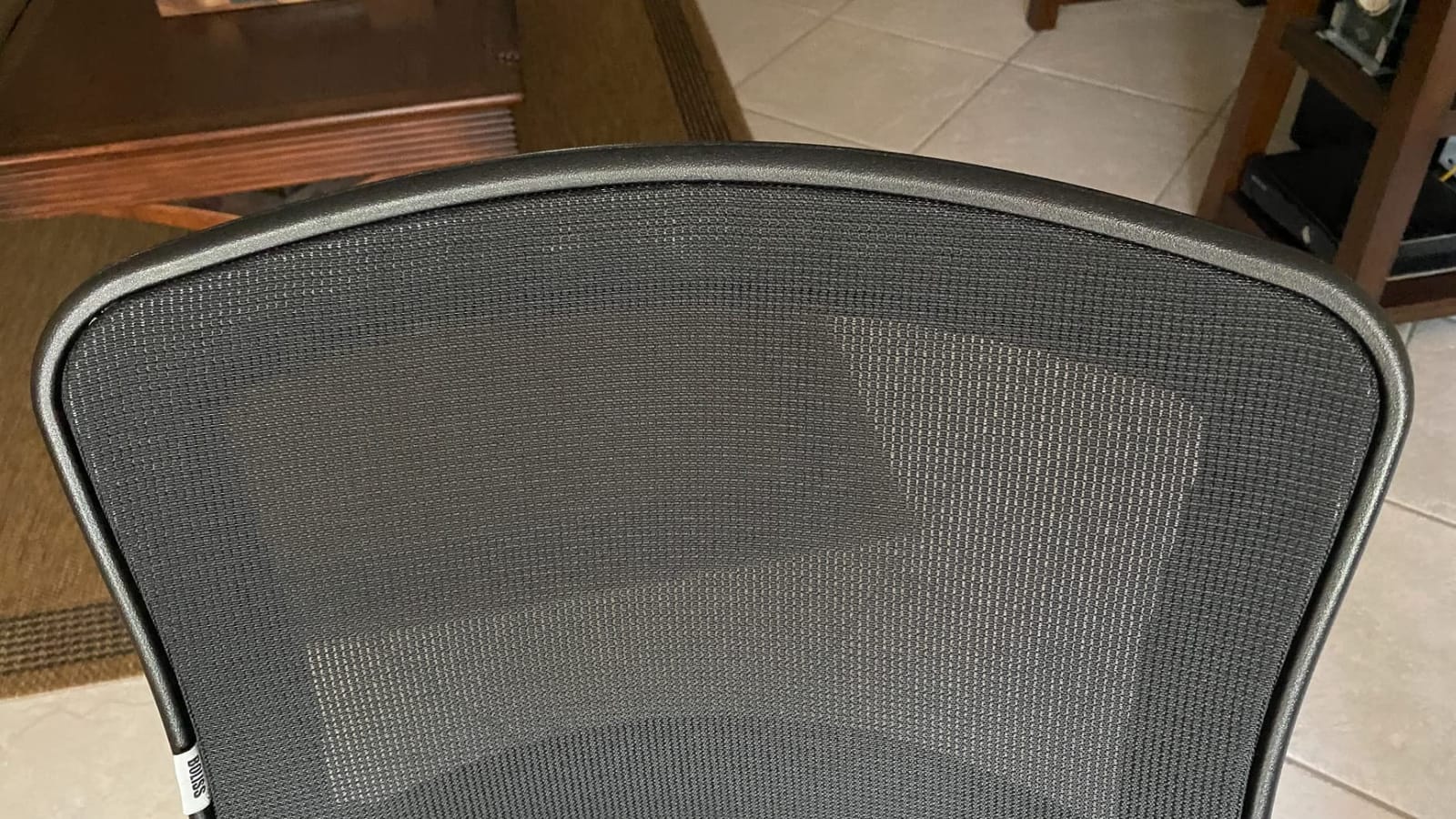
This is the chair to look at if you are around the 300 pound mark and want something breathable. A 5 inch thick molded foam seat is among the deepest in the group, and molded high-density foam holds its shape better than cut-and-stitched foam, which is why owner feedback emphasizes that it still looks right after years.
Several reviewers above 300 pounds specifically confirm the chair holds up, and the 4.4 average across 1837 ratings is the second strongest rating in the group behind our editor’s choice. The nylon mesh back is the other half of the appeal: it does not heat up the way leather and PU do, which matters across eight-plus hour days.
Read the Capacity Field Carefully
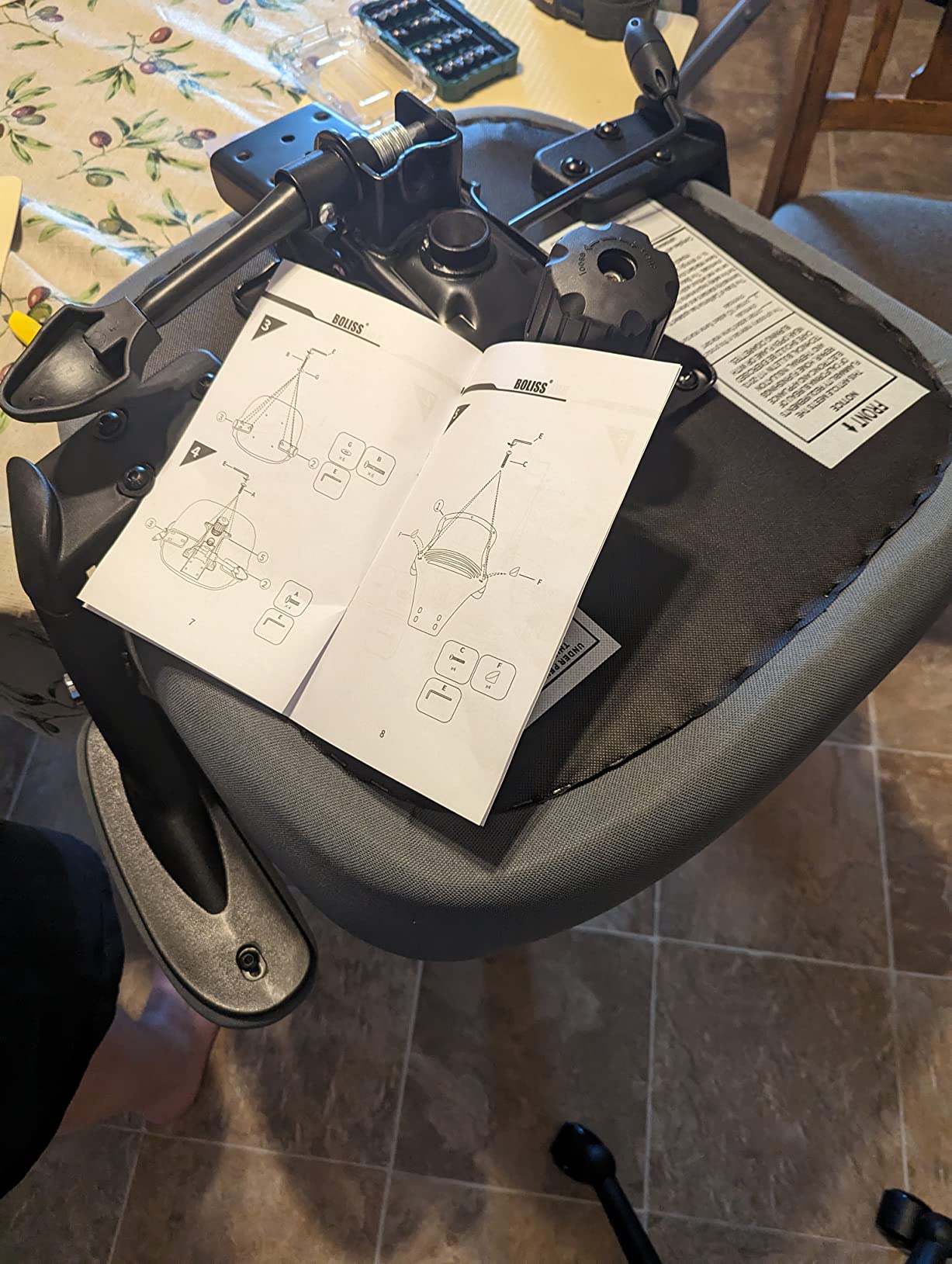
This listing carries a genuine ambiguity. The product detail field states a maximum weight recommendation of 300 pounds, while the listing headline says 400 lbs capacity. If you are anywhere near 350 pounds or above, contact the seller and get the 300 pound figure confirmed before you order, because the two numbers point at very different load paths through the chair.
That ambiguity is worth noting for the whole category. A capacity number is only as good as the component behind it, and this chair uses a plastic and wood frame with PU casters, which is a different structure from the all-metal frames used by the 400 pound chairs in this roundup. The 300 pound figure is the one we would plan around.
Mesh Comfort Over Long Days
Mesh has a real trade-off that no spec sheet will tell you. It is cool and it never makes your back sweat, but it can feel firm against bare skin over long periods, and it offers less conformity than a foam cushion. If you work in a climate-controlled office, mesh is usually the better pick. If your office runs warm, it is a clear win.
The contouring lumbar structure is fixed to the back rather than adjustable, but reviewers above 300 pounds report it aligns with the spine effectively. Tilt tension adjustment and a reclining backrest that locks in any position give you the range to change posture through the day, which is one of the main reasons to buy an adjustable chair at all.
Where It Falls Short
There is no headrest, which rules it out for anyone who reclines to rest, and armrest padding tends to flatten within months with replacement armrests that are hard to source. That second point is a real longevity problem, because a flattened armrest on a 300 pound load is uncomfortable long before the chair itself fails.
The 18 inch seat depth is shallow for anyone who likes to sit cross-legged, and the 28.1 inch overall width means it needs more desk clearance than a typical office chair. Check that it fits your space before ordering, since this is a wide frame despite weighing just 30.6 pounds.
6. EXCEBET Big and Tall 400lb Executive Chair – Best Certified Lift
EXCEBET Big and Tall Office Chair with Footrest, PU Leather High Back Executive Office Chair 400lbs, Ergonomic Computer Chairs Lumbar Support for Heavy People (Brown)
400 lb capacity
SGS Class 4 cylinder
BIFMA metal base
65 lb build
135 degree tilt
+ Pros
- SGS certified Class 4 gas cylinder and BIFMA rated metal base
- Built-in spring cushion under high-density foam
- Retractable footrest paired with 135 degree tilt
- Seat adjusts from 18-7/8 to 22 inches
- Embossed PU leather in 10 color options
– Cons
- Heaviest build here at 65 pounds
- 52 inch backrest is a poor fit for low desks
- PU leather feels warm over long sessions
- Some finish inconsistencies reported on arrival
This is the only chair in the roundup that states an SGS certified Class 4 gas cylinder and a BIFMA approved metal base rated to 400 pounds in its published specifications. That is the single most useful line of text on any product page in this category, because it names both the lift class and the certification, which is exactly the detail most listings omit.
If you want to understand why that matters, a Class-4 cylinder has a larger bore and thicker walls than the Class-3 cylinders standard on 220 to 275 pound chairs. Under sustained load above the Class-3 rating, a Class-3 cylinder loses pressure gradually. A Class-4 cylinder holds it. Owners here describe the base as instilling confidence, and the stability feedback lines up with what the specification claims.
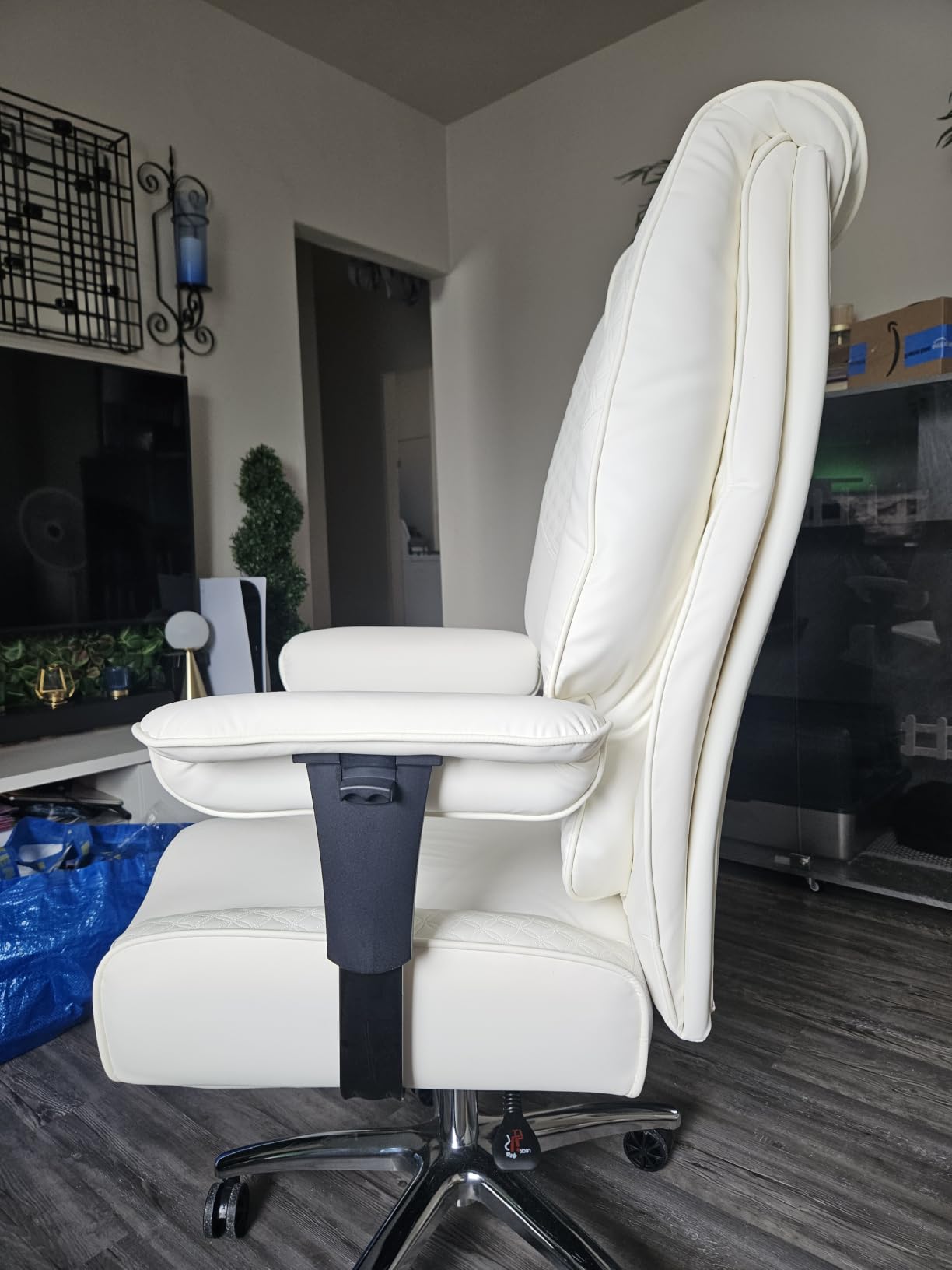
Spring Cushioning Under the Foam
The cushion frame uses FSC-certified wood with a built-in spring layer under high-density elastic foam. That is a meaningfully different construction from the all-foam seats used elsewhere in this group, and it addresses the specific complaint that heavy-duty chairs keep sinking. The springs take the load, so the foam above them is not being crushed continuously.
The adjustable height range from 18-7/8 inches to 22 inches gives you the lowest minimum seat height published for any 400 pound chair in this roundup, which makes it a better fit than most for shorter legs. If you are near 6 feet tall you get enough range, and the 135 degree tilt with retractable footrest gives a genuine rest position.
Desk Clearance Is the Real Trade-Off
At 52 inches tall with a 31 inch width, this is a large chair in physical terms, and that has consequences. It weighs 65 pounds, which makes it the hardest to move and assemble in the group, and the tall backrest is a poor match for low desks or for anyone who wants to sit forward at a keyboard.
The PU leather is breathable relative to bonded leather but still warmer than mesh. Owners who move between this chair and a mesh option at different seasons report noticing the difference within about an hour. Padded armrests that tuck under a tabletop help offset the overall width, which is a deliberate design choice for desk clearance.
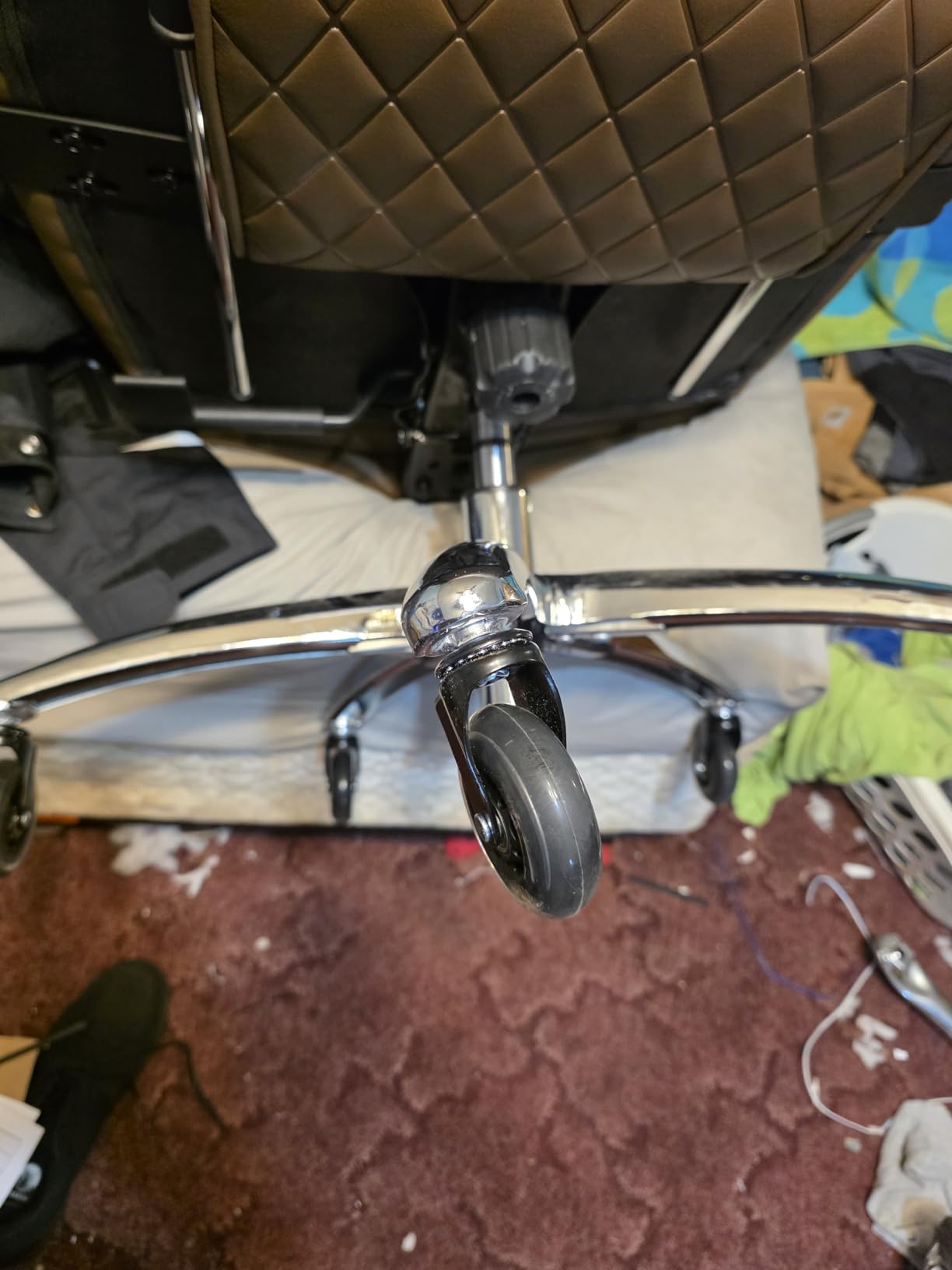
Where It Falls Short
The physical size is the honest drawback. At 65 pounds, you are assembling a two-person job, and assembly takes 20 to 30 minutes. If you work in a small office and move chairs frequently, that is a real cost that the capacity number does not reflect.
There is no stated warranty in the published specification, and a small number of buyers report finish inconsistencies and small cosmetic defects on arrival. If appearance matters to you, inspect the package on delivery. The certification advantage is genuine, but the chair is not a light one.
7. HYLONE 400lb Big and Tall Mesh Desk Chair – Best Fit for Low Desks
HYLONE 400lb Office Chair Big and Tall,Desk Chair with Lumbar Support,Black
400 lb capacity
19.6 inch seat height
32 lb build
24 month parts
5 inch sponge seat
+ Pros
- 5 inch thick sponge seat that resists deformation
- Breathable nylon mesh back
- Flip-up armrests let the chair tuck under a desk
- 28 inch 5-star base stays stable at full height
- 24-month free parts replacement program
– Cons
- Lower backrest is much narrower than the seat
- No headrest
- Recommended only up to about 6 foot 2 inches
- Stained or dented parts reported on some chairs
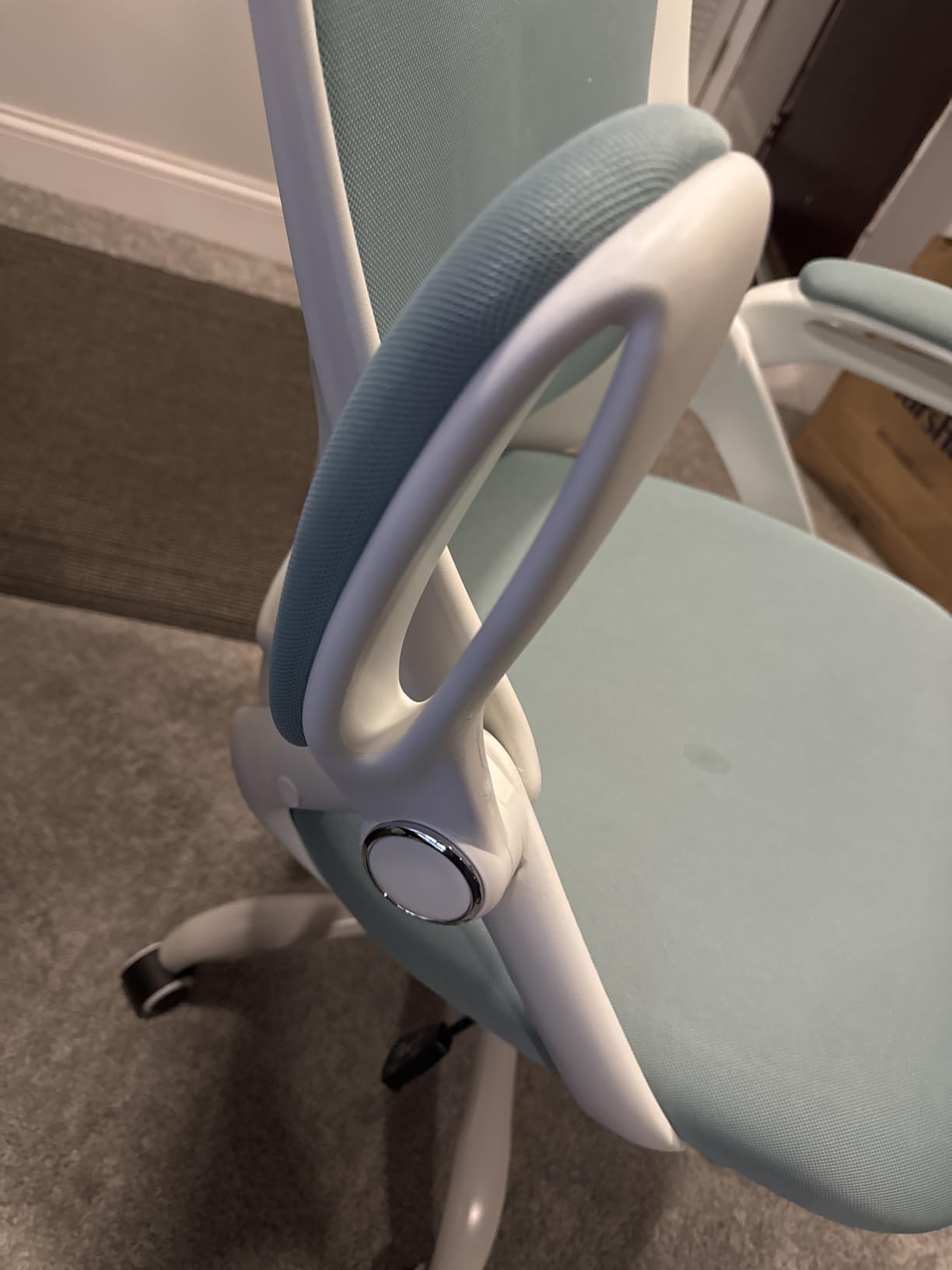
The flip-up armrests are the reason this chair exists for a lot of people. When the arms pivot up, the chair tucks fully under a desk, which removes the whole category of problems caused by a 400 pound rated chair being too wide to slide in. Several owners describe this as the first chair that met every requirement at once.
The 19.6 inch seat height is one of the lowest fixed points in this roundup, and combined with flip-up arms it makes this the most desk-compatible heavy-duty option we looked at. If your desk is low, or if you share a small workspace, that combination is worth a lot.
Fit Is the Whole Story Here
There is a specific fit complaint that appears repeatedly in detailed reviews: the lower portion of the backrest is much narrower than the seat, with plastic behind the arms curving inward to about 14.5 inches. On a chair marketed as big and tall with a 21.5 inch seat length and a 21 inch depth, that narrowing is a real gap between the marketing and the geometry.
The manufacturer also recommends this chair for users about 5 foot 5 inches to 6 foot 2 inches tall. Outside that range the fit suffers, which is worth respecting. This is a well-built chair with a specific envelope rather than a universal one, and the honest framing is that it works best for a mid-to-tall user who needs a low seat and a breathable back.
Base, Casters and the 24-Month Parts Program
The 28 inch five-star base is wider than typical, which improves stability at full lift extension, and that is a meaningful safety consideration at 400 pounds. Owners report smooth rolling across tile, wood and carpet, which is a basic thing that many heavier chairs get wrong.
The 24-month free parts replacement program with a 24-hour support response is longer than most warranties in this category, where one year is the norm and some listings state no warranty at all. For a chair built from a mix of plastic, wood and metal components, that coverage is meaningful, particularly for arm and caster replacement. Assembly takes about 30 minutes.
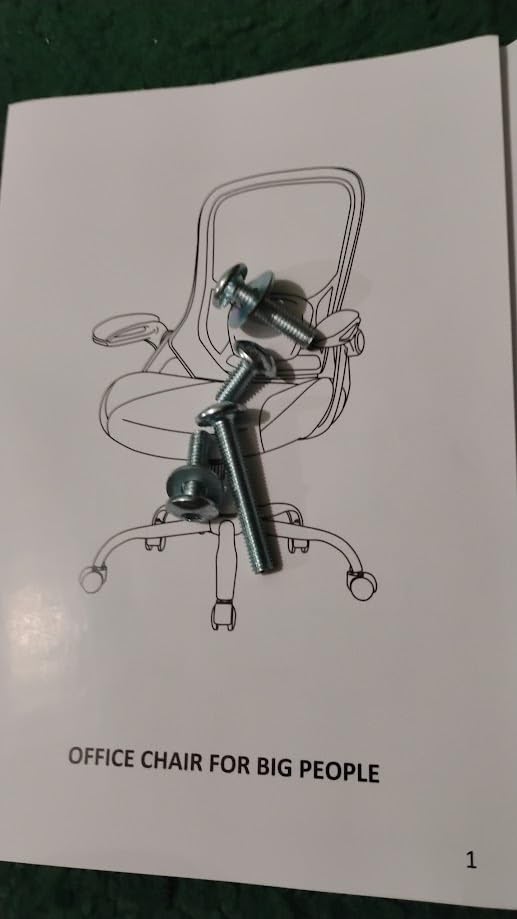
Where It Falls Short
There is no headrest, and the tailored lumbar support is not height adjustable. Both are common omissions in mesh task chairs, but they are the two features people look for first in a big and tall chair, so their absence is worth noting before you order.
Be aware that two seat widths exist within this product, and the narrower one is not wide enough for cross-legged sitting. Confirm which variant you are receiving. A small number of owners also report components arriving stained or dented, so inspect before assembly.
8. Indulgear Big and Tall 500lb Heavy Duty Chair – Best 500 Pound Option
Big and Tall Office Chair, Heavy Duty Office Chair for Heavy People
500 lb capacity
23.62 inch seat depth
80 lb build
4-level gas lift
Rubber-over-PU wheels
+ Pros
- Highest stated capacity here at 500 pounds on a 4-level gas lift
- 23.62 inch deep seat and 27.56 inch wide backrest
- Built-in adjustable lumbar with a wrapping extra-wide backrest
- Rubber-over-PU wheels roll quietly without marking floors
- Breathable PU leather that resists fading
– Cons
- Heaviest build in the roundup at 80 pounds
- Firm PU leather that some users find warm
- Single fixed recline with no tilt tension dial
- Decorative metallic arm finish shows wear
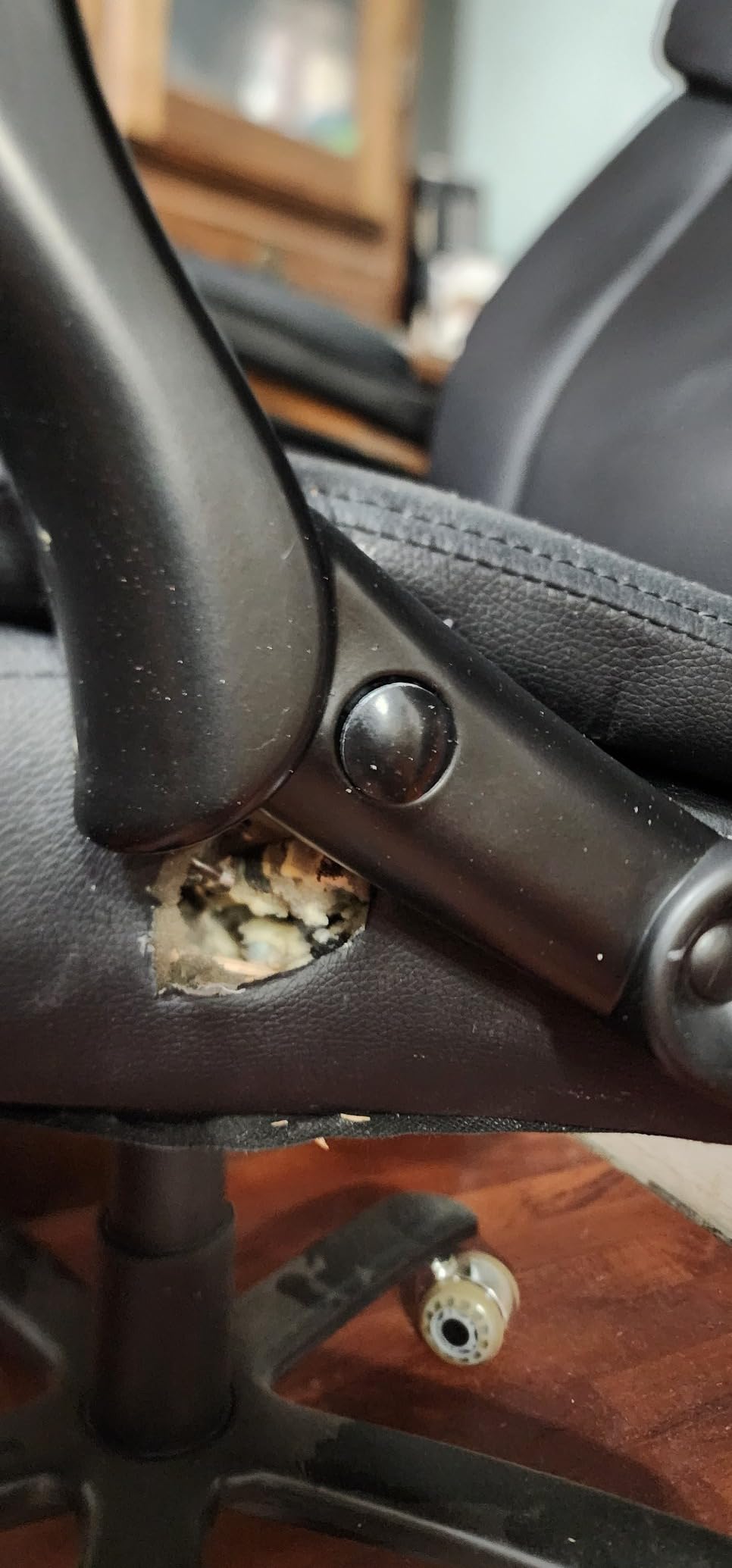
This chair answers the 500 pound question more usefully than anything else we reviewed, and it does it with geometry rather than adjectives. A 23.62 inch seat depth is the deepest in the roundup by a wide margin, and the 27.56 inch backrest is nearly as wide. That combination means you are not perching on the front edge of the seat, which is the single most common complaint heavier users report.
The four-level gas lift on a heavy duty metal base is what carries the 500 pound figure, and the rubber-over-PU wheels are a thoughtful detail: they roll quietly and do not mark a hard floor, which matters in a home office with wood or tile. Built-in adjustable lumbar support across a wrapping backrest is unusual at this size.
Why Seat Depth Beats Capacity Numbers
Consider what a 23.62 inch seat depth actually does. Your thighs are supported along their length rather than at their front edge, your knees sit at the front of the pan instead of past it, and the seat edge that causes the pressure sensation in long sessions moves somewhere else. At 500 pounds, the difference between supported and unsupported thighs is the difference between a chair you can use all day and one you cannot.
The double layer sponge cushion is a standard configuration, and at this weight the double layer helps distribute the load across two foam densities rather than one. The PU leather is described by owners as more resistant to fading and flaking than bonded leather, which addresses the durability complaint that affects most leather chairs in this roundup over multi-year use.
The 80 Pound Problem
This chair weighs 80 pounds, which makes it the heaviest in the roundup by a wide margin. That is a direct consequence of the metal and wood construction that supports the 500 pound rating, and it is not a defect. But it means moving this chair is a two-person job, and repositioning it during the day is not realistic.
Assembly takes about 20 minutes per the listing, and eight colorways are offered. The trade-off to weigh honestly: this is the chair for someone who has a fixed spot and intends to keep it. If you change rooms or change desks often, a lighter 400 pound option is a better tool for the job.
Where It Falls Short
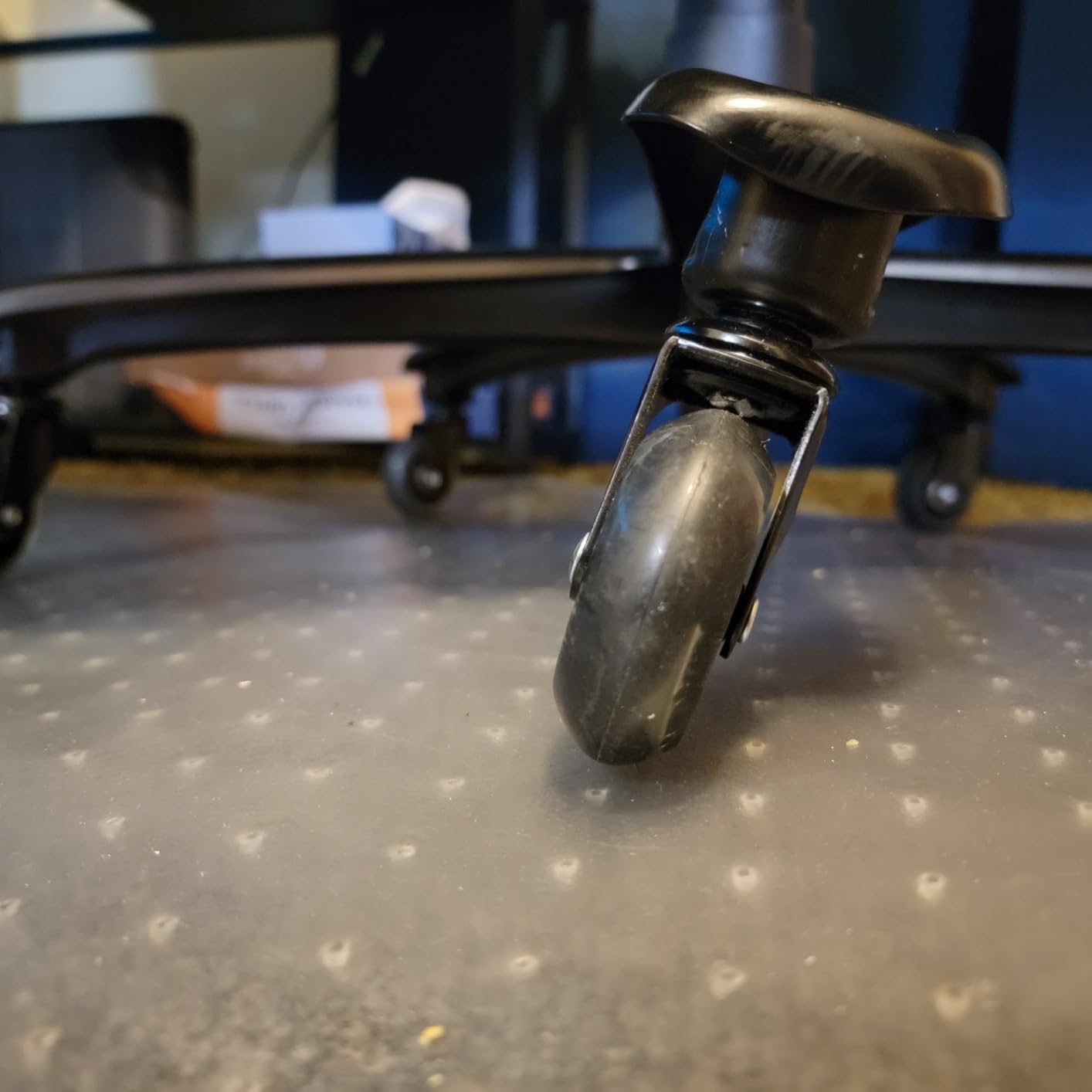
There is a single fixed recline position and no tilt tension adjustment. That is a significant limitation, because tilt tension is what lets a heavy user lean back proportionally rather than either staying rigidly upright or tipping backward. It is the one spec gap in an otherwise very well-proportioned chair.
The PU leather is firm and some users find it warm over long sessions, and the decorative metallic finish on the arms can show wear at contact points. If you are near the top of the 500 pound rating, plan to pair this with a cushion, and check our seat cushion guide for options that do not slide.
9. HESL 400lb Executive Chair with Flip-Up Armrests – Best Desk Clearance
400lbs Executive Office Chair with Flip-Up Armrests, Big and Tall Computer Chair for Heavy People, Heavy Duty Ergonomic Comfy Chair, Breathable PU Leather (Black)
400 lb headline rating
20.5 inch seat height
36.5 lb build
90-120 degree rocking
365-day parts
+ Pros
- Flip-up armrests for maximum desk clearance
- 90 to 120 degree rocking range with tension adjustment
- Firm seat cushion that resists sagging
- Up to 3 inches of height adjustment
- Smooth silent wheels that will not mark flooring
– Cons
- A back frame defect that can snap off on some chairs
- No headrest
- Recline stops at 120 degrees
- Feature bullet cites a 350 pound base rating
This is the highest rated chair in the roundup at 4.7, with 83 percent of ratings at five stars, and the reasons owners give are specific rather than generic: flip-up arms, a firm cushion that does not sag, and assembly that is simple enough to complete in one sitting. The support experience is described as fast and complete, with a replacement chair provided after a defect.
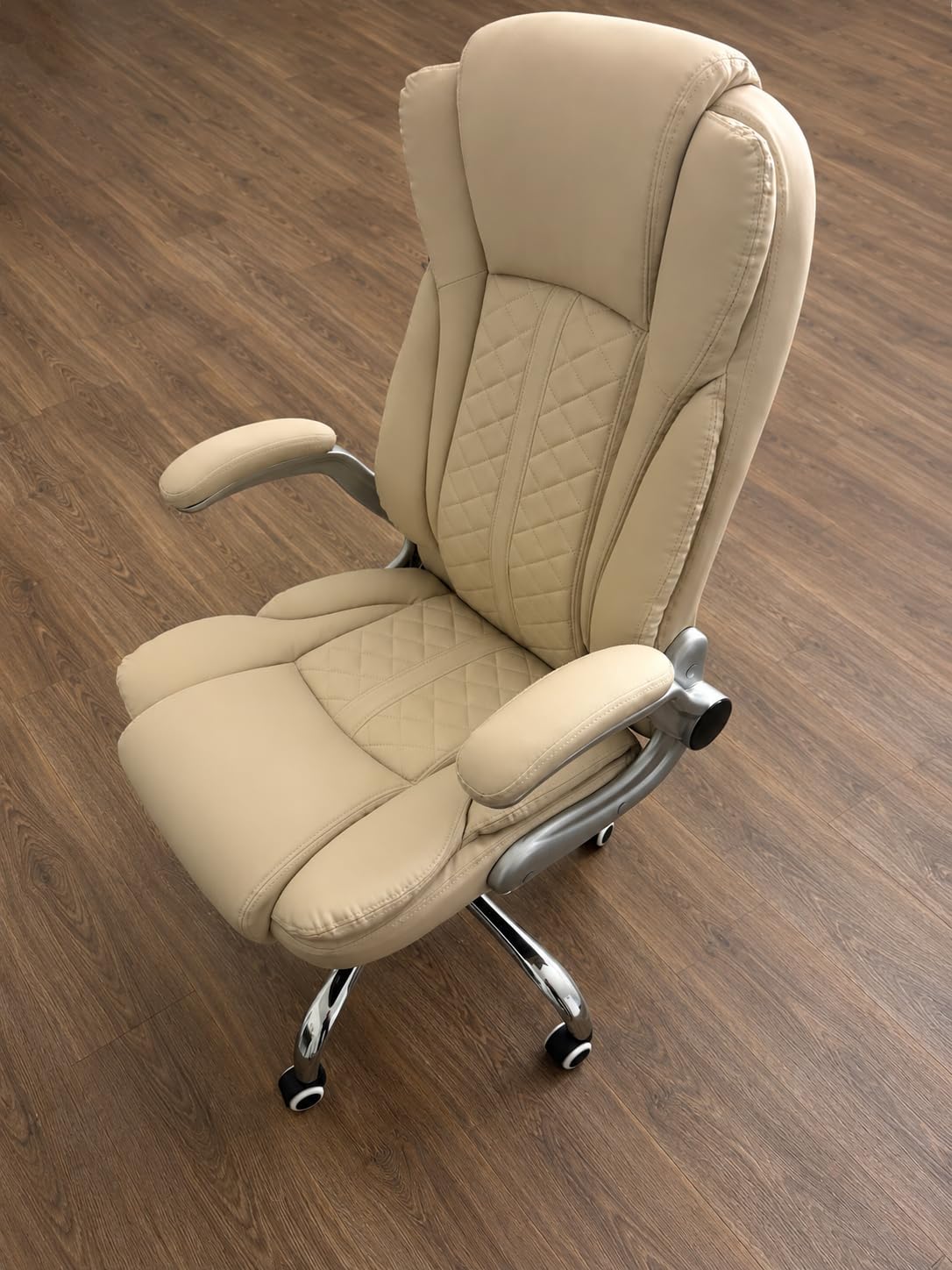
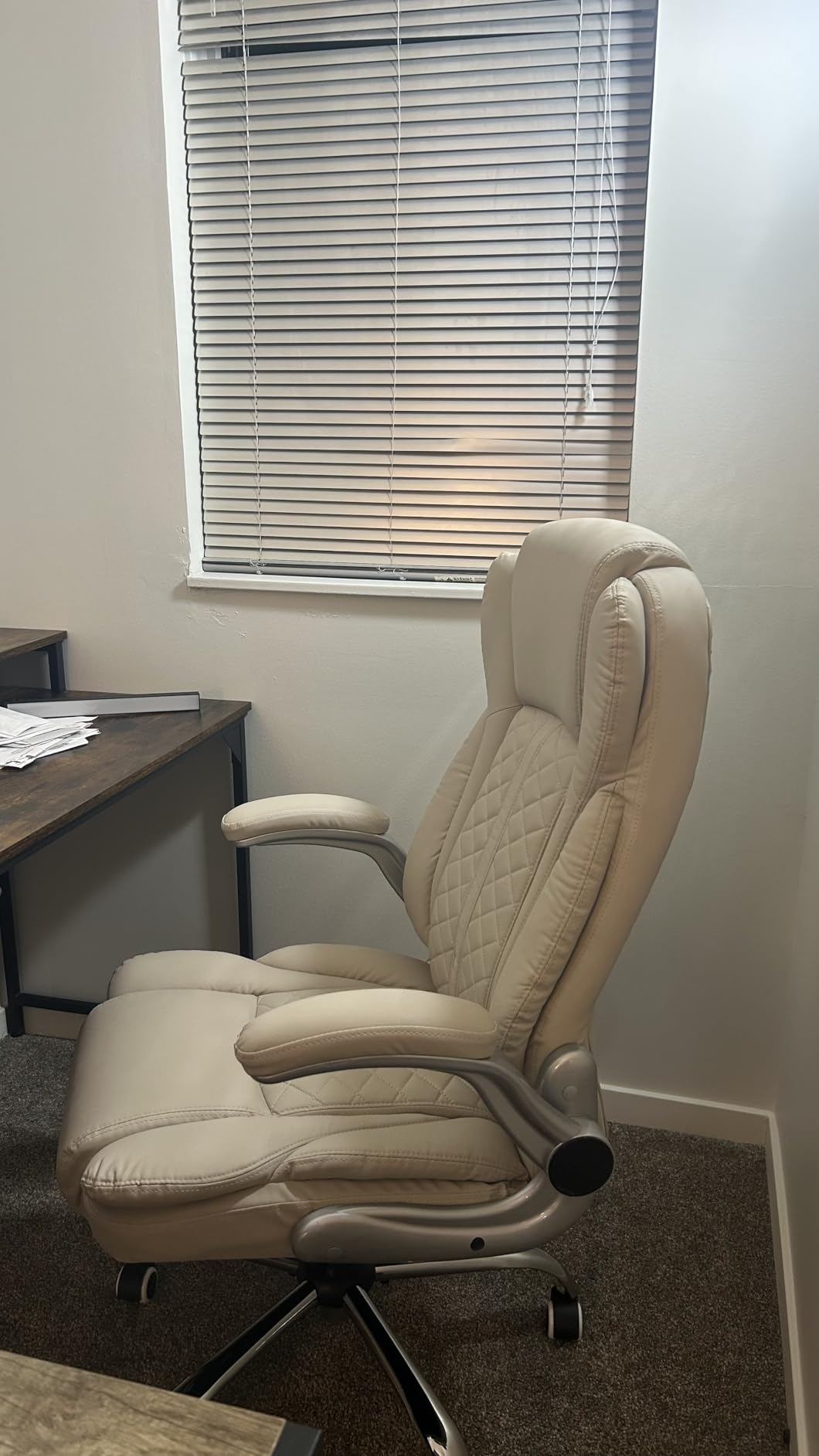
Its 20.5 inch seat height and flip-up arms make it the most usable chair here for a tight desk setup. The overall dimensions of 20 by 22 by 40 inches are also the most conventional in the group, so it fits into a normal home office footprint despite the heavy-duty rating.
A Rating Mismatch Worth Asking About
The listing headline states 400 pounds, while a feature bullet cites a 350 pound base rating. Plan around 350 unless the seller confirms otherwise. This is the second rating discrepancy we found in ten listings, which is itself a useful data point about how capacity claims are handled in this category.
That said, the construction on paper is coherent for a 350 pound load: a metal frame, cotton and foam cushioning at 21.3 inch seat length, and a 22 inch backrest. The flip-up arms are the standout engineering choice, because they let a 400 pound class chair sit at a 20.5 inch seat height under a standard desk, which almost nothing else here manages.
Rocking Range and Why It Stops at 120 Degrees
The rocking function runs from 90 to 120 degrees with adjustable tension, which is a narrower range than the 150 degrees on the gaming-style chairs. That is a deliberate trade: a shallow rocking range with tension control is more stable under a heavy load than a deep recline, and stability is the priority for this weight class.
The firm cushion is called out as non-sagging in owner feedback, and that firmness is a feature rather than a flaw here. A soft foam that conforms beautifully at 150 pounds compresses substantially at 350. Height adjustment spans up to 3 inches, and the wheels are described as smooth and silent without marking flooring.
Where It Falls Short
There is an isolated build defect where the back separates from the frame within a couple of weeks on some units. It is not widespread, but at this weight it is the failure you would most regret, so check the back frame attachment carefully during assembly. The seller’s 30-day returns and 365-day parts replacement terms are the mitigation, and owner reports suggest support resolves problems quickly.
There is no headrest, and the PU leather can feel warm during long sessions. The 340 rating count is the smallest body of owner evidence in this roundup, which means less long-term durability data than the picks above it. High ratings on a small sample deserve that caveat.
10. MAHOMICO ATLAS 750 Big and Tall Mesh Chair – Highest Stated Capacity
750lbs Big and Tall Office Chair with Wide Thick Seat Cushion for Heavy People Ergonomic Computer Mesh Desk Chairs with 4D Armrests, Adjustable Lumbar Support for Adults 8 Hours daliy Work
750 lb stated capacity
29.9 inch overall width
4D armrests
2D lumbar
BIFMA and SGS tested
+ Pros
- Highest stated capacity in the roundup at 750 pounds
- Oversized U-shaped seat cushion with a spring system
- 4D armrests that move in multiple directions
- 2D lumbar support that adapts to leaning forward or back
- BIFMA and SGS tested with a 1 year warranty
– Cons
- Arm height of 20.5 inches crowds a low desk
- Small review base of 310 ratings
- No fixed headrest
- 750 lb figure is a manufacturer claim with no named load test
The 750 pound headline is the number that gets people clicking, and it is why this chair is on the list. It is also the number that needs the most context, because almost no consumer chair carries an independently verified rating at that level. The listing does state BIFMA and SGS testing, but it does not name a specific certification report for the 750 figure, so treat that capacity as a manufacturer claim rather than a verified one.
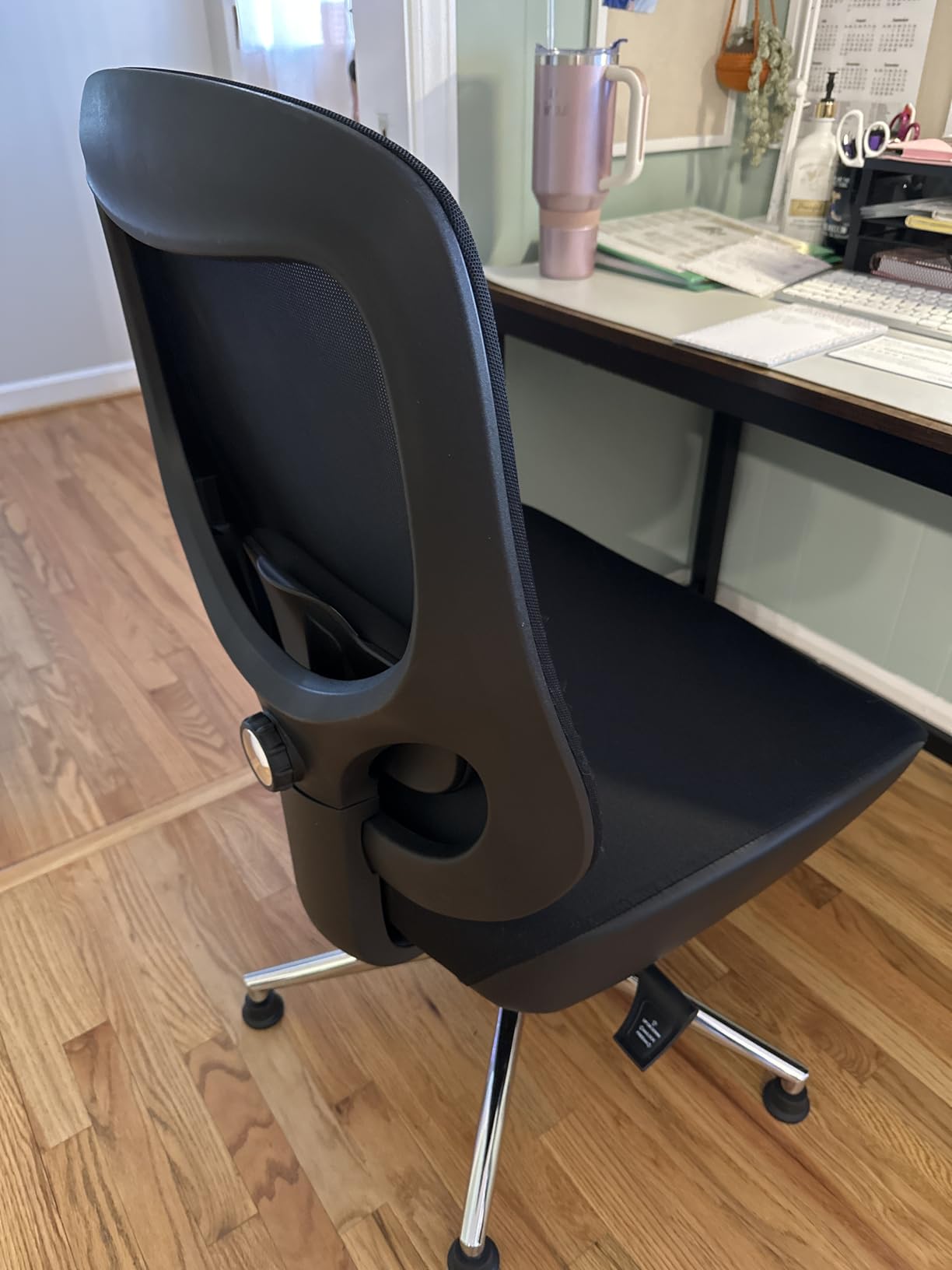
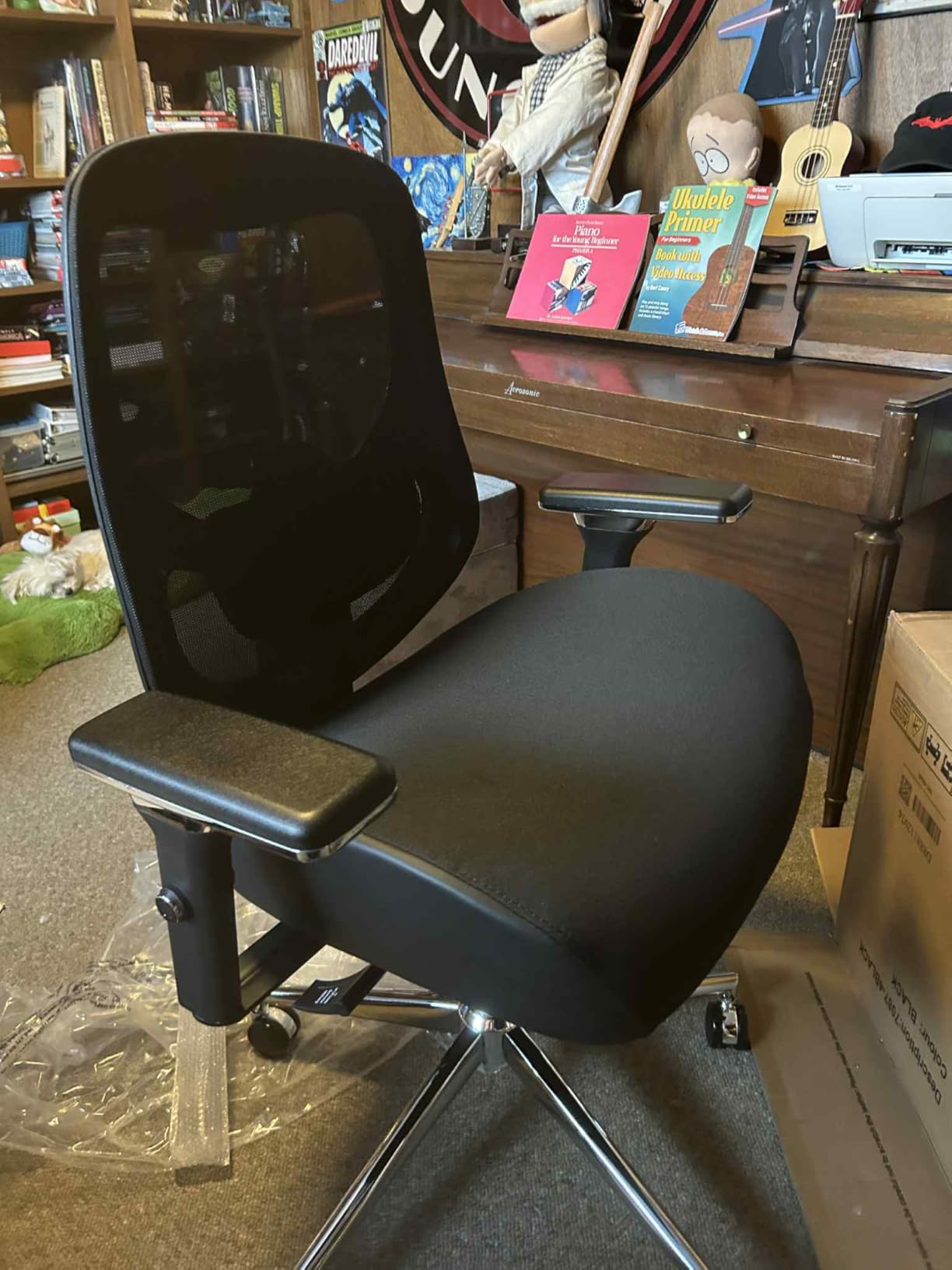
What is verifiable is the geometry. At 29.9 inches wide and 23.6 inches deep, this is the largest overall footprint in the roundup, and the U-shaped seat cushion with a spring system is a construction choice aimed squarely at spreading a heavy load. The 4D armrests that move in multiple directions are unusual at this size and are the detail reviewers respond to most.
Armrests and Desk Height Interact Directly
The armrests sit at 20.5 inches, which is a specific number that determines whether this chair works in your room. A standard desk is typically 29 to 30 inches. If your armrests are at 20.5 inches and you sit with elbows at roughly desk height, the geometry only works if the arms can drop below the desk underside.
This is where the 4D articulation pays off, since armrests that move in multiple directions can be lowered and angled out of the way in ways fixed arms cannot. It is also where the biggest complaints sit, with owners reporting that the arm height crowds a low desk. If your desk is standard or low, test the geometry before committing.
What the 2D Lumbar Actually Adjusts
The lumbar support adjusts in two dimensions, which means it can move forward and back as well as up and down, and it is designed to conform whether you are reclined or leaning forward over a keyboard. On a chair this wide, a fixed lumbar would sit far from your spine once you shift position, so the adjustment is doing real work here.
The breathable mesh back keeps heat down across a long day, and the wheels roll quietly without marking floors. The 19.3 inch seat height is on the lower side, which helps with clearance, and the 20.9 inch interior backrest height is the shortest in the roundup, so this is a chair for someone who does not need tall back support.
Where It Falls Short
The honest limitation is evidence. With 310 ratings, this is the thinnest review history of any chair in the roundup, and long-term durability data at a 400-plus pound load simply does not exist yet. A chair that claims a 750 pound capacity and has 310 ratings is a product whose claim has not been tested by time.
There is no fixed headrest despite the executive positioning, and the 1-year warranty is the shortest offer here. If you are genuinely in the 600 pound range, this category is the wrong place to shop, and a commercial or industrial seating dealer will serve you better than a marketplace listing.
How to Choose a Chair That Will Not Fail You
The sections below cover what we checked on every chair, and what we would check before you buy anything in this category. This is the part that saves you from a return.
Pick a Chair Rated 50 to 100 Pounds Above Your Body Weight
This is the rule the whole guide runs on. If you weigh 320 pounds, buy something rated 400 pounds or higher. The headroom exists because a chair running exactly at its rating is running continuously at the top of its design envelope, and the components that give out first do so under sustained maximum load.
The second reason for headroom is people. If you are near a bracket boundary now, capacity is cheap insurance against a slow drift. It is also the reason a 300 pound chair in a 350 pound bracket often survives longer than a 400 pound chair in a 450 pound bracket, even though both are correctly rated.
Class-3 vs Class-4 Gas Lift: The Spec That Actually Matters
A Class-3 gas cylinder is standard on chairs rated for roughly 220 to 275 pounds. It is the component that produces the slow mid-day sinking described at the start of this guide. Above that weight class, the specification you want is a Class-4 cylinder: larger bore, thicker walls, and a rating designed to hold pressure under sustained heavier load.
How do you verify it? Look for a listing that names the class and the certifying body in the written specifications, not just in the marketing images. The chair at number six in this roundup states an SGS certified Class 4 gas cylinder, which is the clearest example in the group. A capacity rating with no stated certification is a claim; a Class-4 rating with SGS or BIFMA named is a specification. Treat them differently.
Read the Seat Width and Depth, Not the Word Extra Wide
Extra wide is a marketing term with no measurement behind it. The numbers do not lie. Across this roundup, seat width runs from 20.5 inches to a 29.9 inch overall footprint, and seat depth runs from 18 inches to 23.62 inches. Those are very different chairs with very different experiences.
The practical thresholds we use: at least 22 inches wide for a user above 300 pounds, and at least 20 inches of seat depth. Below that, you will perch on the front edge, and the seat edge will press into the backs of your thighs over a long session. A waterfall edge on the front of the pan helps, but it compensates for a small seat; it does not replace a large one.
Base Material and Casters Are Where Heavy-Duty Chairs Break
For a 400 pound rating, you want a steel or metal five-star base. Thin aluminum bases are the most common structural failure in this category, because the lateral stress from standing up or shifting your weight creates micro-fractures at the weld points where the arms meet the base. Owner reports of cracked base plates and wobbling seats, which appear against several chairs here, often trace back to this.
Casters get ignored until they fail. Carriers rated for a 400 pound load exist and cost very little to fit, and they roll better on carpet while protecting a wood floor. If your chair came with soft plastic wheels, upgrading them is the cheapest durability improvement available to you. Also check base width: a 28 inch five-star base, as on the chair at number seven, resists tipping better than a narrow one at full lift extension.
Mesh vs PU Leather for 8-Plus Hour Days
Mesh breathes, so you stay cooler and the back does not sweat. PU leather and bonded leather wipe clean and resist spills, but they hold heat. In a climate-controlled office, either works. In a warm office or a long hot summer, mesh is the clear answer, and the chair at number five is the best balance of mesh cooling and thick foam in this roundup.
There is a durability angle too. PU leather resists stains but can flake at seams after a year or two under sustained load, and bonded leather flakes faster. Mesh does not have that failure mode, but it can feel firm against skin over long sessions and offers less conformity than foam. Our dedicated mesh chair roundup goes deeper on the trade-offs.
Weight Bracket Routing: Which Chair Fits Your Range
Use this table as a starting point, then verify the seat dimensions for your frame. The bracket you fall into determines which of these chairs is worth your time.
Around 250 to 300 pounds: the BOLISS at number five is the pick, with a 5 inch molded foam seat and a breathable mesh back, provided the 300 pound listed rating is confirmed. Below 275 pounds, a mainstream task chair with a Class-4 lift is a viable option too.
Around 300 to 350 pounds: the Amazon Basics big and tall executive at number three and the Serta Fairbanks at number four are the two to compare. They differ on fit: the Amazon Basics is wider and has an adjustable lumbar, while the Serta is more heavily cushioned but sits higher.
Around 350 to 400 pounds: this is the best-served bracket in the category. The GTPLAYER at number one is our pick, the EXCEBET at number six is the pick if certified lift class matters most to you, and the HESL at number nine is the pick if desk clearance is your constraint.
Around 400 to 500 pounds: the Indulgear at number eight is the most purposeful choice, with the deepest seat in the roundup and a 500 pound rating. Its 80 pound weight is the trade-off you accept for that capacity.
Above 500 pounds: this is where the category runs out. The MAHOMICO at number ten claims 750 pounds, but the figure is a manufacturer claim with only 310 ratings behind it. A commercial or industrial seating dealer will have a properly engineered chair with a real warranty, and that is the route we would take.
Desk Clearance and Minimum Seat Height
This is the most overlooked check in the entire category, and it comes up constantly in discussions from people who weigh a lot. A heavy-duty chair is often both taller and wider than the chair it replaces, so it may not fit under your desk, and its seat may not go low enough for your feet to sit flat. When your feet cannot reach the floor you slide forward, and the lumbar support stops working.
Three things to measure before you order. Your desk height, and whether the armrests clear the underside. Your chair-to-wall gap, since a 31 inch wide backrest at full recline sweeps a wide arc. And your own seat-to-floor measurement at your desk, so you know the minimum seat height you need. A chair that cannot adjust low enough for your legs to sit at ninety degrees is the wrong chair no matter what its capacity label says.
Warranty Length as a Durability Proxy
Warranty length is the most honest quality signal on a listing, because it is the one number a manufacturer is financially exposed on. In this roundup the range runs from 24 months of free parts on one chair, to 12 months on another, to a 1 year warranty on several, to no stated warranty on one. A chair rated 400 pounds with a 1 year warranty is telling you what it expects.
Warranty also tells you about the company behind the chair. A 24-month parts replacement program with a stated support response time, as offered on the HYLONE, is a stronger signal than a 5-star rating on a 310-rating sample. Longer warranty, more parts coverage, and a named support response are the three terms to look for when comparing otherwise similar chairs.
Frequently Asked Questions
What is the best office chair for a 300 pound person?
A chair rated around 350 pounds gives you the 50 to 100 pounds of headroom you want, and a mesh back keeps you cooler across long days. In our roundup the BOLISS sits at a listed 300 pounds with a 5 inch molded foam seat, which works at that weight if the listing rating is confirmed. Above 325 pounds, move to a 400 pound chair with a Class-4 gas lift and a seat at least 22 inches wide.
What is the best office chair for a 400 pound person?
Target a chair rated 450 to 500 pounds and check three specs: a Class-4 SGS certified gas cylinder, a metal five-star base, and a seat at least 22 inches wide with 20 inches of depth. The GTPLAYER 400 pound model was our top pick on review history and build quality, while the EXCEBET is the one to choose when a named SGS Class 4 cylinder and BIFMA rated base matter more to you than anything else.
What is the best office chair for a 500 pound person?
The Indulgear big and tall chair rated at 500 pounds is the most purposeful option we reviewed, with a 23.62 inch seat depth that is the deepest in the roundup and a four-level gas lift on a metal base. Plan to accept an 80 pound chair weight and a single fixed recline. Confirm that your desk has the clearance before ordering.
What is the best office chair for a 600 pound person?
Almost no consumer office chair is honestly rated at 600 pounds, so we would stop shopping this category. The one listing here claiming 750 pounds states it as a manufacturer claim with only 310 ratings and no named load test behind it. A commercial or industrial seating dealer will have a properly engineered chair with a real warranty and a documented load rating.
Why do heavy duty office chairs sink over time?
Most often the gas lift is the cause. Standard Class-3 cylinders are rated for roughly 220 to 275 pounds and gradually lose pressure under a sustained heavier load, so the chair drops a few inches by the end of the day. Low-density foam that never recovers and thin aluminum base arms are the other two common causes. A Class-4 cylinder on a metal base with spring-reinforced cushioning addresses all three.
How wide should an office chair seat be for a big person?
At least 22 inches wide and 20 inches deep for a user above 300 pounds. The roundup ranges from a 20.5 inch seat width on the BOLISS to a 29.9 inch overall footprint on the MAHOMICO, and that difference is felt within the first hour. Look for a waterfall front edge as well, since it reduces pressure on the backs of the thighs, but it cannot substitute for a seat pan that is genuinely large.
Are big and tall office chairs actually rated for 500 pounds?
Sometimes, but the label is not standardized. In our ten-chair roundup two listings contradicted themselves, with headlines claiming 400 pounds while the product detail field or a feature bullet said 300 or 350 pounds. Treat big and tall as a retail label, then verify the stated capacity, the gas lift class, the base material, and the published seat dimensions before you buy.
How long does a heavy duty office chair last?
It depends less on the chair than on whether the parts are actually rated for your load. A chair used well within its rating with a Class-4 lift and spring-reinforced foam is built to last far longer than one running at its maximum. Warranty length is the best proxy available before you buy, and in this roundup the terms ranged from 24 months of free parts down to 1 year.
Which Chair Should You Buy?
Start with your bracket, not with a brand. If you are around 300 pounds, the BOLISS with its thick molded foam and mesh back is the sensible entry point once you confirm the listing rating. Between 300 and 350 pounds, compare the Amazon Basics for width and adjustable lumbar support against the Serta for cushioning, and pick based on whether your legs reach the floor.
Between 350 and 400 pounds you have real choice, which is unusual. Take the GTPLAYER if you want the deepest owner-review history and a segmented saddle seat, the EXCEBET if a named SGS Class 4 cylinder and a BIFMA rated metal base are the deciding factors, and the HESL if your desk is tight enough that flip-up armrests decide the outcome. At 400 to 500 pounds, the Indulgear is the most purposeful chair on the list, and the depth of that 23.62 inch seat matters more than anything else it does.
Above 500 pounds, we would stop shopping consumer listings and talk to a commercial or industrial seating dealer instead. You need a documented load rating, and that does not exist in this category.
Whichever bracket you land in, check your desk clearance and your minimum seat height before you order, read the lift class rather than the marketing badge, and use the current listing as the final word on specifications. If your pain is back pain rather than capacity, our lower back chair guide is the right next read, and if it is tall users rather than heavy users, start with gaming chairs for tall people.
What is your weight, how many hours a day do you sit, and how much clearance does your desk give you? Those three answers narrow these ten chairs down to one or two almost immediately, and we are happy to point you at the right one.
Leave a Reply