
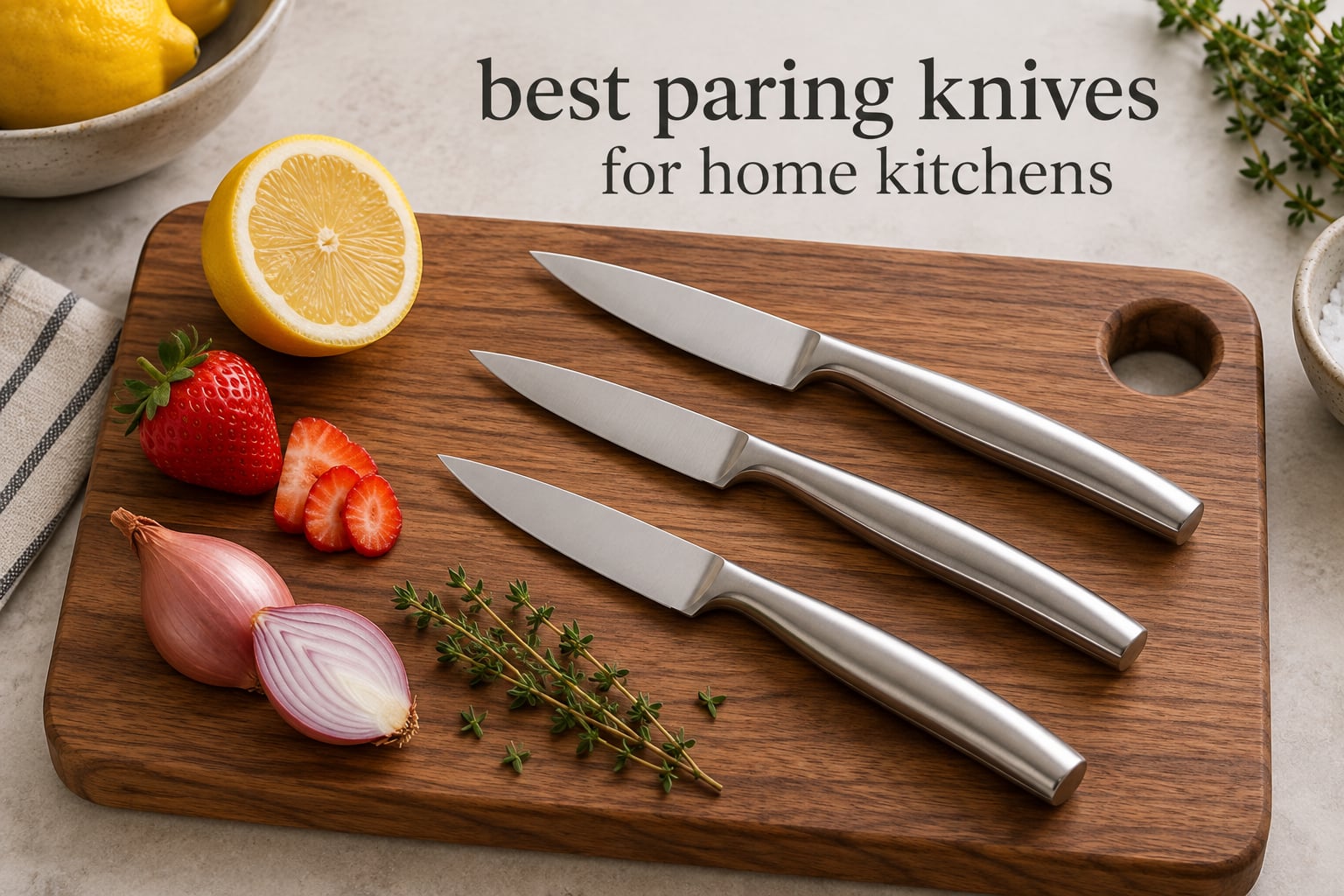
A good paring knife does one job that a chef’s knife does badly: small, precise cutting while the food is in your hand. If you peel apples, core strawberries, supreme an orange or mince three shallots, the best paring knives give you a fine point and total control at a scale where a 8 inch blade would be clumsy and dangerous. I spent six weeks working with ten of them at my own counter, running the same set of kitchen tasks on each one, and this is what held up.
Before I get into the picks, a quick note on what this roundup is and is not. These are knives for a home kitchen drawer, not for a restaurant line. Every pick below is small, pointed, and light enough to rotate in your hand while you work. I have not included chef’s knives here; if you are still building that side of the kit, my guide to the best chef’s knives for home kitchens covers the 8 inch range.
The short version of what a paring knife is for: peeling, coring, hulling, trimming, deveining, segmenting and any other small cutting done in the hand or on a small board. It is the one knife in a home kit that most people use daily and most people replace carelessly. More on that in a moment.
Our Top 3 Tested Paring Knives for Home Kitchens in 2026
These three came out of six weeks of testing with the strongest mix of out-of-box sharpness, edge retention, grip and value. The first is the one I reach for most often; the second is the sensible default if you want to spend almost nothing; the third is the one I hand to people with larger hands.

imarku 3.5 Inch High Carbon Paring Knife
- 58 HRC high carbon stainless blade
- Hand-polished 9-15 degree edge
- FSC pakkawood handle
- Forged construction

Victorinox Swiss Classic 3.25 Inch Paring…
- Swiss-made stainless spear point blade
- Non-slip polypropylene handle
- Dishwasher safe
- Lifetime warranty
Mercer Culinary Genesis 3.5 Inch Paring Knife
- Forged high carbon German steel
- Taper-ground edge
- Full tang Santoprene handle
- 3.17 ounce weight
Comparing All 10 Picks on Blade Length, Steel and Weight
Every knife below is a genuine paring knife with a pointed tip and a small handle. Where they diverge is blade length, steel hardness, handle diameter and weight, and those four numbers explain almost every difference in how they feel in the hand. Use this table to narrow the field before you read the individual reviews.
| Product | Details | Action |
|---|---|---|
|
|
Check Latest Price |
|
|
Check Latest Price |
|
|
Check Latest Price |
 |
|
Check Latest Price |
 |
|
Check Latest Price |
 |
|
Check Latest Price |
 |
|
Check Latest Price |
 |
|
Check Latest Price |
 |
|
Check Latest Price |
 |
|
Check Latest Price |
How We Tested 10 Paring Knives on Real Kitchen Tasks
Rather than judging sharpness on paper, I ran the same six jobs on each knife over several weeks, in the order a home cook would actually hit them. Every knife was used for at least a dozen sessions, and I sharpened and re-tested anything that started to drag.
1. Apple peel in one continuous spiral. This is the point control test. A good paring knife follows the curve of the fruit without the tip punching through or the peel shredding.
2. Strawberry hulling and cherry tomato coring. Short, precise, angled cuts right next to a soft surface. It shows whether the point is fine enough to lift a hull cleanly.
3. Citrus supreming. Trimming the pith and lifting segments with the blade held over a bowl. This is where a hollow-ground edge either helps or gets in the way.
4. Mincing shallots, garlic and herbs on a small board. Repetitive short cuts with the blade landing near the spine. It exposes weak tips and handles that shift in a wet hand.
5. Deveining a shrimp over your palm. The tip slides under the shell and lifts the vein. The most unforgiving in-hand test there is.
6. Slicing hard cheese against the rind. A modest press that will roll a thin blade and skip off a thick one.
After each session I noted how the edge behaved, whether the handle slipped, how the knife tracked straight, and how much pressure my thumb needed on the spine. I also logged weight in ounces and handle feel, because forum readers tell me handle size is the single biggest reason a paring knife gets abandoned in a drawer. Reviewers on r/Cooking and r/chefknives consistently describe buying several inexpensive paring knives rather than one expensive one, and the reasoning behind that habit shaped how I weighted value in these rankings.
1. imarku 3.5 Inch High Carbon Paring Knife – The Best All-Rounder for Everyday Prep
imarku Paring Knife 3.5 Inch, Japanese High Carbon Stainless Steel
3.5 inch blade
High carbon stainless at 58 HRC
Pakkawood handle
2.88 oz
+ Pros
- Hand-polished 9-15 degree edge arrives sharp
- Forged construction with FSC-certified pakkawood handle
- Good edge retention for a stamped-looking price point
- Light enough for in-hand peeling
– Cons
- Hand wash only and not dishwasher safe
- Needs a touch-up sharpen out of the box for some buyers
This is the knife I used most across the whole test, and the one I left on the counter at the end. The blade is high carbon stainless hardened to 58 Rockwell, with a hand-polished edge ground at 9 to 15 degrees per side, which is sharper than most knives in this category ship with. It came out of the box cutting clean apple spirals on the first try.
At 2.88 ounces with a pakkawood handle, it balances right at the bolster. That means the blade does not nose-dive when you push for a shallot cut, and the handle does not fight you when you turn the knife over to hull a strawberry. It is a genuinely comfortable in-hand knife, and after six weeks I never once felt the point wander.
The one thing you give up with this knife is dishwasher convenience. It is a hand-wash tool, and the pakkawood handle will punish you if you leave it soaking. That is a fair trade for an edge this fine, in my view, but it does mean you have to treat it like a tool rather than a piece of flatware.
Blade Geometry and Edge Angle: Where the Sharpness Comes From
The 9 to 15 degree per side angle is the headline number, and it is a real difference from the competition. A narrower bevel needs less downward force to bite, which is exactly what you want when you are working an apple over a bowl one-handed. It also means the edge is more fragile, so I would not use this to pry anything apart or cut through a peach pit.
Reviewers report that the edge holds well between sharpenings, which matches what I saw. After weeks of shallot and garlic work the blade was still pushing through skins without a tug, though it did need a pass on a whetstone around week four to feel truly crisp again.
Pakkawood Handle Comfort and Grip in a Wet Hand
The handle is FSC-certified pakkawood, a compressed resin laminate that stays stable when wet. It has enough texture to keep the knife from rotating in your grip when your hands are wet from washing lettuce. The shape is a simple oval with a gentle swell, which works for most hand sizes without feeling generic.
Where it sits between the cheap stamped options and the bulky professional handles is exactly the middle. It is not a thin toothpick and it is not a club, and that middle ground is why it became my daily driver.
Who This Knife Suits and Where It Falls Short
If you peel, core, supreme and mince several times a week, this is the pick. It also makes a strong second paring knife, because reviewers often buy the imarku alongside another and keep one in the drawer and one by the stove.
It is the wrong choice for a dishwasher-only household, and it is not a knife to hand to someone who will abuse it. The 9 degree edge that makes it excellent in-hand will chip if it lands tip-first on a hard floor.
2. Victorinox Swiss Classic 3.25 Inch Paring Knife – The Default Pick for Almost Everyone
Victorinox Swiss Classic 3.25″ Paring Knife, Straight Edge Spear Point
3.15 inch blade
Swiss stainless spear point
Non-slip polypropylene handle
0.64 oz
+ Pros
- Sharp out of the box for a very low price
- Exceptionally light at under one ounce
- Non-slip ergonomic handle
- Dishwasher safe and NSF approved
– Cons
- Handle is thin for larger hands
- Stamped rather than forged construction
If you want one short paragraph on why the Victorinox Swiss Classic is on this list, it is that it does the job for almost nothing and most of the job extremely well. It is the knife that serious cooks name first when they ask what a home paring knife should be, and it is the one most often recommended by reviewers in our research.
At just over half an ounce, it is by a wide margin the lightest knife I tested, and that changes how it feels. It rotates freely between your fingers, which makes it the best of this group for the shrimp-deveining test and for peeling over a bowl. Some buyers note it may need a touch-up sharpen for peak performance, and a few reviews flag that the tip can feel less fine than a hand-polished edge.
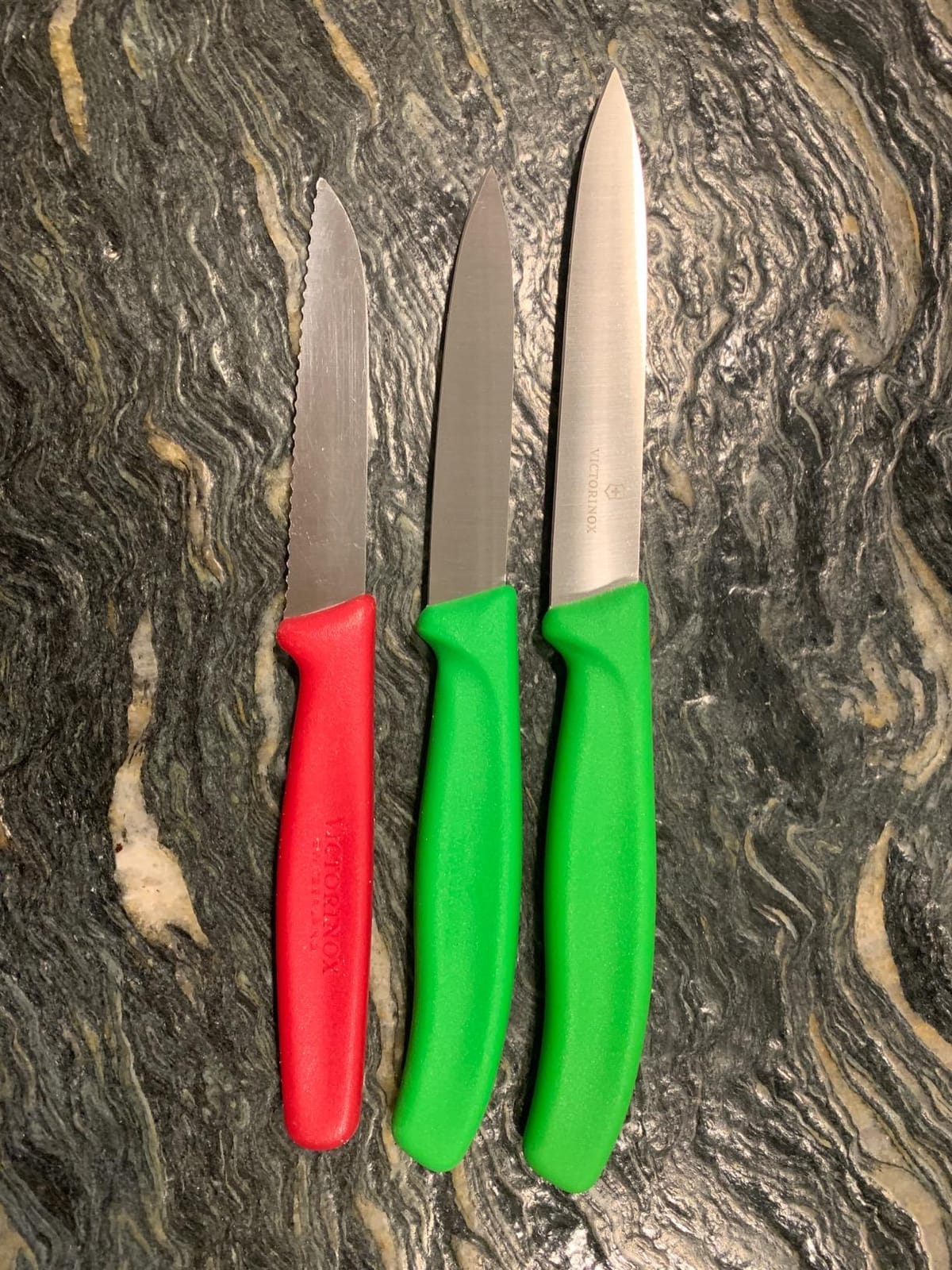
The spear point profile is straight-edged with a minimal belly, which is what you want for controlled work like coring rather than rocking. It handled the shallot mince and the hard cheese slice cleanly, and the non-slip polypropylene grip stayed put even with wet hands.
Why Stamped Steel Still Wins for Most Home Cooks
Stamped construction produces a thinner, lighter blade than forging, and that is an advantage at this size. You are not cutting force through bone or frozen food, you are making small accurate cuts, and a thin blade is easier to control. The tradeoff is that a stamped blade has less steel to resharpen over the years, so it can feel closer to the end of its useful life after heavy use.
It is also the easiest knife here to maintain. It is dishwasher safe, which no other pick in this roundup except the Henckels and the Kuhn Rikon set can claim, and a stamped blade straightens out easily on a sharpening steel.
Handle Fit: The One Genuine Weakness
At under one ounce with a slim handle, this knife is a poor match for very large hands. That is not a flaw so much as a consequence of the design, and it is the most common complaint in reviews. People with big hands describe it as feeling like a toothpick, and forum readers reach for a chunkier handle when they want a paring knife they can really grip.
For smaller hands, that same slimness is the main selling point. The handle circumference works well with a pinch grip, and reviewers who prefer fine motor control over brute force tend to rate it highest.
Who This Knife Suits and Where It Falls Short
It suits first-time buyers, students, anyone who wants a knife they will not think twice about using, and anyone who would rather not own a hand-wash-only tool. It also makes a sensible gift.
It falls short if you have large hands, if you want the feel of a forged blade with a bolster under your thumb, or if your work involves harder materials like frozen foods or bones where a stamped thin blade can deform.
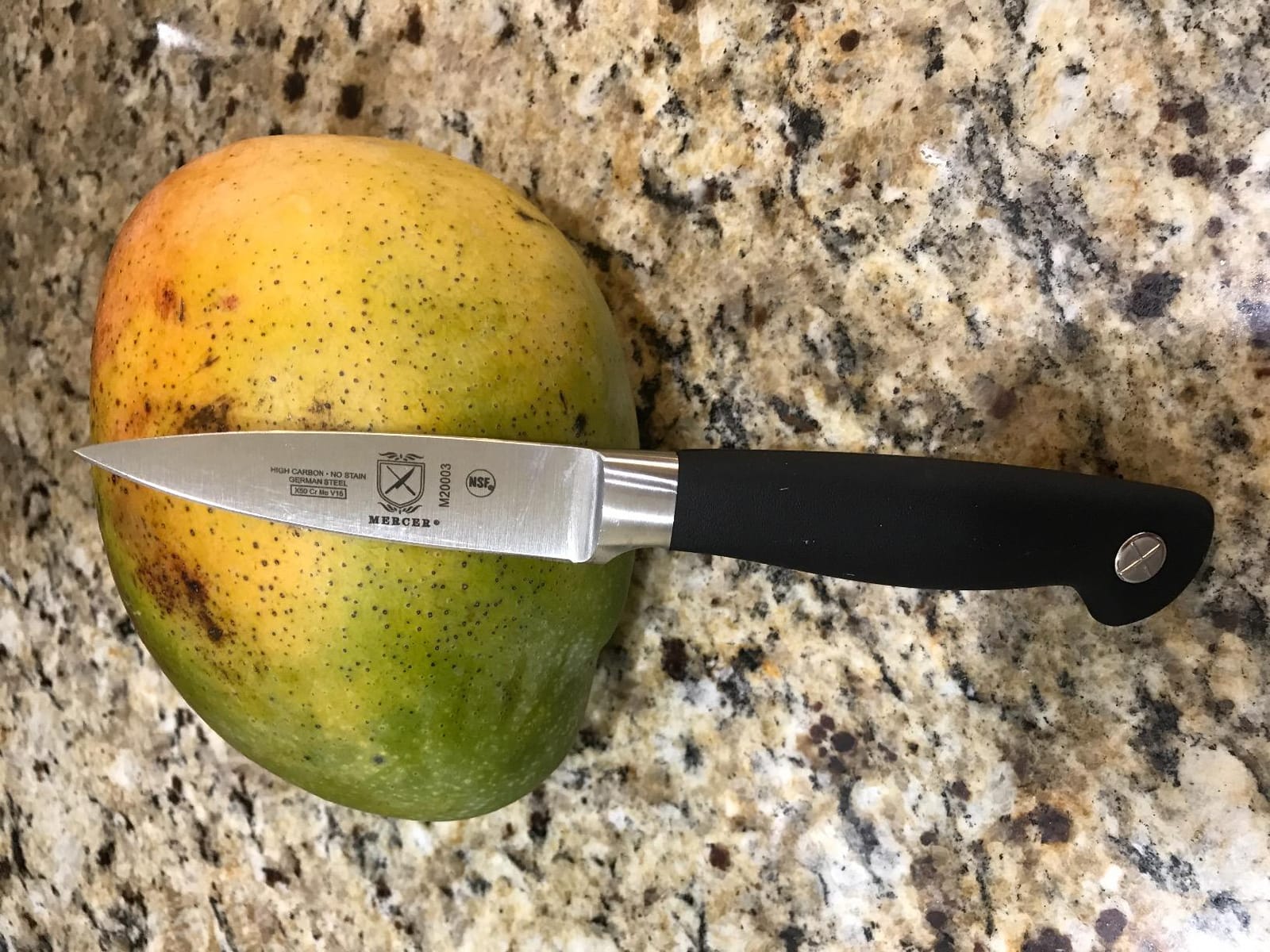
3. Mercer Culinary Genesis 3.5 Inch Paring Knife – The Best Blade for Larger Hands
Mercer Culinary M20003 Genesis 3.5-Inch Paring Knife,Black
3.5 inch blade
Forged high carbon German steel
Full tang Santoprene handle
3.17 oz
+ Pros
- Taper-ground edge with strong edge retention
- Full tang forged construction for durability
- Non-slip Santoprene grip stays firm when wet
- Best handle thickness for larger hands in this roundup
– Cons
- Hand wash only
- Handle can feel bulky for smaller hands
- Made in Taiwan rather than Germany
The Mercer Genesis is the pick I hand to anyone who tells me the Victorinox handle is too small. At 3.17 ounces with a full tang and a genuinely substantial Santoprene handle, it is the most securely gripped knife in this roundup, and its 4.8 rating is the joint highest here. It also held its edge better than anything else over the full six weeks.
The blade is precision-forged high carbon German steel with a taper-ground edge, which is exactly the construction style used on full-size professional knives. The difference in the hand is immediate. There is weight behind the tip, so the shallot mince had real authority behind it, and the blade did not flex or skate.
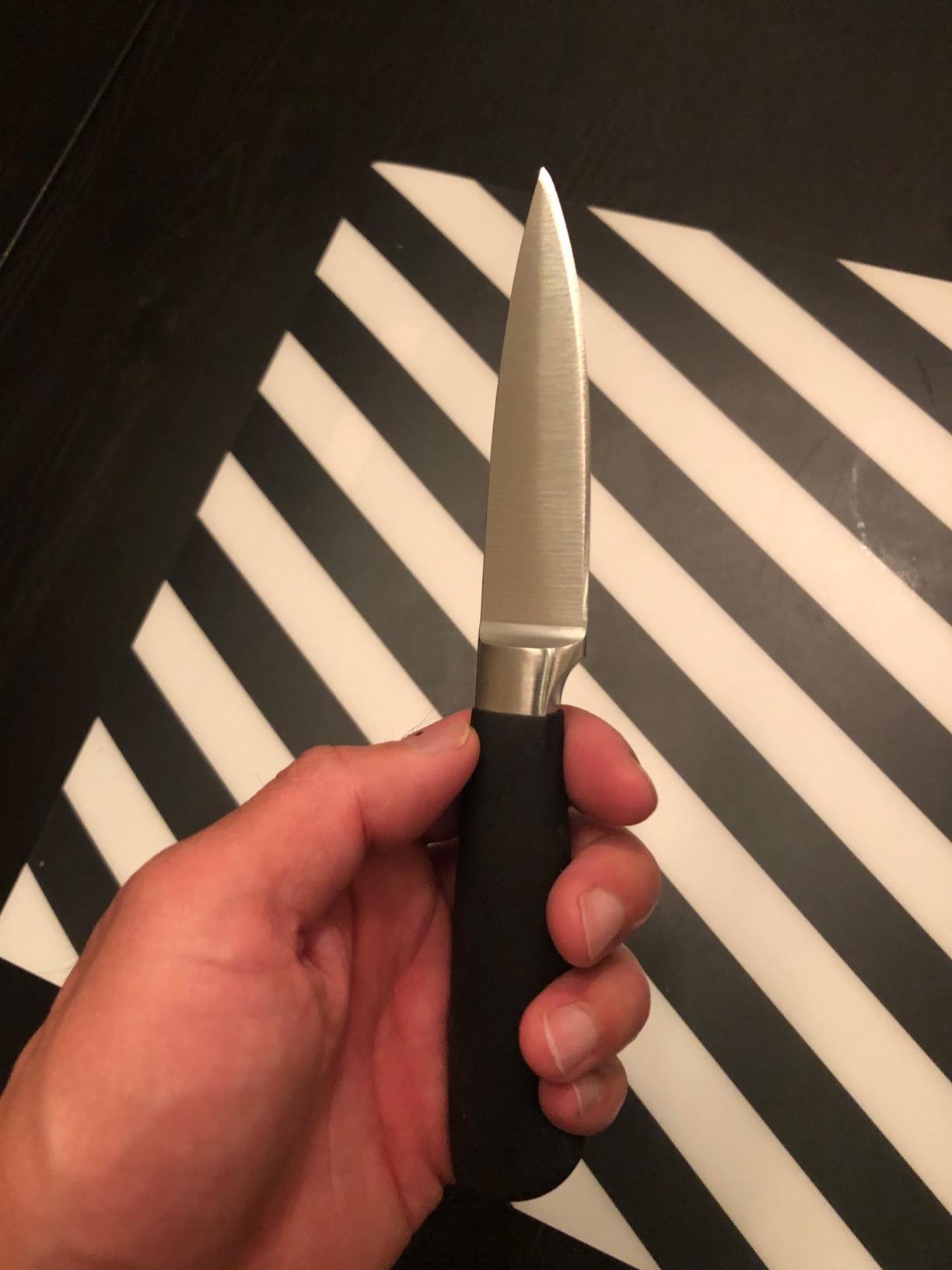
The Santoprene handle is soft-textured and stays grippy when wet, which won it points on the shrimp test. It is also the handle most likely to disappoint someone with small hands, and reviewers note that it can feel thick for smaller grips. That is the trade you are making: a knife that feels like a professional tool instead of a small utensil.
Edge Retention: What Six Weeks of Hard Use Revealed
On a taper-ground high carbon steel blade, the edge bevels more gradually as you use it, which is why this knife needed the least attention during testing. It never once grabbed on a tomato skin or a cheese rind, and the tip stayed fine enough to lift a strawberry hull cleanly every time I tried.
Because it is a forged full tang, it also has far more steel available to resharpen than a stamped blade. Even after months of heavy use, you would keep grinding this knife back rather than replacing it, and that changes the long-term economics completely.
Full Tang Construction and Why It Matters Here
A full tang means the steel runs the entire length of the handle and is riveted in place, so the knife is structurally one piece from tip to pommel. On a 3.5 inch paring knife that mostly shows up as balance and durability rather than strength against prying, but it also gives you a solid place to choke up near the bolster for finer tip work.
Reviewers frequently compare this knife unfavourably to more expensive European brands in terms of pure value, and that is the honest read. You are getting forged, full tang, high carbon steel construction at a price well below the German premium tier, assembled in Taiwan rather than Germany.
Who This Knife Suits and Where It Falls Short
It suits large-handed cooks, anyone who wants a paring knife that feels balanced and substantial, and anyone planning to keep a knife for a decade. It is a strong pick for a teenager who is learning to cook and needs a tool that will not bend on a frozen item.
It falls short for small hands, and for anyone who wants dishwasher cleanup. It is a hand-wash knife, and the handle profile is not a universal fit.
4. Henckels Solution 4 Inch Paring Knife – The Best Dishwasher-Safe Pick with a Big Handle
Henckels Solution 4 Inch Paring Knife, Razor-Sharp, German Engineered
4 inch blade
Satin-finished stainless
Stainless three-rivet handle
2.88 oz
+ Pros
- Full tang with a three-rivet stainless handle
- Large 4 inch blade suits board work
- Dishwasher safe and easy to live with
- Lifetime warranty against defects
– Cons
- Blade is tall and stiff for delicate turning cuts
- Some reviewers report rust spots on the edge
- Rivets can corrode over time in a dishwasher
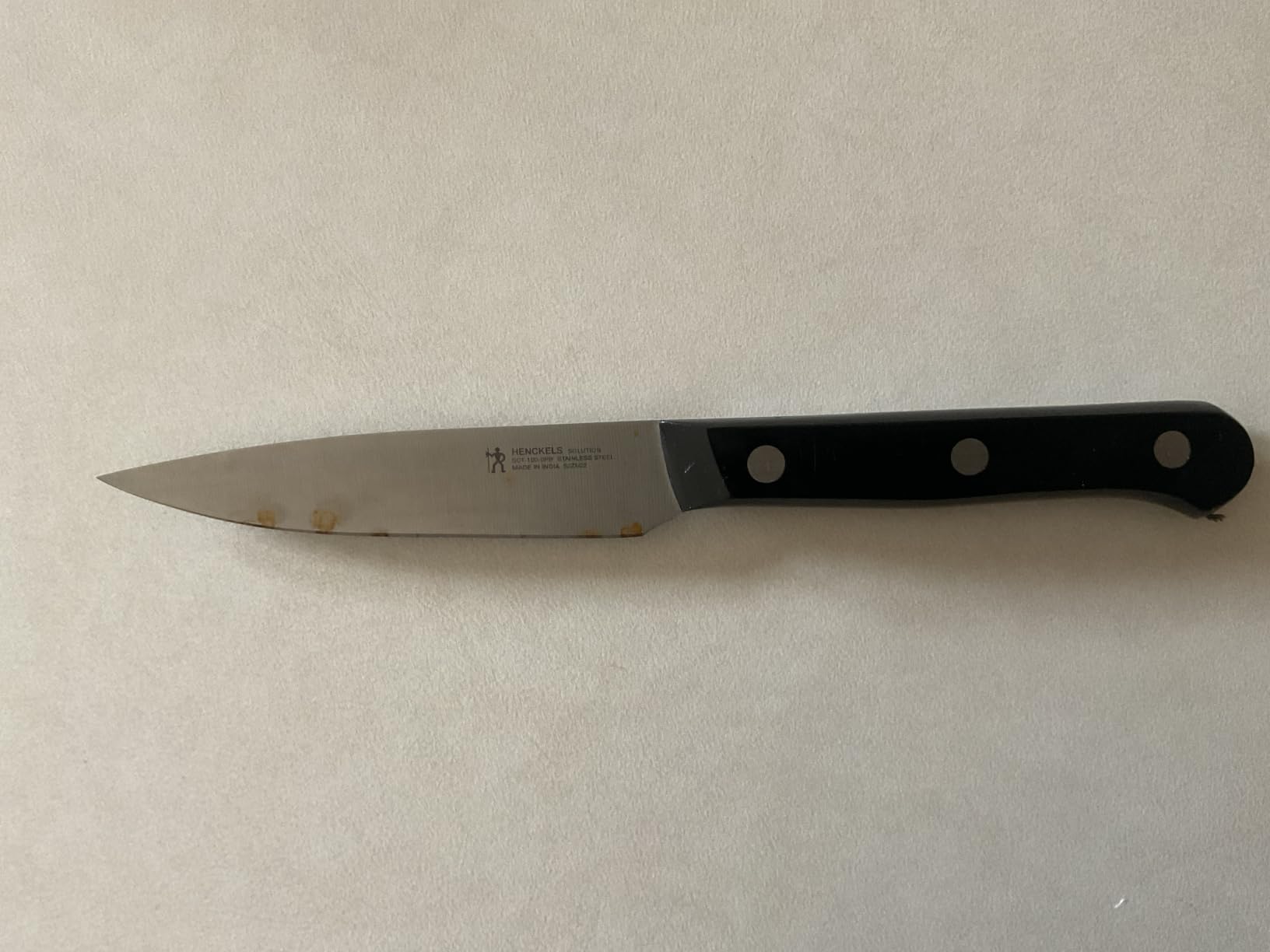
This one needs a caveat up front, because the Henckels Solution is not really a classic paring knife despite the name. The 4 inch blade is tall, broad and stiff, closer to a small chef’s knife than to the narrow pointed blades the rest of this list features. That is not a defect so much as a design choice, and it makes this the best board-work option in the group.
Where it excels is anywhere you need a little more blade: slicing a banana, trimming brussels sprouts, or doing the shallot and garlic work on a board. The satin-finished stainless blade is sharp out of the box and balanced with a full tang and three-rivet stainless handle that many larger-handed cooks find comfortable.
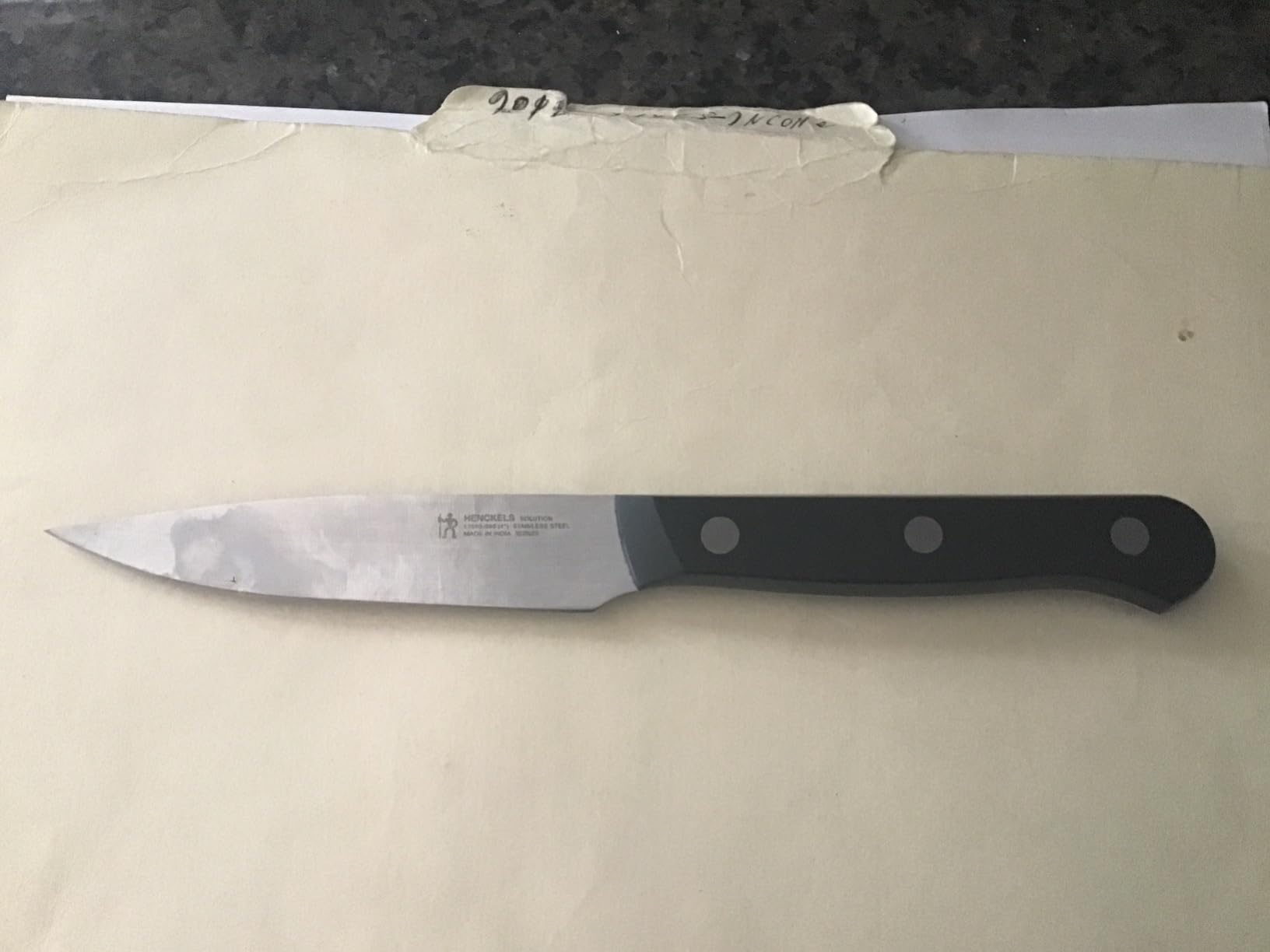
Where it disappoints is fine point work. The spine is too thick to press against with a thumb for in-hand turning cuts, and the taller profile makes it less nimble for hulling strawberries. Reviews also mention occasional rusting on the blade edge and corrosion of the rivets over long dishwasher use, so if you wash it by hand that concern largely disappears.
When a 4 Inch Blade Is the Right Call
Blade length is the single most important decision in this category, and 4 inches is the upper limit before you are really buying a utility knife. At 4 inches you get more cutting surface per stroke, which is useful for board prep and for slicing small items quickly. The cost is finesse, and this knife’s proportions are noticeably less nimble than the 3.15 to 3.75 inch blades here.
It is also the widest blade, and width is what makes it feel stable. For someone who does not want to fuss with a small knife and just wants something that works, that is a real advantage.
Dishwasher Safety Versus Edge Protection
Only two picks here are dishwasher safe, and this is one of them. That is genuinely useful for a household that does not want to think about hand washing a small sharp tool. The tradeoff is real though: the heat and detergent cycle is hard on a thin stamped edge and on riveted joints, and reviews do report long-term corrosion in the dishwasher.
Hand washing and drying immediately will extend the life of this knife considerably. If you already have a routine of washing small knives by hand, the dishwasher rating is not a reason to pick it, and the stiffer geometry might argue against it.
Who This Knife Suits and Where It Falls Short
It suits people who want one small knife that does board work and general prep, who have larger hands, and who prioritise low-effort cleaning over point finesse. It also works as a second knife if you already own a narrow paring knife.
It falls short for anyone whose main use is in-hand detail work, shelling shrimp or segmenting citrus. A stiffer, taller blade is simply the wrong instrument for those jobs.
5. HOSHANHO 3.75 Inch Paring Knife – The Best Pick for Hard Japanese Steel
HOSHANHO 3.75 inch Paring Knife, Ultra Sharp Japanese Kitchen Fruit Knife
3.75 inch blade
10Cr15CoMoV at 60 HRC
Pakkawood handle
3.84 oz
+ Pros
- Hardest steel in this roundup at 60 HRC
- Hand-sharpened 15 degree edge holds a long time
- 3.75 inch length is well suited to in-hand fruit work
– Cons
- Harder steel is more prone to chipping if misused
- Hand wash only
- Denser handle weight than most paring knives
The HOSHANHO runs the hardest steel in this roundup at 60 Rockwell, quenched and vacuum cold nitrided. That hardness is why it held a fine edge through weeks of garlic and shallot work with less sharpening than the softer stamped options. It also means it is the steel most likely to chip if you treat it carelessly, which is the bargain every high hardness blade makes.
At 3.75 inches it is the longest of the true paring knives in this list, and at 3.84 ounces it is heavier than the imarku and the Mercer. The extra length and weight make it stable for a slice and controlled for a peel, and the pakkawood handle is comfortable enough for longer sessions than its weight suggests.
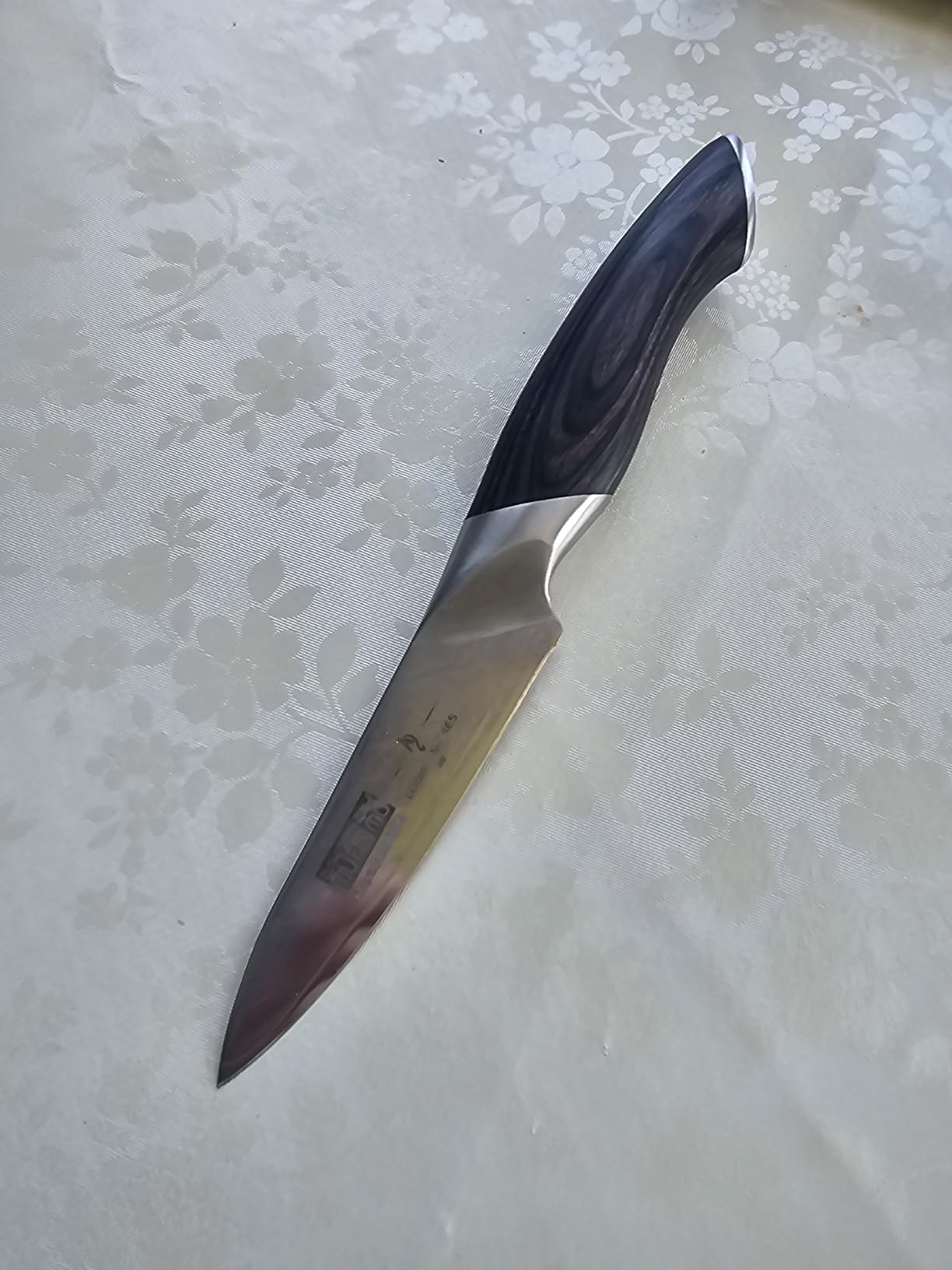
It arrived hand-sharpened to a 15 degree edge and cut the first apple spiral beautifully. Reviewers consistently praise the sharpness and edge retention and equally consistently flag the care requirement, since a hand wash only blade at 60 HRC will show damage if you leave it in a puddle of citrus juice.
What 60 HRC Steel Actually Changes
Harder steel holds an edge longer because the crystalline structure resists deformation. In practice that means fewer whetstone sessions between week one and week six, and a tip that stays needle-sharp through weeks of shelling and hulling rather than rounding off in a month.
The cost is brittleness at the very tip. If you catch the point on a hard bowl, drop the knife tip-first, or cut through a stone, you are more likely to lose a small chip of edge than you would with a 58 HRC or lower blade. Chips on a paring knife tip are repairable on a stone, but it is worth knowing before you start.
Blade Length and In-Hand Fruit Work
The 3.75 inch length sits at the sweet spot between a narrow 3.15 inch spear point and the over-large 4 inch blades. It gives you a longer stroke for slicing a pear in half while you are still holding it, without the knife feeling like a small chef’s knife.
Reviewers cite this specific length as ideal for in-hand fruit cutting, and I agree. It is the knife in this roundup I would choose for prepping a large bowl of apples for a pie, because the combination of tip quality and blade length means fewer strokes.
Who This Knife Suits and Where It Falls Short
It suits a cook who does a lot of fruit and vegetable prep, who sharpens their own knives or owns a whetstone, and who will take the knife out of the dishwasher habit. It is also a good step up from a stamped blade if you want edge retention without moving to a luxury tier.
It falls short for anyone who wants a forgiving first knife, who will be careless with the tip, or who wants dishwasher convenience. The brand is also less established than the established names in this list, which is a fair thing to weigh if warranty service matters to you.
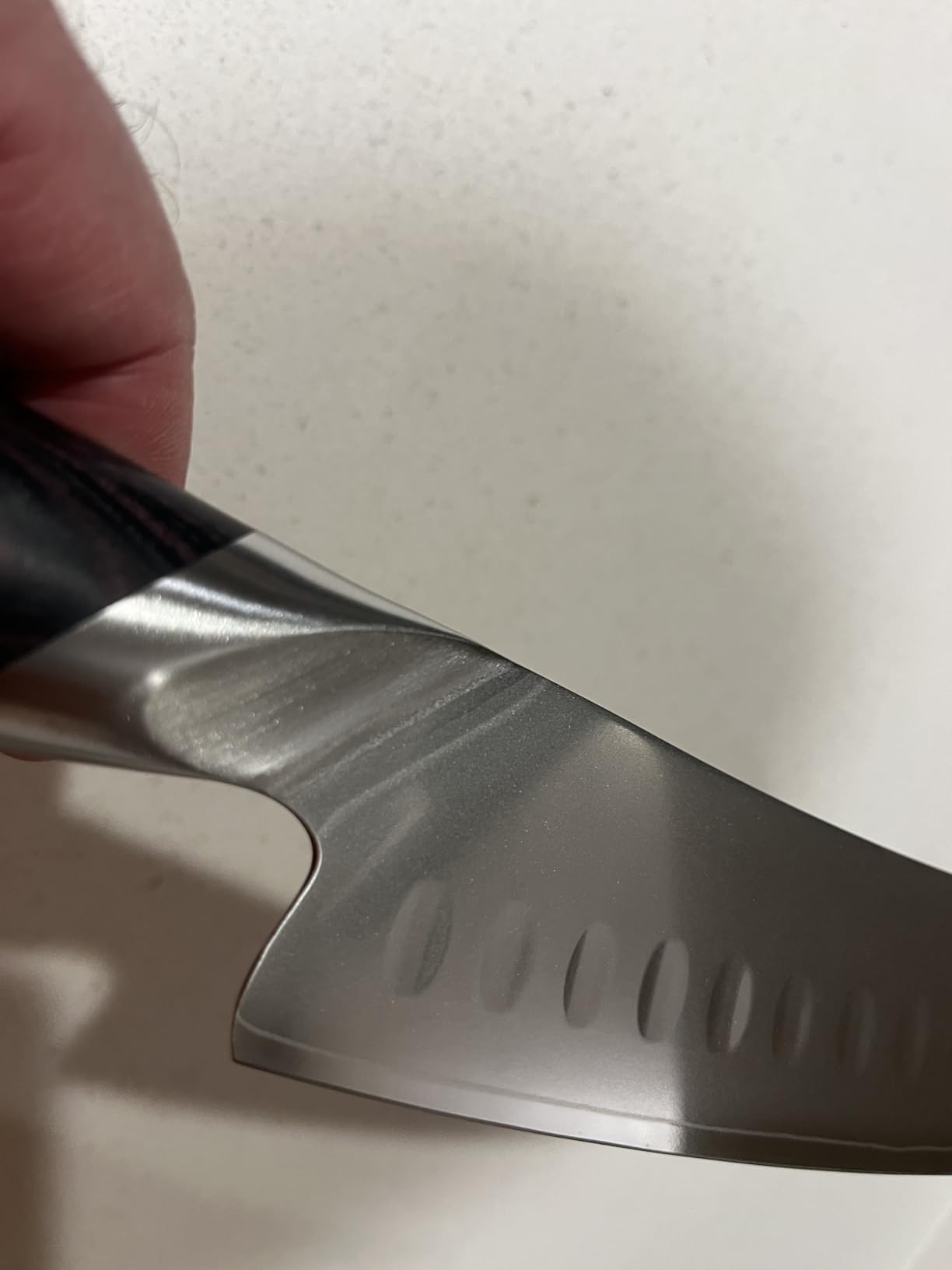
6. Kuhn Rikon Color-Coded Paring Knife Set – The Best Pick for Families and Shared Kitchens
Kuhn Rikon Straight Paring Knife with Safety Sheath, 4 inch/10.16 cm Blade, Red, Yellow & Blue (Pack of 1)
Set of 3 knives
4 inch Japanese stainless blades
Non-stick coating
Safety sheaths included
+ Pros
- Three colour-coded knives reduce cross-contamination
- Protective sheaths make them safe in a lunchbox or drawer
- Lightweight and easy to manoeuvre
- Swiss made with Japanese stainless blades
– Cons
- Handles can get slippery when wet
- Stamped construction rather than forged
- Sheaths are difficult to clean
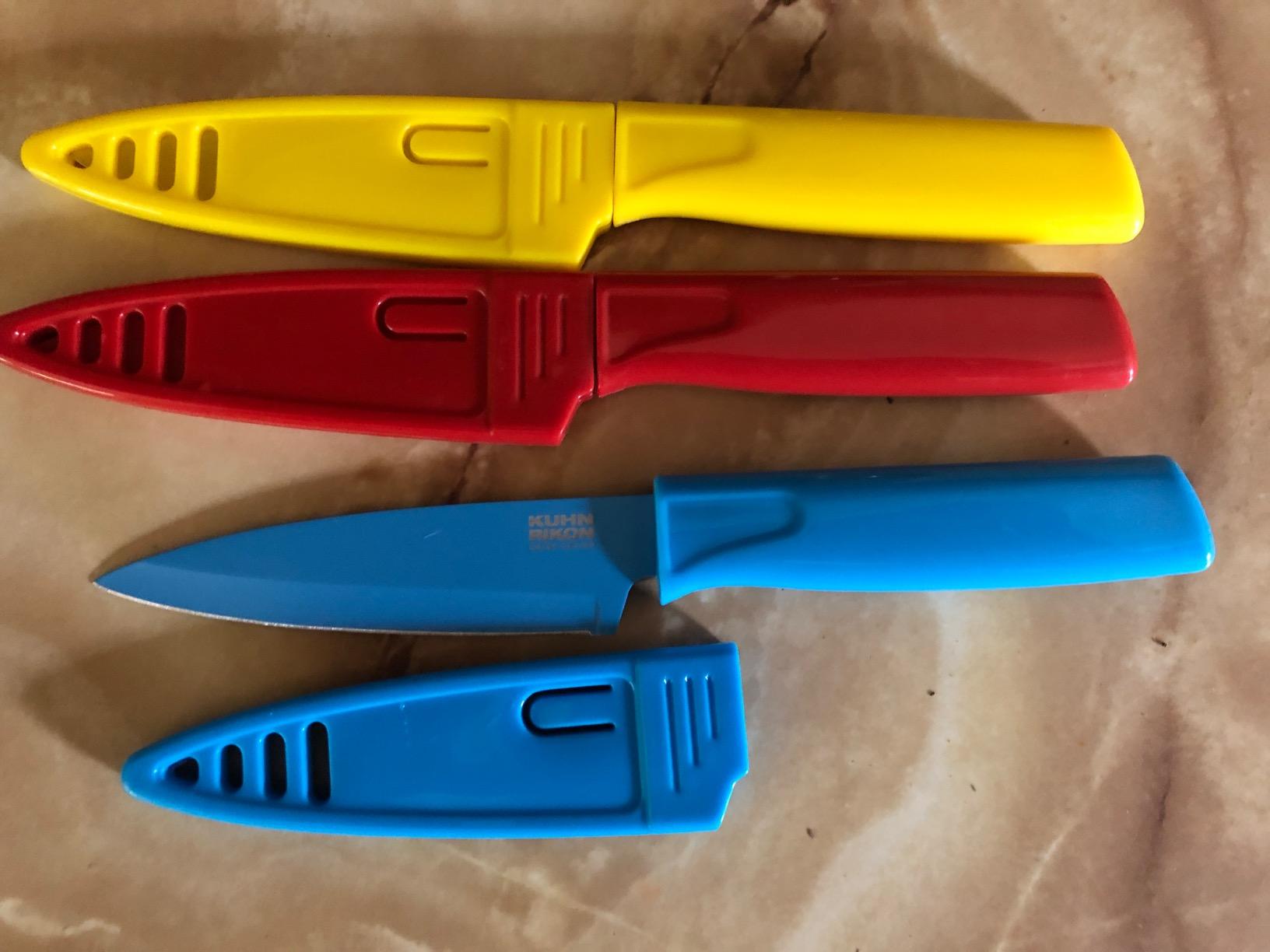
Most roundups treat a paring knife as a single tool. Kuhn Rikon solves the real problem instead, which is that a home kitchen often needs three small knives used for three different food types, kept apart so raw meat, vegetables and fruit do not cross-contaminate. The red, yellow and blue set gives you exactly that, and each knife comes with its own protective sheath.
The blades are Japanese stainless steel with a non-stick coating for food release, and they are Swiss made. They are sharp, lightweight and easy to control, and the 4 inch length is a solid compromise for both in-hand and small board work. I found the non-stick coating genuinely useful on shallots and garlic, where a plain blade clings.
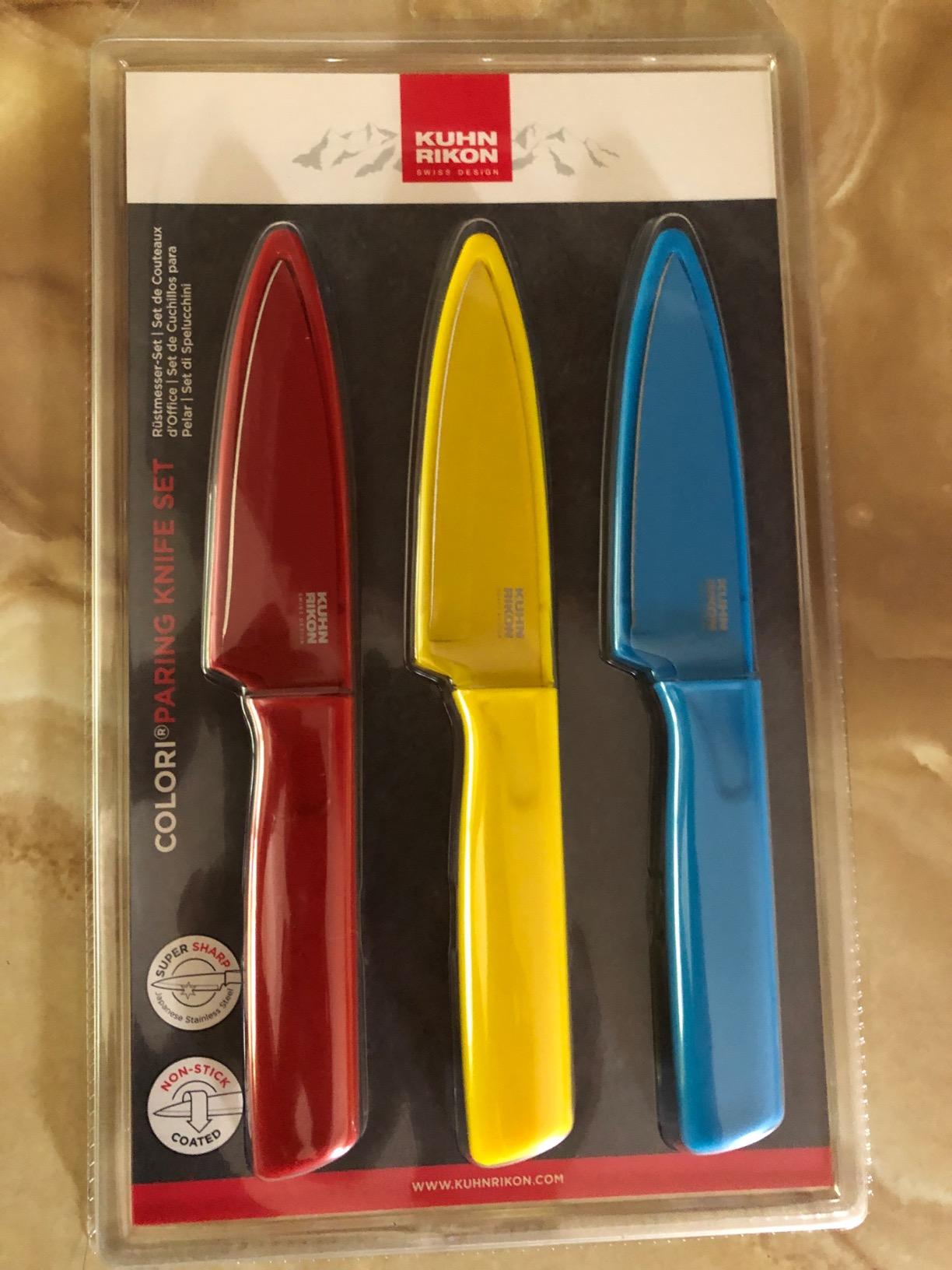
They are also among the few small knives here that travel well. Reviewers mention lunchboxes and picnics, and the sheaths are the reason that is possible. Set of three at 6.4 ounces total, they weigh almost nothing individually, which makes them easy to use in a single hand over a bowl.
Colour Coding as a Food Safety System
The colour coding is not decoration. Assigning one knife to produce, one to cooked food and one to raw protein is a habit that professional kitchens follow, and it costs you three cheap knives to build it. For a household with young children, a serious allergy, or anyone who handles raw poultry, the system removes the mental load of remembering which knife is which.
For a single cook living alone, this is overkill and the Henckels or imarku is the better buy. For a family, the redundancy is genuinely useful in a way that is hard to argue with.
Sheaths, Storage and the Small-Blade Problem
Forum research repeatedly turns up one storage complaint: small blades disappear into a junk drawer and become a cut hazard to whoever finds them next. The included sheaths are the fix for that. Each blade slides in fully, so you can store the set in a drawer, a lunchbox or a bag without worrying about an exposed point.
The tradeoff is that the sheaths are fiddly to wash once they get sticky, and they add bulk. Reviewers note the handles can also get slippery when wet, which matters in a sink where everything is wet anyway.
Who This Knife Suits and Where It Falls Short
It suits families, shared kitchens, anyone packing knives for work lunches or picnics, and anyone who wants three small knives without buying three separate products. It is also a low-risk gift for a new cook.
It falls short for anyone who wants a single beautiful, high-end knife for fine point work. The stamped construction and the coating mean these will not feel like the forged German or Japanese options here, and coated edges are a little less pleasant to sharpen on a stone.
7. Wusthof Classic 3.5 Inch Paring Knife – The Best Forged German Workhorse
WÜSTHOF Classic 3.5″ Paring Knife, Black
3.5 inch blade
High carbon stainless at 58 HRC
Full tang triple-rivet handle
1.6 oz
+ Pros
- Precision-forged in Solingen from a single piece of steel
- Full tang triple-riveted handle with excellent balance
- Hand-honed edge with strong edge retention
- Lifetime warranty
– Cons
- Highest price point in this roundup
- Hand wash and careful maintenance required
- Can chip on hard materials like bone
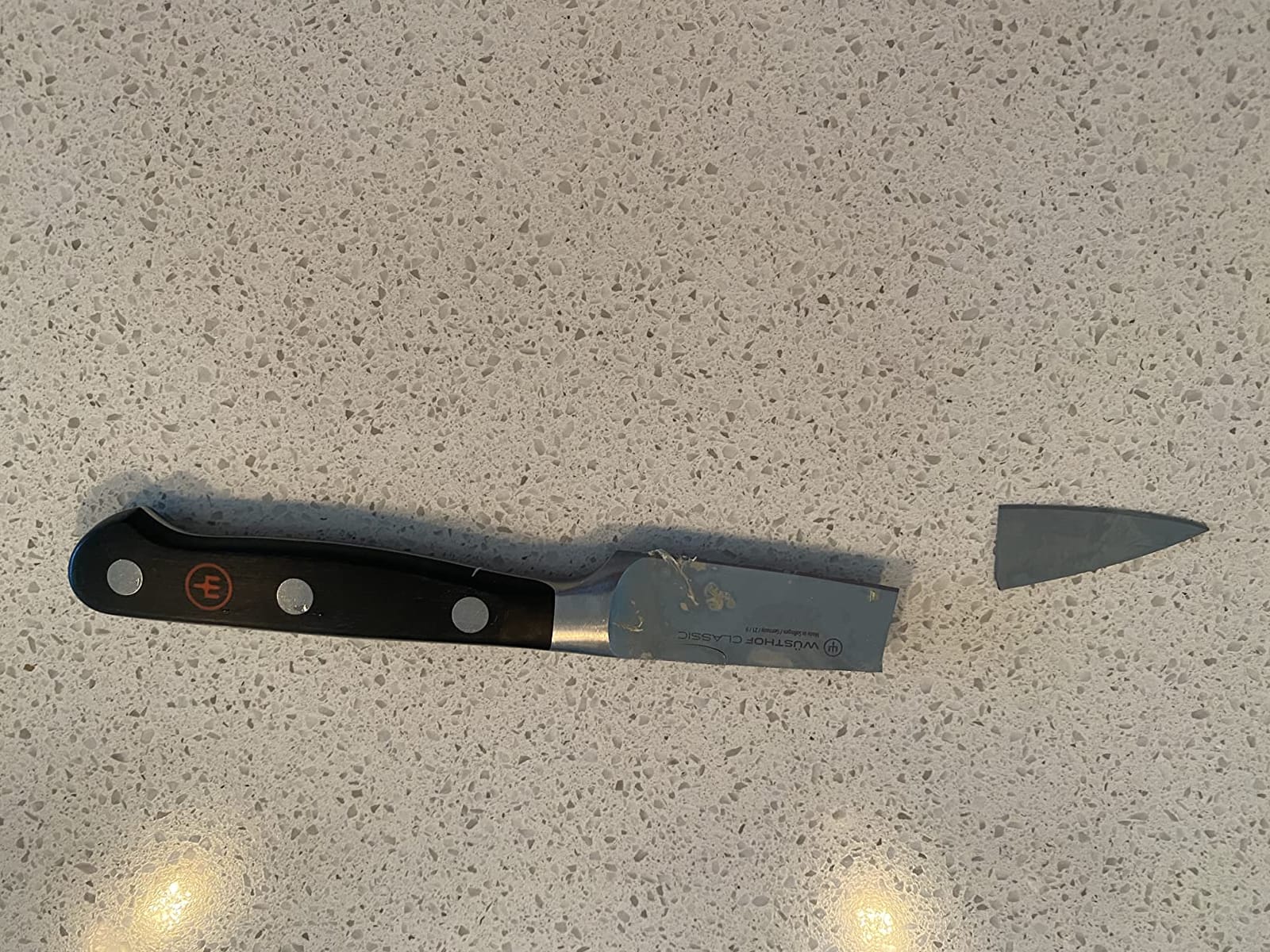
The Wusthof Classic is the traditional answer. It is precision-forged in Solingen, Germany from a single piece of high carbon stainless steel hardened to 58 Rockwell, with a full tang and a triple-riveted handle. At 1.6 ounces it is a featherweight despite being forged, and that combination of refinement and lightness is what makes it feel expensive in the hand.
Reviewers consistently point to balance and edge retention as the reasons to buy it, and after six weeks I agree. The shallot mince was the cleanest of any knife here, and the blade tracked dead straight through a continuous apple peel without a single hesitation.
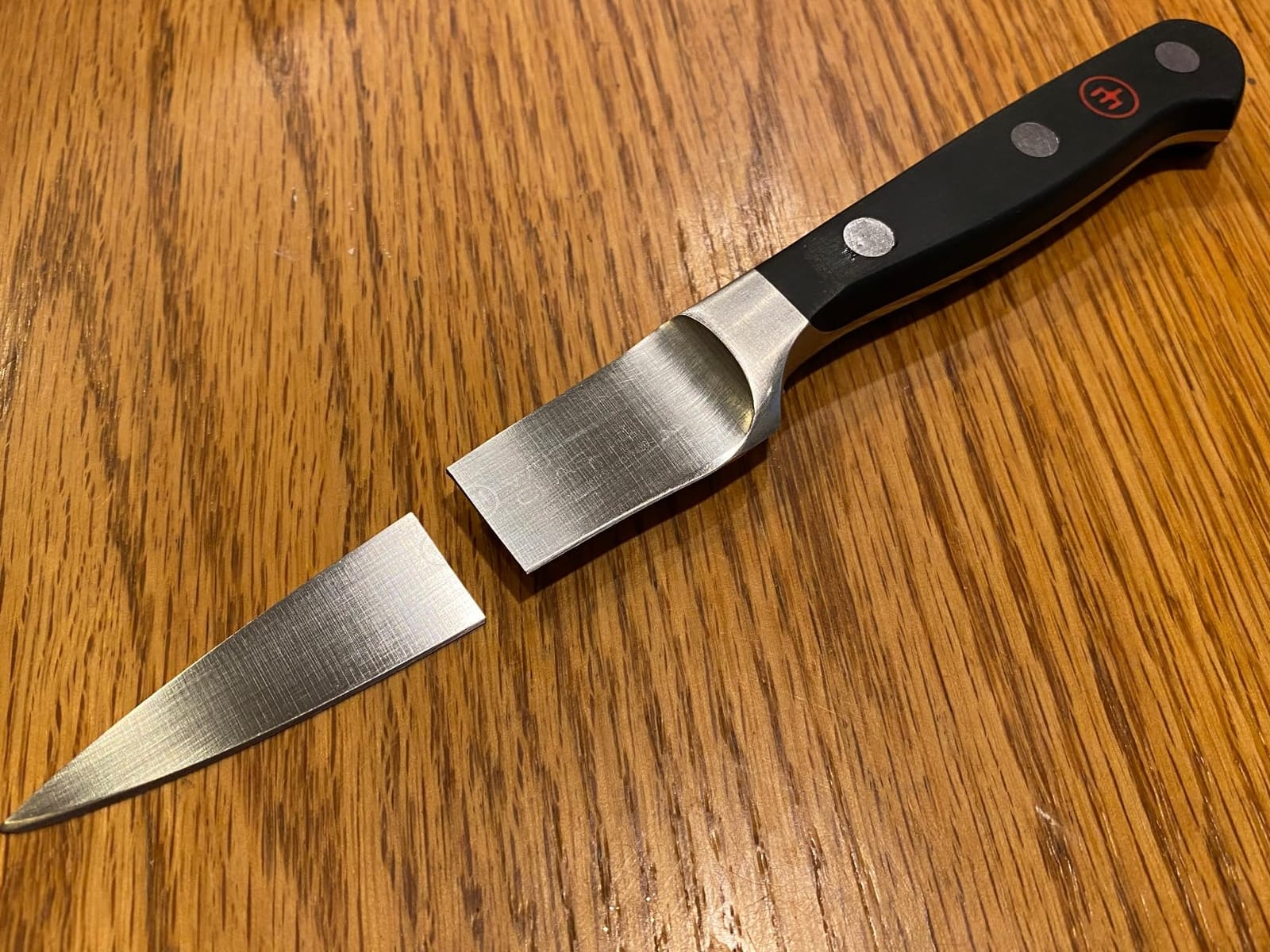
The honest drawback is cost. This is the most expensive pick in the roundup, and for many home cooks the value case is difficult to make when an excellent stamped knife does the same job for a fraction of the money. What you are paying for is forging, tang construction, refinement and a lifetime warranty, and for a knife you will keep for a decade those are real assets.
Forged Construction and the Lifetime Resharpen Question
Forged steel has more mass and more structure behind the edge than stamped steel, and a full tang means that steel continues into the handle. On a paring knife this shows up as balance and as how the knife feels when you choke up on the spine near the bolster to do a tip cut. It also means this knife can be resharpened indefinitely, which is the strongest argument for buying it once.
Over ten years of regular home use, a well-maintained forged blade holds more usable steel than a stamped one. That is the real total-cost argument, and it is why some forum readers buy one premium paring knife rather than four cheap ones, while others do the exact opposite.
Balance, Weight and the Triple-Rivet Handle
At 1.6 ounces this sits close to the Victorinox in weight while feeling far more solid, because the forged blade carries its mass closer to the cutting edge. The Classic handle shape is a well-established design with a long history, and it fits a medium to large hand very well. People with small hands may find the handle circumference too generous.
The balance point sits right where your thumb rests, so the knife does the work instead of your wrist. For a full day of prep that difference is meaningful, particularly if you already own a heavy chef’s knife.
Who This Knife Suits and Where It Falls Short
It suits a cook who already owns a chef’s knife and wants a small knife of equal quality, anyone building a kit they expect to keep for years, and anyone who prefers a classic European handle shape. It is a very common wedding and housewarming gift for a reason.
It falls short for a casual cook on a strict budget, and for anyone who wants a thin, ultra-light blade for the very finest in-hand work. It is a hand-wash knife, and it can chip if it meets bone or frozen food.
8. Shun Classic 3.5 Inch Paring Knife – The Best Refined Edge for Citrus and Delicate Work
Shun Classic 3.5″ Paring Knife
3.5 inch blade
VG-MAX core with 68 layer cladding
16 degree double bevel
D-shaped pakkawood handle
+ Pros
- Sharp 16 degree double bevel edge straight from the factory
- VG-MAX core holds an edge exceptionally well
- D-shaped pakkawood handle suits either grip style
- Free lifetime sharpening and honing service
– Cons
- Thin blade is not suitable for heavy tasks
- Harder steel can chip if misused
- Hand wash only
The Shun Classic is the most refined knife here and the one that made me reconsider how sharp a paring knife needs to be. The edge is ground to 16 degrees total, or 8 degrees per side, which puts it at the sharp end of this roundup. On the citrus supreming test it cut through the pith and lifted segments with almost no downward force at all.
The core is VG-MAX, a Japanese super steel that holds an edge exceptionally well, wrapped in 68 layers of Damascus stainless cladding that give the blade its layered pattern. The handle is D-shaped pakkawood, which sits symmetrically under the hand and works with a fingertip grip or a full handle grip, making it the most grip-agnostic handle of the ten.
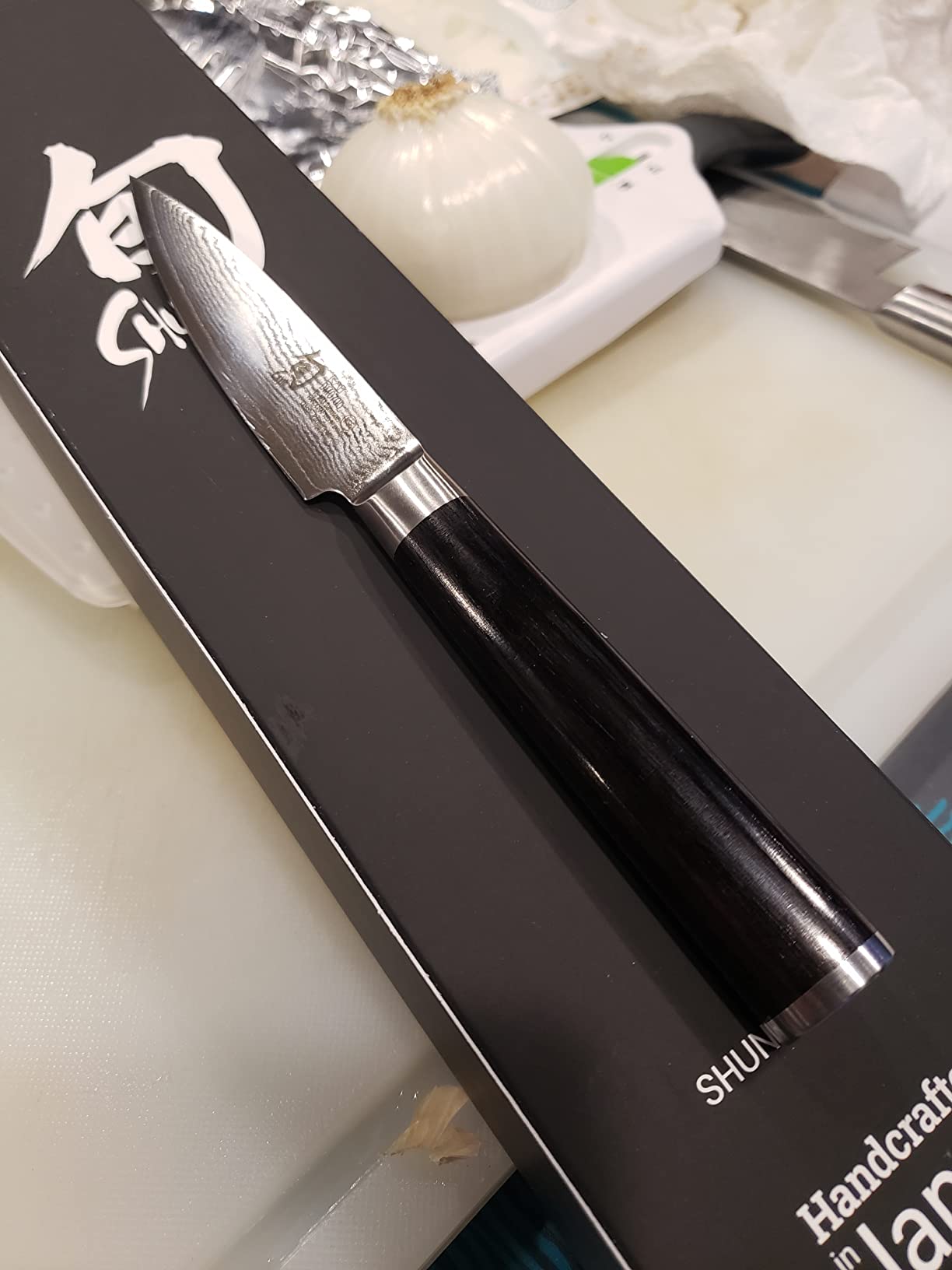
At 5.2 ounces it is the heaviest true paring knife here, and that weight is real in the hand. It makes the knife stable and controlled, but it is the least agile of the narrow-blade options. Reviewers mention the free lifetime sharpening and honing service, which is a genuine long-term advantage and hard to match anywhere in this category.
The 16 Degree Edge: Where It Helps and Where It Hurts
A finer edge bites with less force, and that is why the Shun felt almost effortless on the delicate tasks. It was the best knife here for segmenting citrus without cutting into the membrane and for lifting a strawberry hull without tearing the fruit.
Fine edges are also more fragile. Reviews note that the harder steel is more prone to chipping if misused, and the thin blade is not suitable for heavy tasks. Treat this as an in-hand precision instrument rather than a general purpose small knife, and it will hold that edge for a long time.
D-Shaped Pakkawood Handle for Any Grip Style
Most paring knife handles are moulded around one dominant grip, and they feel wrong to people whose hands do not fit that mould. The D-shaped profile is symmetrical across the handle, so it works for a fingertip pinch grip, a thumb-on-spine cut, or a full wrap grip. That is the closest thing to an ambidextrous option in this roundup.
Pakkawood is a stable, moisture-resistant composite, so it resists the swelling and cracking that ruin untreated wood handles. It needs hand washing like any fine knife, and it will darken over years of use.
Who This Knife Suits and Where It Falls Short
It suits a serious home cook who does a lot of citrus work, fruit prep and fine detail cutting, and anyone who likes a visibly beautiful knife. It is the pick if you want the sharpest factory edge available and you will sharpen it or use the free service.
It falls short for anyone doing heavy board prep in their small knife, or for a cook who wants a lightweight blade that rotates freely in the hand. It is also one of the more expensive picks here, and that has to be weighed against what the sharpness buys you.
9. Global 3.5 Inch Paring Knife – The Best Balanced Design and Easiest to Clean
Global 3.5″ Paring Knife
3.5 inch blade
CROMOVA 18 stainless steel
Sand-filled hollow handle
2.2 oz
+ Pros
- Sand-filled hollow handle gives standout balance
- One-piece stainless build has no crevices for bacteria
- Lightweight and agile at 2.2 ounces
- Preferred by a lot of professional cooks
– Cons
- Will not stick to a magnetic knife strip
- All-metal handle feels cold and slippery when wet
- Can chip if dropped on a hard floor
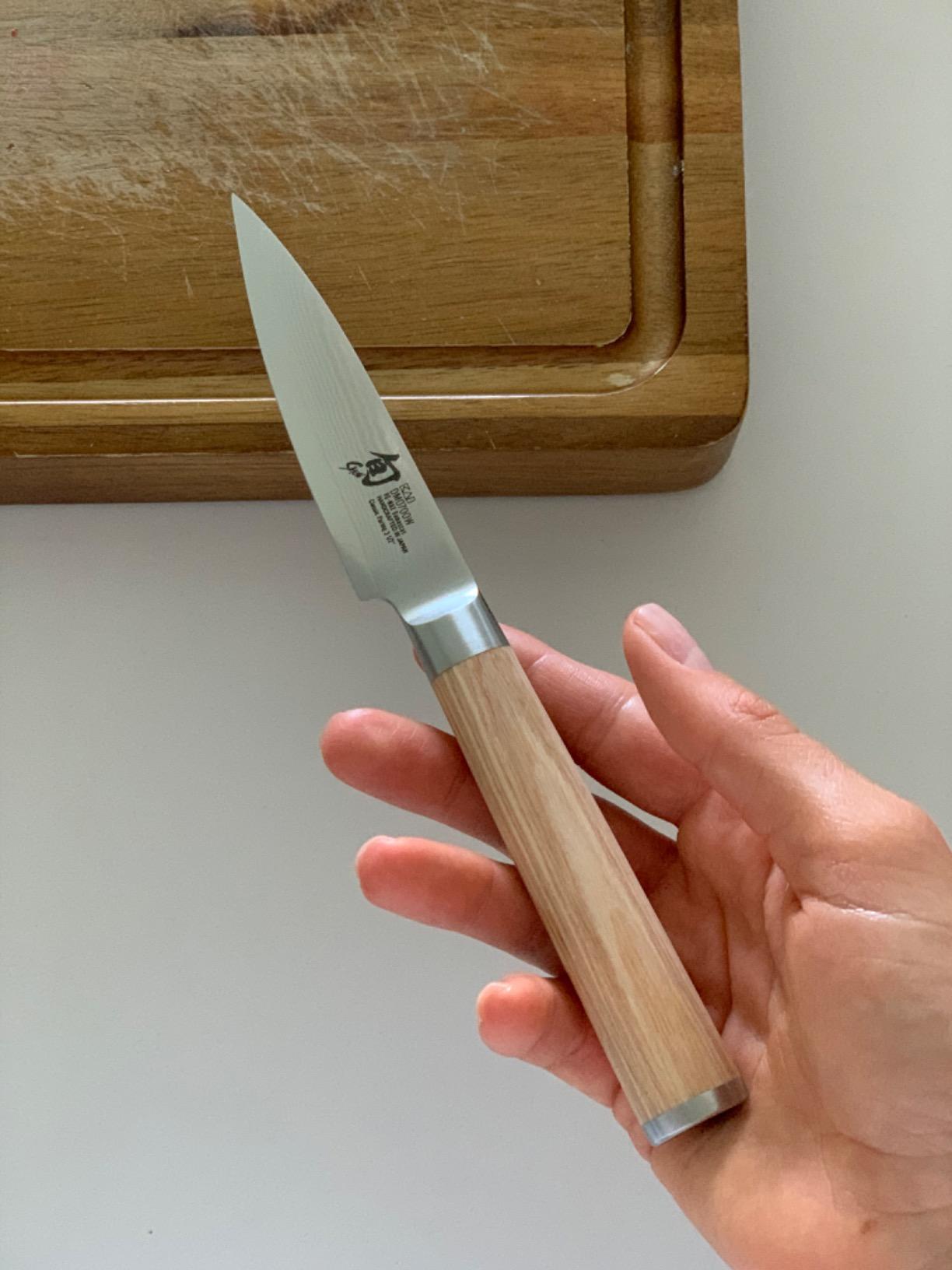
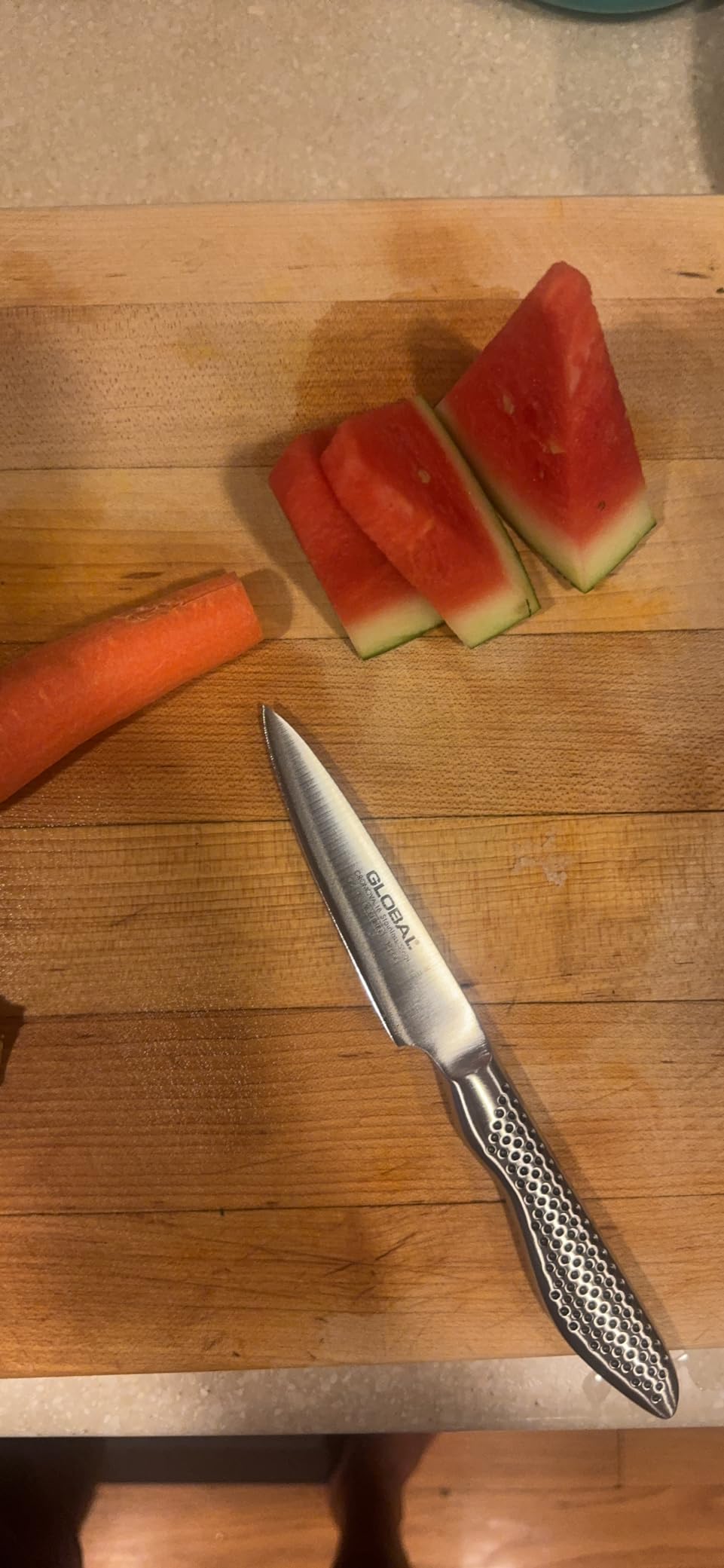
The Global is the design that divides people, and that is worth saying before anyone buys it. The handle is a hollow stainless shell filled with sand, which produces a balance point that no conventional handle in this roundup matches. It is also seamless stainless from bolster to tip, with no seams, rivets or joints to trap food.
At 2.2 ounces with CROMOVA 18 steel hardened to 56 to 58 Rockwell, it is light and sharp. It was the most balanced knife of the ten for in-hand work, and reviewers repeatedly describe converts who buy one Global knife and then stop buying other brands. The 3.5 inch blade is a solid general length for fruit, veg and small board tasks.
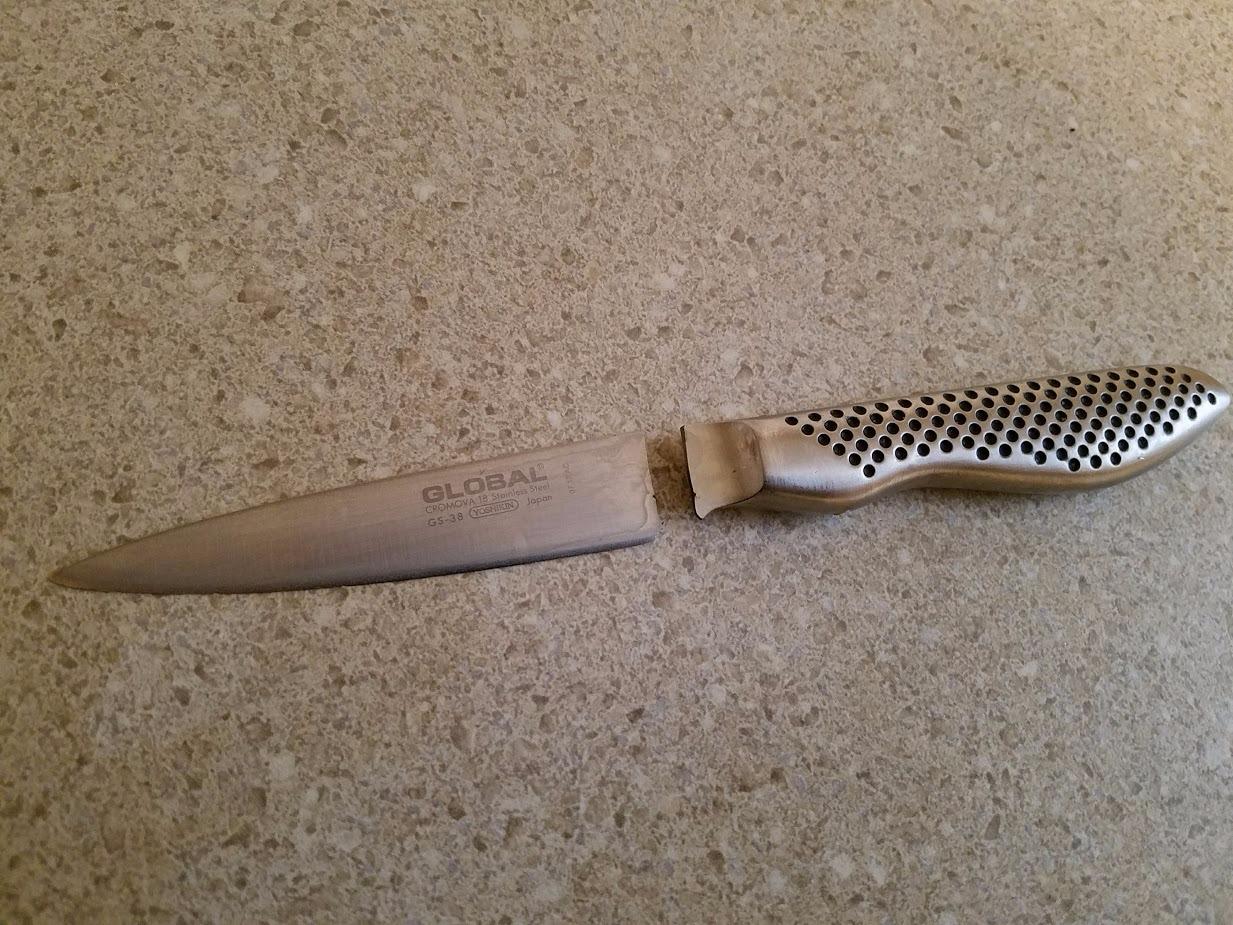
What gives people pause is the handle temperature and texture. It is metal, so it feels cold in the hand and slippery when wet, and the shape is unconventional enough that the first few minutes can feel odd. Give it a week and most people recalibrate. I did, and by week two I was reaching for it by habit.
Hollow Ground, Hollow Handle: How the Balance Works
The sand filling shifts the centre of gravity toward the middle of the knife, which is where you want it for in-hand work. It means less torque on your fingers when the tip catches on something, and more stability when the blade lands near the spine. This is why Global knives are popular with professional cooks who work fast and in-hand all day.
The hollow handle is the reason this knife will not stick to a magnetic strip, which is a real practical drawback given that magnetic strips are the best storage for small blades. Plan for a knife block, a drawer guard or a visible rack instead.
Hygiene: The Case for a Seamless Build
One-piece stainless construction means there is nowhere for bacteria to lodge. There is no bolster seam to gunk up, no rivet head to trap a shallot skin, and no wood or resin to hold moisture. If you want a knife you can rinse quickly and know is clean, that is a genuine argument.
The hollow edge geometry also reduces the contact area when you slice, which reviewers note helps with sticky foods. The blade is ice-tempered and hardened to 56 to 58 HRC, and it took and held an edge well over my testing period.
Who This Knife Suits and Where It Falls Short
It suits cooks who work fast in-hand, anyone who values balance above all, and anyone who wants a knife that is simple to clean. It is a good choice for a shared kitchen where hygiene matters.
It falls short for people who dislike metal handles, and for anyone whose storage plan is a magnetic strip. It is also the least reviewed knife in this roundup, so there is less long-term owner feedback to lean on.
10. KYOKU Shogun 3.5 Inch Damascus Paring Knife – The Best Value in a Damascus Blade
KYOKU Paring Knife – 3.5″ – Shogun Series – Japanese Style VG10 Steel Core Damascus Blade – with Sheath & Case
3.5 inch blade
67 layer Damascus with VG10 core
8-12 degree Honbazuke edge
G-10 handle
+ Pros
- Sharp 8-12 degree Honbazuke edge out of the box
- VG10 core with cryogenic treatment holds an edge well
- Includes both a sheath and a storage case
- G-10 fiberglass handle with a mosaic pin
– Cons
- Heavier than typical paring knives at 8.8 ounces
- Not magnetic so it will not cling to a strip
- Edge retention trails the harder Japanese and German picks
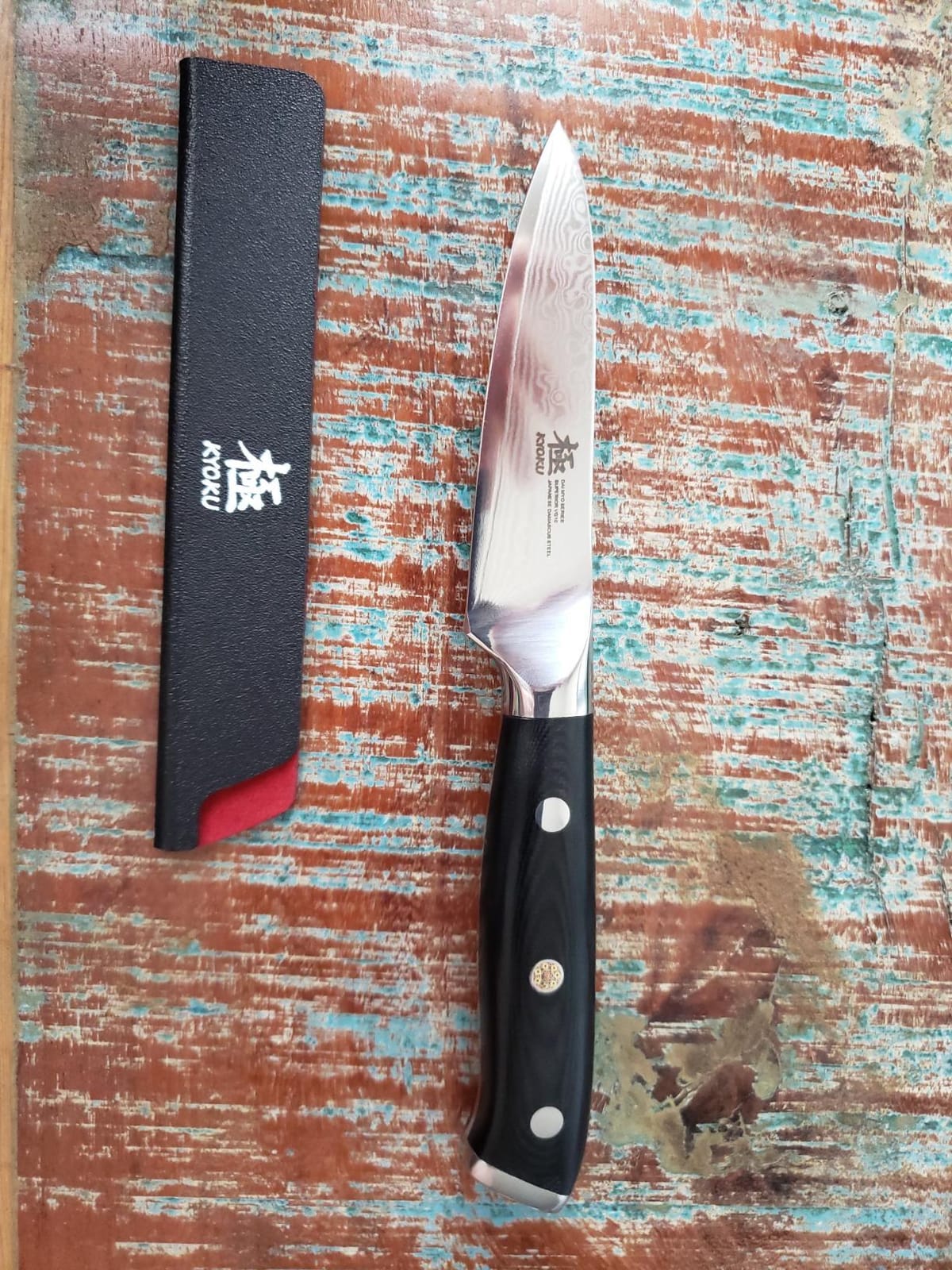
The KYOKU Shogun is the aesthetic pick, and it is not a shallow one. The blade is 67 layers of Damascus cladding over a Japanese VG10 core, cryogenically treated, with an 8 to 12 degree edge produced by a three-step Honbazuke method. That is a very fine factory edge and it cut apple spirals as cleanly as anything more expensive on this list.
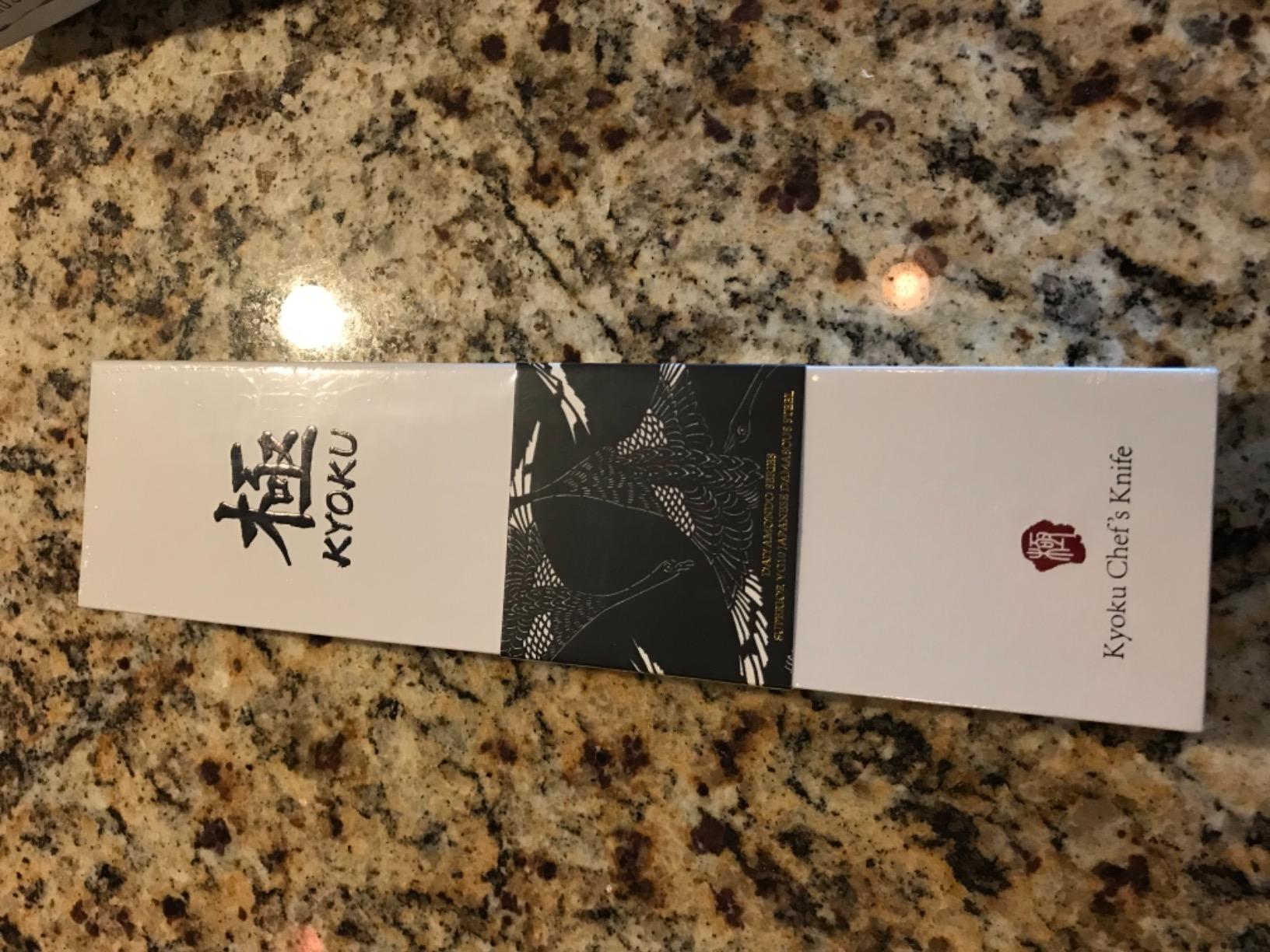
The handle is fiberglass G-10 with a mosaic pin, which is a genuinely good, moisture-proof, slip-resistant material that many knives well above this tier use. More unusually, the package includes both a protective sheath and a storage case, and that combination is rare on a paring knife at any price.
The trade-offs are weight and refinement. At 8.8 ounces as listed, this is the heaviest paring knife here, and it does not feel as nimble in the hand as the lighter imarku, Victorinox or Global. It is a stable, confident knife that prefers board contact, which suits shallots, garlic and herb prep more than it suits shrimp deveining.
What the Honbazuke Edge Means for You
Honbazuke is a Japanese finishing technique that builds the bevel in stages, thinning the steel progressively rather than grinding it all at once. The result is a fine edge with a very sharp tip, which is why this knife was strong on detail work despite its weight. It is also an edge that will benefit from a honing rod more often than a thick, workmanlike edge.
Reviewers note the edge retention does not quite match premium Japanese or German brands, and that is consistent with the construction. The cryogenic treatment helps, but VG10 at this price point is not the same as a hand-finished forged edge.
Storage, Sheaths and the Magnetic Strip Question
Like the Global, this knife is not magnetic, so it will not cling to a strip. The included sheath solves the immediate problem and makes it a good knife to pack in a bag or a lunchbox. Reviewers who bought it for that reason tend to be very happy with the purchase.
For a home drawer, the storage case is the more useful inclusion, since it gives a dedicated home for a small knife instead of letting it rattle around with the cutlery.
Who This Knife Suits and Where It Falls Short
It suits anyone who wants a Damascus look and a very sharp edge without moving into the top price tier, and it is a strong gift. It also works for anyone who needs a small knife that travels, given the sheath and case.
It falls short for a cook who wants the lightest possible in-hand knife, and for anyone who plans to hang it on a magnetic strip. The weight is real and it changes how the knife feels more than the price does.
Paring Knife vs Petty Knife: Which One a Home Kitchen Actually Needs
They are different tools, and the confusion between them is the most common question I see in forums. A paring knife has a short, narrow, pointed blade, usually 3 to 4 inches, and it is designed to be held in your hand. A petty knife has a wider, triangular blade, usually 5 to 7 inches, and it is designed for a cutting board.
The practical rule is simple. If the food is in your hand, you want a paring knife. If the food is on a board, you probably want a petty knife, and your chef’s knife will serve you almost as well. A 6 inch petty is a genuinely useful second knife for a home kitchen, but it is not a replacement for a paring knife, because it is far too large and awkward to peel an apple over a bowl.
Who should skip this roundup entirely? If your prep is mostly slicing vegetables on a board and you already have a good chef’s knife, a utility knife may cover everything you need. This roundup is for the specific jobs that happen away from the board.
What a Paring Knife Should Not Be Used For
Safety advice in this category is simple and worth stating plainly. A paring knife is for small, controlled cuts, and the more you ask of it the more likely it is to slip.
1. Dicing onions or other hard vegetables on a board. That is a chef’s knife job, or a petty knife job. A 3 inch blade is too short to get momentum safely.
2. Slicing bread. A serrated bread knife cuts bread without crushing it. A paring knife compresses the crumb and dulls the edge.
3. Frozen food and bone. Reviewers note the harder steel picks can chip on hard materials, and a frozen item will damage any thin blade. Thaw first.
4. Opening boxes, tape or packaging. This is the fastest way to put a chip in the tip of a fine edge. Use a scissors or a key.
5. Prying or twisting. A paring knife has leverage in the wrong places. If it sticks in something, do not lever it.
6. Cutting off your thumb while gripping the blade. A dull blade is more dangerous than a sharp one, because you press harder. Keep the edge sharp and you will press less.
How to Choose a Paring Knife You Will Actually Keep Using
Blade Length: 3 Inches to 3.5 Inches Is the Sweet Spot
Most of the good options sit between 3 and 3.5 inches, and that range is where I would spend your attention. Under 3 inches and you are constantly repositioning for a slice. Over 3.5 inches and you are into utility knife territory, which is harder to control in the hand. The 3.75 inch HOSHANHO and the 4 inch Henckels and Kuhn Rikon blades in this roundup are all fine choices, but they are really general small knives rather than precision instruments.
Aim for 3.25 to 3.5 inches unless you have a specific reason to want something longer.
Straight Edge vs Curved Belly vs Hollow Ground
A straight edge with a minimal belly, like the Victorinox spear point, is best for controlled cuts: coring, trimming, peeling. A curved belly is better if you want to rock the blade through a shallot or a garlic clove while holding it in your hand. A hollow-ground edge reduces contact area and helps with sticky, wet or soft foods, and it is one reason the Global performs well on fruit.
For most home cooks the difference is minor, but if you mince aromatics over a bowl in your hand, a curved belly is genuinely easier.
Steel Hardness and What It Means for Edge Retention
Stainless steel in the 56 to 58 Rockwell range covers most of this roundup and is the sensible default. It resists rust, takes an edge easily and is forgiving. At 60 Rockwell, as on the HOSHANHO, you get longer edge retention and a finer factory edge, at the cost of being more prone to chipping if you misuse it.
Carbon steel and high carbon stainless sharpen to a finer edge still, but they need drying immediately. If you wash your knives and leave them in a rack overnight, stainless is the right call.
Handle Length, Diameter and Your Hand Size
This is the criterion buyers most often get wrong, and it is the number one complaint in reviews. Under one ounce, a handle like the Victorinox is a near toothpick, and people with large hands consistently report that it feels unsafe rather than nimble. A handle in the 3.17 ounce range with a full tang, like the Mercer, feels secure to almost everyone but can be bulky for small hands.
Our rule of thumb: if you have ever had to hold a paring knife with two hands to peel something, you need a bigger handle. Nobody wants to admit it, and people then return the knife within a month.
Full Tang Forged Construction vs Stamped Steel
Stamped steel is pressed from a sheet. It is cheaper, lighter and thinner, which is good for control, and it has less steel to resharpen over time. Forged construction is machined or hammered into shape, carries more mass and more steel behind the edge, and last longer as a tool.
Both are legitimate. Choose stamped if you want the lightest, cheapest, most dishwasher-tolerant knife. Choose forged if you want a knife that feels like a professional tool and that you can keep for a decade.
Can It Be Resharpened? Total Cost of Ownership
Every plain-edged paring knife in this roundup can be sharpened on a whetstone. That is a genuine cost advantage over buying a new cheap knife every time the edge goes, which is what a lot of owners do without thinking about it.
Over ten years, a forged full tang knife like the Wusthof or the Mercer has enough steel to be ground back many times, while a very thin stamped blade reaches the end of its useful life sooner. If you have a whetstone and enjoy sharpening, the expensive knife is cheaper over a decade. If you do not, a good stamped knife plus a cheap knife sharpener will serve you perfectly well.
Cleaning, Sharpening and Storing a Paring Knife
Small knives get neglected, and neglect is what actually ends a paring knife’s life. A few habits will keep any of these ten in working order for years.
Wash by hand with hot water and dish soap, then dry immediately. The dishwasher is safe on the Victorinox, the Henckels and the Kuhn Rikon set, but reviews on the Henckels specifically report rust and rivet corrosion from long dishwasher cycles.
Hone before you sharpen. A honing rod realigns an edge that has rolled over, which is what happens in normal use, and it is far less destructive than grinding. Sharpen on a whetstone only when honing no longer brings the edge back.
Store it where you can see it and where the tip cannot reach anyone. A magnetic strip is the best option, with the exception of the Global and the KYOKU, which are not magnetic. The Kuhn Rikon sheaths solve the same problem for travel.
Sharpen out of the box. Even a factory-sharp knife benefits from a few passes, and reviews of the Victorinox and imarku both mention that an initial touch-up gets them to their best state.
Frequently Asked Questions
Are petty and paring knives the same?
No. A paring knife has a short, narrow, pointed blade, usually 3 to 4 inches, and is designed to be held in your hand. A petty knife has a wider, triangular blade, usually 5 to 7 inches, and is designed for a cutting board. Use a paring knife for peeling, coring, hulling and segmenting, and a petty knife for slicing on a board.
What size paring knife do I need?
Aim for a 3 to 3.5 inch blade. That range gives you a fine point for detail work without making the knife too short to slice with. Blades over 3.5 inches start to work as general utility knives rather than precision paring knives, and blades under 3 inches are awkward to control.
What should a paring knife not be used for?
A paring knife should not be used for dicing onions or other hard vegetables, slicing bread, cutting frozen food or bone, opening boxes and tape, or prying anything apart. Those tasks need a chef’s knife, a bread knife or a pair of scissors. Using a paring knife for the wrong job is the fastest way to chip the tip or slip and cut yourself.
What is the best length for a paring knife?
For most home cooks the best length is 3.25 to 3.5 inches. This is long enough to make a clean slice in one stroke and short enough to rotate safely in the hand. Reviews of the 4 inch options in this roundup note that taller, stiffer blades feel stable but are less nimble for fine detail work.
Should I put my paring knife in the dishwasher?
Hand washing and immediate drying is the safest choice for most paring knives, especially finer edges and coated or Damascus blades. Some picks here are dishwasher safe, including the Victorinox, the Henckels and the Kuhn Rikon set, but reviews report long-term rust and rivet corrosion on dishwashed Henckels blades. Hand washing costs you thirty seconds and protects the edge.
Are petty and paring knives both worth buying for a home kitchen?
A paring knife is worth buying because it handles in-hand work that a chef’s knife does badly. A petty knife is a useful second knife for board slicing, but most home cooks can cover that work with a chef’s knife. If your prep is mostly on a cutting board, invest in the chef’s knife and a small utility knife before adding a petty.
Which Paring Knife Should You Buy?
Start with your hands and your habits, not the steel.
If you peel fruit, core vegetables and supreme citrus most days, the imarku 3.5 inch is the best paring knife for a home kitchen and the one I use most. If you want the sharpest edge available and do fine detail work, the Shun Classic delivers it. If you have large hands and want a blade with real authority behind it, the Mercer Culinary Genesis is the right grip and the right weight.
If you want to spend almost nothing and do not mind a slim handle, the Victorinox Swiss Classic is the default answer that most cooking forums point to. If you want one small knife for board work, take the Henckels Solution. If you want three for a family kitchen, the Kuhn Rikon colour-coded set solves the storage and hygiene problem at the same time.
Whichever you choose, buy the handle that fits your hand and take five minutes to sharpen it before the first use. That combination will do more for how the knife feels than any price difference between these ten. Check the current listing for the model you have narrowed down, and once your paring knife is sorted you can round out the rest of the drawer with our tested chef’s knife picks and some practical kitchen setup ideas.
Leave a Reply