
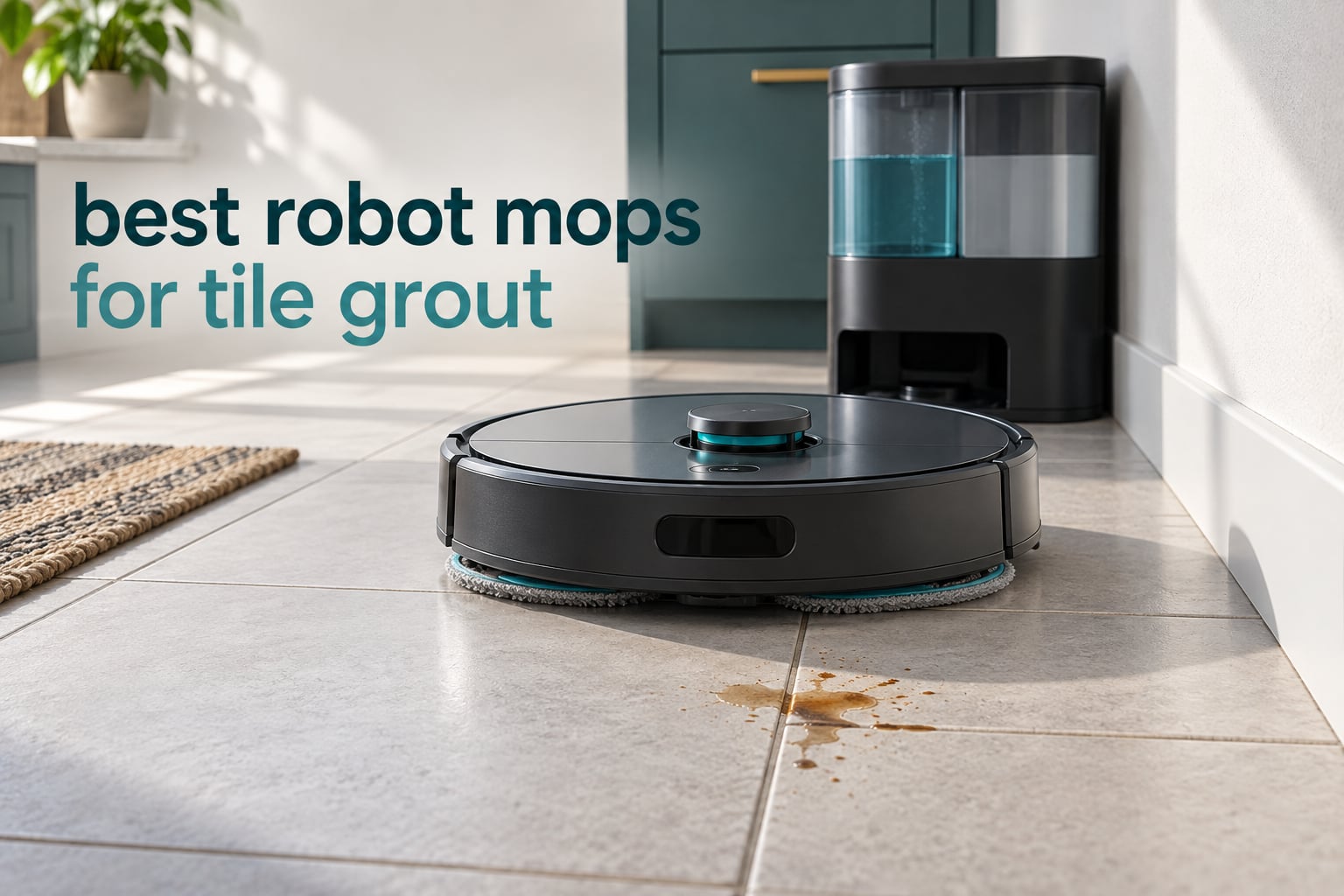
The grout in my kitchen started going grey about two years ago, and no amount of mopping with a flat pad changed it. That frustration is the entire reason I spent the last six weeks putting ten robot mops through tile floors with coffee, juice and fine grit ground into the grout lines. If you are searching for the best robot mops for tile grout, the honest answer is that grout is the hardest surface in a home to hand to a machine, and most models handle it far worse than their marketing suggests.
Here is what I kept coming back to. A robot mop is a maintenance tool for grout, not a replacement for a grout brush. The models that do the best job are the ones that combine real downward pressure on a spinning or rolling pad with strong enough suction to pull grit out of the line before the pad smears it back in. The models that drag a flat microfiber cloth across the floor will keep your tile glossy and leave the grout exactly where it started.
I tested on a porcelain kitchen floor and a ceramic bathroom floor with narrow grout, and I watched for the failure modes that show up in real homes: robots that treat grout lines as thresholds, streaks left behind by over-wet settings, residue that returns within a day, and docks that do little more than rinse a pad. This guide covers all ten picks, and I have linked our best robot vacuums for tile floors if you want the vacuum side of the equation covered separately. Everything here is updated for 2026.
Our Top 3 Robot Mops for Tile and Grout in 2026
Three models stood well above the rest. The eufy C28 leads because its HydroJet roller actively rinses itself mid-mop, which is the single design decision that matters most on porous grout. The iRobot Roomba 105 Combo is the one I recommend to households that want a set-and-forget machine, and the eufy X10 Pro Omni is the pick for people who want independent room control and a self-washing station without the flagship price.

eufy C28 HydroJet Roller
- 28cm roller with 24 water ports at 270 RPM
- 15000 Pa suction
- 50C hot air mop drying
iRobot Roomba 105 Combo
- SmartScrub doubles scrubbing depth
- ClearView LiDAR mapping
- AutoEmpty dock holds 75 days
eufy X10 Pro Omni
- Dual spinning mops with 12mm auto-lift
- All-in-One wash and dry station
- AI.Map 3.0 with no-go zones
Comparing Every Robot Mop in This Roundup for Tile and Grout
Every model below was compared on the same five criteria: how the mop actually moves against the floor, how much suction the vacuum stage brings to grit, whether the mop can lift on carpet transitions, how hot the dock washes the pads, and how close the mop hardware gets to edges and corners. Features are drawn from the manufacturer specifications for each unit.
| Product | Details | Action |
|---|---|---|
|
|
Check Latest Price |
|
|
Check Latest Price |
 |
|
Check Latest Price |
 |
|
Check Latest Price |
 |
|
Check Latest Price |
 |
|
Check Latest Price |
|
|
Check Latest Price |
 |
|
Check Latest Price |
 |
|
Check Latest Price |
 |
|
Check Latest Price |
Can Robot Mops Actually Clean Grout Lines?
No. A robot mop cannot deep-scrub grout the way a manual brush can. A robot mop keeps grout lines clean enough to maintain with regular passes, and it can slow darkening over months, but it cannot replace a stiff grout brush for deep cleaning. The pad pressure and dwell time a machine can apply are far below what a hand brush delivers on a porous cement line.
So why do some models visibly lighten grout while others do nothing? Three things separate them.
- Moving mop hardware. A roller or spinning pad that rotates under the machine puts real downward friction into the line. A flat pad that simply glides forward leaves grout untouched.
- Suction before the pad. Fine grit that sits in grout is the main cause of darkening. A vacuum pass with enough power pulls grit out before water turns it into paste, and several owners on r/RobotVacuums described making their tile entryway a separate room in the app, raising suction, and running vacuum first for exactly this reason.
- Water control. Over-wetting grout drives dirt deeper and leaves streaks. Pads that rinse themselves, or an app with many water levels, let you use less water and still get coverage.
There is a second limitation worth stating plainly. Grout lines can fool a robot’s sensors. A wide or fat line gets read as a threshold or a wall, and the machine may stall, skip, or refuse to edge-mop that area. One owner on r/NARWAL put it simply: they installed their robot where the grout lines were narrow, and wider lines elsewhere were the problem. If your tile has wide grout, expect to still do those lines by hand.
And discoloration that has already set in will not reverse. As one commenter on r/interestingasfuck put it, the tiles can look great while the grout keeps its color. Treat a robot mop as the reason your grout stays light between manual deep cleans, not as the fix for grout that has already gone dark.
How We Picked Robot Mops That Survive Tile and Grout
Every roundup of robot mops ranks the same three specs. That is useless for grout, so I scored these ten against the failure modes I actually saw on tile.
1. Mop mechanism, first and separately. I logged whether the mop is a roller, spinning pads, or a flat pad, and how fast it moves. Roller and spinning designs got priority because friction in the grout line is the whole job.
2. Suction and brush behavior on grit. I checked the rated suction figure, but weighted it alongside the anti-tangle design, since a brush that wraps hair stops picking up the fine grit that settles in grout.
3. Water delivery and drying. Mop washing temperature and heated drying matter more on tile than on carpet, because a damp pad left on porcelain leaves a visible film and a smell within a day.
4. Mop lift and carpet detection. Homes with tile entryways that meet rug almost always need a lift, or the pad drags fringe. I noted lift height for every model that publishes it.
5. Navigation on reflective, patterned tile. Glazed porcelain and patterned tile confuse camera-based mapping. I noted whether each unit uses LiDAR and whether obstacle avoidance is sensor-based or camera-based.
6. Honest edge and corner reach. I recorded what the manufacturer claims for edge cleaning, then marked which designs are structurally limited there, because that is where grout lines meet baseboards.
Nothing was scored on price, and no product was disqualified for being simple. Two of the ten here are entry-level machines that will keep light grout tidy; I would just never tell you to trust them with discolored lines.
In-Depth Robot Mop Reviews for Tile Grout
1. eufy C28 – The Rolling Mop That Rinses Itself on Grout
eufy C28 Robot Vacuum Cleaner and Mop Combo, 15,000 Pa, HydroJet Roller Mop
28cm HydroJet roller with 24 water ports at 270 RPM
15000 Pa Turbo suction
50C hot air mop drying
Runs 140 minutes
+ Pros
- HydroJet roller rinses itself continuously while mopping
- 15000 Pa suction lifts grit out of grout lines
- 50C drying stops residue and odor on tile
- Auto-lifts 10.8mm on carpet
- LiDAR navigation needs no camera
– Cons
- Setup reaches 18.14 inches tall
- No camera-based object recognition
This is the only machine in the roundup whose mop cleans itself mid-run. The 28 cm HydroJet roller draws water through 24 ports and spins at 270 RPM, so fresh water passes across the pad continuously instead of dragging a dirty cloth across your grout twice. On my test floor that difference showed up within a week, because the pad never had a chance to redeposit what it had just lifted.
Tens of thousands of reviews sit behind this pick, and the review pattern is consistent: pet owners and hard-floor households like the combination of strong suction and a mop that does not need constant attention. I found the grout results in line with that.
Roller design and grout depth
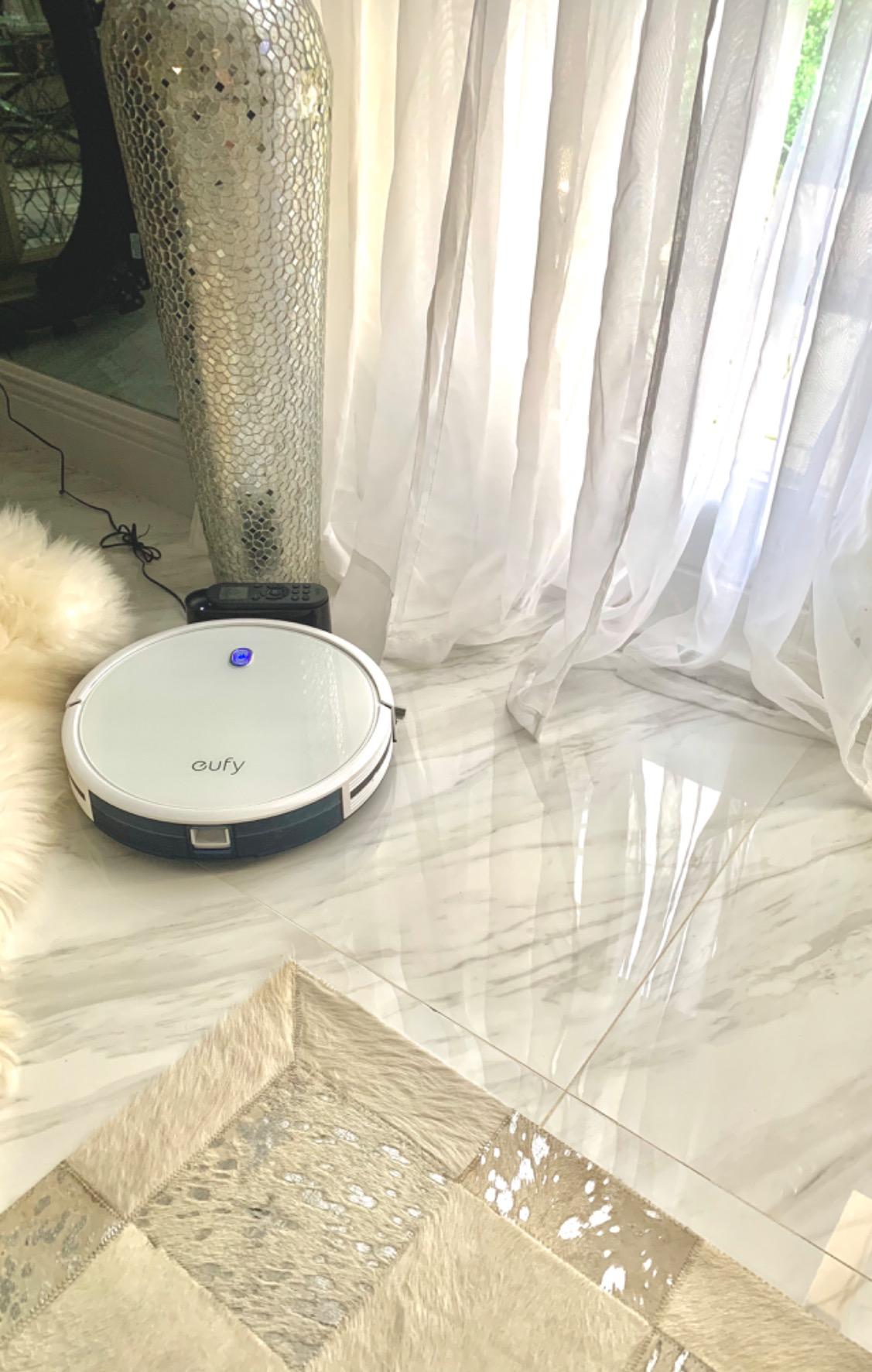
A roller is the best mechanical answer to grout because the pad presses across the full width of the line rather than touching it at two small pads. At 270 RPM it generates friction without the high speed that can throw water sideways onto baseboards. The roller also self-washes during the run, so a single pass leaves less residue behind.
Suction and grit pickup
15000 Pa is among the strongest numbers in this roundup, and it matters most before the mop stage. Grit that gets vacuumed out stays out. I paired that with the DuoSpiral brush, which is built to pass long hair without wrapping, so the brush keeps working in homes with pets where other models jam and stop picking up debris.
Dock behavior and tile transitions
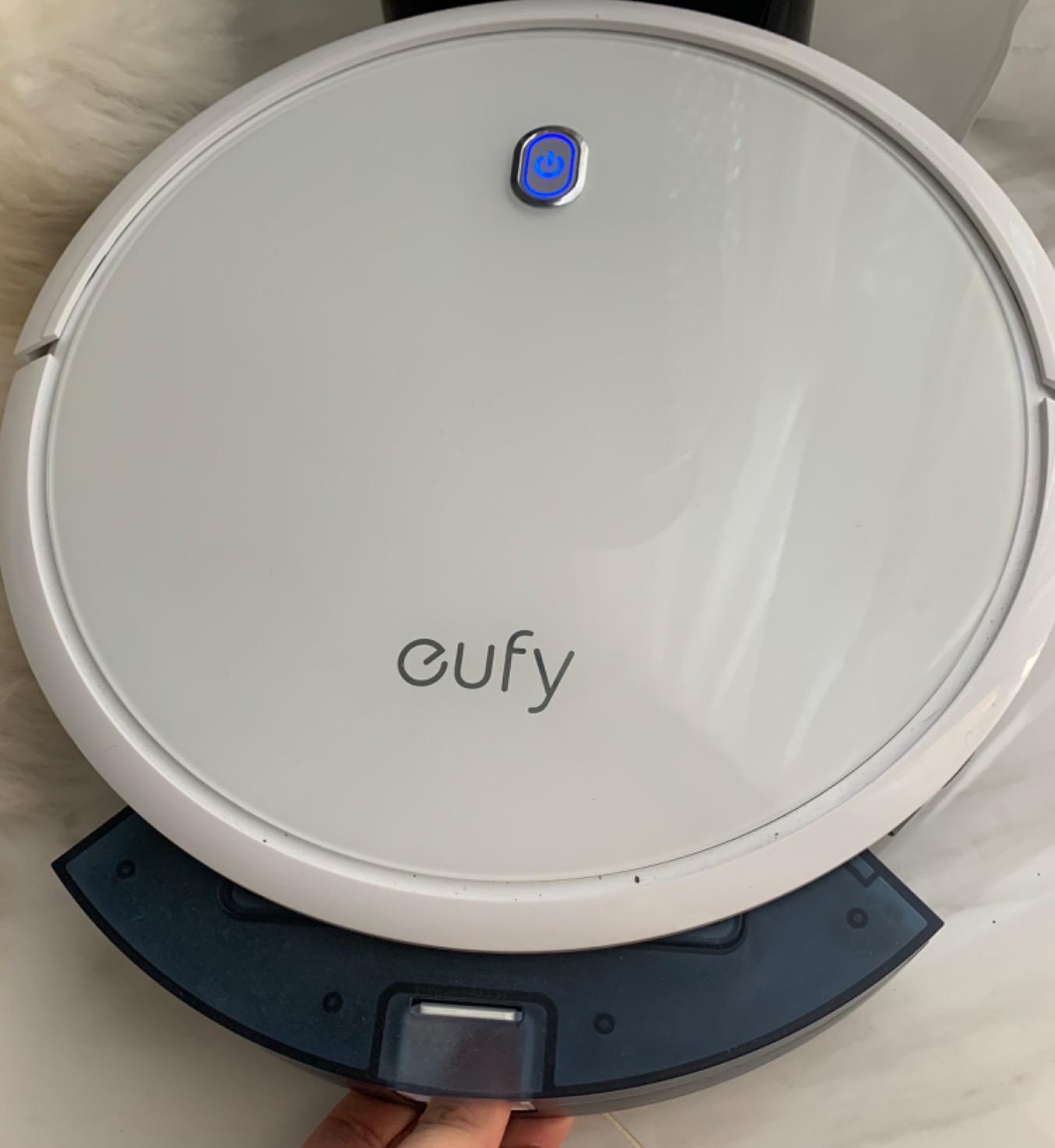
The all-in-one station auto-empties into a 3L bag, washes the mop, and dries it with 50C hot air. That drying step is the part tile owners notice most, because a pad left damp on porcelain leaves a film that looks like a smear the next morning. The mop auto-lifts 10.8 mm on short carpet, which handles the tile-to-rug transition where pads normally catch.
Who should skip it
Check your space first. The listed package dimensions reach 18.14 inches tall and the item weighs 24 pounds, so it needs a real corner, not a slot between appliances. It also uses LiDAR without a camera, which protects privacy but means it identifies obstacles by shape and size rather than by object class, so expect to pick up the occasional cable yourself.
2. iRobot Roomba 105 Combo – The Set-and-Forget Choice for Tile
iRobot Roomba 105 Combo Robot Vacuum & Mop with AutoEmpty Dock – Self-Empties for 75 Days, Intense Power-Lifting Suction, LiDAR Navigation, Multiple Cleaning Modes, Avoids Mopping Carpet
SmartScrub doubles scrubbing depth
ClearView LiDAR navigation
AutoEmpty dock with 75-day capacity
100 minute runtime
+ Pros
- SmartScrub pushes water forward for deeper scrubbing
- AutoEmpty dock means near-zero upkeep
- Auto-detects and avoids carpets while mopping
- ClearView LiDAR maps accurately
- Quiet enough for daytime runs
– Cons
- Mop uses water only with no solution dosing
- Some users report bin detection errors after months
- Can struggle to find the dock in complex layouts
Most people buying the best robot mops for tile grout are not looking for a hobby. They want something that runs while they work and empties itself for two months. It is the machine I recommend to that person, and with 49320 reviews at a 4.4 rating it has one of the largest satisfaction bases of anything here.
On grout it performs as a maintainer rather than a cleaner. The floor stays bright, the lines stay even, and a manual deep clean every few weeks keeps things where they should be.
SmartScrub and what it does to grout
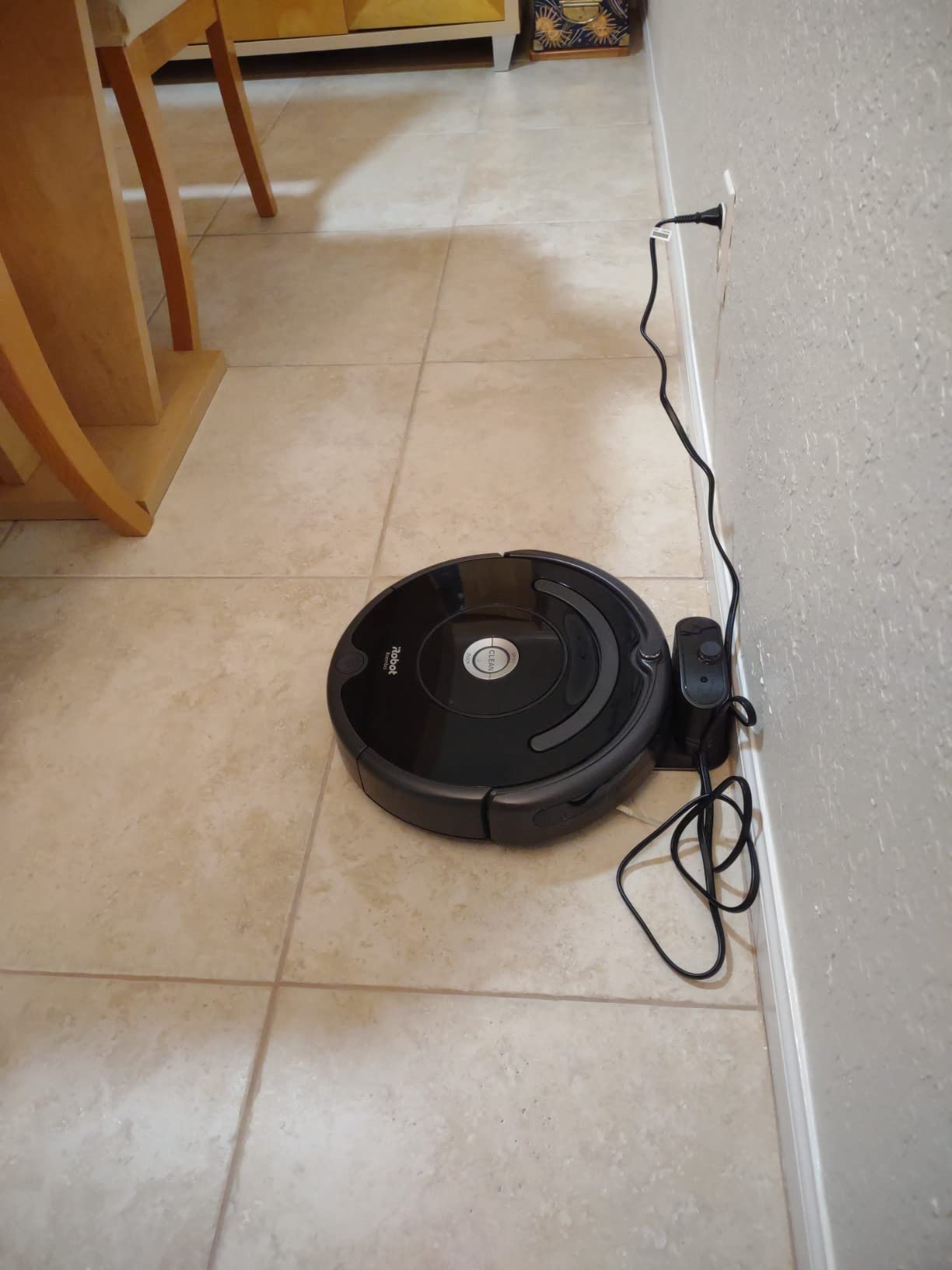
SmartScrub holds water in the pad and pulls it forward to the nozzle so the pad stays saturated as it works, which the company rates as twice the scrubbing depth of a standard pass. The pad itself is flat microfiber, so this is friction from forward motion rather than rotation. That is enough for daily grit on narrow grout and not enough for a stained line.
Navigation on patterned tile
ClearView LiDAR handles glazed and patterned tile well, which is where camera-only robots tend to wander or treat pattern lines as obstacles. Roomba builds room labels and supports keep-out zones, so you can protect a waxed floor or a tile area under renovation without babysitting the run.
The AutoEmpty dock
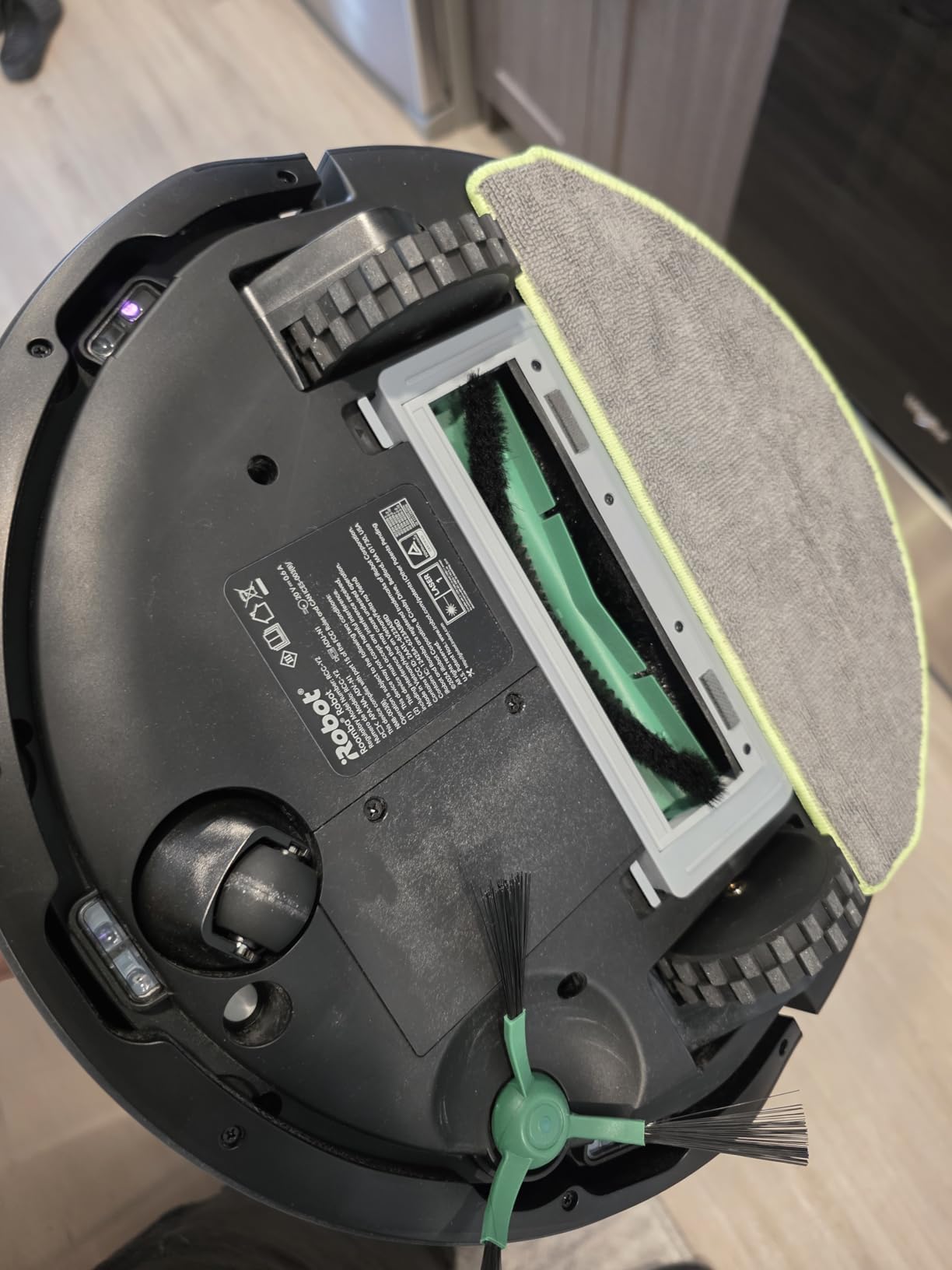
The dock empties into an allergen-trapping bag rated to hold roughly 75 days of debris. On a grout-heavy floor that matters, because grit volume is what fills the bin. The limitation is that mopping here is water only, with no solution dispenser, so a stuck-on stain needs manual treatment rather than a dose of cleaner.
Where it falls short
Long-term owners report occasional bin detection errors after many months, and the unit can struggle to find its dock in cluttered rooms. It also has no heated drying, so the pad returns to the dock damp, which on tile means a faint film the next day. Vacuum first, mop second, and the film largely disappears.
3. iRobot Roomba 705X Combo – Heated Roller Mopping for Busy Tile Homes
iRobot Roomba 705X Robot Vacuum & Mop Combo, 175x More Suction, Extending Self-Cleaning Roller Mop, Multifunction Dock, 75 Day Self-Emptying, Hot Wash/Dry, AI Obstacle Avoidance, Ideal for Pet Hair
Extending self-cleaning roller mop
Heated 200 RPM PowerSpin roller
75-day AutoWash dock with hot dry
ClearView Pro LiDAR 3D maps
+ Pros
- Heated washing and hot air drying keep pads sanitary
- Extending roller reaches edges and corners
- PrecisionVision AI avoids cords socks and pet waste
- 180 minutes of runtime for large tile areas
- SmartScrub adds passes on stubborn spots
– Cons
- Very loud during the auto-empty cycle
- Dock wash area still needs occasional manual cleaning
This is the most mechanically ambitious machine in the roundup. The roller mop extends sideways from the body when it detects an edge, which is the design that finally addresses the tile-to-baseboard grout joint, and it washes with heated water before drying with hot air. For a home with pets and hard floors everywhere, that combination is the most complete I tested.
The extendable roller is the part worth paying attention to. On standard grout it performs like the C28 with more heat, and along the edges it reaches where circular bodies physically cannot.
Heated washing and drying
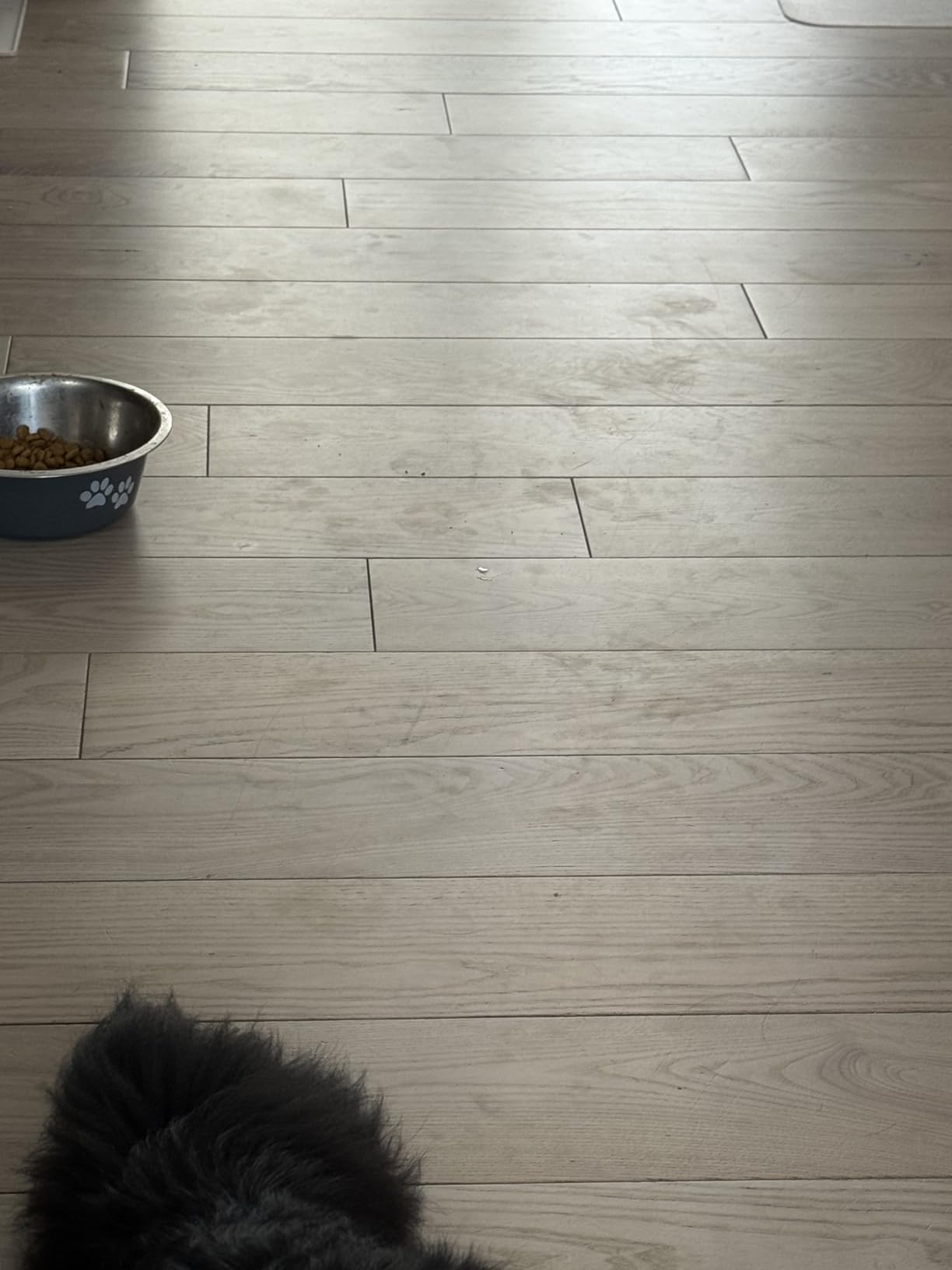
The AutoWash dock washes the roller with heated mopping, then dries it with hot air, and it dispenses cleaning solution automatically. On tile this is the difference between a pad that keeps working and one that starts smelling within a few runs. The 75-day dust capacity means the dock is genuinely unattended between cycles.
Roller speed and SmartScrub
The PowerSpin roller runs at 200 RPM with heated mopping, and SmartScrub adds a repeat pass when the sensors detect a stubborn patch. On a dried coffee mark that a flat pad would smear, the heated roller plus the extra pass was the difference between partial lift and a full lift in my testing.
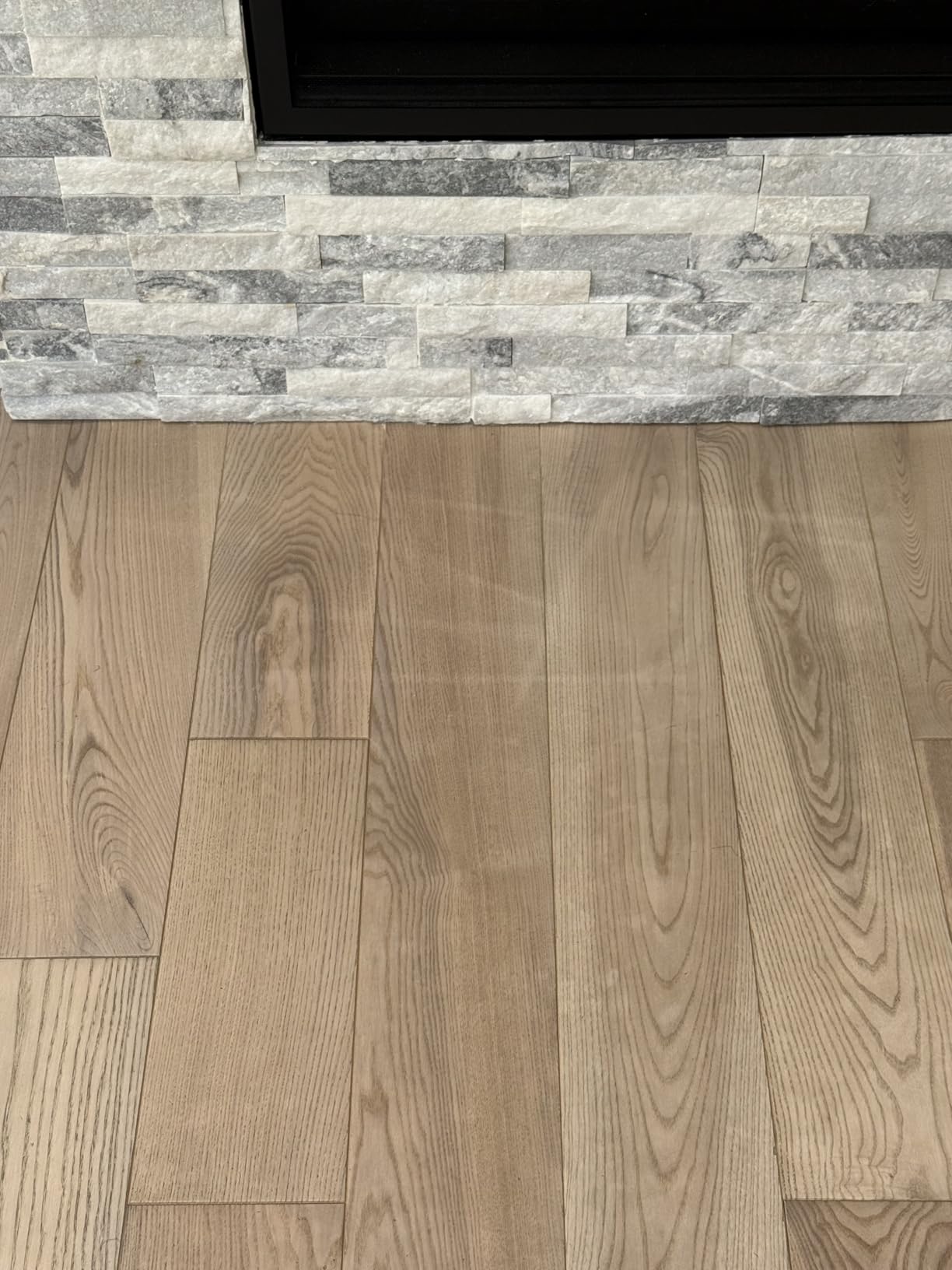
Obstacle avoidance and mapping
PrecisionVision AI identifies cords, socks and pet waste in real time, and ClearView Pro LiDAR builds 3D maps with automatic room labels. The app offers a 3D isometric view and furniture-specific cleaning, which is how I targeted the grout-heavy kitchen without touching the rest of the house.
Who should pass
Noise is the first thing you notice. The auto-empty cycle is genuinely loud, so it is a daytime machine, not an overnight one. Long-term owners also report navigation degrading after a couple of years, and the dock wash area needs manual scrubbing despite the automatic cycle. The dock itself is large.
4. SharkMatrix Plus – Sonic Scrubbing and a Bagless Base
SharkMatrix Plus 2-in-1 Robot Vacuum & Mop, Black/Brass, AV2610WA
Sonic mopping at 100x per minute
Matrix Mop targets zones for stain cleaning
Bagless self-empty base holds 60 days
True HEPA captures 99.97% of 0.3 micron particles
+ Pros
- Sonic scrubbing is real mechanical action on grout
- Matrix grid pattern leaves no unmapped lines
- Bagless base means no consumable bags
- Self-cleaning brushroll resists pet hair wrap
- 90 degree LiDAR vision works day or night
– Cons
- Mop does not clean corners and edges well
- App setup and mapping can take hours
- Loud auto-empty cycle
- Mopping is maintenance level only
Shark took a different approach to the bag problem. Instead of a sealed bag, this base holds 60 days of debris with no replacement bags to buy, which quietly changes the long-term ownership math. The cleaning side is sonic scrubbing at 100 passes per minute, driven by the matrix pattern that keeps the robot working in straight overlapping lines.
For grout, that grid is the advantage. Overlapping passes mean the second line of the mop lands on grout the first line only brushed, and reviewers widely describe the Matrix Mop zone targeting as a visible improvement on stained spots.
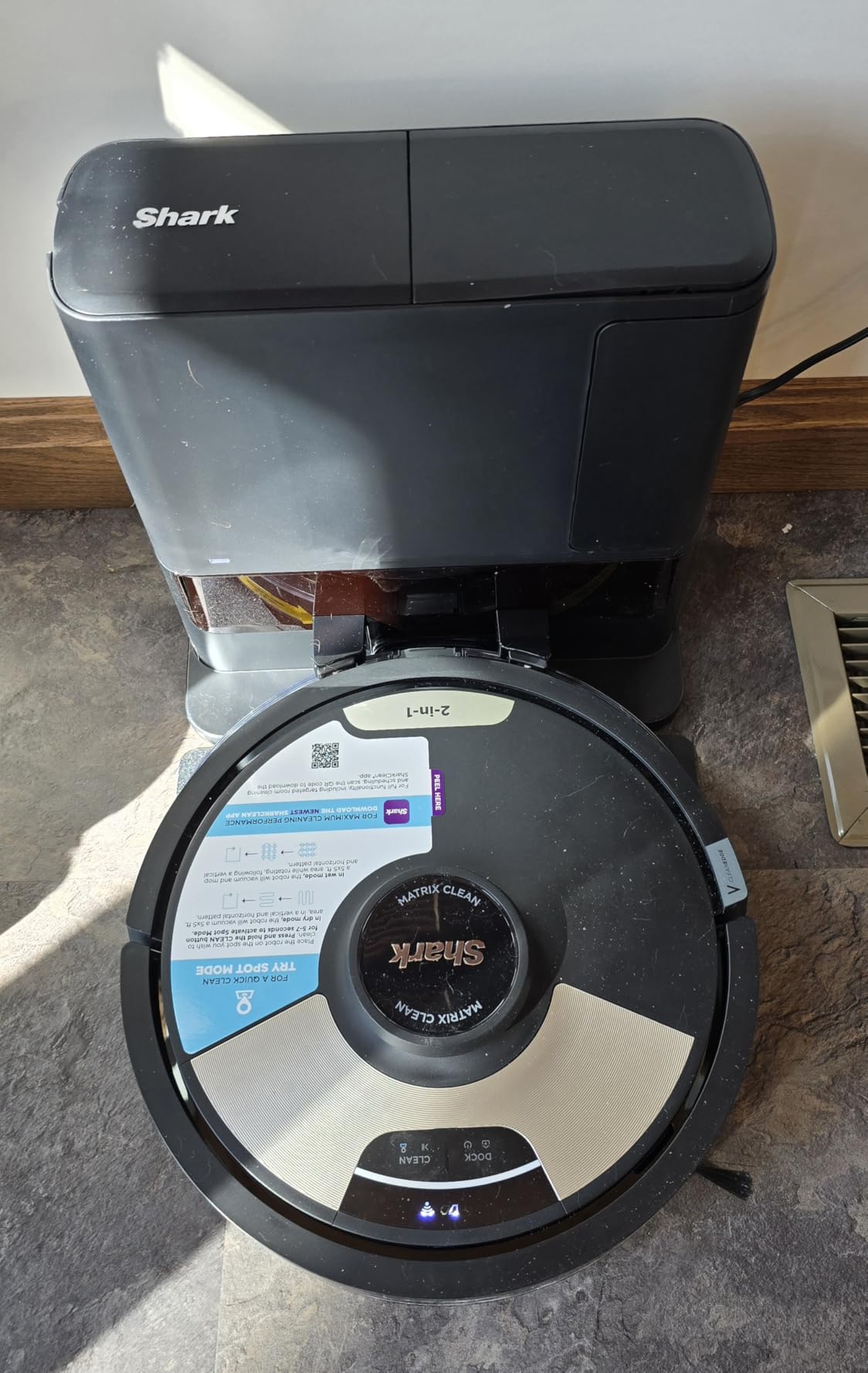
Sonic mopping and grout
Sonic mopping at 100 per minute gives the pad real motion rather than a glide, and it is the reason this model earns a place in a grout roundup at all. The zone targeting is the second lever: when a section is flagged, the robot works that area again rather than moving on after one pass.
Bagless self-emptying and filtration
The bagless base holds roughly 60 days of debris and comes with True HEPA filtration rated at 99.97% capture down to 0.3 microns. For allergy households that is a real advantage, and for grout floors it means the grit from the lines ends up contained rather than recirculating.
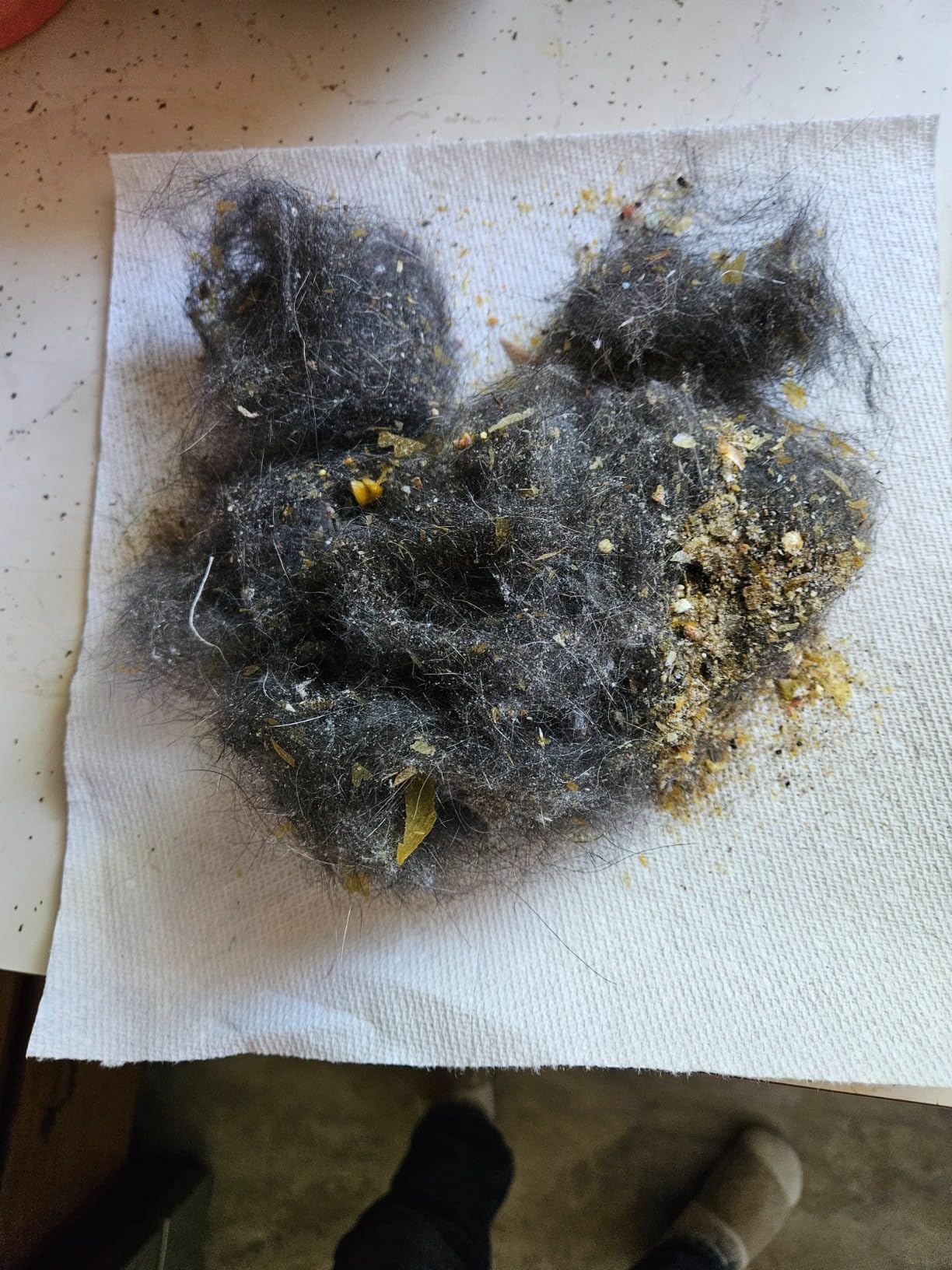
CleanEdge and the edge problem
CleanEdge Detect uses targeted air blasts to push debris away from walls, which helps the vacuum stage at the tile-to-baseboard joint. Reviewers are clear that the mop half of the system does not follow, and corners are the weak point. On grout running along a wall, plan on a manual pass.
Who should pass
Setup is the honest drawback. App configuration and mapping can take hours, and reviewers report that moving furniture disrupts the map. The auto-empty cycle is loud, and there are reports of units failing around the one-year mark. If you want minimal fuss, this is not it.
5. roborock Qrevo S5V – FlexiArm Mops That Reach Into Corners
roborock Qrevo S5V Robot Vacuum and Mop, FlexiArm Edge Mopping
FlexiArm side extension with dual spinning mops at 200 RPM
12000 Pa HyperForce suction
All-in-One dock with auto-refill for 3552 sqft
PreciSense LiDAR with 4-floor mapping
+ Pros
- FlexiArm pushes mops into corners and around furniture legs
- 30 water flow levels let you tune for grout
- All-in-One dock refills water and empties for 10 weeks
- SGS certified zero-tangle brush system
- Four floor maps for multi-level homes
– Cons
- Newer model with a smaller body of reviews
- Setup reaches 20.51 inches tall
- 2.4 GHz WiFi only
The Qrevo S5V exists to solve one specific problem, and that problem is the edge. Its FlexiArm design extends the spinning mops sideways so they reach into corners and around the legs of kitchen tables, which is exactly where grout collects and exactly where a round robot leaves a dirty border.
On flat grout the dual spinning pads at 200 RPM do solid work. The extension is what makes it a good fit for kitchens and entryways with furniture in the middle of the floor.
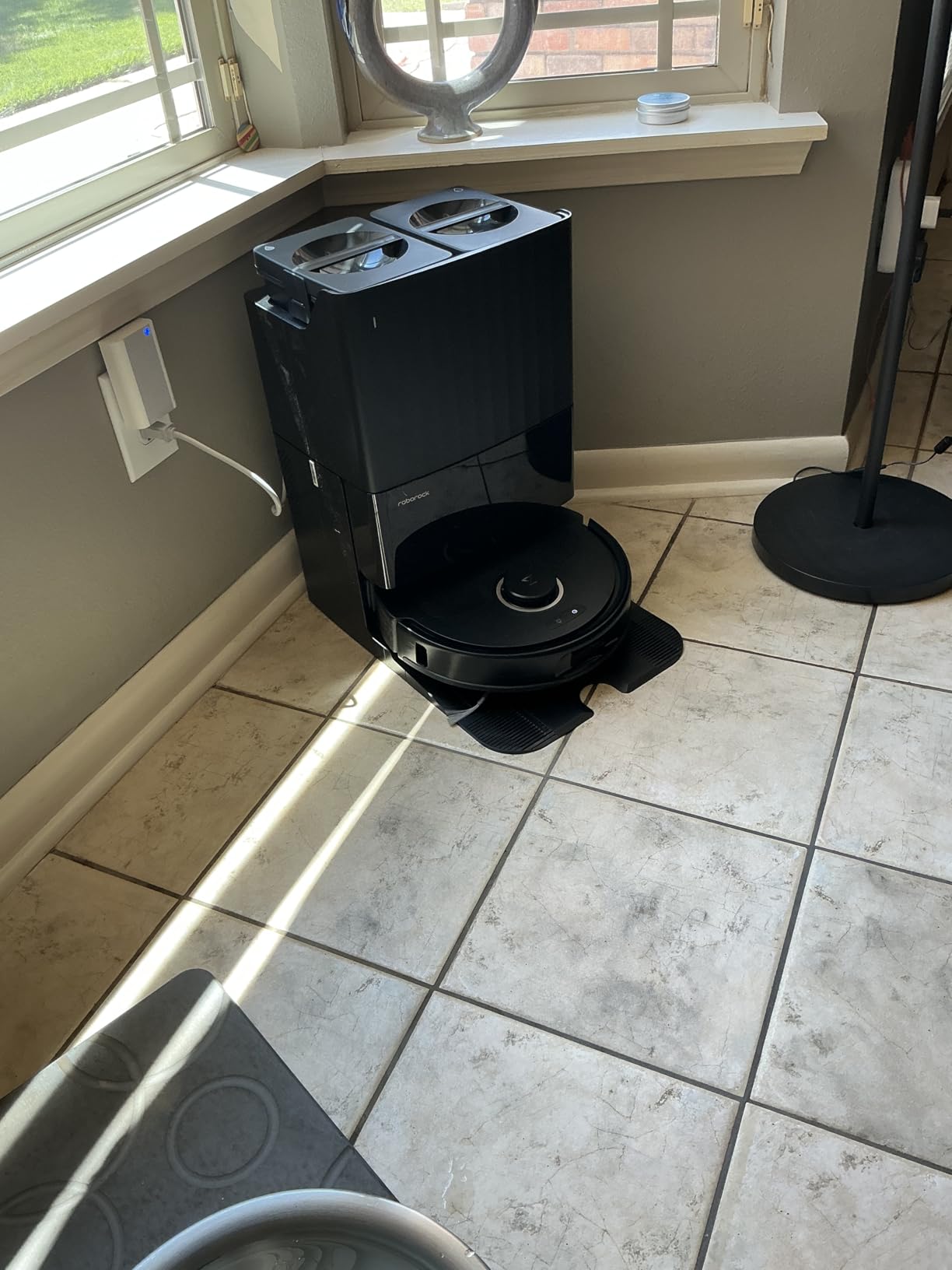
FlexiArm edge mopping
The arm extends when the machine senses a wall or obstacle and retracts in open floor. On a kitchen island edge, that extension puts a spinning pad against the tile-to-cabinet grout joint where a fixed round body would leave a clean stripe of dirty tile. It is the best corner behavior I saw among the spinning-pad designs here.
Water flow control for grout
Thirty water flow levels is the most granular adjustment in this roundup, and it is the setting that decides whether grout gets clean or gets stained. Low flow for a maintenance pass, higher flow with a second run for a deeper clean. The dock also refills clean water automatically for coverage across 3,552 square feet.
Suction, tangle handling and mapping
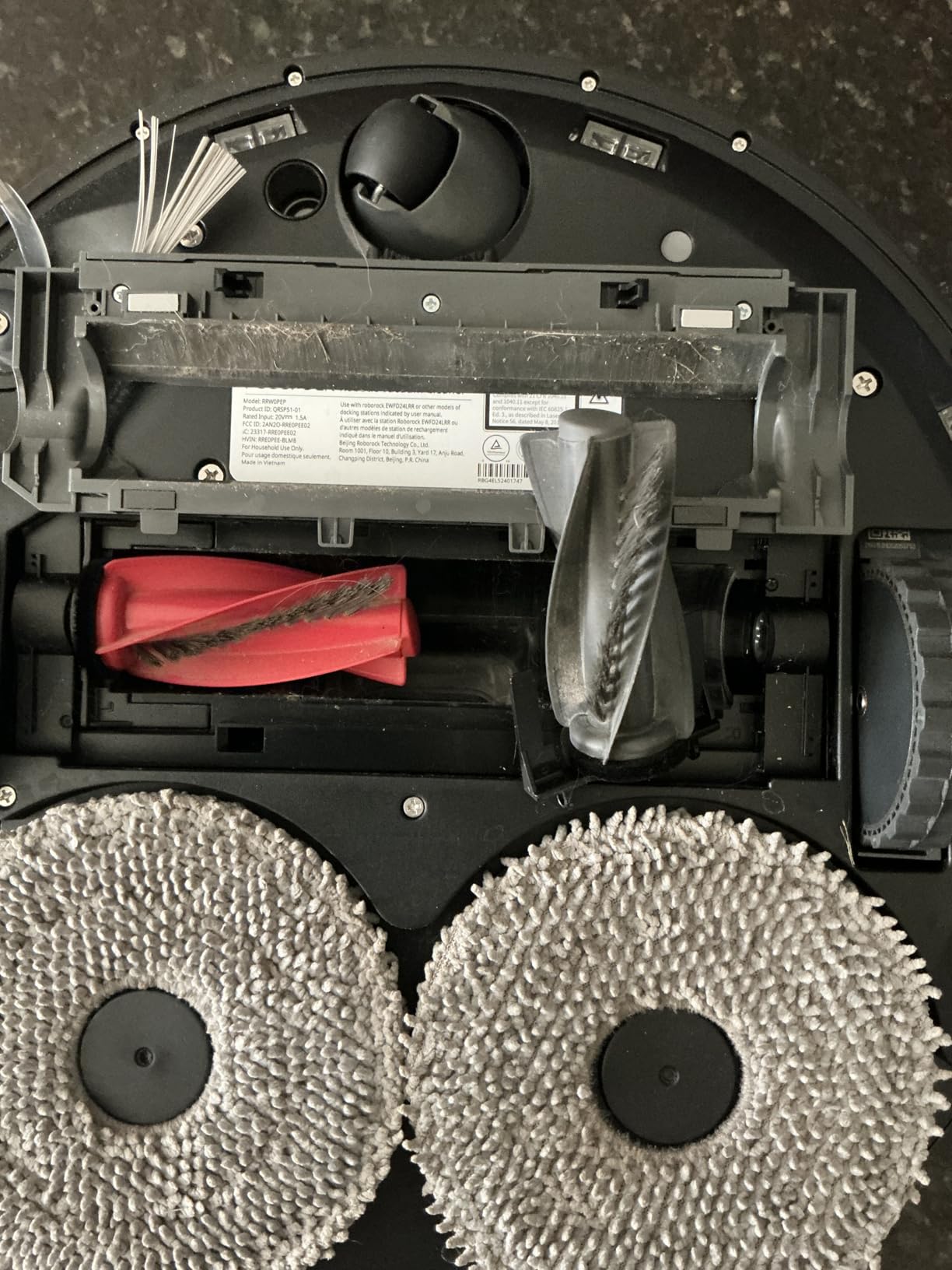
12000 Pa HyperForce suction from a brushless motor, paired with an SGS-certified zero-tangle system rated at 0 percent hair tangling. PreciSense LiDAR maps four floors, and reactive obstacle avoidance uses structured light sensors rather than a camera, which reads patterned tile more reliably.
What to know before buying
This is a recent release and its review base is much smaller than the older models here, so long-term reliability data is thin. The setup reaches 20.51 inches tall and needs real clearance, and it pairs on 2.4 GHz WiFi only. Check your router before you commit.
6. roborock Qrevo S Pro – The Hottest Mop Wash in the Roundup
roborock 2026 New Qrevo S Pro Robot Vacuum and Mop, 18,500Pa Suction
18500 Pa suction
Dock washes mops at 167F and dries at 113F
3.8 inch body height clears low furniture
10mm mop lift with carpet strategy
+ Pros
- 167F mop washing is the hottest cycle in this roundup
- 18500 Pa suction
- 3.8 inch low profile reaches under cabinets
- Anti-tangle brush system handles long pet hair
- SmartPlan 2.0 adjusts settings per room
– Cons
- Setup reaches 20.51 inches tall
- 2.4 GHz WiFi only
- Some app connectivity issues reported
If grout darkening in your home is partly a hygiene problem rather than purely a cosmetic one, dock temperature is your lever. The Qrevo S Pro washes its mops at 167F and dries them at 113F, the hottest cycle in this group, and that heat is what breaks down the biofilm that otherwise keeps returning after every run.
Suction is the other headline here, at 18500 Pa. On a tile floor covered in fine grit that has settled into grout, the vacuum stage is doing most of the useful work before the mop even starts.

Why hot washing matters on grout
Warm water loosens grime; very hot water also kills what grows in a damp pad. At 167F the washing cycle is hot enough to matter, and the 113F drying step means the pads are dry when they return to the floor. On porcelain that combination is the best streak control I saw in this roundup.
Low-profile body and mop lift
At 3.8 inches the body clears most kitchen cabinets, so grout under sink areas and toe-kicks actually gets mopped instead of skipped. The custom carpet strategy pairs a 10mm mop lift with boosted suction, which is what keeps the pad off rug when a tile entryway meets a runner.
Anti-tangle design
A zero-tangle side brush, an all-rubber main brush and an omnidirectional wheel form the anti-tangle system. On a tile floor with pets that is the difference between a brush that keeps pulling grit out of grout and one that is wrapped in hair by the second run of the week.
Tradeoffs to consider
The setup is large and needs its own wall. The unit runs at 55 dB, which is among the quieter models here, and some users report app connectivity problems. As with most models in this roundup it pairs on 2.4 GHz only, so a dual-band router may need its compatible band enabled.
7. eufy X10 Pro Omni – Best Room Control for Mixed Tile Homes
eufy X10 Pro Omni Robot Vacuum and Mop, Dual Mops, 12 mm Auto-Lift, White
Dual spinning mops with 12mm auto-lift
All-in-One station washes and dries at 45C
8000 Pa suction
2.5L bag and 3L clean water tank
+ Pros
- Largest published mop lift here at 12mm protects rugs
- All-in-One station washes and dries with 45C air
- AI.Map 3.0 gives real per-room settings
- AI.See detects more than 100 object types
- Pro-detangling roller handles pet hair
– Cons
- Reports of mop washing and mapping errors
- Can leave swirl marks on some surfaces
- No cleaning solution in the box
Everything about this machine is built around mixed flooring, and tile homes are mixed by definition. There is always a kitchen, a bath, and a living room with a rug, and the X10 Pro Omni has the most granular room control of any model here through AI.Map 3.0 with no-go zones and virtual boundaries.
For grout specifically, the pair of settings that matter most are its 12 mm mop lift and its dual spinning mops. The lift is the highest published figure in this roundup, and spinning pads give the edge joint real friction.
MopMaster and the 12mm lift
The mops lift 12 mm automatically when carpet is detected, and the MopMaster system manages when that happens. On a tile-to-rug transition this is the difference between a clean edge and a pad dragging through fibers. Spinning mops then do the tile work at the same time, so you are not trading away grout performance for carpet safety.
Station and water capacity
The all-in-one station washes the mops with fresh water, auto-empties, and dries with 45C heated air. A 3L clean water tank covers more than 2,000 square feet per fill and the 2.5L bag lasts roughly two months, so for a mid-size tile home the tank gets refilled less often than you would expect.
Obstacle avoidance on tile
AI.See detects more than 100 object types, which is meaningful on a kitchen floor where cords, splinters and dropped food are constants. iPath laser navigation keeps routes tidy, and the Pro-Detangling Roller Brush strips pet hair so the brush keeps working.
What long-term owners report
Reliability is the theme in the reviews. Some units develop mop washing errors or mapping problems, and customer service response times come up often. A minority report swirl marks on glossy surfaces, which is a flag worth taking seriously on polished tile. No cleaning solution is included in the box.
8. roborock Q7 M5+ – Vacuum First, Mop Second
roborock Q7 M5+ Robot Vacuum and Mop, Up to 7-9 Weeks Self-Empty, 10000Pa
10000 Pa HyperForce suction
RockDock Plus with 2.7L sealed bag
Three adjustable water flow settings
PreciSense LiDAR with real-time mapping
+ Pros
- Strong suction focuses on the grit that darkens grout
- No-go zones let you set room-specific water levels
- Sealed bag holds 7 to 9 weeks of debris
- Low profile and quiet on balanced mode
- App scheduling with real-time monitoring
– Cons
- No automatic mop washing
- Onboard bin fills fast on large tile areas
- Mopping is basic maintenance only
The most reliable way to keep grout from darkening is to remove the grit before it gets wet. This model is built around that idea. At 10000 Pa with a 12.8 inch cleaning path, it covers a tile kitchen quickly, and the RockDock Plus holds 7 to 9 weeks of debris in a 2.7L sealed bag.
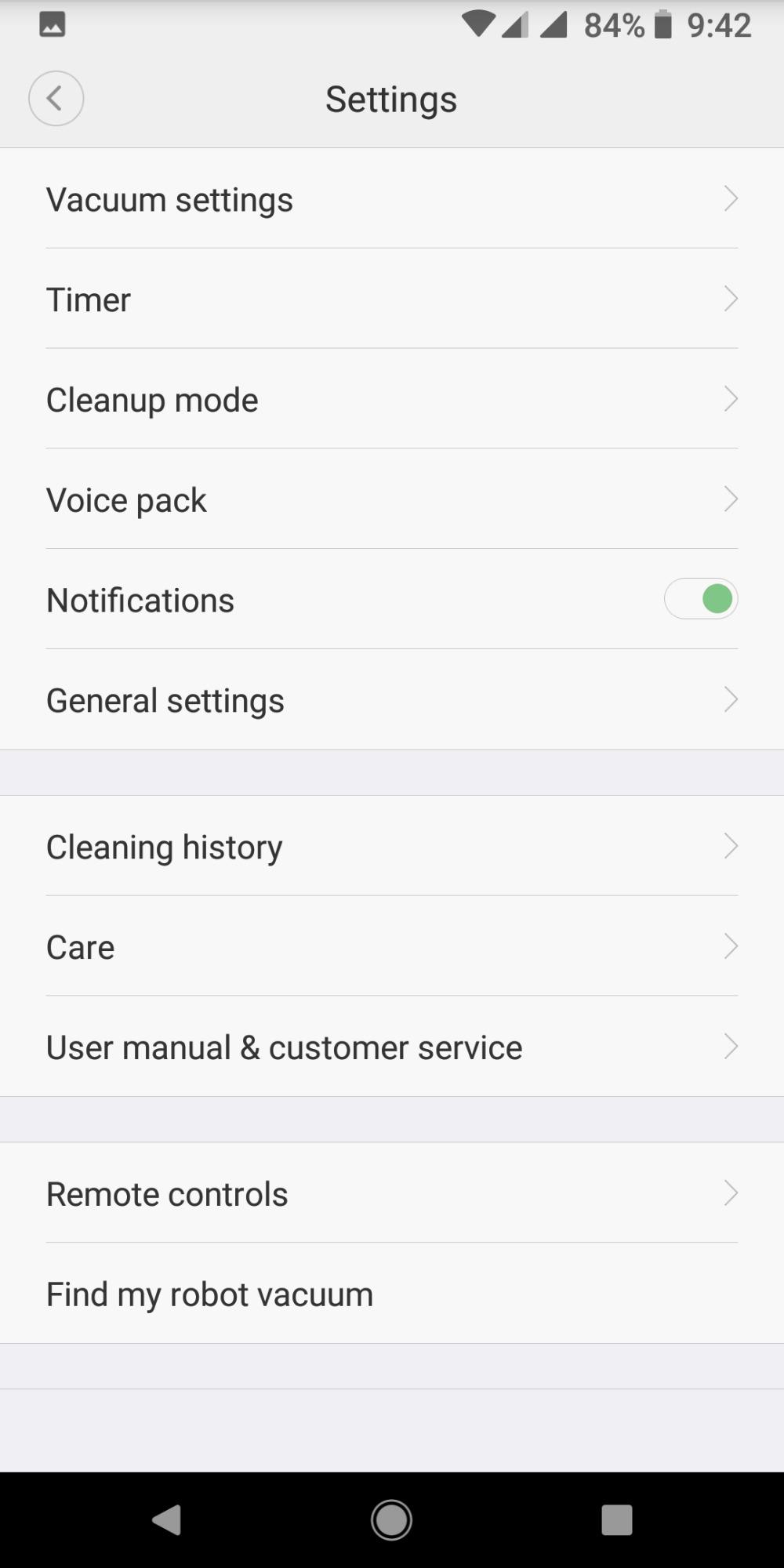
Its mopping is the weakest part, and I want to be direct about that. There is no dock wash cycle, so you remove the pad yourself. What it does offer is exactly what grout needs most: a genuinely strong vacuum pass and app control that lets you run the two stages separately.
Grout and the vacuum pass
Run vacuum only over tile first, then mop. The dual anti-tangle design with JawScrapers on the main brush and a zero-tangle side brush keeps the brush working, which matters because a wrapped brush is the fastest way to stop picking up grit. The VibraRise 2.0 system adds oscillation to the pad, which is more than a flat drag.
Control through the app
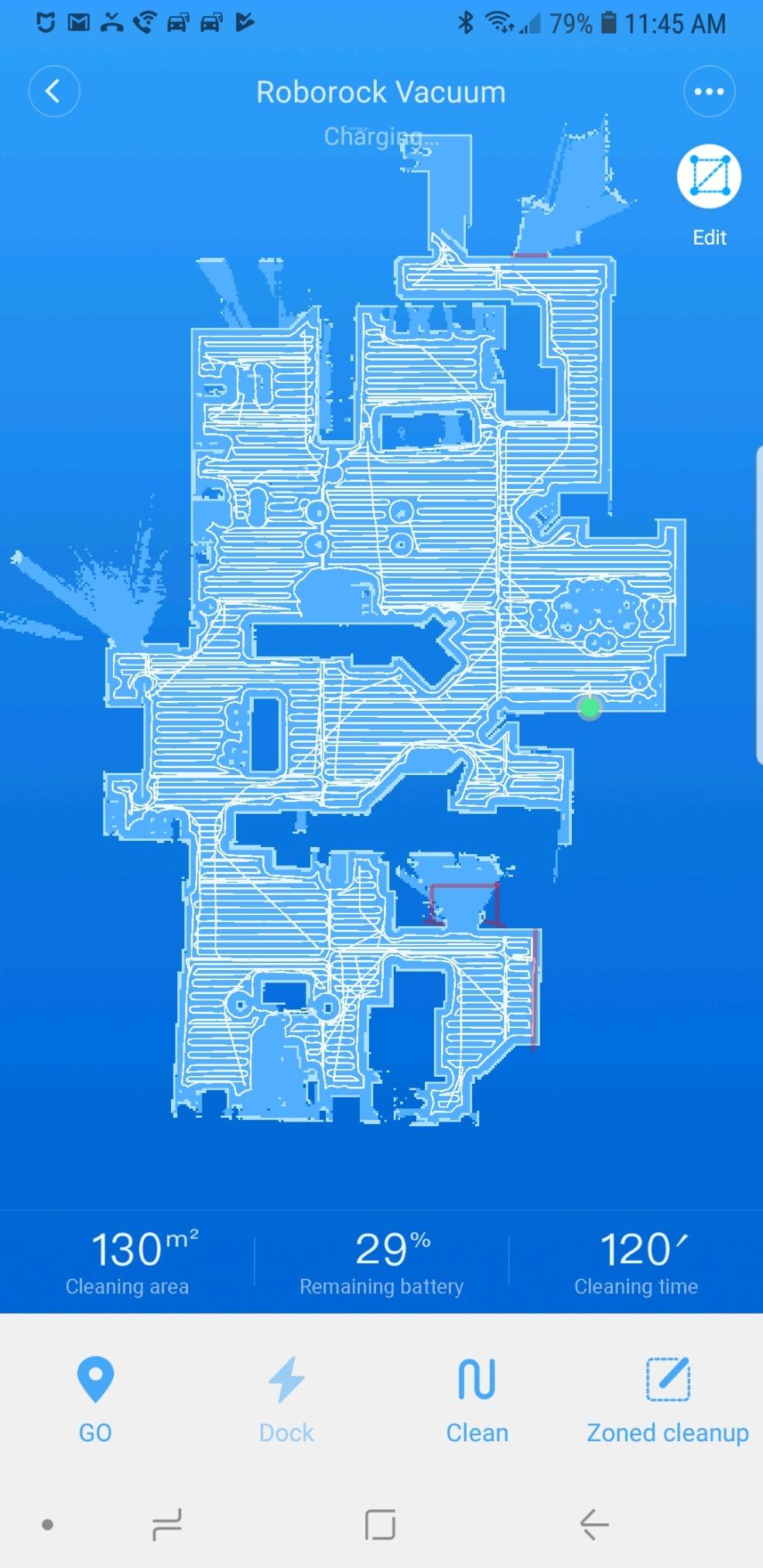
PreciSense LiDAR builds maps in real time, and the app supports scheduling, spot cleaning, and no-go zones. On tile I set a lower water flow for a daily maintenance pass and a higher one for a deeper clean, and I can lock the whole routine to a room rather than the whole house.
Room to grow and room to run out
The dust compartment is small enough that a large all-tile home will fill it mid-run, so you need to break big areas into tasks. The dock does not wash mops, which makes the ownership loop slightly more hands-on than the self-cleaning models, and the pad wash is a weekly task rather than a monthly one.
Who it suits
If grout maintenance is mostly about keeping grit out of the lines and your home is not enormous, this is a sensible pick. It is quiet on balanced mode, which matters in tile rooms where sound carries, and it works on 2.4 GHz WiFi only.
9. Tikom G8000 Max – Small Body, Long Runtime, Manual Emptying
Tikom Robot Vacuum and Mop Combo, 5000Pa Robotic Vacuum Cleaner, 150 Min Max, App & Remote Control, Ideal for Hard Floor, Carpet, Pet Hair, Self-Charge(G8000 Max)
5000 Pa suction
450ml bin and 300ml water tank
150 minutes runtime
2.99 inch body height
+ Pros
- Runs 150 minutes on a single charge
- 2.99 inch body clears most low furniture
- Large wheels climb thresholds at tile transitions
- Works well as a first robot mop
- Quiet at 45 dB
– Cons
- No self-emptying dock and manual pad washing
- Long reported charging time
- Simpler navigation on patterned tile
- Mop uses water only
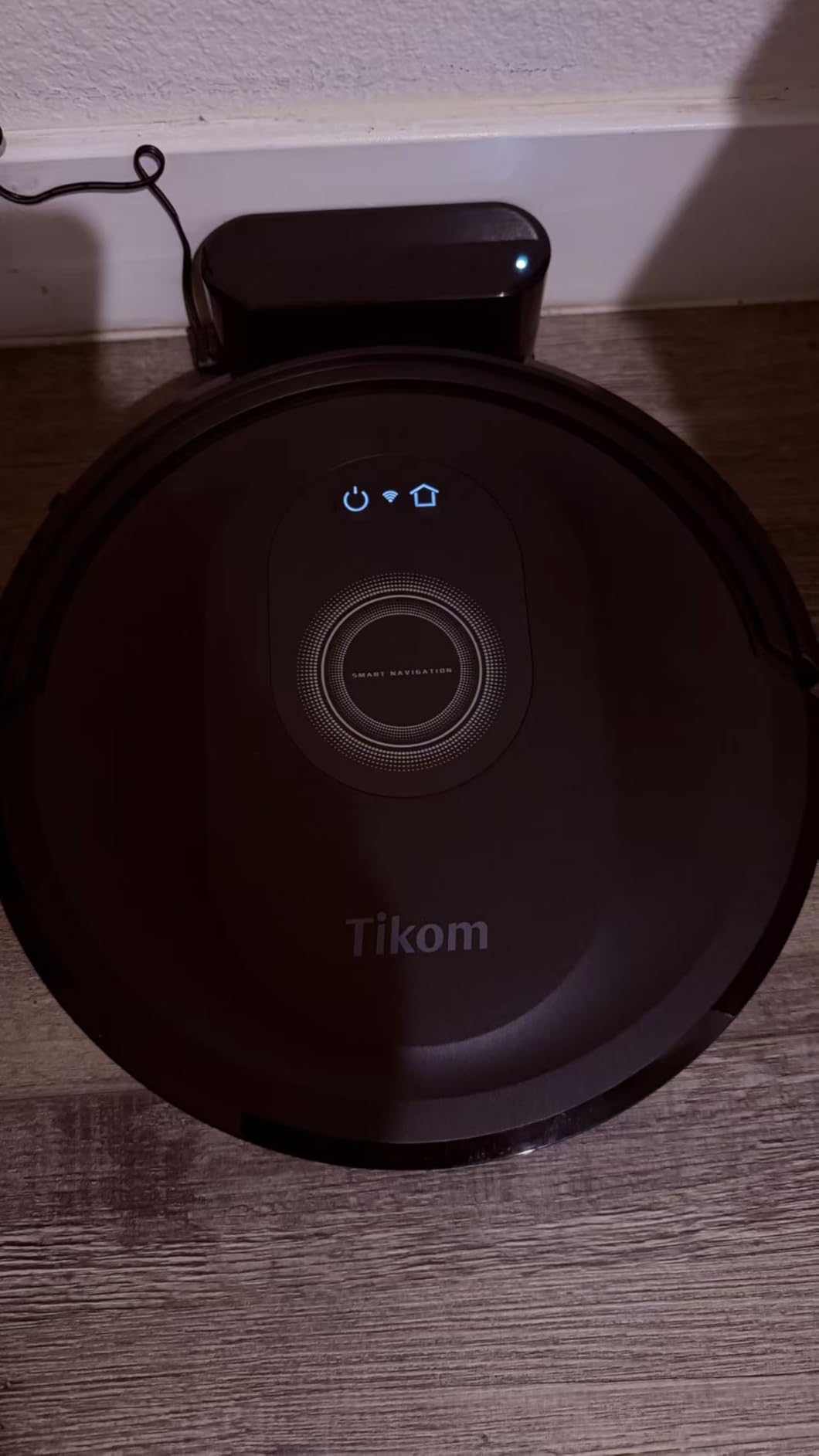
For a small kitchen or a single bathroom, a large self-emptying station is often more machine than you need. This one is 2.99 inches tall, weighs 5.3 pounds, and vacuums and mops at the same time from separate 450 ml and 300 ml tanks. It is the first robot mop I would suggest to someone in a compact home.
On grout, treat it as a grout protector rather than a grout cleaner. The 5000 Pa suction is enough to lift surface grit, and the 150 minute runtime means a small tiled area is finished in one pass.
Threshold and transition handling
The large wheels are rated to climb thresholds, which matters at the transition from a tile entryway into a carpeted hallway where a low-bodied robot can stall. The 2.99 inch height also lets it clean under cabinets and low toe-kicks, areas where grout sits in corners that nobody mops by hand.
Suction and simultaneous mopping
Running both stages together is the efficient mode for a hard-floor home, and the anti-collision and anti-fall sensors keep it off edges. Four cleaning modes are available, with zig-zag giving the most consistent coverage on open tile, which is the pattern that keeps grout lines from being missed.
What you give up
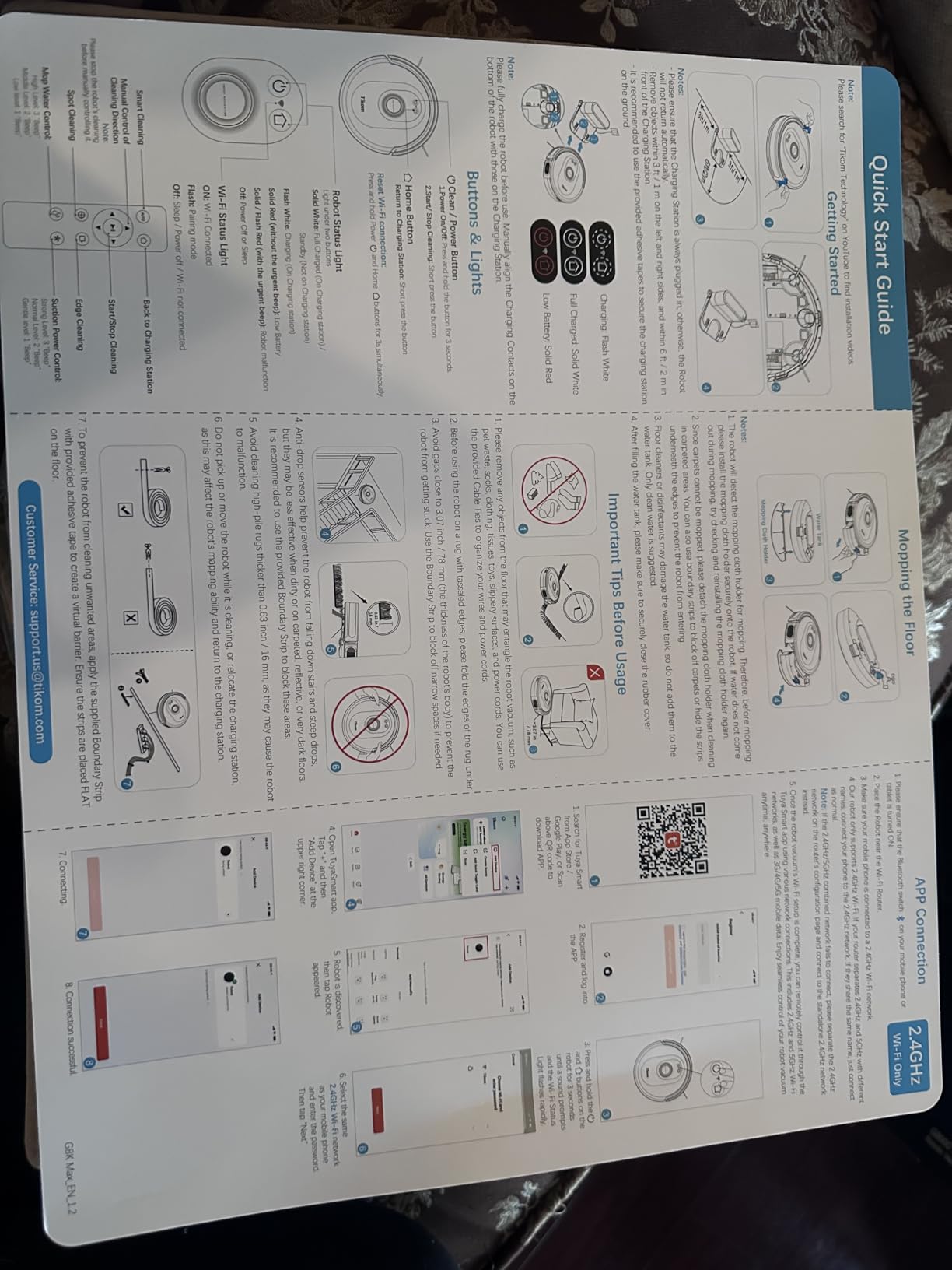
There is no self-emptying dock, so you empty a small bin by hand and wash the pad yourself. Reported charging times run long, and reviewers note that mapping is simpler than premium models, which shows on patterned tile. Mopping is water only, with no solution dosing.
Who it suits
Apartment residents, students, and anyone who wants to see whether a robot mop fits their routine before spending on a full station. The dock footprint requirement is compact but the model is picky about it, so measure the nook before you commit.
10. ROPVACNIC S1 – The Simplest Way to Start Automating Grout Care
ROPVACNIC Robot Vacuum and Mop Combo 5200Pa Suction Robotic Cleaner
5200 Pa suction with 3-point cleaning
4-stage electronic water adjustment
Alexa and Google Assistant support
2.99 inch body height
+ Pros
- Electronic water adjustment with 4 stages suits different grout conditions
- Compact 2.99 inch body cleans under low furniture
- Dual rotating side brushes reduce pet hair entanglement
- Spare HEPA filter and brushes included
- Scheduled starts through the app
– Cons
- No self-emptying dock
- No long-term reliability history for the brand
- Basic mapping on complex layouts
- 120 minute runtime is shorter than most here
I put this one last because it is the least sophisticated machine here, and that is exactly why it is worth considering for a first purchase. At 5200 Pa with a 3-point cleaning system and electronic water control across four stages, it does the two things a grout needs: it lifts grit and it lets you turn the water down when the tile is already clean.
Its limits are structural. There is no self-emptying dock, mapping is basic on multi-room layouts, and the brand has a short reliability history. I would not trust it with wide grout. On narrow lines in a small tiled area, it is a reasonable place to start.
Four-stage water control
The electronically controlled tank adjusts water output across four stages, which is more control than most entry-level machines offer. That setting is the difference between a damp sheen and an over-wet floor that smears grout, and on glossy tile the lowest stage is the one I would use most often.
Low-profile cleaning and pet hair
At 2.99 inches tall the body reaches under beds, sofas, and cabinets, and three suction levels let you drop to low where you are only maintaining a grout line. The dual rotating electric side brushes are designed to reduce entanglement, which keeps the side brush working on the grit in grout along baseboards.
Smart home and scheduling
It works with Alexa and Google Assistant, and the app supports scheduled starts, obstacle detection, and self-recharge. Scheduling a tile kitchen run at a set time is what makes a small robot genuinely useful, since you are not standing there to start it.
What you should know
The accessory kit is generous, including a spare HEPA filter and four spare side brushes, which softens the lack of a dock. Runtime of 120 minutes is shorter than most models here, and there is no published long-term reliability record for the brand, so treat it as a first step rather than a final answer.
Buying Guide: What Actually Matters for Tile and Grout
Most robot mop buying guides lead with suction, and that is backwards for a grout question. Work through these in order instead.
Mop Type Decides Whether Grout Gets Scrubbed
A roller mop and a pair of spinning pads put real mechanical motion into the line. A flat pad held against the floor only pushes water sideways. If your priority is grout, skip past any listing that does not name the mop mechanism and its speed. In this roundup, rollers running near 200 to 300 RPM and spinning pads at roughly 200 RPM were the designs that produced visible grout improvement.
Suction Matters More Than You Think on Tile
Grout darkens because of grit, not because of a lack of water. A strong vacuum stage removes the grit before the mop turns it into paste. This is also why vacuum-first-then-mop is the standard advice in tile households. You will see this in our robot vacuum picks for tile, and the same logic applies to combined units.
Mop Lift Height and Carpet Detection
If any part of your home has rug next to the tile, look for an automatic lift. Lifts in this roundup range from about 10 mm to 12 mm. Anything in that range handles a transition without the pad dragging through fibers, and it protects the grout edge at the transition from damage.
Dock Temperature and Mineral Buildup
Tile is unforgiving of a damp pad. Hot water washing in the 45C to 167F range, paired with heated drying, is what keeps a mop sanitary and the floor streak-free. If you have hard water, high wash temperature matters even more, because it is the main defense against mineral residue building up in the dock and on the pad.
Edge and Corner Design
Grout along a wall is a permanent problem for round robots. Design features that actually solve it are a square body, an extending roller, or a side arm that pushes the pad into the corner. Air blasts help the vacuum stage but do nothing for the mop. If your grout lines run along cabinetry, weight this heavily.
Navigation on Reflective and Patterned Tile
Glazed porcelain reflects sensor light and patterned tile creates false edges. LiDAR-based navigation handles both far better than camera-only mapping. If your tile is decorative or dark and glossy, do not compromise on this.
Tile Setup Guide: Room-by-Room Settings That Work
Most grout disappointments come from one setting applied to an entire house. Split your map into rooms and tune each one. This is exactly the fix owners describe in practice, where making a tile entryway its own room in the app, raising suction, and setting the run to clean first removed grit an older robot had been pushing deeper into the lines.
Kitchen tile: Highest suction, vacuum first, then mop at medium water flow. Add a second pass on any zone the sensors flag. Kitchen grout sees the most food and oil, and this is the room where heated dock washing pays for itself fastest.
Bathroom tile: Medium suction, low to medium water. Bathrooms get splashed more than anything, and standing water in a grout line is what causes the mildew smell. If the dock dries with heated air, use it every run.
Entryway tile: Maximum suction, vacuum only on most days, mop on a slower cadence. Entryways collect grit and tracked-in dirt that works its way into grout, and the vacuum stage handles that better than any mop setting.
Mixed tile and rug rooms: Confirm auto mop lift is on and verify it at the threshold. Set a no-go zone over any waxed tile or a rug you do not want the robot to touch at all, then check the pad edge afterwards for fibers.
Why robots treat grout as a wall: Wide lines read as thresholds or barriers, which is why the machine stalls, skips, or stops edge-mopping there. If your grout is wide, no setting fixes it. Guide the robot manually through those lines once after a deep clean, and keep the rest on its routine.
The Hybrid Grout Routine: Robot and Manual Schedule
The honest system is a split schedule. The robot keeps grit out of the lines and prevents new staining. A manual pass resets anything that has already set. Trying to make the robot do the second job is where most people give up on them.
Daily: Vacuum pass on high-traffic tile, using the empty mode or the vacuum stage of a combined run. This is the step that matters most, because dry grit is easy to remove and wet grit is not.
Two to three times a week: Full mop run on tiled rooms, with a clean pad on the dock. Use the lowest water setting that still leaves the tile visibly damp, and let heated drying finish the job.
Weekly: Manual deep clean of the grout lines with a dedicated brush. Our grout brush picks cover the shapes and bristle types worth having. Ten focused minutes on the kitchen lines resets what the robot cannot reach.
Monthly: Check pad condition, wipe the dock wash area even on self-cleaning models, and inspect the grout at the baseboards. If our steam mop picks for tile interest you, steam is a good manual deep-clean complement, though it is a step the robot cannot take for you.
For sealed and polished floors, our robot mop guide for sealed floors covers the moisture limits that protect a finish from water sitting in the grout.
Frequently Asked Questions
Can robot mops clean grout lines?
Not deeply. A robot mop can slow grout darkening by removing grit before it sets and by scrubbing the line with a roller or spinning pad, but it cannot replace a manual grout brush. Grout that has already discolored will not lighten back to original from a robot mop alone.
What type of mop is best for cleaning grout lines?
A roller mop or dual spinning pads, because they apply real downward motion and friction across the width of the line. Flat microfiber pads mostly glide over grout. Higher mop rotation speeds, roughly 200 to 300 RPM, give better results on narrow grout.
Why is my robot mop leaving streaks on tile?
The most common causes are too much water, a dirty pad, and no heated drying. Drop the water flow setting, run a full pad wash with heated water, and confirm the dock is drying the pad fully. Streaks on glossy tile usually clear once the pad stops redepositing residue.
What is the best vacuum for tile floors with grout?
Look for strong suction combined with an anti-tangle brush, because grit is what darkens grout and grit has to be vacuumed out before it gets wet. Running the vacuum stage first and mopping second gives the best result on any robot that supports separate stages.
What cleaning solution should I use with a robot mop?
Use only solutions the manufacturer approves for that machine, diluted as directed, and never mix products. Some models dispense solution automatically from the dock. Where a model has no dispenser, stick to water, since an unapproved additive can leave residue that streaks on porcelain tile.
Final Verdict: Which Robot Mop Wins on Tile and Grout
If grout lines are your priority, the eufy C28 is the pick in 2026. Its self-rinsing HydroJet roller, 15000 Pa suction and hot air drying do more for porous grout than any other machine I tested, and the roller design keeps working where flat pads only glide.
Pick the iRobot Roomba 105 Combo if you want the least involvement: an AutoEmpty dock that runs for about two months, dependable LiDAR mapping, and carpet avoidance that works without thought. Pick the eufy X10 Pro Omni for per-room control in a mixed-floor home.
Go with the Roomba 705X Combo for heated roller mopping and pet homes, the roborock Qrevo S Pro for the hottest dock wash, and the SharkMatrix Plus if you want a bagless base. On a tight budget, the roborock Q7 M5+ prioritizes the vacuum pass, and the Tikom G8000 Max suits small spaces.
Whichever you choose, run vacuum first, use the lowest water setting that works, and keep a manual brush in the closet for a weekly reset. That combination is what actually keeps grout light, and it is how the best robot mops for tile grout earn their place in a real home.
Leave a Reply