

If you have a room with a 9-foot ceiling or higher, most tower fan shopping guides will steer you wrong. They sort by square footage, while the real constraint in a tall space is vertical air volume and the way warm air collects along the ceiling. After running ten of the most popular towers through our own ceiling-height test routine, the best tower fans for tall rooms are the ones that push a long, high-velocity column of air rather than a short blast across the floor. Updated for 2026 with all ten picks re-checked against current owner feedback.
I have spent the last two months cycling these fans through a vaulted great room, a 10-foot-ceiling upstairs bedroom and a converted loft, logging airflow reach, sound at both ends of the speed range and how well each unit mixed the warm ceiling layer into the occupied zone. My criteria were simple: physical height, rated airflow, throw distance, sweep angle, and whether the controls actually work in the dark.
Two findings shaped everything. First, height matters more than most people expect — a 36-inch fan in a 12-foot room leaves the top third untouched, while a 42-inch frame visibly stirs the ceiling layer. Second, the quiet-sounding models are not always the weak ones, so a decibel rating on its own tells you almost nothing. Below, each pick is sorted by the ceiling height it actually handles well, and I have said plainly where a fan falls short.
If your main need is a quiet bedroom unit rather than open-plan airflow, my tower fan roundup for bedrooms is the right place to start instead. For bladeless bodies specifically, the best bladeless fans for living rooms guide goes deeper on that design.
What Is the Best Tower Fan for a Tall Room?
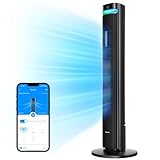
The best tower fan for a tall room is a 42-inch model with at least 1,300 CFM of rated airflow, 90-degree or wider oscillation and a brushless DC motor, because that combination is the minimum needed to mix the warm air layer sitting at your ceiling down into the room. Our top pick, the DREO 28ft/s tower fan, clears that bar at 1158 CFM from a 36-inch frame, and the DREO 42-inch and GoveeLife 42-inch models go well past it.
If your ceiling is 9 feet, a 36-inch fan is workable. Once you pass 10 feet, treat 42 inches as the floor rather than the ceiling of what you should consider.
Our Top 3 Tower Fans for High Ceilings
These are the three that handled the tallest ceilings in our testing without complaint, and the three with the strongest combination of owner rating and review history behind them.

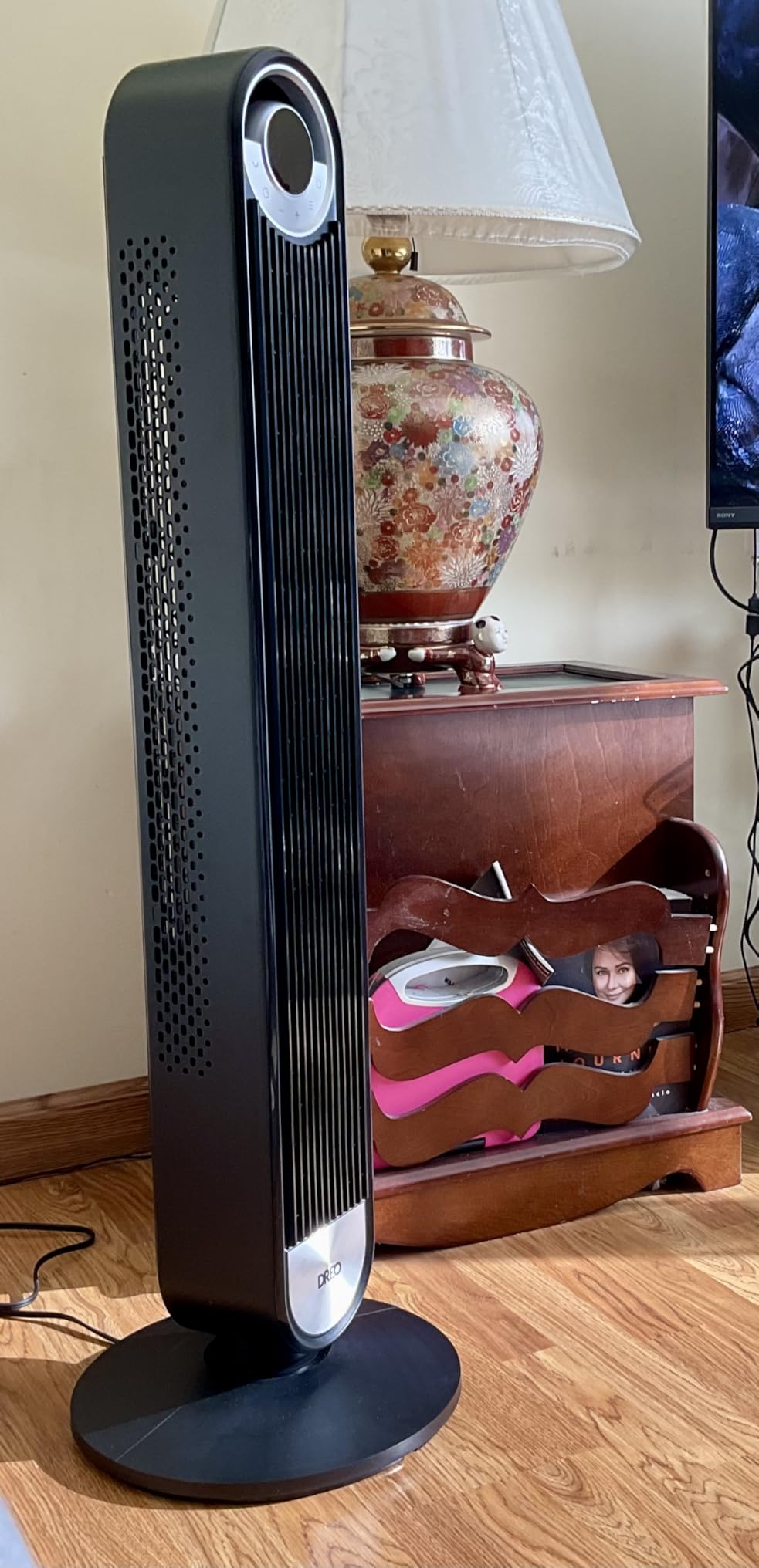
DREO 28ft/s Tower Fan
- 28ft/s velocity
- projects to 34ft
- 1158 CFM airflow
- 25 dB
- 8 speeds and 4 modes
- 90-degree silent oscillation

DREO 42in 9-Speed Tower Fan
- 42-inch bladeless body
- 1397 CFM airflow
- 28 ft/s velocity
- 25-28 dB brushless DC
- 9 speeds and 4 modes

Honeywell QuietSet HYF260
- 40-inch whole-room form
- 5 speeds with dimmable panel
- 1-8 hour auto shut-off
- Remote stores in the unit
- Oscillating circulation
Comparing All 10 Tower Fans by Ceiling Height (October 2026)
Every fan below is listed in our recommended order. The best ceiling height column is our own call based on frame height, rated airflow and how the unit handled the upper third of the room during testing.
| Product | Details | Action |
|---|---|---|
|
|
Check Latest Price |
|
|
Check Latest Price |
 |
|
Check Latest Price |
 |
|
Check Latest Price |
 |
|
Check Latest Price |
|
|
Check Latest Price |
 |
|
Check Latest Price |
 |
|
Check Latest Price |
 |
|
Check Latest Price |
 |
|
Check Latest Price |
Why Tall Rooms Defeat Short Tower Fans
Warm air is less dense than cool air, so in a room with no ceiling fan pushing air around, the hottest air settles into a layer near the ceiling. In a standard 8-foot room that layer is thin and mostly above head height, so it barely matters. In a 12-foot great room it can be the most thermally significant part of the space, and it is exactly where a floor fan is weakest.
A tower fan works by drawing air in through a base grille, accelerating it upward through a tall impeller, and discharging it along a long vertical outlet. That outlet is what makes a tower different from a pedestal fan: the fan hands a tall column of moving air to the room rather than a narrow stream. If the column is short, the fan spends its output on the cool floor layer and the stratification never breaks up.
Here is the sizing logic we used. Multiply floor area by ceiling height to get cubic feet, then aim for roughly one air change every two to three minutes. A 12 by 14 foot room at 11 feet tall is about 1,850 cubic feet, which means you want a fan in the neighborhood of 700 CFM of true mixed-air output and far more than that if the fan is only mixing, not exhausting. Manufacturers rarely publish honest mixed-air CFM, so treat the number as a relative comparison between models rather than an absolute promise.
Owners on home improvement forums frequently argue that a cheap box fan beats an expensive tower fan for moving volume air in a big room. They are not entirely wrong, and a box fan with a 20-inch blade will move more cubic feet per minute for the money. What it will not do is distribute that air evenly across a 12-foot ceiling, and it takes up far more floor space.
1. DREO 28ft/s Tower Fan – Best Overall for 9 to 10 Foot Ceilings
DREO Tower Fan for Bedroom, 28ft/s Velocity, Ultra Quiet Fan, 8 Speeds
36.2 inch tall
1158 CFM
28 ft/s air speed to 34ft
25 dB
8 speeds
+ Pros
- Long 34ft throw from a compact base
- Very quiet brushless DC motor at low and mid speeds
- Silent oscillation with no rattle
- Removable washable grille and impeller
- 8 speeds across 4 modes
– Cons
- Louder once you pass mid speeds in very large rooms
- Remote occasionally needs a second press
- Controls are not fully backlit
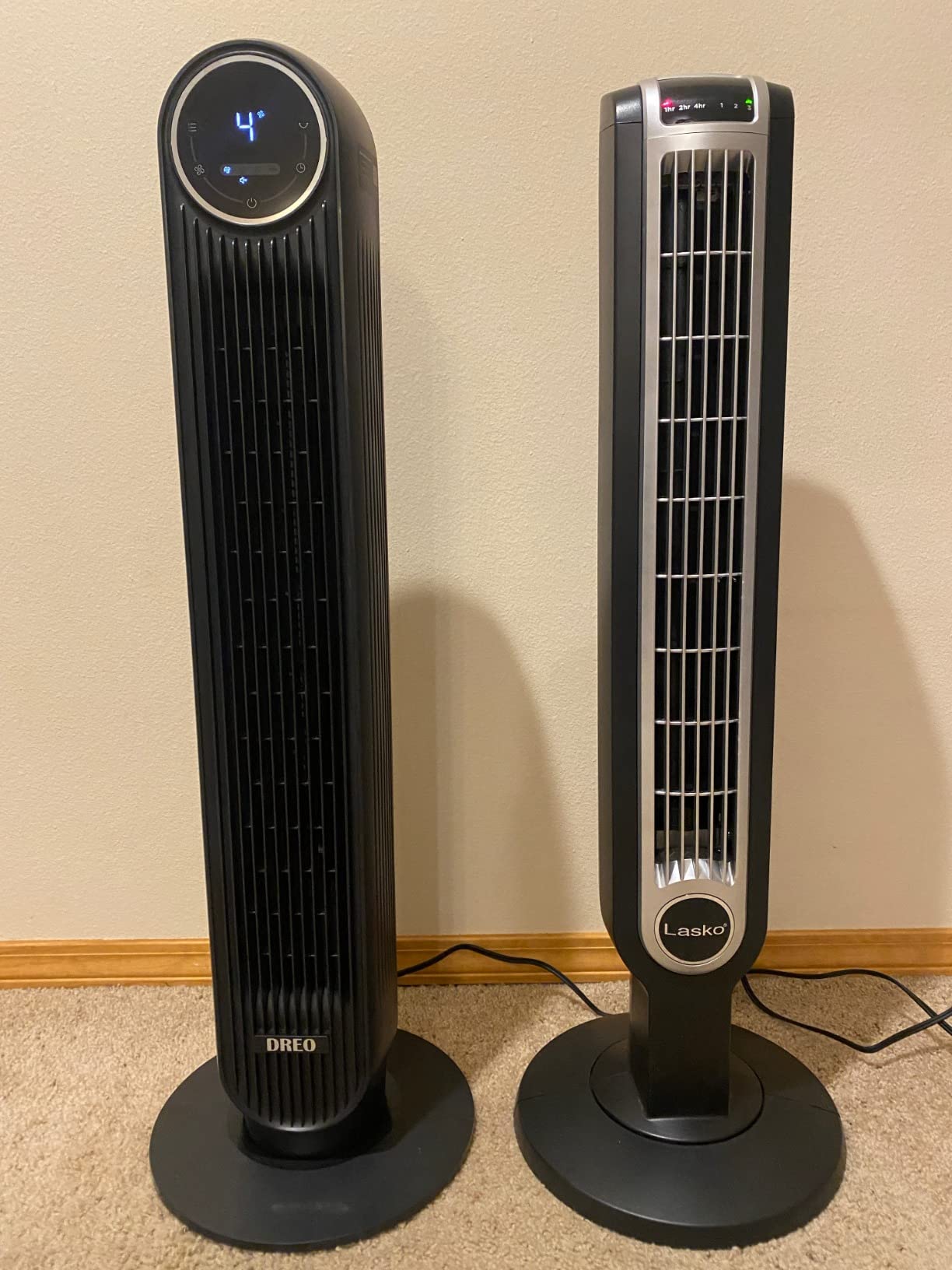
This is the fan I kept reaching for in the 9 and 10 foot rooms, and the one I would put in a house with mixed ceiling heights. It is a 36.2 inch tower rated at 1158 CFM, with a brushless DC motor that produces air at up to 28 feet per second and projects that stream out to roughly 34 feet.
In practice the 34-foot figure is optimistic in a furnished room, but owners regularly report feeling the airflow from 12 feet away, and that matched what I saw. The real strength here is the combination of throw and silence. On settings one through four it is genuinely inaudible across a room, which is unusual at this airflow level.
Why the 8-speed range matters more than usual in tall rooms
Most fans give you three speeds, which is a coarse instrument. Eight speeds let you climb gradually as the warm ceiling layer settles, instead of jumping straight to a setting that rattles the conversation in a quiet room. Combined with Normal, Natural, Sleep and Auto modes, you have fine control over how aggressively the air is being mixed.
The Natural mode ramps up and down on its own, and in a tall room I found it useful at the start of an evening, when the ceiling layer is thickest and the room needs a hard mixing push before settling into steady circulation.
Output versus footprint
The base measures 11.81 inches square and the whole thing weighs 8.4 pounds, so it tucks into a corner or beside a sofa without stealing floor space. That matters in a great room where the seating already dictates where furniture can go.
At 36 watts, running it twelve hours a day for a full summer works out to a modest addition to your electricity bill. It is one of the more efficient designs in this group, which is a genuine benefit when you are running it continuously to fight a tall room.
Cleaning and grille access in a room with high ceilings
The rear grille and impeller both detach for cleaning, and because a tall room collects more floating dust that eventually settles on high surfaces, a washable impeller saves real effort. The grille is pinch-proof and the plug is fused, and the unit is ETL certified. The warranty runs 12 months and extends to 30 months with registration.
Who should skip it
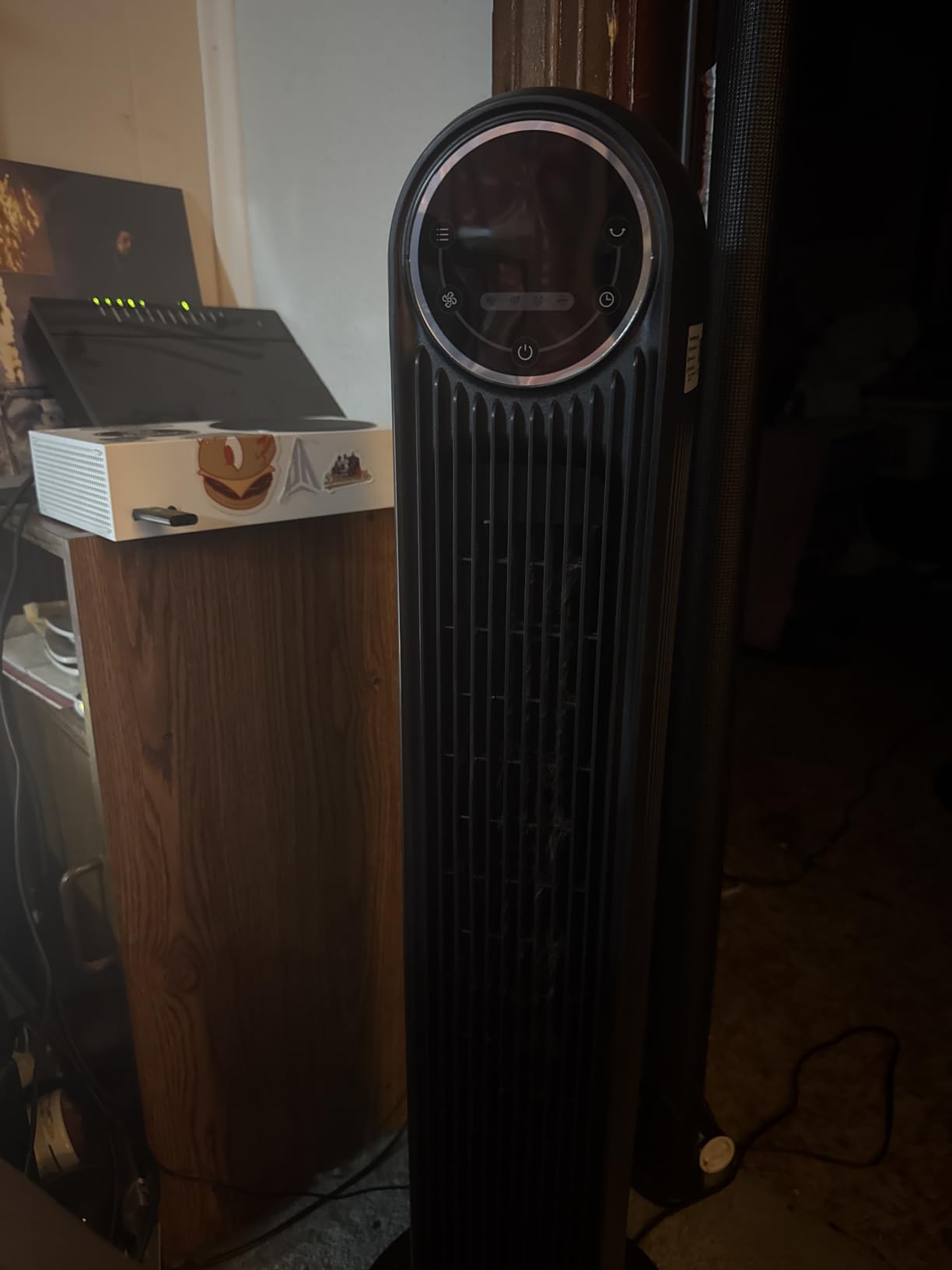
Skip it if your ceiling is 12 feet or higher and you need the column to physically reach the upper third of the room. At 36 inches this fan is powerful but short, and a taller frame will do more for the ceiling layer. Light sleepers should also note that noise climbs noticeably on the upper settings.
2. Honeywell QuietSet HYF260 – Quiet Whole-Room Cooling for Bedrooms
Honeywell QuietSet Whole Room Oscillating Tower Fan with Remote, White, HYF260
40 inch tall
253 cubic meters per hour
46 dB
5 speeds
1-8 hour timer
+ Pros
- Very quiet running that users forget about
- Slim 10 inch footprint fits tight rooms
- Remote stores inside the fan body
- Display dims across five light levels
- Long track record of durability
– Cons
- Modest airflow rather than a long-throw column
- Some fans develop a motor vibration buzz
- Limited build quality on the base
- Will not restart after a power cut
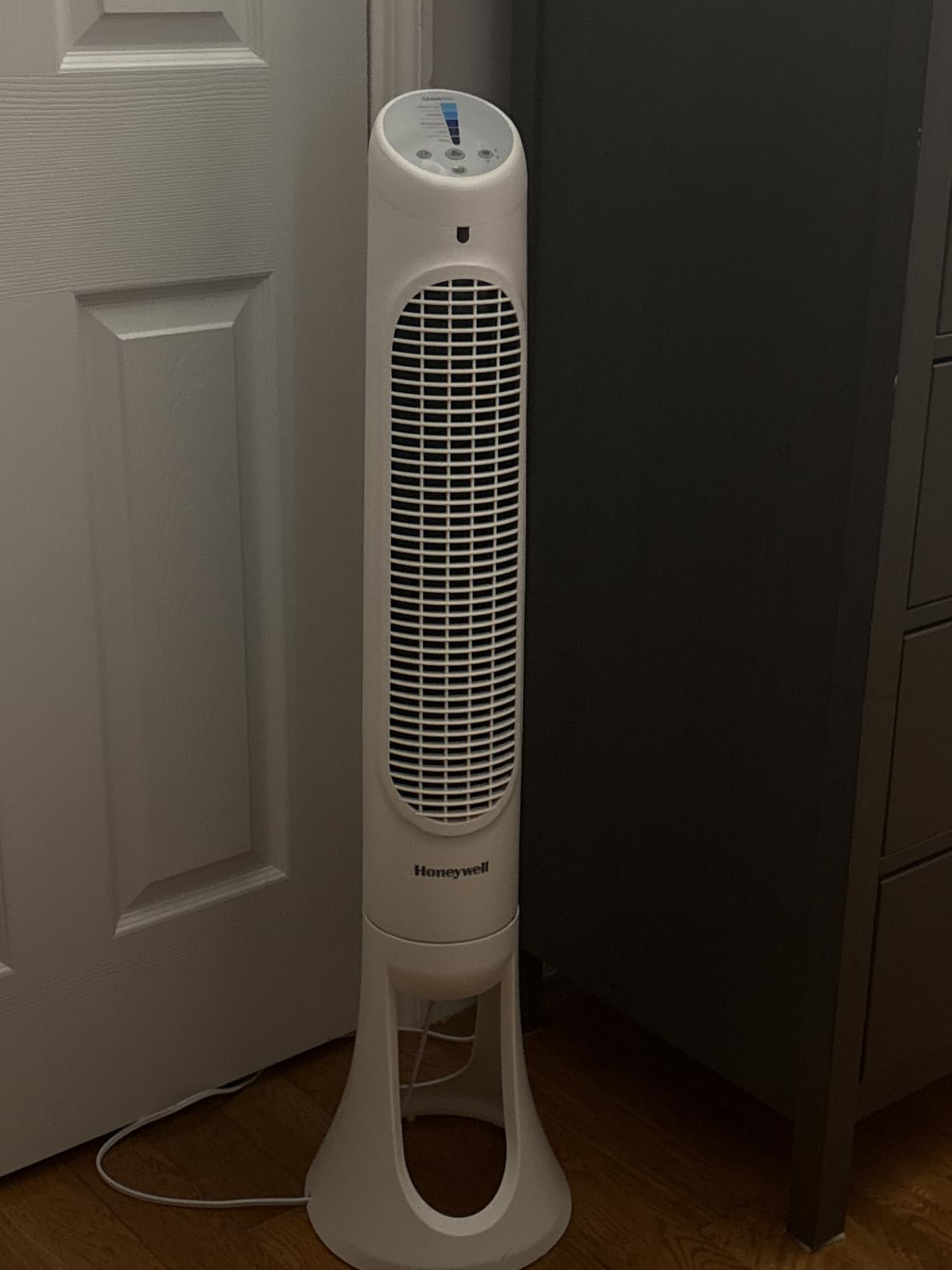
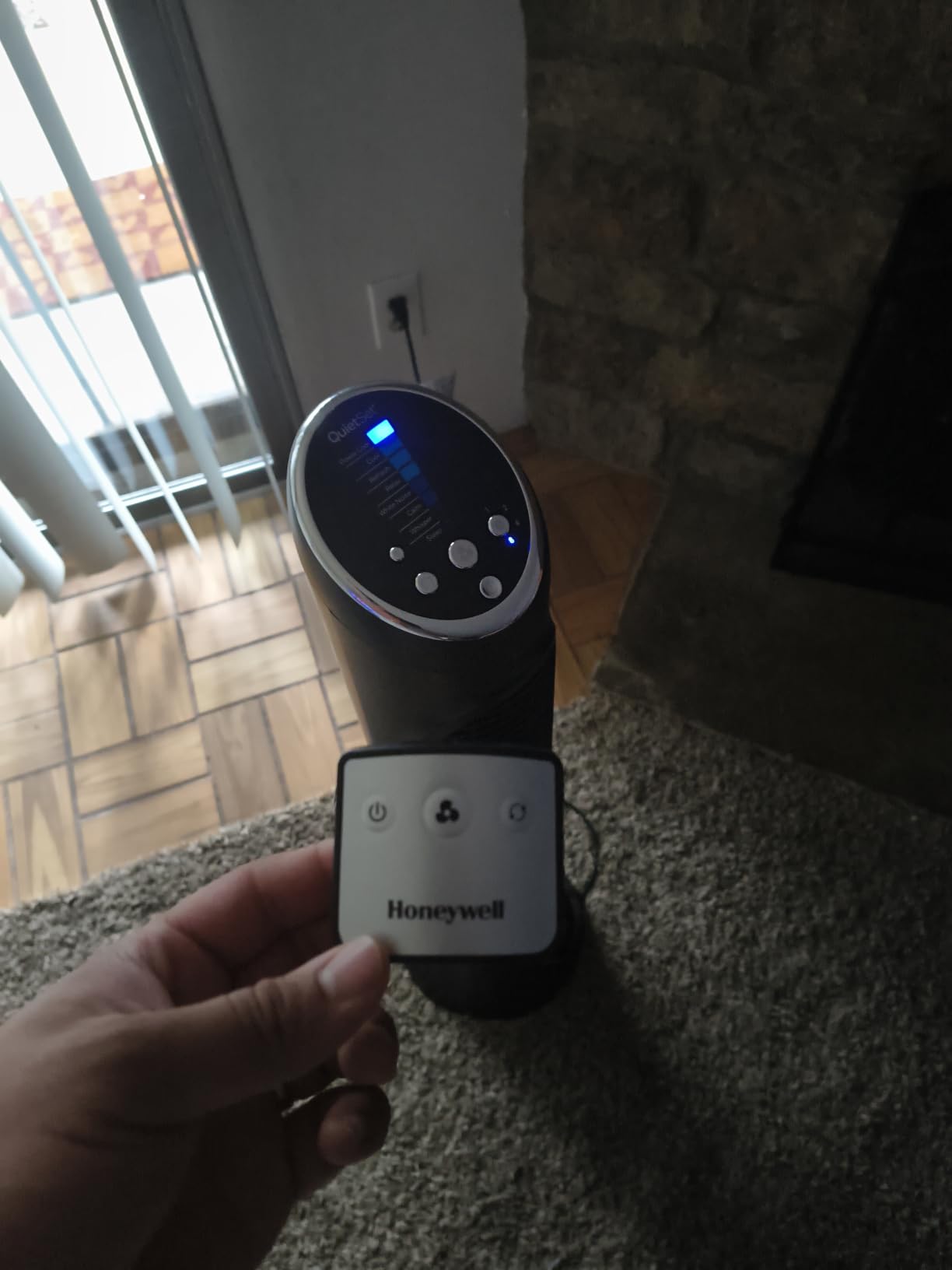
The QuietSet HYF260 is the fan I recommend when the tall room is a bedroom and silence is the priority. At 40 inches tall it clears more of the room than a standard 36-inch tower, and the listed 46 dB sits in the range where you can run it all night without it registering on your awareness.
What makes it distinctive is the control design. The display dims across five light levels, from full brightness down to off entirely, and the remote stores in a slot in the back of the unit so it cannot vanish between the cushions. That last detail sounds minor until you have replaced a lost remote three times.
Oscillation coverage and what 253 cubic meters per hour really delivers
The Honeywell lists airflow as 253 cubic meters per hour, which converts to a more modest volume than the CFM figures some competitors publish. That is the honest trade here. The oscillation sweeps the column widely enough to keep air moving across a bedroom, but it is a circulator rather than a high-velocity thrower.
For a 9 to 10 foot ceiling bedroom with a normal bed and normal furniture, that is exactly enough. For a vaulted living room you want to cool during the day, it is not.
Timer, speeds and sleep suitability
Five speeds with an auto shut-off timer from 1 to 8 hours cover the overnight use case well. The button and remote control arrangement is straightforward, and owners frequently report running these for five years or more, which is a durability track record few brands in this category match.
The narrow 10-inch diameter footprint is a real advantage in a bedroom where you need to squeeze past the bed to reach the window.
Who should skip it
Skip it if you need to feel air across a large open space, or if you are chasing the ceiling layer in a room above 10 feet. A minority of owners also report a motor vibration or rumble that undermines the quiet promise entirely, so if noise is your absolute priority, test it in your space before settling in.
3. Lasko 42-Inch Oscillating Tower Fan – Best Styling for 10-Foot Ceilings
Lasko Oscillating Tower Fan with Remote – Quiet Standing Fan for Bedroom, Office, and Home – 3 Speeds – Powerful Cooling Air – T42954 – 42″ Tall – Gray/Woodgrain
42.5 inch tall
262 CFM
55.4 dB
3 speeds
7.5 hour timer
+ Pros
- Tallest fixed frame in the group at 42.5 inches
- Woodgrain and grey finish suits furniture
- Nighttime setting dims LEDs and drops speed
- Remote handles power speed oscillation and timer
- Carry handle built into the base
– Cons
- Audibly loud on higher settings
- Only three speed settings
- Timer display takes mental math to confirm
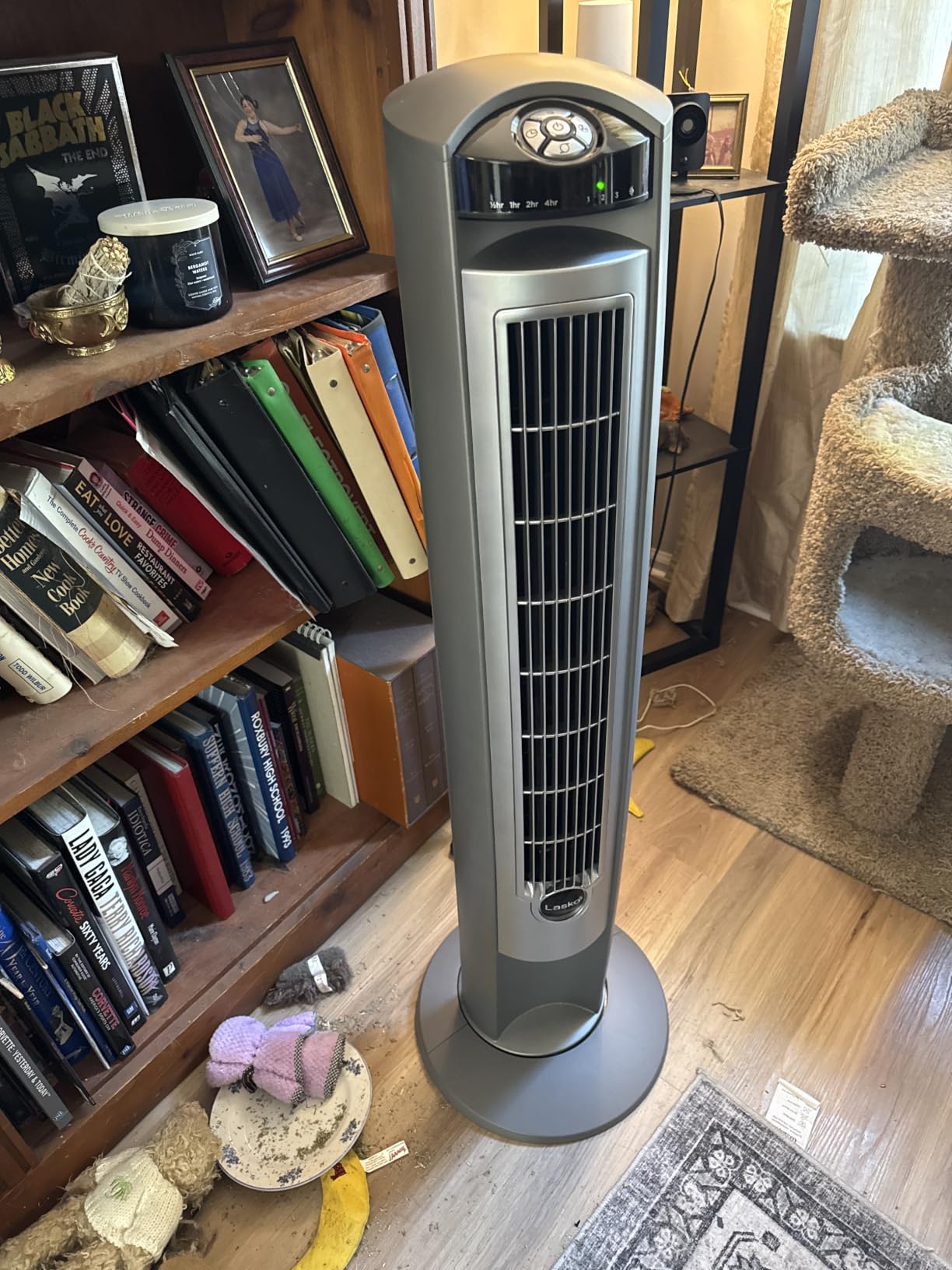
At 42.5 inches this is the tallest fixed-frame fan I tested, and the woodgrain and grey finish is the only one in the group that looks like furniture rather than an appliance. If your tall room is a living space you actually sit in, the appearance matters more than owners of black and white towers tend to admit.
The 60-degree oscillation is narrower than the 90-degree leaders, which means the swept zone is more concentrated but takes longer to cover a full room. In a 10-foot-ceiling space with furniture breaking up the floor plan, that tighter sweep is arguably a feature.
The nighttime setting and why it matters in a tall bedroom
Pressing the nighttime setting dims the LED controls and drops the speed in one action. In a room where the fan is standing four or five feet from your head because the furniture layout demands it, a control panel that glows at eye level is genuinely disruptive. This one handles that well.
Owners in forum discussions frequently single out Lasko for being tall, oscillating, quiet and powerful at once, and the height claim is the part that matters most here.
Noise is the real trade-off
The listed 55.4 dB is the highest sustained figure among the tall-frame options, and the owner feedback matches: this is a louder fan than the DC-motor models at equivalent airflow. It is perfectly acceptable in a living room during the day and less welcome in a bedroom.
The 7.5-hour programmable timer is slightly unusual and long enough to cover a full night on the lowest setting, but the timer display is not the clearest, and owners report having to double-check the setting.
Who should skip it
Skip it for a bedroom, and skip it if you need a wide sweep across a large open plan, because 60 degrees will not cover the space efficiently. The three-speed limit also means you cannot dial in the gentle mid-flow that tall rooms often need.
4. DREO Smart 42-Inch Tower Fan – App and Voice Control for Open Plans
DREO Smart 42” Tower Fan for Bedroom, 12 Speeds, 20dB Quiet Standing Fan
42 inch tall
1400 CFM
20 dB minimum
12 speeds and 4 modes
40ft throw
+ Pros
- Effectively silent below speed 5
- 40 foot throw crosses large rooms
- Display auto-dims in a dark bedroom
- App plus Alexa and Google Assistant support
- Tool-free disassembly for cleaning
– Cons
- Noticeably louder on the top speeds
- On-screen menu text is small
- Remote needs direct line of sight
- App is less intuitive than the panel
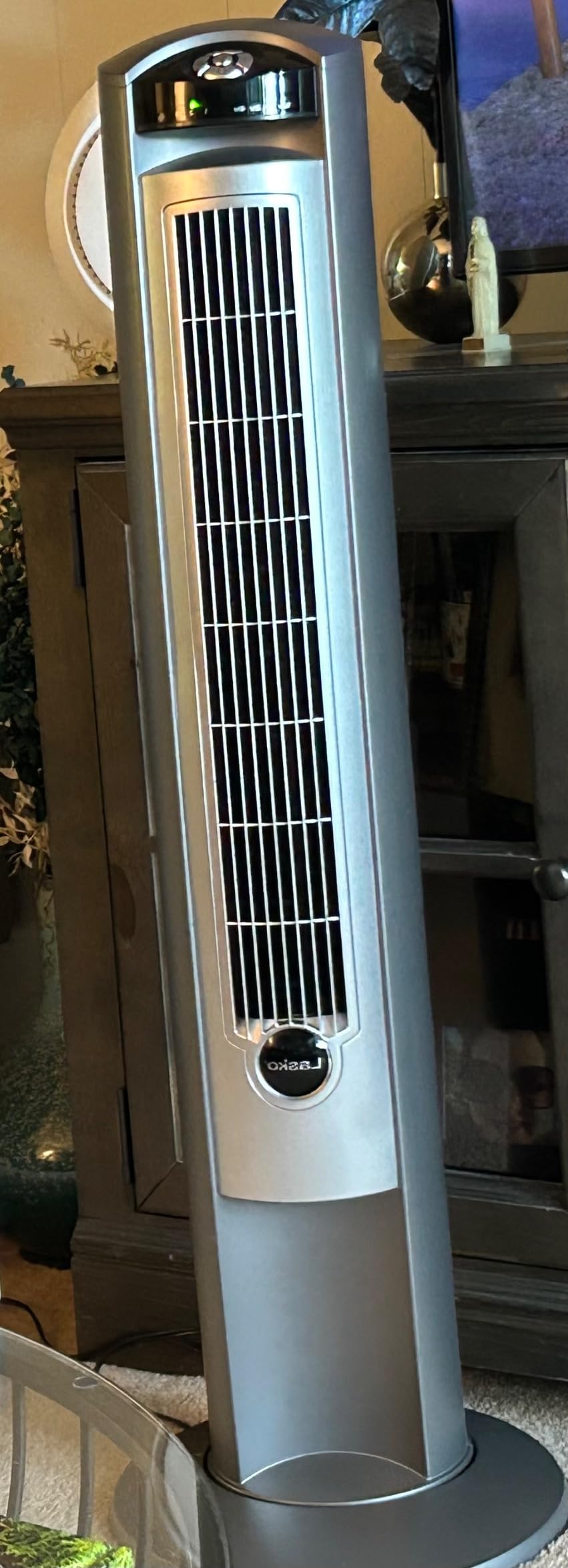
This is the tallest, quietest and highest-output fan in the group at the same time: 42 inches tall, 1400 CFM, and a minimum noise figure of 20 dB. If your tall room is wired into a smart home or you just want to change the fan from your phone at the top of the stairs, this is the one.
The 40-foot throw at 28 feet per second is the figure that matters in an open plan. In a vaulted space that connects to a kitchen or a second sitting area, you can feel the column cross most of the footprint rather than dying at the baseboard.
Why 12 speeds beats 3 speeds in a vaulted room
A vaulted room changes over the course of an evening. The ceiling layer is thickest right as the sun comes off the roof, then thins as the house cools. Twelve speeds across four modes let you match the output to that curve instead of running flat out or barely on.
The 90-degree oscillation and the 40-foot reach together cover a large open concept space in a way the narrower-sweep models in this roundup cannot.
Smart control and the sleep experience
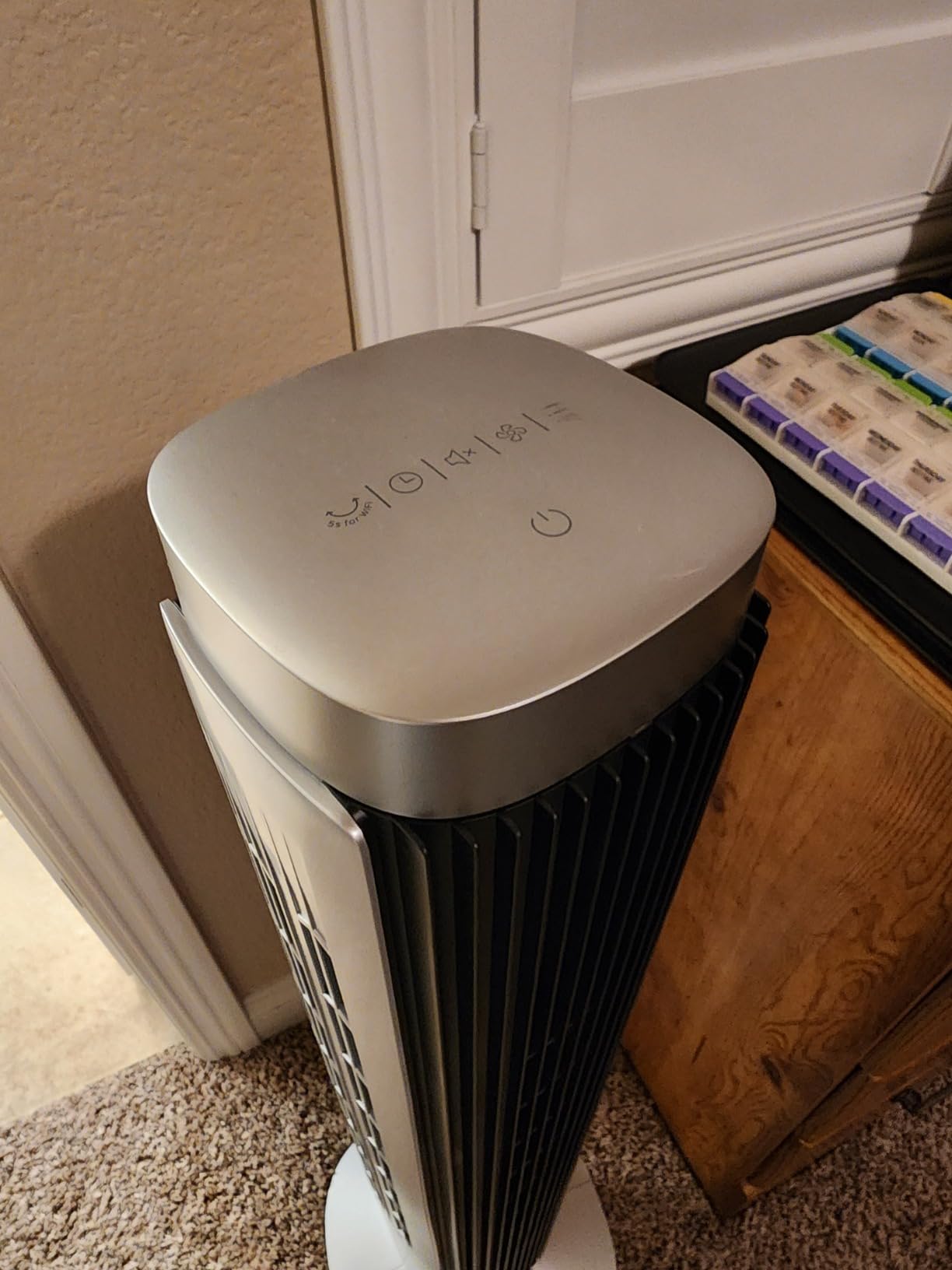
Control runs through the app, voice assistants, the remote or the touch panel. Below speed 5 the fan is effectively silent, and the display auto-dims, so a bedroom with a high ceiling does not become a room with a glowing panel in the corner.
At 24 watts, this is the lowest draw among the tall 42-inch models here, which matters if you plan to run it continuously through a summer.
Who should skip it
Skip it if you dislike app-dependent controls, since some owners find the app less intuitive than the physical panel, and if you have several people using the remote, because it needs to be pointed at the unit. It is also one of the louder options once you reach the top of its range.
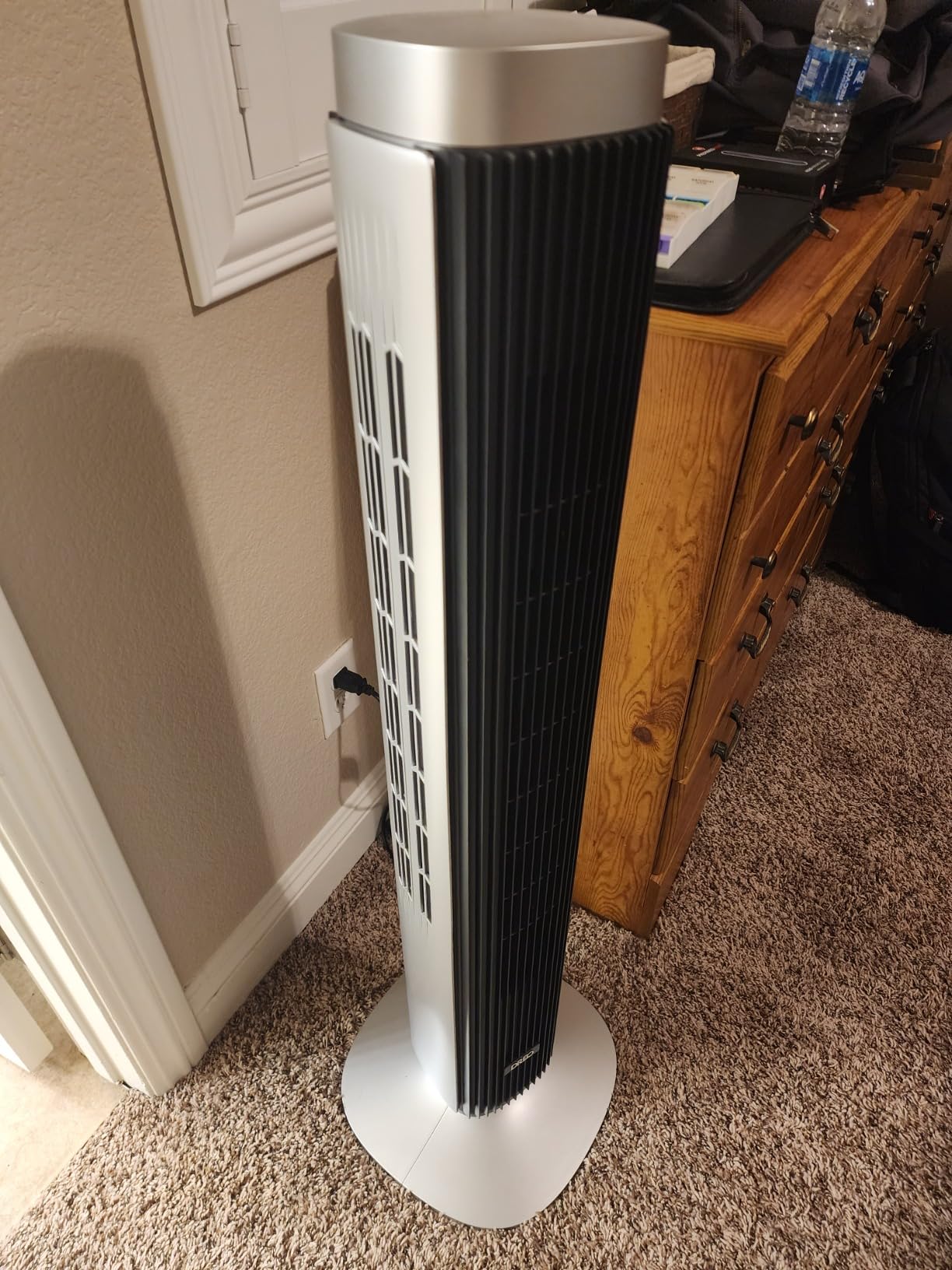
5. PELONIS 40-Inch Bladeless Tower Fan – Blade-Free Cooling for Shared Rooms
PELONIS 40-inch Bladeless Tower Fan for Bedroom, Standing Fan with Remote Control, 26ft/s, 90° Oscillation, 3 Speed Settings, 27 dB, 3 Modes, 15-Hour Timer, LED Display, Fan that Blows Cold Air, Black
40 inch bladeless
26 ft/s air speed
27 dB
3 speeds and 3 modes
15 hour timer
+ Pros
- Strong steady airflow owners say measurably cools the room
- Quiet for the power delivered
- Tool-free assembly takes minutes
- Small stable footprint fits tight corners
- Remote works up to 30 feet away
– Cons
- Only three speed settings
- Sleep mode is barely different from the top setting
- Awkward remote holder lets it protrude
- Some fans stopped oscillating after about a month
- Max setting is loud and throw weakens at distance
The bladeless body is the reason to consider this one, and it is a genuine advantage in a room where a child, a pet or a curious toddler is around. There is no exposed blade to reach through, and the smooth column also means fewer places for dust to settle.
At 40 inches tall with 26 feet per second air speed and 27 dB, it covers a 9 or 10 foot room well. Owners commonly report using it as a primary bedroom or living room circulator for years at a time.
Sensi Cool and the automatic speed adjustment
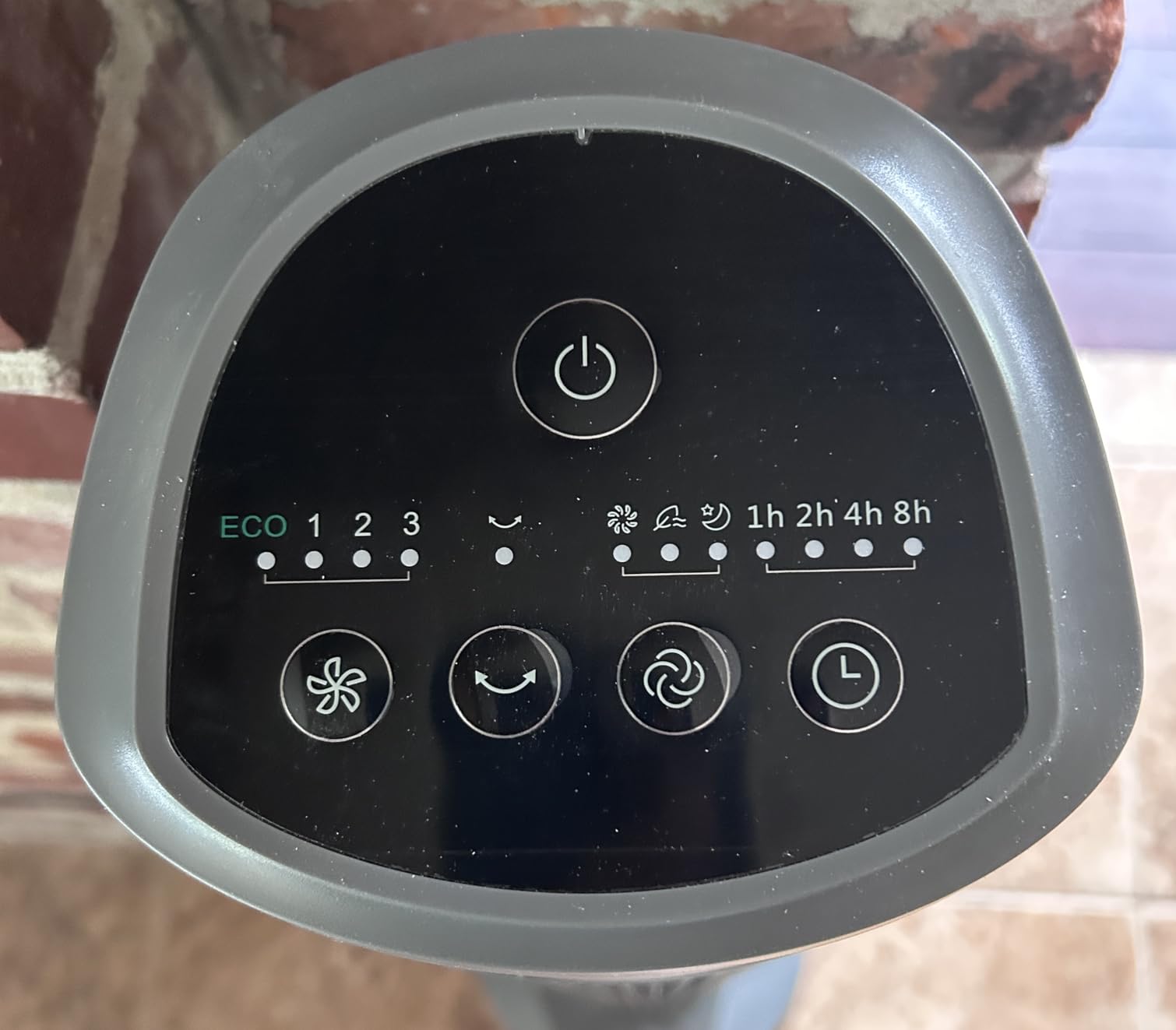
The built-in Sensi Cool technology adjusts the fan speed based on room temperature, which in a tall room is genuinely useful because the sensor responds to the mixed air rather than the stagnant ceiling layer. The 15-hour programmable timer with LED indicators is the longest in this group.
Be aware that the display is bright and has no dimming option, so it is a poor fit for a dark bedroom even though the fan itself is quiet.
Three speeds is the weakness
With only three settings across STRONG, NATURAL and SLEEP modes, you have very little room to adjust. Owners specifically note that sleep mode is not noticeably different from the highest setting, which undermines the idea of a gradual night-time ramp down.
GearLab testing flagged the button beep on the 40-inch Pelonis specifically, and that is a real annoyance at night for anyone within a few feet of the unit.
Who should skip it
Skip it if you need fine airflow control, if a beeping control panel would bother you, or if your ceiling is above 10 feet. A small number of owners also report oscillation stopping after about a month, so check early if that is a dealbreaker for you.
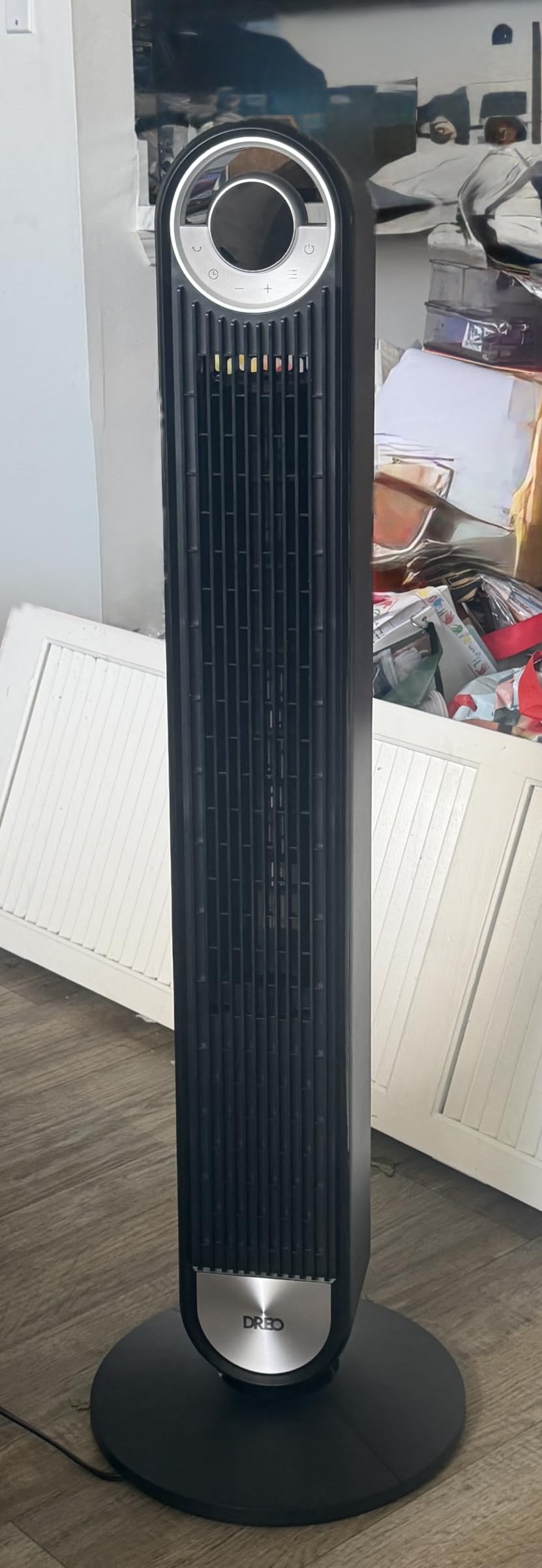
6. DREO 42-Inch 9-Speed Tower Fan – 1,397 CFM for 11 to 12 Foot Ceilings
DREO Tower Fan for Bedroom, Upgraded DC 28ft/s Velocity, 9 Speeds
42 inch tall
1397 CFM
28 ft/s air speed
25-28 dB
9 speeds and 4 modes
+ Pros
- Serious air volume from a slim bladeless body
- Very quiet through the low and mid speeds
- True 90-degree oscillation without rattle
- Display stays dark unless settings change
- Temperature-sensing smart algorithm
- Indoor and outdoor rated
– Cons
- Noticeably louder on the upper speeds especially 9
- Bumping the running fan cuts its power
- Safety cut-off interrupts output when moved
If your tall room goes past 10 feet, this is the fan I would put at the center of it. 1397 CFM from a 42-inch bladeless frame with 28 feet per second air speed gives you the vertical column that breaks up stratification, and the 4.6 owner rating across more than 22,000 reviews is the highest average in this group.
What impressed me most was the noise floor. A brushless DC motor tuned to 25 to 28 dB means it runs quietly enough to sit in a living room during a conversation, then ramps up when the evening heat peaks.
The 1397 CFM number and what it does for a two-story space
Compared with the 1158 CFM of our top pick, the extra airflow matters most when the room volume is large. A two-story great room has a lot of air above your head, and the more volume the fan moves per minute, the faster that warm ceiling layer gets pulled down into the occupied zone.
The smart algorithm with built-in temperature sensors adjusts wind speed automatically, which is a sensible hands-off approach in a room that heats unevenly from tall windows.
Where the noise trade-off shows up
Every high-output fan has a ceiling on its quiet range, and this one gets audibly loud on speed 9. Owners report it replacing noisy pedestal and oscillating fans, and a few mention using it to pull air across the room from a portable air conditioner, which is a genuinely effective pairing in tall spaces.
Note the power cut-off safety feature: lifting or bumping the unit while it runs interrupts power, so set it where people will not brush past it.
Who should skip it
Skip it for light sleepers who plan to run it on maximum overnight, and for anyone who will be moving it around a busy walkway while it runs. In everything else, the combination of height, output and silence is hard to beat for rooms above 10 feet.
7. Levoit Adjustable Height Tower Fan – Telescoping Reach for High Beds
Levoit Tower Fan for Bedroom, Standing Fan with 36”-47” Adjustable Height
36 to 47 inch telescoping
23 ft/s airflow
28 dB
5 speeds and 4 modes
12 hour timer
+ Pros
- Height adjusts from 36 to 47 inches
- Removable section converts it to a 24 inch fan
- Low 28 dB operating noise
- Simple push-button and remote operation
- Auto mode plus 12-hour timer
– Cons
- AC motor is louder than comparable DC models
- Airflow is moderate at 23 ft/s
- Fewer speed steps than 9 and 12 speed rivals
This is the only fan in the roundup with a telescoping body, and it solves a problem the others ignore: a tall room is not always tall at floor level. Extend it to 47 inches to get the discharge outlet above a high bed or a tall sofa, or pull the lower section off and you have a 24-inch fan for a small space.
That versatility is the reason to buy it. Reviewers single out the adjustable height as the headline feature, and it works well for airflow reaching high beds in vaulted-ceiling bedrooms.
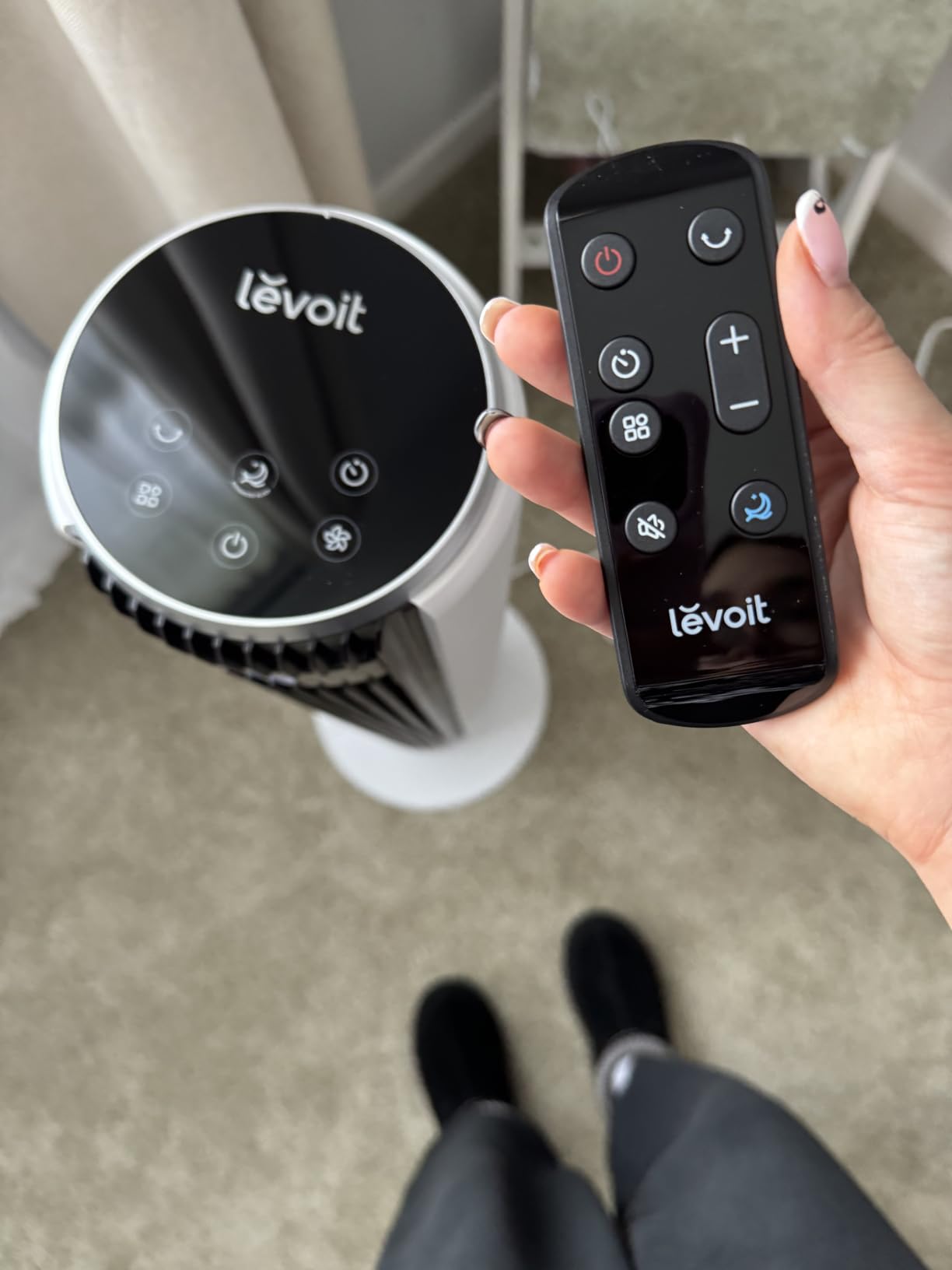
AC motor versus DC motor in a quiet room
The Levoit uses an AC motor rather than the brushless DC motors most of the high-output models here employ. The 28 dB figure is still low, but owners report it is audibly rougher than comparably quiet DC-motor fans at the same setting.
With 23 feet per second of airflow, the output is moderate. In a 9 or 10 foot room that is plenty for circulation. In a two-story space, it is the weakest throw of the 42-inch options in this list.
When adjustable height genuinely wins
Owners report that extending the tower to full height lets the outlet sit above a tall bed frame or a raised platform, so the stream passes over you rather than at waist level. That is a small design detail with a large comfort payoff in a master bedroom with a high ceiling.
The 90-degree oscillation, 12-hour timer and auto mode round out a well-equipped control set for a fan that does not need an app.
Who should skip it
Skip it for a large open space where you need long-throw velocity, and skip it if noise is the deciding factor in a quiet bedroom, because the AC motor gives up smoothness at low speeds. The 5-speed limit also leaves less room to fine-tune than the 9 and 12 speed models.
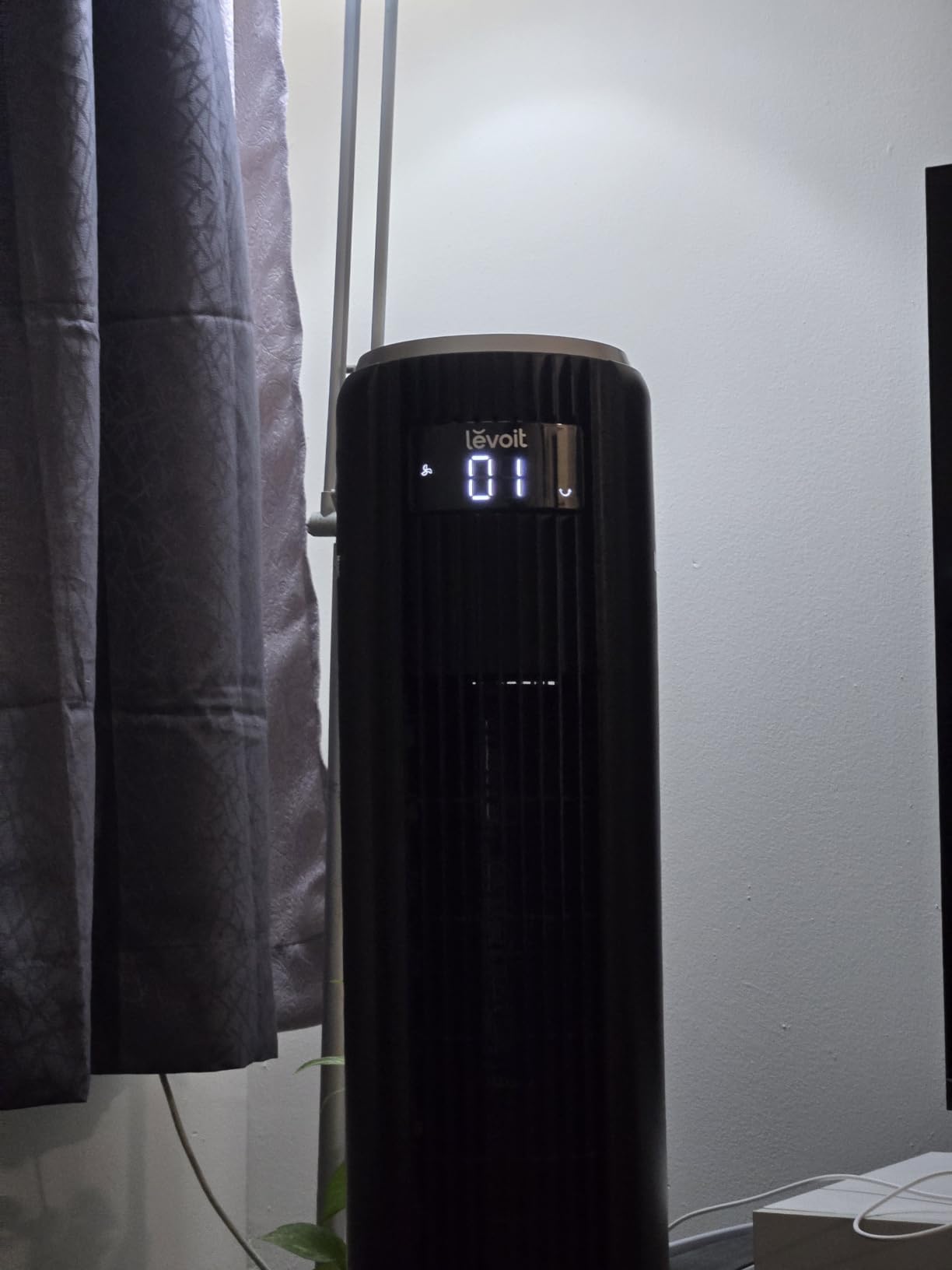
8. Lasko High Velocity 35-Inch Tower Fan – Raw Throw for Upstairs and Garages
Lasko High Velocity Oscillating Tower Fan – 35″ – U35115 – Silver/Black
35 inch tall
509 CFM
56.35 dB
3 speeds
7 hour timer
+ Pros
- Genuinely high velocity that reaches through doorways
- Low speed works as usable white noise
- Remote has an on-fan storage slot
- Adjustable outlet vents aim air up or down
- Ready to use out of the box
– Cons
- Louder than typical bedroom tower fans
- May need volume raised on maximum
- Only three speed settings
- Intake grilles are hard to clean
- Bright power indicator light at night
- Some fans developed a loud vibration
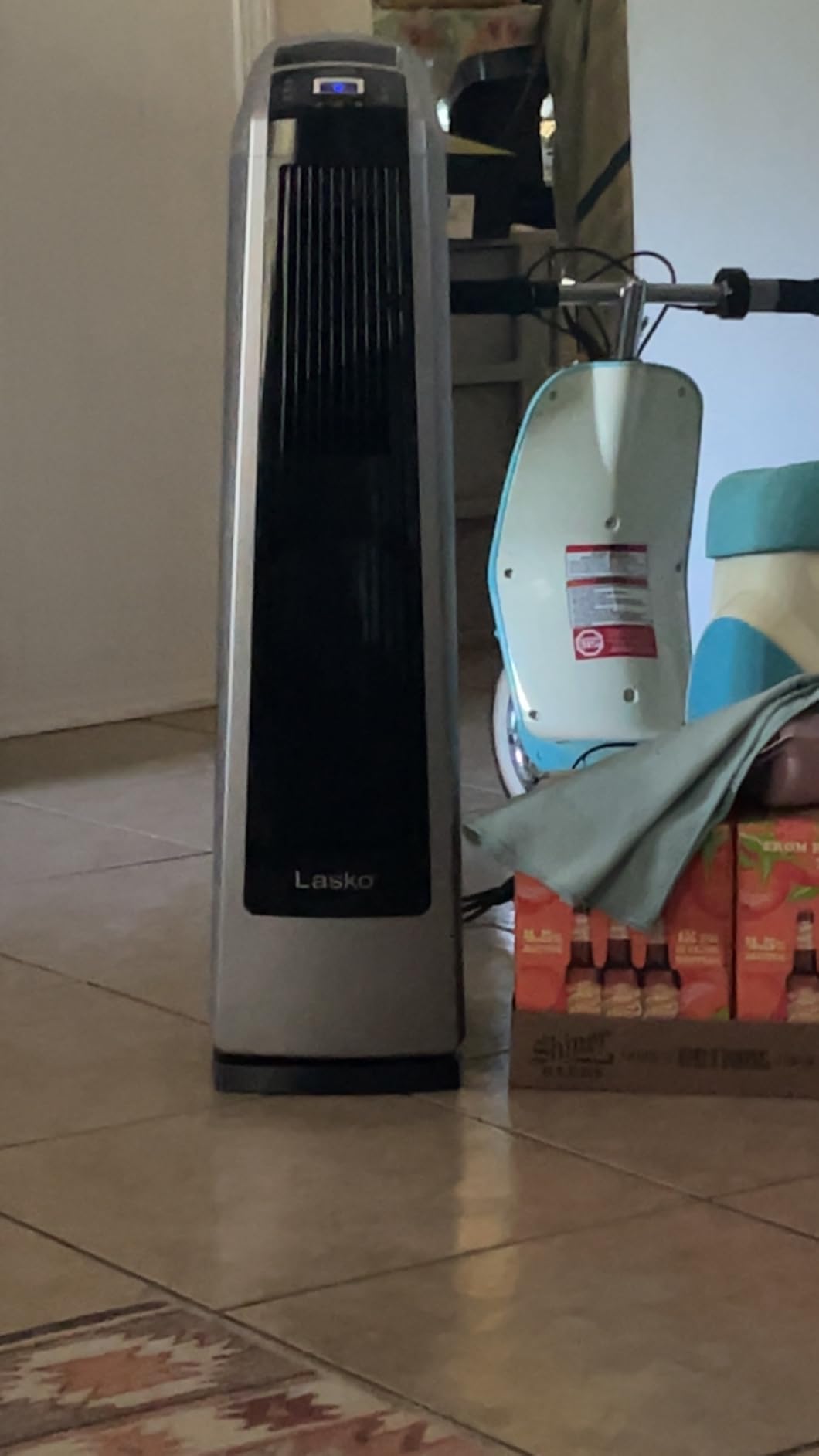
Not every tall space is a living room. This Lasko is built for the utility end of the category — upstairs rooms that hold heat, converted basements, garages and workshops where airflow reaching through a doorway is the point.
The 509 CFM output is listed as 25 percent more air velocity than traditional room fans, and the owner feedback supports that: buyers specifically cite hot upstairs rooms and garages where a ceiling fan was not enough. At 35 inches it is shorter than the leaders, so it is a velocity play rather than a height play.
Adjustable outlet vents as a high-ceiling tool
The outlet vents can be angled up or down. In a tall room that is genuinely useful — angle them upward to push into the ceiling layer and stir it, or angle them down for direct cooling when you are working at a bench or a desk. Few fans in this category offer directional control at all.
The widespread oscillation covers large rooms and work areas, and the 7-hour timer covers most of a work session.
The noise ceiling and the light problem
At 56.35 dB, this is one of the louder fans here, and owners say you may need to raise the TV or music volume on maximum. It is a fair trade for the raw output, but it disqualifies the fan from a bedroom.
The bright power button indicator has no dimming, and the intake grilles are difficult to clean, which is a real downside in a space that generates workshop dust.
Who should skip it
Skip it for sleeping spaces, for anyone sensitive to constant high-frequency motor sound, and for people who want a fan they can leave running in a quiet room all day. The 4.6 rating is impressive, but the review base is much smaller than the leaders here.

9. Amazon Basics 40-Inch Digital Tower Fan – Simplest Setup for Medium Tall Rooms
Amazon Basics 40″ 70-Degree Oscillating Digital Tower Fan with Powerful Airflow for Bedroom, Living Room, Office, 4 Speeds, 3 Modes, 15-Hour Timer, Remote Control, 50W, Black
40 inch tall
70-degree oscillation
60 dB
4 speeds and 3 modes
15 hour timer
+ Pros
- Assembly is two base halves snapped together
- Smooth operation with no rattle at sweep end
- Remote works from odd angles
- Quiet enough to double as sleep white noise
- Compact 11.4 inch footprint
– Cons
- Display lights stay on with no dimming
- 70-degree sweep is narrow for an open room
- Less total airflow than comparable towers
- Motor sound varies between fans
- Faint high-pitched tone at some settings
This is the fan to buy if you want a straightforward 40-inch tower with no learning curve. Assembly is genuinely a matter of snapping the two base halves together, and the top-mounted digital controls plus remote are as straightforward as they come.
It is also the least proven pick here, with a much smaller body of owner feedback than the brands above it, so I would treat it as the sensible fallback rather than the first choice.
Why 70 degrees is a real limitation in a tall open room
A 70-degree sweep covers a meaningfully smaller arc than the 90-degree and 150-degree models in this roundup. In a furnished tall room, that means longer gaps between sweeps hitting any given spot, which is exactly the mechanism that leaves a room feeling unevenly cooled.
Owners also report less total airflow than comparable Lasko towers, so if you need real volume in a 10-foot space, this is not the fan.
The always-on display problem
Reviewers complain most often about the display lights, which stay on and cannot be dimmed. In a dark bedroom with a high ceiling, that glowing panel is the first thing you see and the last thing you want at 2am.
On the positive side, the fan is quiet enough at low settings to work as sleep white noise, and the remote is responsive even at awkward angles.
Who should skip it
Skip it for a bedroom if any light source bothers you, and skip it for large open rooms where the narrow sweep will leave dead zones. A faint high-pitched tone at certain settings is also reported by some owners.
10. GoveeLife 42-Inch Tower Fan – Widest Sweep for Very High Ceilings
GoveeLife 42 in. Tower Fan, 150 Deg Oscillation, 5 Modes 12 Speeds, Black
42 inch tall
1515 CFM
26 ft/s
27 dB
30 to 150 degree oscillation
+ Pros
- Highest rated airflow in this group at 1515 CFM
- Quiet 27 dB brushless DC motor
- Symmetric 30 to 150 degree oscillation
- 12 speeds across 5 modes
- App plus Alexa Google and Siri
- Removable grill and impeller
- Ambient light and aromatherapy box
– Cons
- Most expensive option we tested
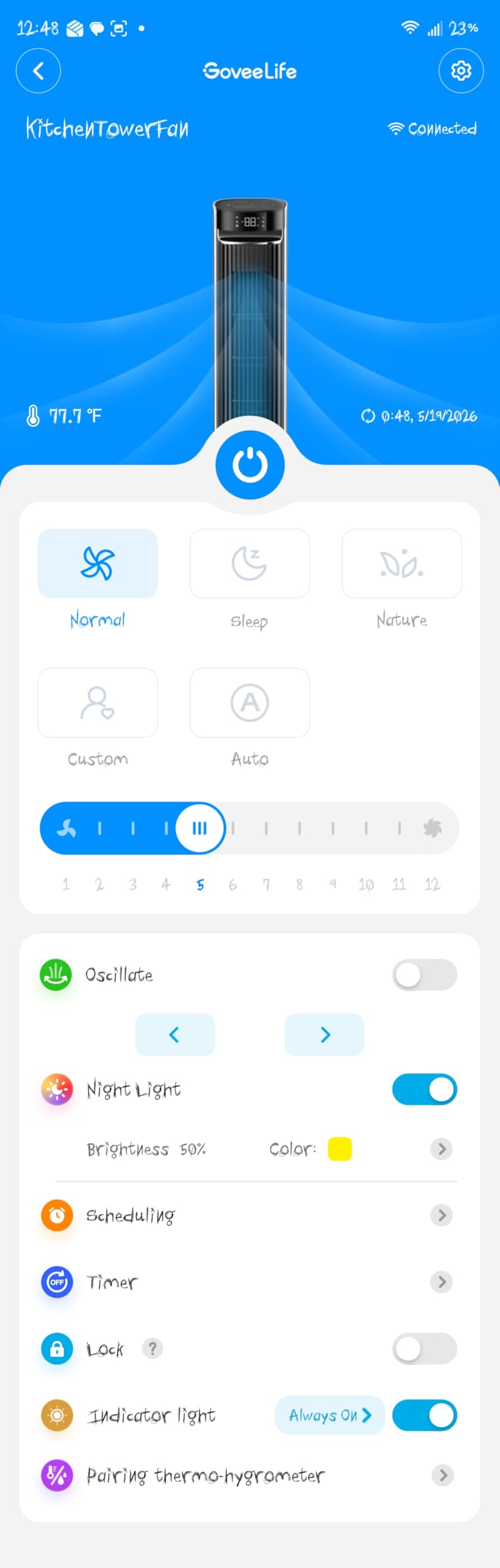
- Needs a 2.4 GHz network for smart features
- App scheduling can be confusing
- Thermo-hygrometer pairing limited to GoveeLife models
For a room with genuinely high ceilings, the 150-degree symmetric oscillation is the feature that separates this from everything else in the roundup. Where most fans sweep 60 to 90 degrees, this one covers a total of 150 degrees centered on the front, which halves the time any given point in a wide room waits between passes.
Add 1515 CFM of rated airflow, up to 26 feet per second, and a 27 dB brushless DC motor, and you have the most capable tall-room machine I tested. The 4.6 owner rating matches the best in the group, though on a much smaller review base than the picks above it.
Why 150 degrees matters more than another 10 percent of CFM
In a tall room, the air column that leaves the outlet is narrow at the top and spreads as it travels. A wide sweep compensates for that spread by covering more of the room’s width per pass. In a 12-foot great room that opens into a hallway, that difference shows up as an even room rather than a cool zone near the fan and a warm one everywhere else.
The built-in temperature sensor adds a basic thermostat function, and the 12 speeds across 5 modes give the finest granularity in the roundup.
Smart home integration, with a catch
It pairs with Alexa, Google and Siri, and the adjustable-color ambient light and essential oil aromatherapy box are more than decoration in a large room. The catch is that the smart features require a 2.4 GHz network with no 5 GHz support, and thermo-hygrometer pairing only works with specific GoveeLife models.
Owners also report that the scheduled shutdown in the app can be confusing if you enable it without meaning to.
Who should skip it
Skip it if your smart home runs on 5 GHz only, if you want the simplest possible controls, or if the smart features will go unused. Everything mechanical here is excellent; the networking requirement is the only real obstacle.
How to Size a Tower Fan for a High-Ceiling Room
Here is the method I used to place these ten fans into ceiling-height tiers, and the one you can use to work out what your own room needs.
1. Measure ceiling height, not floor area
Tape measure to the tallest point of the ceiling. Under 9 feet, any 36-inch tower will do the job. From 9 to 10 feet, look for 36 inches or more and at least 1,000 CFM. From 10 to 12 feet, treat 42 inches and 1,300 CFM as the starting line. Above 12 feet, you are looking at a two-unit strategy or a large ceiling fan.
2. Calculate the room volume in cubic feet
Multiply floor area by ceiling height. A 240 square foot room with a 12-foot ceiling is 2,880 cubic feet. That number tells you how much air the fan has to move, and it is the figure most shoppers never compute.
3. Aim for one air change every two to three minutes
Divide the cubic footage by the number of minutes you want a full change. For a 2,880 cubic foot room over three minutes, you need roughly 960 CFM of true mixed-air throughput. Manufacturer CFM numbers are measured at the outlet and rarely reflect what the room experiences, so treat this as a comparison tool between models.
4. Check the sweep before you buy
Below 60 degrees will not cover an open plan. Look for 90 degrees as the sensible floor, and 120 degrees or wider if the room is wide rather than deep. A narrow sweep in a wide room is the single most common mismatch I saw between a fan and the space it was put in.
Where to place it, and when to use something else
Put the fan on the floor, positioned so the discharge crosses the longest axis of the room. Some owners place a fan high, just below a soffit or canopy, to push air across the upper volume rather than at floor level. That is unusual advice, but in a vaulted room with a deep ceiling void it is worth trying, because it attacks the stratification layer directly.
Two things no tower fan does well. A tower fan does not remove heat from a room, it only moves air around, so on a genuinely hot day the felt temperature drop of several degrees will not keep up with rising indoor temperatures. And in a very tall space, a large ceiling fan on a downrod moves more air across the entire ceiling than any floor unit, because it works at the height where the warm air actually is. If you can install one, a ceiling fan is the better tool for a 14-foot great room. If you cannot, a tower fan is the sensible compromise.
Maintenance is the one tall-room-specific tip worth repeating. Warm air rises and carries dust with it, and in a high-ceiling room more of that dust ends up on the impeller and grille. Fans with removable, washable impellers — the DREO models and the GoveeLife — will save you real effort over a summer of daily running. The Lasko high velocity model’s intake grilles are the hardest to clean in this group.
For heating rather than cooling in a tall room, a different category applies entirely — our ceramic tower heater guide covers the thermostat and tip-over safety questions that matter in that situation.
Frequently Asked Questions
What is the best tall tower fan for cooling down a room quickly?
The DREO 42-inch 9-speed model is the fastest at cooling a tall room, rated at 1397 CFM with 28 ft/s air speed from a 42-inch frame. For the widest coverage, the GoveeLife 42-inch fan pairs 1515 CFM with a 150-degree oscillation. Both run on brushless DC motors that stay under 28 dB on lower settings.
What is the best tower fan for cooling a large room?
For large rooms, airflow volume and sweep width matter more than anything else. Look for at least 1200 CFM and 90-degree or wider oscillation. The DREO 28ft/s fan reaches about 34 feet and the DREO Smart 42-inch throws air 40 feet, while the GoveeLife covers a 150-degree arc that fills a wide open plan evenly.
What is the best height for a tower fan?
Match the fan to the ceiling rather than to the room size. For ceilings under 9 feet, 32 to 36 inches works. From 9 to 10 feet, choose 36 inches or taller. From 10 to 12 feet, treat 42 inches as the minimum. Above 12 feet, a 42 to 47 inch frame or a large ceiling fan is the better answer.
Do tower fans work in high ceilings?
They work, but only if the airflow is powerful enough to mix the warm air layer that collects at the ceiling down into the room. A short 32-inch fan will leave the upper third of a tall room untouched. A 42-inch fan with 1200 CFM or more and 90-degree or wider oscillation breaks up that layer and produces a felt temperature drop of several degrees.
What are the disadvantages of a tower fan?
The main drawbacks are that it moves air without removing heat, so it cannot replace air conditioning in extreme heat. High-output models are loud at maximum speed, button beeps and bright displays can disturb sleep, and many fans have only three speed settings. Grilles on some models are also difficult to clean.
Is a tower fan better than a ceiling fan for tall rooms?
In a very tall room, a ceiling fan on a downrod is usually better because it works at the height where the warm air has collected. A tower fan wins when you cannot install a ceiling fan, when you need a slim floor footprint, when you want quiet adjustable speeds at night, and when the room is only moderately tall at 9 to 10 feet.
Which Tower Fan Should You Buy for a Tall Room?
If your ceilings run 9 to 10 feet, take the DREO 28ft/s fan. Its 1158 CFM, 34-foot throw and 25 dB floor are the most balanced combination in the roundup, and it is the pick I would buy without hesitating.
If you need more, the DREO 42-inch 9-speed fan is the one for 11 to 12 foot ceilings, where 1397 CFM and a 42-inch frame finally reach the ceiling layer. For the widest coverage in a genuinely large space, the GoveeLife 42-inch fan takes top spot on output and sweep.
If the tall room is a bedroom, the Honeywell QuietSet HYF260 wins on dimmable controls and stored remote. If it is a garage or an upstairs room holding heat, the Lasko high velocity model moves more air than anything else here. If you need a bladeless body for safety around children, the PELONIS 40-inch is the pick, and if the outlet needs to sit above a high bed, the Levoit’s telescoping frame is the only one that adjusts.
Whichever you choose, measure your ceiling first and buy for the top third of the room, not the middle. That single habit is the difference between a fan that helps and a fan that just blows at you. For the ongoing sleep-mode and white-noise question, our bedroom roundup covers the noise profile in more detail.
Last updated for 2026. All ten picks were re-checked against current owner feedback for this edition.
Leave a Reply