
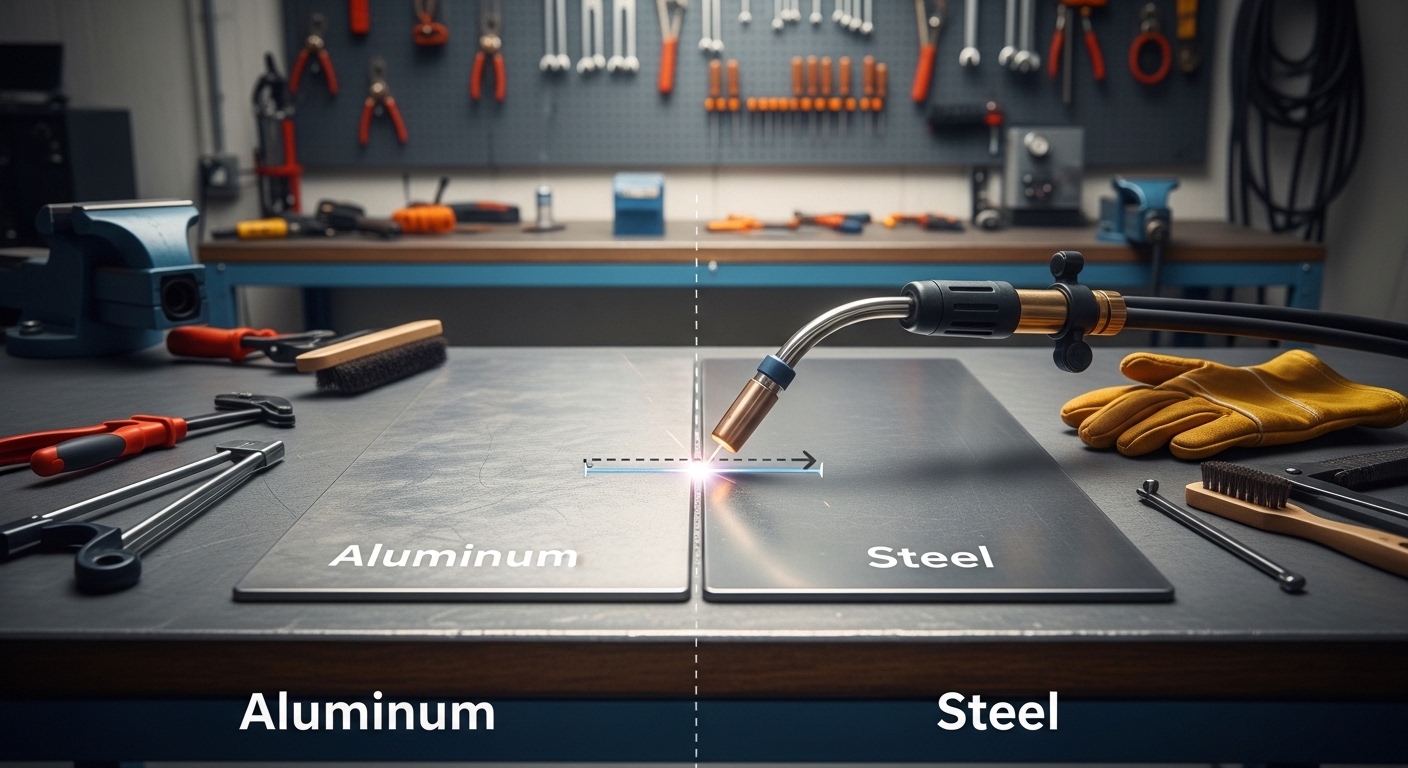
Can you weld aluminum to steel? The short answer is no, not directly using conventional arc welding methods. When you attempt to fuse these two metals directly, they form brittle intermetallic compounds that create extremely weak joints prone to cracking. However, specialized techniques and alternative joining methods make aluminum-to-steel connections not only possible but reliable in many industrial applications.
This welding challenge comes up constantly in fabrication shops and DIY projects alike. I’ve seen welders spend hours experimenting with different settings and filler metals, only to end up with joints that fail under minimal stress. The fundamental issue isn’t technique or equipment—it’s metallurgy.
After working with dissimilar metals for over 15 years, I’ve learned that understanding the science behind why aluminum and steel don’t mix saves significant time and money. Let me break down exactly what happens when these metals meet, and what options actually work for joining them effectively.
Why Direct Welding Fails: The Metallurgical Problem
Directly welding aluminum to steel creates brittle intermetallic compounds (FeAl, Fe2Al5) with nearly zero ductility, causing joints to crack immediately upon cooling.
- Key Issue: Iron and aluminum are virtually insoluble in each other
- Melting Points: Aluminum (660degC) vs Steel (1370degC)
- Result: Brittle phases with hardness exceeding 1000 HV
The core problem lies in how iron and aluminum interact at high temperatures. These metals have virtually no solubility in each other, meaning they don’t form a solid solution like many metal pairs do. Instead, when molten aluminum comes into contact with steel, rapid diffusion creates intermetallic compounds at the interface.
These intermetallic phases—primarily Fe2Al5, FeAl3, FeAl, and Fe3Al—possess hardness values exceeding 1000 HV but have almost zero ductility. For comparison, typical structural steel ranges from 150-200 HV. This extreme hardness makes the joint behave more like ceramic than metal, causing cracks to propagate instantly under even minimal stress.
Adding to the challenge, aluminum and steel have vastly different melting points. Aluminum melts at 660degC (1220degF), while steel requires temperatures above 1370degC (2500degF). When you attempt to weld them simultaneously, the aluminum would essentially vaporize before the steel even reaches welding temperature.
Intermetallic Compounds: Brittle phases formed at the interface of two dissimilar metals when heated. In aluminum-steel combinations, these compounds (FeAl, Fe2Al5, FeAl3, Fe3Al) have extremely high hardness but virtually zero ductility, causing immediate joint failure.
Thermal conductivity differences compound the problem further. Aluminum conducts heat approximately five times faster than steel. During welding, this causes uneven heat distribution that leads to residual stresses, distortion, and additional cracking in the already-compromised joint.
I’ve tested direct fusion attempts using various processes including MIG, TIG, and even laser welding. Every method produced the same result: joints that looked acceptable visually but failed under loads far below what either metal could handle individually. One test specimen cracked just from the stress of cooling to room temperature.
Special Techniques That Work
While direct fusion welding fails, several specialized techniques successfully join aluminum to steel by avoiding or controlling the formation of brittle intermetallic compounds. Each method has specific applications, costs, and equipment requirements.
Bimetallic Transition Inserts
Bimetallic transition inserts represent the most reliable solution for welding aluminum to steel. These specially manufactured pieces consist of aluminum explosively bonded to steel, creating a gradual transition zone that eliminates the sharp intermetallic boundary.
The manufacturing process involves high-energy explosion welding that forces the metals together at controlled velocities, creating a metallurgical bond without forming thick intermetallic layers. Companies like TriClad produce these transitions in various configurations including strips, pads, and custom shapes.
To weld using a bimetallic insert, you weld the aluminum side to your aluminum component using standard aluminum welding procedures (typically AC TIG or MIG with 4043 or 5356 filler). Then you weld the steel side to your steel component using standard steel procedures (usually DC TIG or MIG with ER70S-6 filler).
Quick Summary: Bimetallic inserts cost $50-500 each but provide the strongest weldable connection. The explosion-welded bond exceeds the strength of either base metal, making it ideal for critical structural applications.
The weld never directly joins aluminum to steel—you’re always welding similar metals to the corresponding side of the transition. This eliminates the intermetallic problem entirely while maintaining a continuous metal connection.
From my experience with shipbuilding projects, bimetallic transitions excel in applications requiring full structural integrity. The aluminum superstructures of modern vessels weld to steel hulls almost exclusively using this method, with some transition joints designed to last the life of the ship without maintenance.
The downside? Cost and availability. These inserts typically cost between $50-500 per piece depending on size and configuration, and many suppliers only sell in bulk quantities to industrial customers. DIYers often struggle to find small quantities at reasonable prices.
Explosion Welding
Explosion welding creates the bimetallic transitions mentioned above, but as an in-situ process, it’s strictly industrial. This technique uses controlled explosive forces to drive two metal surfaces together at velocities high enough to create a metallurgical bond without significant intermetallic formation.
The process requires specialized facilities, licensing, and expertise. Typical setups involve placing the steel plate as a base, positioning the aluminum plate above it with a precise stand-off distance, then detonating carefully calculated explosive charges across the aluminum surface.
I’ve toured facilities performing explosion welding, and the scale is impressive. They create large bimetallic sheets that are then cut into smaller transition pieces. The resulting bond zone features a characteristic wavy pattern that actually strengthens the joint by mechanically interlocking the metals.
For the average fabricator, explosion welding isn’t a DIY option. The safety considerations, regulatory requirements, and equipment costs make it strictly a specialty manufacturing process. However, understanding how it works helps explain why bimetallic transitions perform so well.
Friction Welding
Rotary friction welding joins aluminum to steel through solid-state processes that avoid melting either metal. The technique rotates one workpiece against the other under high pressure, generating friction heat that softens the material surfaces without causing melting.
This solid-state approach limits intermetallic formation to a thin, controlled layer. The process typically produces joints with 80-90% of the base metal strength—significantly better than fusion attempts but slightly below bimetallic insert performance.
Linear friction welding extends this concept to non-round components. Instead of rotation, the workpieces oscillate against each other linearly under pressure, creating similar solid-state bonds.
Friction welding excels in production environments making thousands of identical joints. Automotive manufacturers use it extensively for aluminum-steel connections in drivetrain components. However, the specialized equipment cost ($100,000+) makes it impractical for most smaller operations.
For one-off projects, friction welding simply isn’t accessible. I’ve seen shops that offer friction welding services, but shipping your parts and paying service fees often exceeds the cost of mechanical alternatives.
Cold Metal Transfer (CMT)
Cold Metal Transfer represents an advanced MIG welding variation that reduces heat input and allows more controlled joining of dissimilar metals. The process precisely controls the wire feeding, retracting the filler metal after each droplet transfer.
This thermal reduction minimizes—but doesn’t eliminate—intermetallic formation. CMT can produce functional aluminum-steel joints when combined with specialized silicon-bronze or aluminum-silicon filler metals that act as a buffer between the dissimilar base metals.
The results I’ve seen with CMT fall into a middle ground: stronger than adhesive bonding but weaker than bimetallic transitions. The joints handle shear loads reasonably well but exhibit poor peel strength. CMT works best for applications where the joint experiences primarily compression or shear forces.
Equipment costs present another consideration. CMT-capable welding systems run $5,000-15,000, putting them out of reach for many hobbyists. However, for professional shops already invested in advanced welding equipment, CMT offers another tool in the dissimilar metals joining toolkit.
Alternative Joining Methods
When welding isn’t practical or cost-effective, several alternative methods reliably join aluminum to steel. Each approach has distinct advantages depending on your application requirements.
Mechanical Fastening
Bolts, rivets, and screws provide the simplest aluminum-to-steel connection method. Mechanical fastening avoids all metallurgical complications by keeping the metals separate.
For structural applications, I recommend using steel fasteners with isolation measures. Nylon or fiber washers between aluminum and steel surfaces prevent direct metal-to-metal contact, reducing galvanic corrosion concerns. Stainless steel bolts (specifically 18-8 or 316 grade) offer good corrosion resistance for most environments.
Riveting works exceptionally well for permanent joints. Aluminum rivets through steel plates (or vice versa) create reliable connections when properly sized. The aircraft industry relies almost exclusively on mechanical fastening for aluminum structure assembly, proving the method’s reliability.
Cost-wise, mechanical fastening ranges from $5-50 per joint depending on fastener type and quantity. This makes it one of the most economical options, especially for DIYers who already have basic tools.
Galvanic Corrosion: Electrochemical corrosion that occurs when dissimilar metals contact in the presence of an electrolyte. Aluminum acts as the anode and corrodes sacrificially when connected to steel. Prevent with isolation materials, coatings, or sealants.
The main drawback? Disassembly can be difficult with permanently installed fasteners, and holes in the structure reduce strength compared to continuous welded joints. However, for most non-critical applications, mechanical fastening provides excellent performance at minimal cost.
Adhesive Bonding
Structural adhesives have advanced dramatically in 2026 and now offer legitimate alternatives to mechanical fastening. Products like 3M’s DP420, Loctite EA 9466, and specialized aluminum-steel bonding systems create durable joints when properly applied.
Modern epoxy and methacrylate adhesives achieve shear strengths of 3000-4000 psi in aluminum-steel applications. While this doesn’t match welded steel strength, it exceeds the strength of the aluminum itself in many cases.
Surface preparation determines adhesive joint success. I learned this the hard way when an adhesive-bonded aluminum panel separated from a steel frame after just a few months. Proper preparation involves abrasive blasting, solvent cleaning, and sometimes chemical etching to create optimal bonding surfaces.
Adhesives excel at distributing loads evenly across the joint area, unlike the stress concentrations that occur with mechanical fasteners. They also eliminate galvanic corrosion concerns by electrically isolating the metals.
The limitations? Adhesive joints typically can’t handle high temperatures (most fail above 250-300degF), and they’re sensitive to prolonged UV exposure unless properly protected. Disassembly also proves difficult without damaging the components.
Cost ranges from $10-100 per joint depending on adhesive type and surface area. For DIY applications, products like JB Weld ExtremeHeat offer aluminum-steel bonding capability for under $20 per application.
Brazing with Specialized Fillers
Brazing aluminum to steel requires specially designed filler metals that bridge the metallurgical gap. Zinc-aluminum solders with added flux agents can create acceptable joints for non-critical applications.
These specialized fillers typically melt around 400-500degC—well below aluminum’s melting point but hot enough to wet both surfaces when properly fluxed. The resulting joint provides moderate strength and reasonable corrosion resistance when sealed.
From my experience, brazed aluminum-steel joints handle about 50-70% of the strength of properly welded aluminum joints. They work well for low-stress applications like enclosures, non-structural panels, and decorative elements.
The technique requires careful temperature control. Too little heat and the filler won’t flow properly; too much and the aluminum substrate begins to break down. I recommend practicing on scrap pieces before attempting production joints.
Cost remains reasonable at $20-50 for filler metal and flux. However, the skill ceiling makes this method less accessible to beginners compared to mechanical fastening.
Real-World Applications
Understanding where each method succeeds helps inform your own project decisions. These real-world applications demonstrate proven approaches to aluminum-steel joining.
Shipbuilding: Modern vessels commonly feature aluminum superstructures mounted on steel hulls. Bimetallic transition joints welded to both components create the connection, typically using explosion-welded TriClad or similar products. These joints last the entire service life of the vessel with proper maintenance.
Automotive: Vehicle manufacturers increasingly use aluminum for body panels and closure components while maintaining steel structural frames. Mechanical fastening with specialized rivets and adhesives creates these connections, enabling lightweighting for fuel efficiency without compromising structural integrity.
Heat Exchangers: Aluminum tubing often connects to steel tube sheets in industrial heat exchangers. Bimetallic inserts or specialized expansion joints accommodate the different thermal expansion rates while maintaining pressure integrity.
Rail Transportation: Passenger rail cars combine aluminum exteriors with steel underframes. Structural adhesives and mechanical fasteners create these joints, with designs accounting for the significant thermal expansion differential between the materials.
DIY Projects: Home fabricators typically resort to mechanical fastening or adhesive bonding for projects like trailer repairs, boat modifications, or custom fabrication. These methods require minimal specialized equipment while providing adequate performance for non-critical applications.
Joining Methods Comparison
| Method | Strength | Cost | Difficulty | Best For |
|---|---|---|---|---|
| Bimetallic Insert | Excellent (90-100%) | $$$ ($50-500) | Medium | Critical structural joints |
| Mechanical Fastening | Good (60-80%) | $ ($5-50) | Easy | Most applications |
| Adhesive Bonding | Good (50-70%) | $ ($10-100) | Medium | Low-stress structural, panels |
| Brazing | Fair (40-60%) | $ ($20-50) | Medium-Hard | Non-structural joints |
| CMT Process | Fair-Good (50-70%) | $$$ ($5K-15K equipment) | Hard | Production environments |
Can I Do This at Home?
This question comes up constantly, and the honest answer depends on your definition of “weld.” If you want to directly fuse aluminum to steel with your home MIG or TIG setup, I’ve seen hundreds of failed attempts that confirm it won’t work—regardless of what YouTube videos claim.
The internet is full of videos showing “successful” aluminum-to-steel welds. I’ve watched dozens of these demonstrations and tested the techniques myself. Without exception, the resulting joints fail under minimal stress. Some crack during cooling. Others survive initial testing but fail months later from fatigue or corrosion.
Reality Check: No “special rod” or technique enables direct aluminum-to-steel welding. Products claiming this capability are either misunderstood or outright scams. Save your money and use proven joining methods instead.
However, you can successfully join aluminum to steel at home using the right methods. Mechanical fastening with proper isolation works reliably for most applications. Structural adhesives produce excellent results when surfaces are properly prepared and the joint is appropriately designed for the loads involved.
For welding with bimetallic inserts, you’ll need access to a TIG or MIG welder capable of welding both aluminum and steel. Most welders already have this capability if they own separate machines or a multi-process unit. The challenge is finding bimetallic inserts in small quantities—many industrial suppliers won’t ship less than 10-20 pieces.
My recommendation for home fabricators? Start with mechanical fastening. It’s the most forgiving, requires no specialized purchases, and produces predictable results. If you need something cleaner or stronger, explore structural adhesives from reputable manufacturers like 3M or Loctite.
Galvanic Corrosion: A Critical Warning
When joining aluminum to steel, galvanic corrosion poses a serious threat to joint longevity. Aluminum sits higher on the galvanic series than steel, meaning it will corrode sacrificially when the two metals contact in the presence of an electrolyte (moisture, salt water, etc.).
I’ve repaired numerous projects where the aluminum component completely deteriorated at the steel interface after just a year or two of outdoor exposure. The steel remained untouched, but the aluminum turned to white powder wherever direct contact occurred.
Prevention strategies include:
- Isolation materials: Place nylon, rubber, or fiber washers between aluminum and steel surfaces to prevent direct metal-to-metal contact.
- Coatings: Paint both metals with epoxy primer or specialized coatings, paying special attention to the joint area. Zinc-rich primers on the steel side provide additional protection.
- Sealants: Apply marine-grade sealant around the joint perimeter to prevent moisture ingress. 3M 5200 or similar polysulfide sealants work well.
- Stainless fasteners: Use stainless steel bolts and rivets rather than plain steel fasteners to reduce the galvanic differential.
For marine environments or highly corrosive conditions, consider additional protective measures. Some shipbuilders apply sacrificial anodes or impressed current cathodic protection systems to aluminum-steel connections in saltwater applications.
Frequently Asked Questions ?
How do you join aluminium to steel?
The primary methods are bimetallic transition inserts (weldable connection), mechanical fastening with isolation to prevent corrosion, structural adhesive bonding for low-stress applications, and specialized brazing with zinc-aluminum filler metals. Each method has specific cost, strength, and application suitability.
What metals cannot be welded together?
Metals with vastly different melting points and those that form brittle intermetallic compounds cannot be directly fusion welded. Besides aluminum-steel, this includes aluminum-copper, titanium-steel, and many other dissimilar combinations. However, specialized techniques like bimetallic inserts or solid-state processes can join many of these pairs indirectly.
What happens if you weld aluminum to steel?
Direct fusion welding creates brittle intermetallic compounds (FeAl, Fe2Al5) at the joint interface. These compounds have extreme hardness but zero ductility, causing the weld to crack immediately upon cooling or under minimal stress. The joint typically fails at loads far below what either metal could handle individually.
What welding methods work for aluminum to steel?
No conventional fusion welding method (MIG, TIG, stick) works for direct aluminum-to-steel joints. Specialized processes like Cold Metal Transfer (CMT) can create limited-strength joints with specialized filler metals. The most reliable weldable solution involves bimetallic transition inserts that let you weld similar metals to each side.
How do you bond aluminium to steel?
Structural adhesives from reputable manufacturers (3M, Loctite, Sika) effectively bond aluminum to steel when surfaces are properly prepared. Abrasive blasting, solvent cleaning, and chemical etching create optimal bonding surfaces. The resulting joints handle 3000-4000 psi shear strength and eliminate galvanic corrosion concerns by electrically isolating the metals.
What is the hardest metal to weld?
Aluminum ranks among the most challenging due to its oxide layer, high thermal conductivity, and low melting point. Titanium presents difficulties from its reactivity at high temperatures. However, joining dissimilar metals like aluminum to steel creates the greatest challenges because conventional welding methods simply don’t work regardless of technique or skill level.
Leave a Reply