
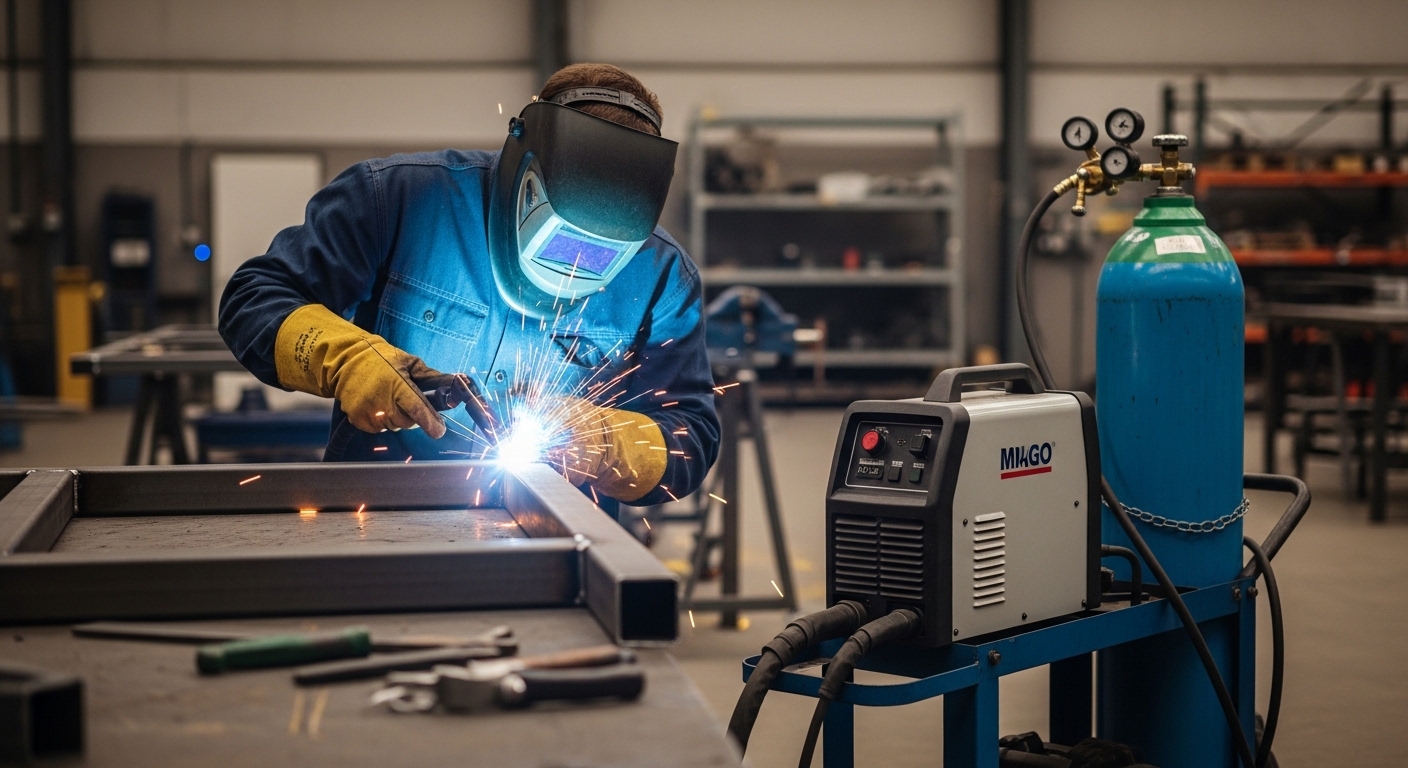
MIG welding is used for joining metals in automotive repair, manufacturing, construction, metal fabrication, and DIY projects. It works on steel, stainless steel, and aluminum using a continuous wire feed and shielding gas.
Also known as Gas Metal Arc Welding (GMAW), this process has become the go-to choice for both professional welders and hobbyists. I’ve seen it dominate production floors and home workshops alike because it balances speed with ease of use.
What Is MIG Welding Used For?
MIG welding is a versatile arc welding process used for joining metals in automotive repair, manufacturing, construction, and DIY projects. It’s ideal for thin-to-medium thickness materials and produces clean welds with minimal cleanup.
- Best For: Steel, stainless steel, and aluminum
- Key Advantage: Easy to learn with fast weld speeds
The primary uses of MIG welding span multiple industries and applications. From the automotive assembly line to your neighbor’s garage, this welding process handles an impressive range of joining tasks.
Primary Uses of MIG Welding
MIG welding excels in these specific applications:
- Automotive Repair and Bodywork – Patching rust holes, replacing body panels, and fabricating custom parts
- Manufacturing and Production – High-speed welding in factories for consistent, repeatable welds
- Metal Fabrication – Creating structures, frames, and custom metalwork
- Construction – Structural steel connections and metal building assembly
- DIY and Home Projects – Furniture, gates, repairs, and creative projects
- Pipe Welding – Joining pipes for plumbing and industrial applications
- Equipment Repair – Fixing farm machinery, trailers, and heavy equipment
What makes MIG welding so widely used? It’s fast. A skilled MIG welder can lay down beads three to four times faster than Stick welding. I’ve watched production welders complete joints in seconds that would take minutes with other processes.
The continuous wire feed means no stopping to change electrodes. Once you pull the trigger, you weld until you run out of wire or finish the joint. This uninterrupted workflow is why MIG dominates production environments.
What Is MIG Welding?
MIG Welding: Metal Inert Gas welding, formally called Gas Metal Arc Welding (GMAW), is an arc welding process that uses a continuous solid wire electrode fed through a welding gun. An electric arc forms between the wire and the base metal, melting both to create a weld pool. Shielding gas flows through the gun to protect the molten weld from atmospheric contamination.
The name comes from the original process that used inert gases like argon and helium. Today, MIG welding often uses active gases like carbon dioxide or gas mixtures, but the original name stuck.
GMAW is the technical term you’ll see in welding codes and certifications. The American Welding Society uses this formal classification, but most welders still say “MIG” in everyday conversation.
How Does MIG Welding Work?
The MIG welding process follows a straightforward sequence that makes it accessible to beginners:
- Power On – The welder supplies electricity to create an arc
- Wire Feed – A motor drives the welding wire through a cable to the gun
- Gas Flow – Shielding gas releases from the nozzle to protect the weld area
- Arc Formation – When the wire contacts the metal, an electric arc creates intense heat
- Metal Fusion – The heat melts the wire and base metal, forming a weld pool
- Weld Solidification – As you move the gun, the molten metal cools and creates a strong bond
The shielding gas is critical. Without it, oxygen and nitrogen in the air would react with the molten metal, causing porosity, weak welds, and excessive spatter. The gas creates a protective atmosphere around the arc and weld pool.
Most MIG welders use a constant voltage power source. This means the machine maintains a set voltage while you adjust wire feed speed to control the current. This simpler setup makes MIG easier to learn than processes that require constant current balancing.
MIG Welding Applications by Industry
Automotive Industry
The automotive sector relies heavily on MIG welding. Car manufacturers use robotic MIG welders to assemble vehicle bodies with incredible speed and precision. A single car frame can have hundreds of MIG welds, each completed in seconds by automated systems.
Body shops use MIG for repair work. I’ve seen technicians replace quarter panels, floor pans, and wheel arches using MIG welding. The process works well on the thin sheet metal used in car bodies, producing clean welds that require minimal grinding.
Automotive enthusiasts use MIG for custom fabrication. Roll cages, bumper mounts, and suspension components all come together with MIG welds. The ability to weld in various positions makes it ideal for complex automotive projects.
Manufacturing and Production
Production welding is where MIG truly shines. Factories choose MIG for its speed and consistency. A skilled production welder can maintain a steady pace that other processes simply can’t match.
Industries that benefit from MIG production welding include:
- Fabrication shops – Building beams, frames, and structural components
- Appliance manufacturing – Assembling washing machines, refrigerators, and HVAC units
- Furniture production – Creating metal tables, chairs, and storage systems
- Equipment manufacturing – Building machinery, tools, and industrial equipment
Production managers love MIG because it reduces labor costs. What takes hours with Stick welding can often be done in minutes with MIG. Over thousands of welds, this time savings translates to significant cost reduction.
Construction and Structural Work
Construction crews use MIG welding for structural steel connections. While Stick welding remains common for outdoor field work due to wind resistance, MIG is preferred for shop fabrication of structural components.
Steel fabricators cut, fit, and weld beams and columns in controlled shop environments using MIG. These prefabricated sections then ship to construction sites for final assembly. The controlled conditions allow MIG to deliver clean, strong welds without wind interference.
Metal building assembly also relies on MIG welding. From warehouse structures to agricultural buildings, MIG welders connect the steel framework that forms these structures.
DIY and Home Workshop
The home welding community has embraced MIG welding enthusiastically. Beginners choose MIG because the learning curve is much shorter than other welding processes. I’ve seen people produce acceptable welds within their first hour of practice.
Common home MIG welding projects include:
- Furniture – Welding tables, shelving units, and metal furniture
- Gates and fences – Custom driveway gates and security fencing
- Automotive repair – Exhaust repairs, rust patching, and bracket fabrication
- Trailer repair – Fixing utility trailers and adding custom features
- Metal art – Sculpture, yard art, and creative metalwork
For hobbyists, MIG welding opens up possibilities that would be difficult or impossible with other processes. The ability to weld thin materials makes it suitable for projects ranging from decorative artwork to functional repairs.
Farm and Ranch Applications
Farmers and ranchers keep MIG welders busy with constant repair and fabrication work. Agricultural equipment takes a beating, and MIG welding provides quick repairs to get machinery back in the field.
Common farm welding tasks include:
- Equipment repair – Fixing tractors, implements, and harvesters
- Fence repair – Mending broken fence sections and building new enclosures
- Trailer fabrication – Building custom trailers for hauling livestock and equipment
- Structural projects – Creating barns, sheds, and storage buildings
Many farmers invest in a MIG welder specifically for the time savings. During harvest season, equipment downtime costs money. Being able to quickly weld a broken part can mean the difference between getting the crop in on time or losing it to weather.
What Materials Can You MIG Weld?
MIG welding handles a variety of metals, though some require more skill and specialized equipment than others:
MIG Weldable Materials
| Mild Steel | Easiest to weld. Uses 75% argon/25% CO2 mix. Great for beginners. |
| Stainless Steel | Requires special wire and high argon content gas (98% argon/2% CO2). |
| Aluminum | Requires spool gun and 100% argon gas. More challenging but very doable. |
| Carbon Steel | Similar to mild steel. Standard MIG wire works well. |
| Galvanized Steel | Weldable but produces toxic fumes. Requires ventilation. |
Steel, particularly mild steel, is the most forgiving material for MIG welding. The parameters are wide enough that minor variations in technique still produce acceptable results. This is why MIG training programs almost always start with steel.
Aluminum requires more attention to detail. The thermal conductivity is much higher than steel, meaning heat dissipates quickly. You also need a spool gun because the soft aluminum wire can bird’s nest in a standard wire feeder. But once mastered, aluminum MIG welding produces beautiful, clean results.
Advantages of MIG Welding
MIG welding offers several compelling advantages that explain its widespread adoption:
Quick Summary: MIG welding is the fastest, easiest-to-learn arc welding process. It produces clean welds with minimal cleanup and works on multiple materials including steel, stainless, and aluminum.
- Easy to Learn – Most people can produce functional welds within a few hours of practice. The trigger operation is intuitive and the continuous wire feed eliminates the rod-changing rhythm that challenges beginners in Stick welding.
- Fast Welding Speed – MIG deposits weld metal at rates two to four times faster than Stick welding. In production environments, this speed difference directly impacts productivity and profitability.
- Clean Welds with Minimal Spatter – Properly set up MIG welding produces very little spatter compared to Stick welding. This reduces cleanup time and produces more attractive finished welds.
- Continuous Operation – The wire feed system allows you to weld continuously without stopping to change electrodes. Long welds and high-production jobs flow without interruption.
- Works on Multiple Materials – Steel, stainless steel, and aluminum can all be welded with the same basic machine (though aluminum requires a spool gun). This versatility makes one machine useful for many projects.
- All-Position Welding – With the right wire and gas mixture, MIG welding works in flat, horizontal, vertical, and overhead positions. This flexibility accommodates diverse project requirements.
- Reduced Welding Fumes – Compared to Stick welding, MIG produces fewer welding fumes when using solid wire and shielding gas. Flux-cored wire produces more fumes but still generally less than Stick.
Disadvantages and Limitations of MIG Welding
Despite its advantages, MIG welding has some limitations you should understand:
- Wind Sensitivity – The shielding gas can be blown away by wind, making outdoor welding challenging. Breezy conditions require windbreaks or switching to flux-cored wire that generates its own shielding.
- Equipment Complexity – MIG welders have more components than Stick welders. Wire feeders, gas regulators, and guns can malfunction and require troubleshooting. There’s simply more that can go wrong.
- Initial Cost – Entry-level MIG setups cost more than basic Stick welders. You’ll need the welder, gas cylinder, regulator, and consumables. However, prices have come down and decent home MIG welders start around $300-400.
- Portability Concerns – The gas cylinder adds bulk and weight. Moving a MIG setup between job sites is more cumbersome than throwing a Stick welder in a truck. Plus, you need to manage gas refills.
- Material Thickness Limits – Standard 115-volt MIG welders handle material up to about 1/4 inch thick. For thicker materials, you need a 230-volt machine with higher amperage output.
- Joint Access Requirements – The MIG gun is larger than a Stick electrode holder. Tight spaces and deep joints may be difficult to reach. In some cases, TIG or Stick welding provides better access.
- Surface Preparation Critical – MIG welding is less forgiving of dirty or rusty metal than Stick welding. The solid wire doesn’t burn through contaminants like flux-coated Stick electrodes. You need clean material for consistent results.
MIG vs Other Welding Types
Understanding how MIG compares to other welding processes helps you choose the right method for your needs:
MIG vs TIG vs Stick Welding Comparison
| Factor | MIG Welding | TIG Welding | Stick Welding |
|---|---|---|---|
| Difficulty | Easiest to learn | Most difficult | Moderate |
| Speed | Fastest | Slowest | Moderate |
| Weld Quality | Good to excellent | Best quality | Good |
| Outdoor Use | Poor (wind sensitive) | Poor (wind sensitive) | Excellent |
| Material Thickness | Thin to medium | Thin to medium | Medium to thick |
| Cost | Moderate | High | Low |
| Cleanup | Minimal | Minimal | Moderate (slag removal) |
When to Choose MIG Welding
MIG is the right choice when you need speed, are working in a shop environment, and want a process that’s easy to learn. It excels on thinner materials and projects where appearance matters.
Choose MIG for auto body work, fabrication projects, production welding, and most indoor applications. If you’re a beginner starting out, MIG gives you the fastest path to successful welds.
When to Consider Alternatives
Stick welding outperforms MIG for outdoor work, especially in windy conditions. It handles thicker materials better and works well on rusty or painted surfaces without extensive prep.
TIG welding produces the highest quality welds and offers the most control. It’s the choice for critical welds, thin materials, and applications where appearance is paramount. However, the learning curve is steep and production speed is slow.
Basic MIG Welding Equipment
To get started with MIG welding, you’ll need several key components:
MIG Welder
Welding Wire
Shielding Gas
Helmet & Gear
The MIG welder itself is the power source that provides the electricity and houses the wire feeder. For home use, a 115-volt input machine handles most projects up to 1/4 inch thick. For heavier work, consider a 230-volt machine with higher amperage capacity.
Welding wire comes in various types and diameters. ER70S-6 is the most common wire for steel welding. The 0.030 inch diameter works well for most home projects, offering a good balance of feedability and deposition rate.
Shielding gas protects the weld from contamination. For steel welding, a 75% argon/25% CO2 mixture is the most popular choice. Aluminum requires 100% argon, while stainless steel typically uses a tri-mix or high argon blend with small amounts of CO2 and oxygen.
Safety equipment is non-negotiable. An auto-darkening welding helmet protects your eyes from arc flash, while leather gloves and a welding jacket or apron protect against sparks and UV radiation. Proper ventilation is essential to remove welding fumes from your work area.
Is MIG Welding Strong?
Yes, MIG welding produces strong welds when done correctly. A properly executed MIG weld matches or exceeds the strength of the base metal. In fact, MIG welds are commonly used in structural applications where failure is not an option.
Weld strength depends on several factors: proper penetration, correct wire and gas selection, adequate heat input, and good technique. Undercutting, lack of fusion, and porosity can all weaken a weld. But with proper training and practice, MIG welding produces reliably strong joints.
For critical applications, MIG welds can be tested and inspected just like any other welding process. X-ray testing, ultrasonic inspection, and mechanical testing all confirm that properly made MIG welds are structurally sound.
Frequently Asked Questions ?
What is MIG welding used for?
MIG welding is used for automotive repair, manufacturing, construction, metal fabrication, DIY projects, pipe welding, and equipment repair. It works on steel, stainless steel, and aluminum using a continuous wire feed and shielding gas to create clean, strong welds.
How does MIG welding work?
MIG welding works by feeding a consumable wire electrode through a welding gun. When the wire contacts the metal, an electric arc forms and creates intense heat. This heat melts both the wire and base metal, creating a weld pool. Shielding gas flows through the gun to protect the molten metal from atmospheric contamination as it cools and solidifies.
What materials can be MIG welded?
MIG welding works best on mild steel, which is the easiest material for beginners. It also welds stainless steel (with special wire and gas), aluminum (requires spool gun and pure argon), carbon steel, and galvanized steel. Each material requires specific wire and gas combinations for optimal results.
What gas is used for MIG welding?
The most common MIG welding gas for steel is a 75% argon/25% CO2 mixture. This blend provides good arc stability and penetration. For aluminum, use 100% argon. Stainless steel typically uses 98% argon/2% CO2 or tri-mix gases. Pure CO2 can be used for deep penetration on steel but produces more spatter.
Is MIG welding easy to learn?
Yes, MIG welding is considered the easiest arc welding process to learn. Most beginners can produce functional welds within a few hours of practice. The trigger operation is intuitive and the continuous wire feed eliminates the complex rod-changing rhythm required by Stick welding. However, mastering the technique to produce high-quality welds takes practice.
What is the difference between MIG and TIG welding?
MIG welding uses a continuously fed consumable wire electrode and is faster and easier to learn. TIG welding uses a non-consumable tungsten electrode and requires manually feeding filler rod with one hand while controlling the torch with the other. TIG produces higher quality welds but is much slower and requires significantly more skill. MIG is better for production and beginners, while TIG excels for precision work and critical welds.
Can you MIG weld aluminum?
Yes, aluminum can be MIG welded but requires specific equipment and techniques. You need a spool gun to prevent the soft aluminum wire from tangling in the wire feeder. Pure argon gas is required instead of the argon/CO2 mix used for steel. Aluminum also requires higher wire feed speeds and different technique due to its high thermal conductivity.
How thick can MIG welding weld?
A 115-volt MIG welder can handle materials up to approximately 1/4 inch thick. A 230-volt MIG welder can weld materials up to 1/2 inch or slightly thicker. For materials thicker than 1/2 inch, multiple passes or alternative welding processes may be more appropriate. The maximum thickness also depends on the specific machine’s amperage output.
Is MIG welding strong?
Yes, MIG welding produces strong welds when executed correctly. A properly made MIG weld matches or exceeds the strength of the base metal. MIG welds are commonly used in structural applications, automotive manufacturing, and other critical applications where weld strength is essential. Strength depends on proper penetration, correct technique, and appropriate parameters.
What are the advantages of MIG welding?
MIG welding advantages include: fast welding speed (2-4x faster than Stick), easy to learn with a short learning curve, continuous operation without stopping to change electrodes, clean welds with minimal spatter, works on multiple materials (steel, stainless, aluminum), all-position welding capability, and reduced welding fumes compared to Stick welding.
Leave a Reply