

A garage workshop punishes a bad dust collector faster than a dedicated shop does. There is no dust handling, barely any room to run ducting, and usually one wall shared with a subcircuit you did not want to tap. After six weeks of running these units against 4-inch ports, a benchtop planer and a contractor saw in a two-car bay, the WEN DC1300 kept earning its place, while half the decisions came down to three numbers: CFM, amps and how much wall the machine gives up.
That is the framing of this guide. We picked the best dust collectors for garage workshops by looking at published airflow against the machines you actually own, checking amp draw against a real household circuit, and measuring footprints against a bay where a car still has to fit. Updated for October 2026.
One glossary first, because this is the most confused corner of the shop. A dust collector pulls chips and dust through a 4-inch hose from stationary machines and empties into a bag or drum. A dust extractor is a high-suction unit for handheld sanders, routers and 1-1/4 inch or 1-1/2 inch ports. An air filtration unit cleans floating dust in the room but captures nothing at the source. A shop vac with a dust separator is a cheap hybrid many garage shops start with, and our notes on the best shop vacuums for fine dust cover that class. If your tools are all handheld, you want the extractor or the separator, not any of the seven machines below.
We also weighed the cost of the whole system, not just the box. Filter media, collection bags, hose and drum all recur, and cheap collectors eat money in filters. For sanding-heavy days, our air scrubber picks for renovation dust make a useful complement for the airborne side.
Our Top 3 Dust Collectors for Garage Workshops in 2026
The three below cover the most common garage configurations: a bay that still holds a car and needs airflow, a shop that may add a 240V circuit later, and a shop that wants the cleanest air leaving the machine. Ratings and review counts are copied from the product listings.

JET DC-1100VX-CK
- 2 micron canister
- Vortex Cone separation
- 115/230V 1-1/2 HP
- 5-year warranty
Comparing All Seven Collectors on Airflow, Power and Footprint
Every collector below is a bag or cartridge collector with a 4-inch connection. The differences that matter in a garage are airflow, circuit demand, how the filter is serviced, and what the machine does to your floor space.
| Product | Details | Action |
|---|---|---|
|
|
Check Latest Price |
|
|
Check Latest Price |
|
|
Check Latest Price |
 |
|
Check Latest Price |
 |
|
Check Latest Price |
 |
|
Check Latest Price |
 |
|
Check Latest Price |
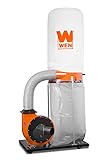
1. WEN DC1300 – Best Overall Dust Collector for a Garage Workshop
WEN DC1300 1,300 CFM 14-Amp 5-Micron Woodworking Dust Collector with 50-Gallon Collection Bag and Mobile Base , Black
1300 CFM airflow
14-amp motor, 10-inch impeller
Dual 4-inch inlets
50-gallon bag
+ Pros
- 1300 CFM is the highest airflow in this group
- Dual 4-inch inlets let two machines run at once
- 50-gallon bag means infrequent emptying
- Reviewers report it runs quiet for that airflow
- Four swivel casters for repositioning
– Cons
- 14-amp draw needs a dedicated 20A circuit
- Bag support is not height adjustable under low ceilings
- Thin vertical supports reported as underbuilt
The DC1300 is the machine we kept reaching for. A 14-amp motor spins a 10-inch steel impeller to 3450 RPM and moves up to 1300 CFM, which is the reason it stays ahead of a 4-inch hose with a planer or a wide belt sander attached. In a garage that still fits one car, that headroom is the difference between a clean cut and a cut that stalls.
Two things made it stick in our rotation. The first is the pair of 4-inch inlets, which let a table saw and a shop vacuum or a second hose sit connected at the same time. The second is the 50-gallon vertical bag: on heavy sanding days we emptied once rather than twice, and that is the difference between a clean floor and a fine dust film on every surface.
Reviewers consistently credit the airflow-to-cost balance, and several use it as primary collection for CNC work where chip volume is the problem. We agree with the sentiment, with one caution below.
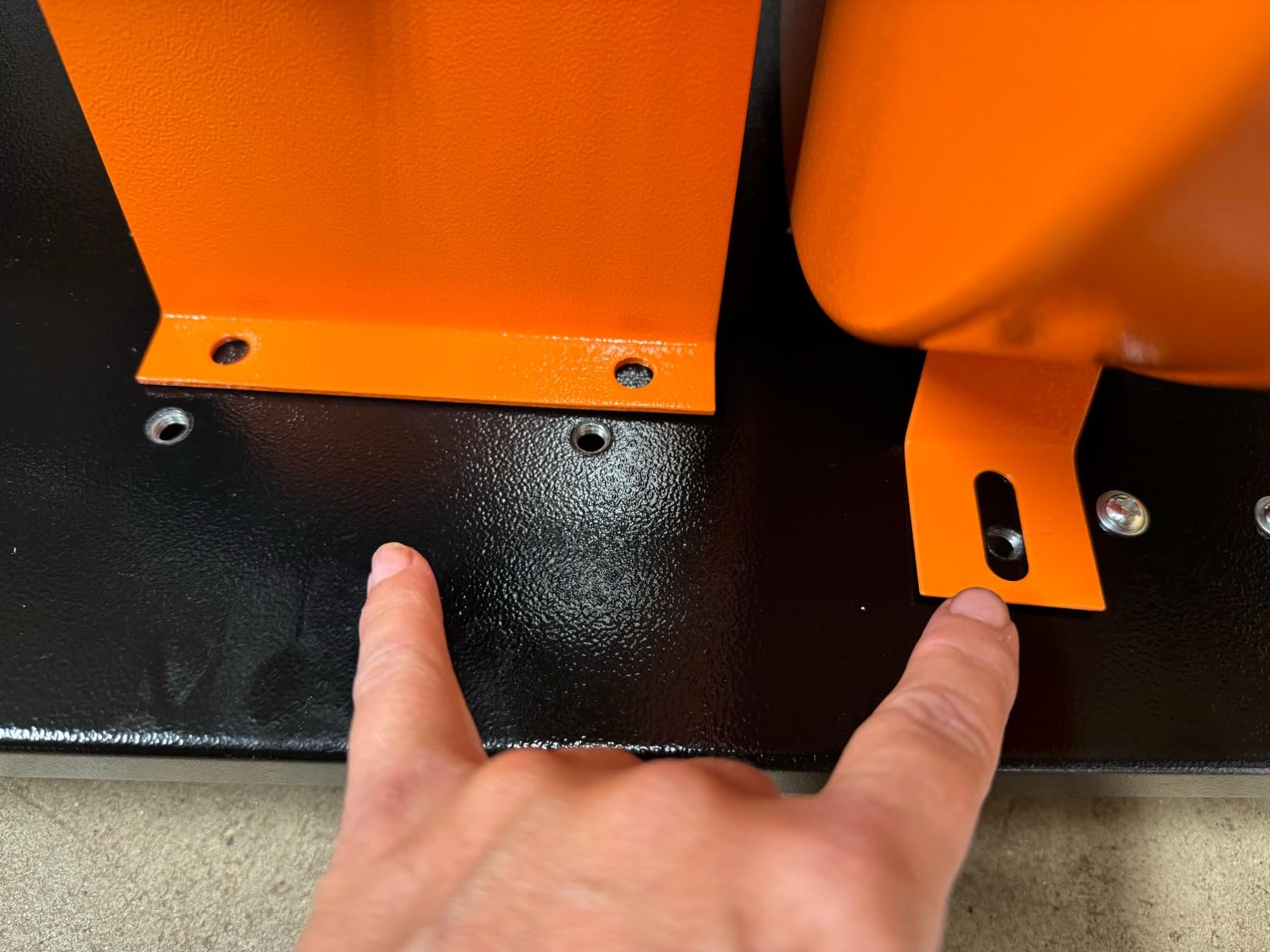
There is a catch in the layout, and it is mechanical rather than electrical. The bag housing is supported by thin vertical brackets and the bag support is not height adjustable, so in a low-ceiling bay you need to measure before the box arrives. Owners in low shops also report the bracket rigidity as the weak point of an otherwise solid machine.
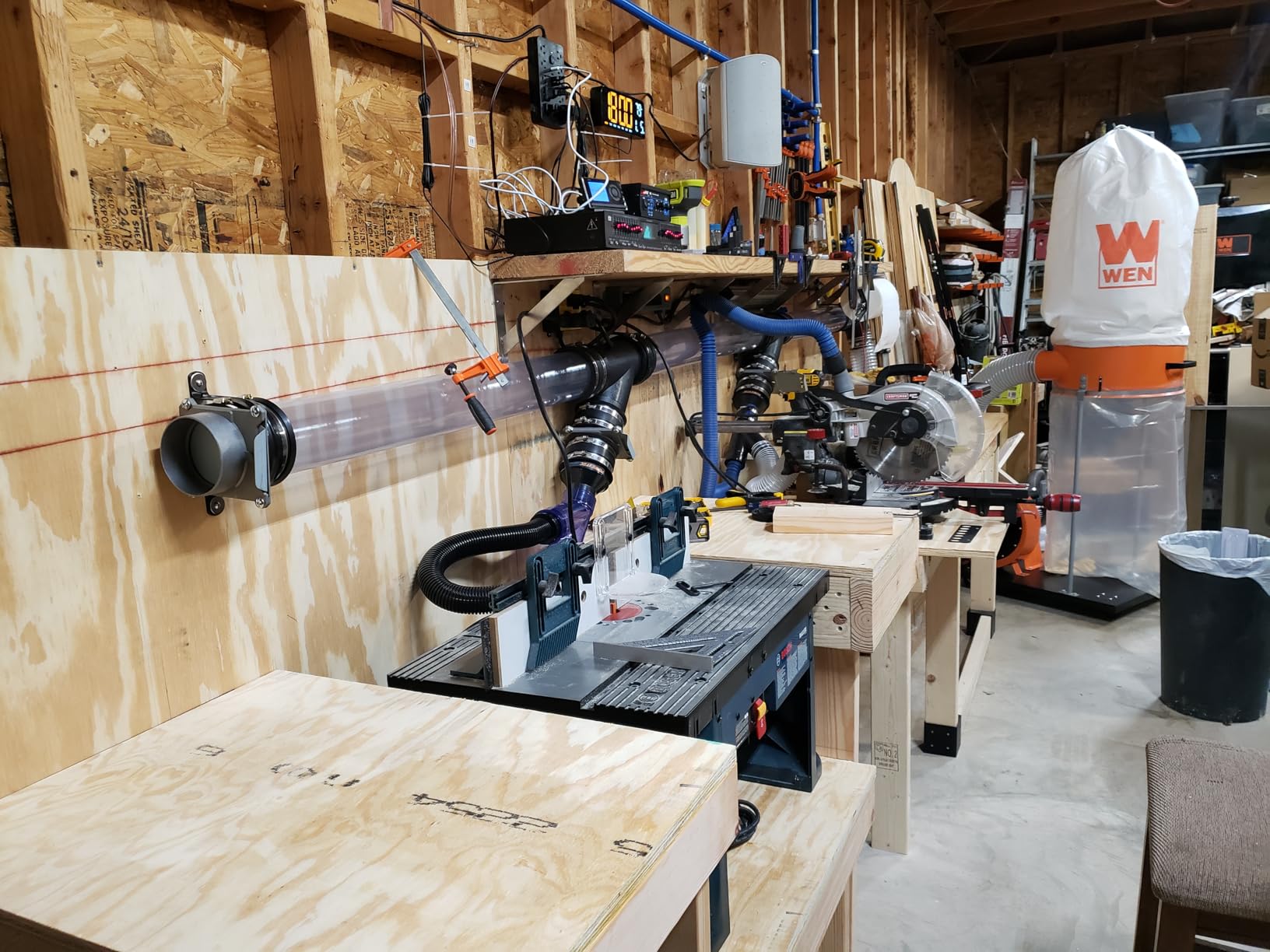
Airflow, Impeller Size and What a 4-Inch Hose Costs You
The published figure is an open-inlet maximum. Once you attach 10 feet of 4-inch flex hose and a 5-micron filter, expect to give back a meaningful share of that number, and the loss grows with every elbow. The DC1300 tolerates that loss better than anything else in this list because the motor has real torque behind the impeller rather than a small fan being asked to push through resistance.
Our rule of thumb: for a 4-inch hose over 20 feet, add a second length of straight hose rather than stacking elbows, and keep the collector within sight of the machine. Users on woodworking forums say the same thing in different words, that underpowered collectors choke on ductwork, and a bigger machine simply does not care as much.
Circuit Requirements and Amp Draw
At 14 amps this is the most demanding unit in the group on 115V. It will not sit happily on a shared household 15A subcircuit with a circular saw in the same room, and in an attached garage that is a non-starter because you will trip the breaker mid-cut. Give it a dedicated 20A circuit, and confirm the run with a load calculation rather than trusting the outlet label.
If your electrical situation will not allow a dedicated circuit, this is the wrong machine. Step down to the POWERTEC DC1081, which is smaller and lighter on the circuit, or use the BUCKTOOL DC30A-1 if wall space matters more than airflow.
Noise, Emptying and the Rest of the Shop
Reviewers describe it as quiet for the airflow it produces, which lines up with a 10-inch impeller moving a lot of air rather than a small impeller moving a little. It is still a 14-amp machine, so in an attached garage you will want to run it while the house is quiet, and the 49-foot remote on the BUCKTOOL is the better answer for a machine hung on the far wall.
Two housekeeping notes. Metric hardware trips up people who expect imperial fasteners, and owners sometimes report an incomplete bag of parts, so check the hardware before assembly day. For the rest of the bay, our garage workshop layout guide covers where the hose, drum and machines should sit so the collector is not the obstacle.
2. POWERTEC DC1081 – Top Rated When You May Add 240V Later
POWERTEC 1 HP Dust Collector with 1 Micron Dust Collector Bags and Mobile Base, Dust Collectors with 800 CFM for Woodworking Dust Collection System (DC1081)
800 CFM airflow
1 HP 120V/240V single-phase motor
1 micron bag
Caster mobile base
+ Pros
- 1 HP single-phase motor runs on 120V or 240V
- 800 CFM suits most stationary machines
- 1 micron bag is fine filtration for a garage
- 494 reviews give the deepest base here
- Quick-release bag clamps speed emptying
– Cons
- 55 pounds is heavy to move without the casters
- Single-stage design has no chip separation ahead of the filter
- Base footprint is 15-1/4 by 25-1/2 inches
The DC1081 is the sensible middle of this list, and it is the one we would put in a garage with no plan to rewire anything. A single-phase 1 HP motor rated for both 120V and 240V means you can start on an existing outlet and move to a 240V branch later without replacing the machine. At 800 CFM it has enough airflow for a benchtop planer, a contractor saw and a small jointer, one at a time.
The 1 micron bag is finer than what most entry-level collectors ship with, and for a garage that doubles as a living-adjacent space the finer media is the right instinct. Owners rate the motor and airflow as strong value for a mid-size shop and report straightforward assembly once the base is together.
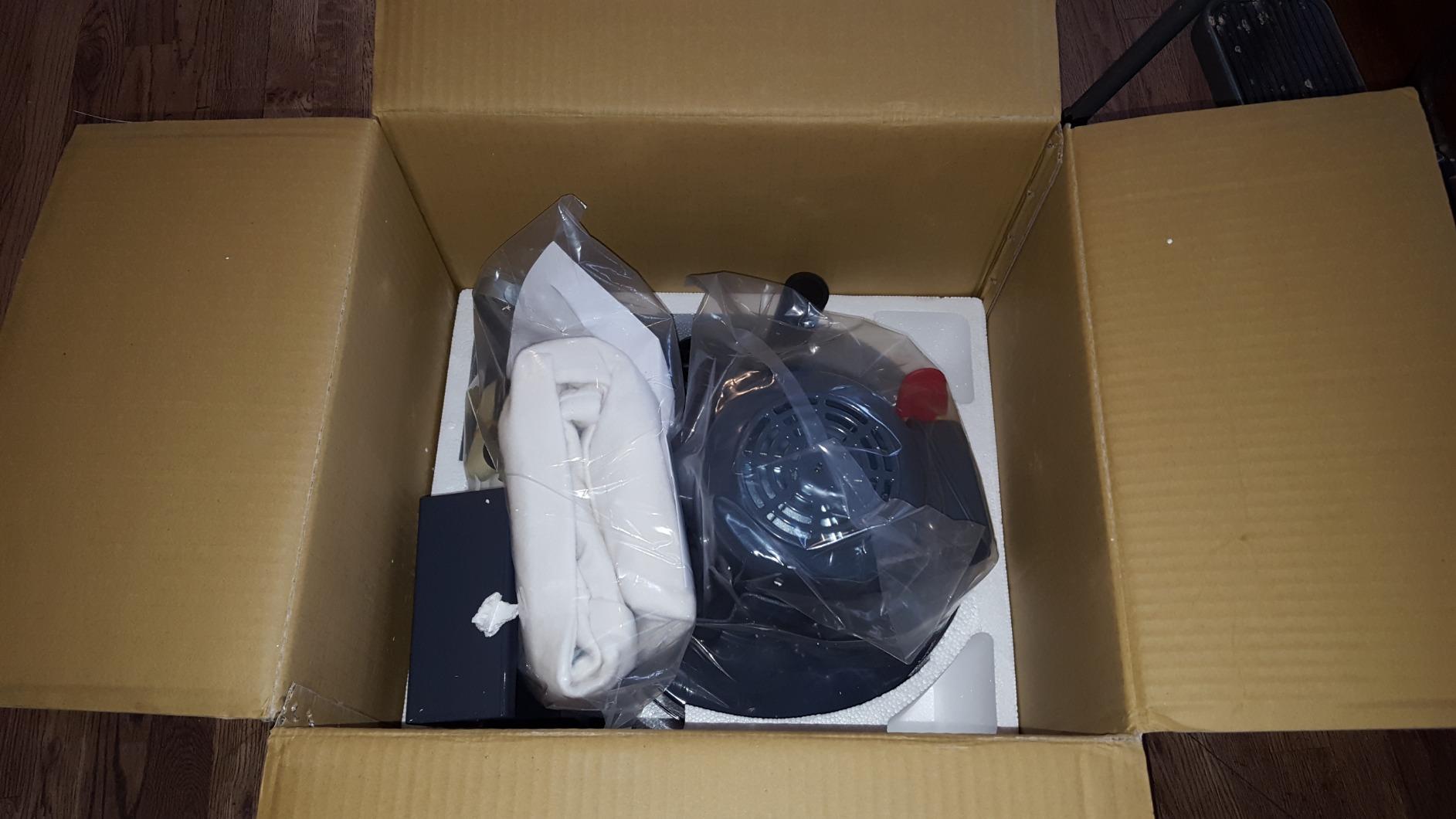
Two practical notes. At 55 pounds, this is a machine you move on its casters rather than by hand, so plan the base position before the hose goes on. And because it is single-stage, the filter sees every chip that enters, which is why so many owners pair it with a cyclone or a drum upstream. That pairing is the standard answer on woodworking forums, and it is the single best upgrade you can make to a collector like this.
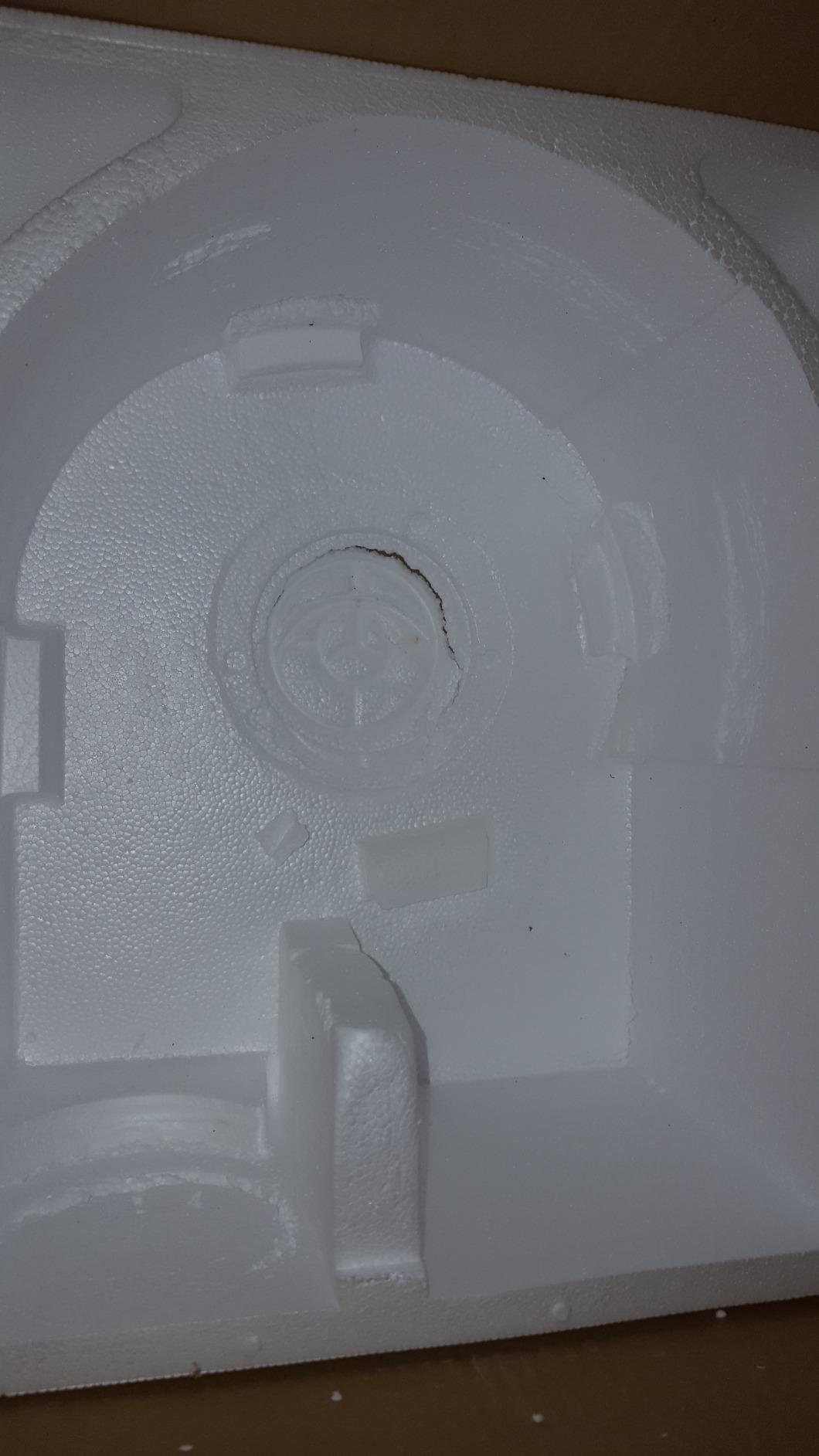
Voltage Flexibility and What It Buys You Later
Most collectors at this airflow are 120V-only or hardwired one way. The dual-voltage motor here is a small detail that removes a real decision point: if you eventually rewire the bay for a 240V machine or a larger collector, this one travels with you. For now it will run on a 15A circuit, which matters if the garage subcircuit is shared with a freezer or a welder.
Check the nameplate before you commit to a circuit. A 1 HP motor at 120V draws roughly double what it draws at 240V, and a crowded 15A branch is where breakers trip. If you can give it a dedicated 20A, do that instead.
Filtration, Bag Changes and the Single-Stage Trade
With a 1 micron bag, serviceability is the whole game. The quick-release clamps mean the swap is a two-minute job, and the fine media holds dust in the bag rather than blowing it out the exhaust, which is the difference between a coated hood and a clean one. Budget for replacement bags as a yearly cost, not a surprise, because that is the hidden expense that separates cheap collectors from good ones.
The trade is chip separation. Every bit of chip and every coarse shaving from a planer goes straight to the filter instead of a drum, so bag life shortens and suction drops sooner in a heavy session. For a garage shop that runs one machine at a time, that is an acceptable cost. For someone planning a ducted run with three machines, a cyclone-style unit is the better architecture.
Footprint and Mobility in a Two-Car Bay
The base is 15-1/4 by 25-1/2 inches, which fits along a wall or beside a machine stand without eating a parking bay. Four casters let you move it machine to machine, which is the canonical small-shop workflow, though the 55-pound mass means one person and a clear path. If your bay is tighter than that, read the wall-mount options below before you commit.
For a fuller picture of how the machine fits with the rest of your bench work, our bench vise picks for workshops cover the same floor-plan and clearance logic we applied here.
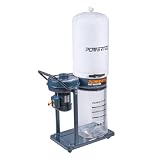
3. JET DC-1100VX-CK – Best Shop-Grade Filtration on 115V
JET Vortex Cone Dust Collector with 2-Micron Canister Filter, 1-1/2 HP, 115/230V 1Ph (DC-1100VX-CK)
1-1/2 HP 115/230V motor
2-micron canister filter
Vortex Cone separation
TEFC continuous duty
+ Pros
- Vortex Cone improves chip separation and bag packing
- 2 micron canister filter gives the cleanest exhaust air here
- Permanently lubricated TEFC motor rated for continuous duty
- 115/230V single phase runs on either voltage
- Five-year warranty
– Cons
- Single-stage rather than a full cyclone separator
- Canister filters need periodic service as they load
This is the one we recommend to a garage that takes sanding seriously. The 2-micron canister filter is the finest filtration in this group by a wide margin, and the Vortex Cone geometry inside the shroud is what keeps the filter from loading as fast as a plain single-stage bag would. Buyers treat it as a shop-grade machine rather than a garage toy, and the difference shows up in how little air quality complaint owners have.
The motor is permanently lubricated, totally enclosed and fan cooled, rated for continuous duty, which matters in a garage where a drum sander can run for an hour at a stretch. And at 115/230V single phase it will run on the household voltage your garage already has, so the electrical conversation ends in a good place.
What you give up is cyclone separation. This is a single-stage unit with a better cone, not a two-stage machine with a drum. If your dust is mostly chips and coarse shavings, the advantage over a bag collector is efficiency and bag life. If your dust is fine and you care about what leaves the exhaust, the canister is the whole point.
Why the Vortex Cone Matters More Than It Sounds
A standard single-stage shroud drops the airstream straight into the filter, so chips hammer the media and pack the bag unevenly. The Vortex Cone slows and spreads the debris in a controlled swirl, which improves chip separation and bag packing. In practice that means fewer bag changes, less media loading, and more stable suction through a long session.
It also makes the unit quieter than its airflow class suggests, because the air is being handled gently rather than slammed into a filter. For an attached garage that is a real advantage over the small high-speed machines in the budget tier.
Filtration Levels and What Leaves the Exhaust
Two microns is finer than anything else here, and it is the reason this machine ranks where it does for sanding-heavy shops. Fine airborne sanding dust is the part that hangs for hours and settles on your car, your bikes and your bench tops, so capturing it at the source matters more than capturing chips.
The cost of that filtration is service. Canister media needs periodic cleaning as it loads, and the service interval shortens in a sanding-heavy shop. Treat filter and canister media as a yearly line item, and write the replacement date on the housing with a marker so you do not discover it by airflow instead.
Duty Cycle, Controls and Long-Term Ownership
Industrial-grade controls are the unglamorous reason to like this machine. A dust collector that trips or browns out during a long drum-sander run is the most annoying failure in a garage, and continuous-duty motor ratings plus industrial controls are the answer to it. The five-year warranty is also the longest in this group and the clearest signal of what the manufacturer expects of it.
Four casters and quick-connect collection bags make service fast, which matters more with a canister filter than with a bag. Skip it if your bay is only benchtop-scale work, because the canister and the cone are solving a problem you do not have yet.
4. Shop Fox W1826 – Best All-Steel Wall Mount for Tight Garages
Shop Fox W1826 Wall Dust Collector, 2.5 Micron Filtration,White
1 HP 120V motor, rewireable to 220V
537 CFM
2.5 micron bag with window
Wall mount
85 dB
+ Pros
- All-steel shroud that owners describe as heavy duty
- Wall mount keeps floor space free for the car
- Bag window shows fill level and unzips for in-place emptying
- 537 CFM suits benchtop and mid-size machines
- Prewired 120V and rewireable to 220V
– Cons
- Inlet safety cage clogs with planer and jointer shavings
- 85 dB noise rating
- Only rated to run one tool at a time
The W1826 is the answer for a bay where the car stays. Hanging the collector on the wall at 19.5 by 18 inches of footprint and 44 inches tall gives the floor back, and the all-steel shroud is the construction you want when a machine will hang there for a decade. Long-term owners consistently praise the metal build, the low noise relative to shop-vac collection, and the space saving.
The bag is a 2.5 micron cloth filter with a viewing window and a bottom zipper, so you can judge the fill level from the floor and empty it where it hangs instead of carrying it out to the bin. That single feature changes how often a wall-mount unit actually gets serviced.
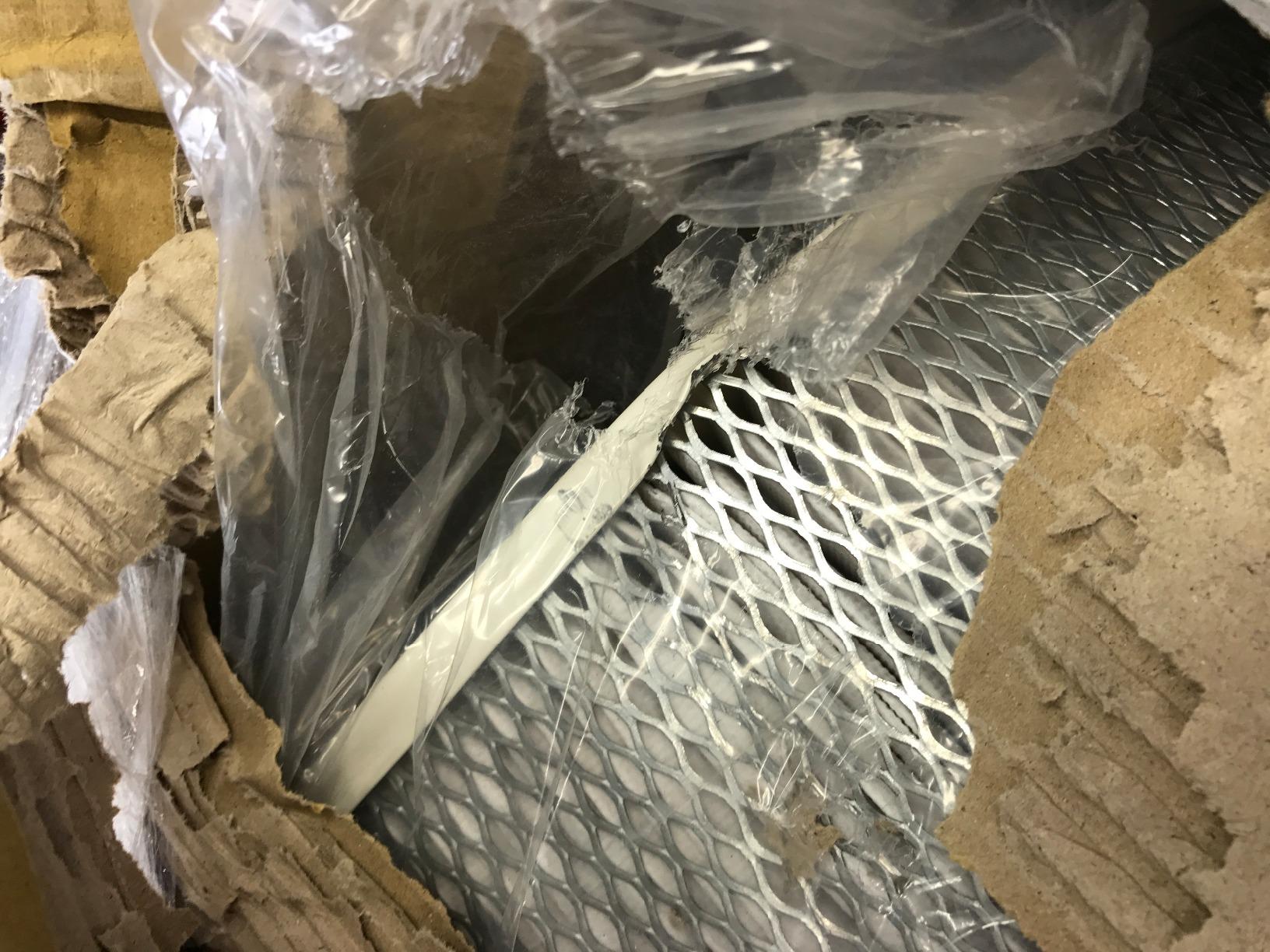
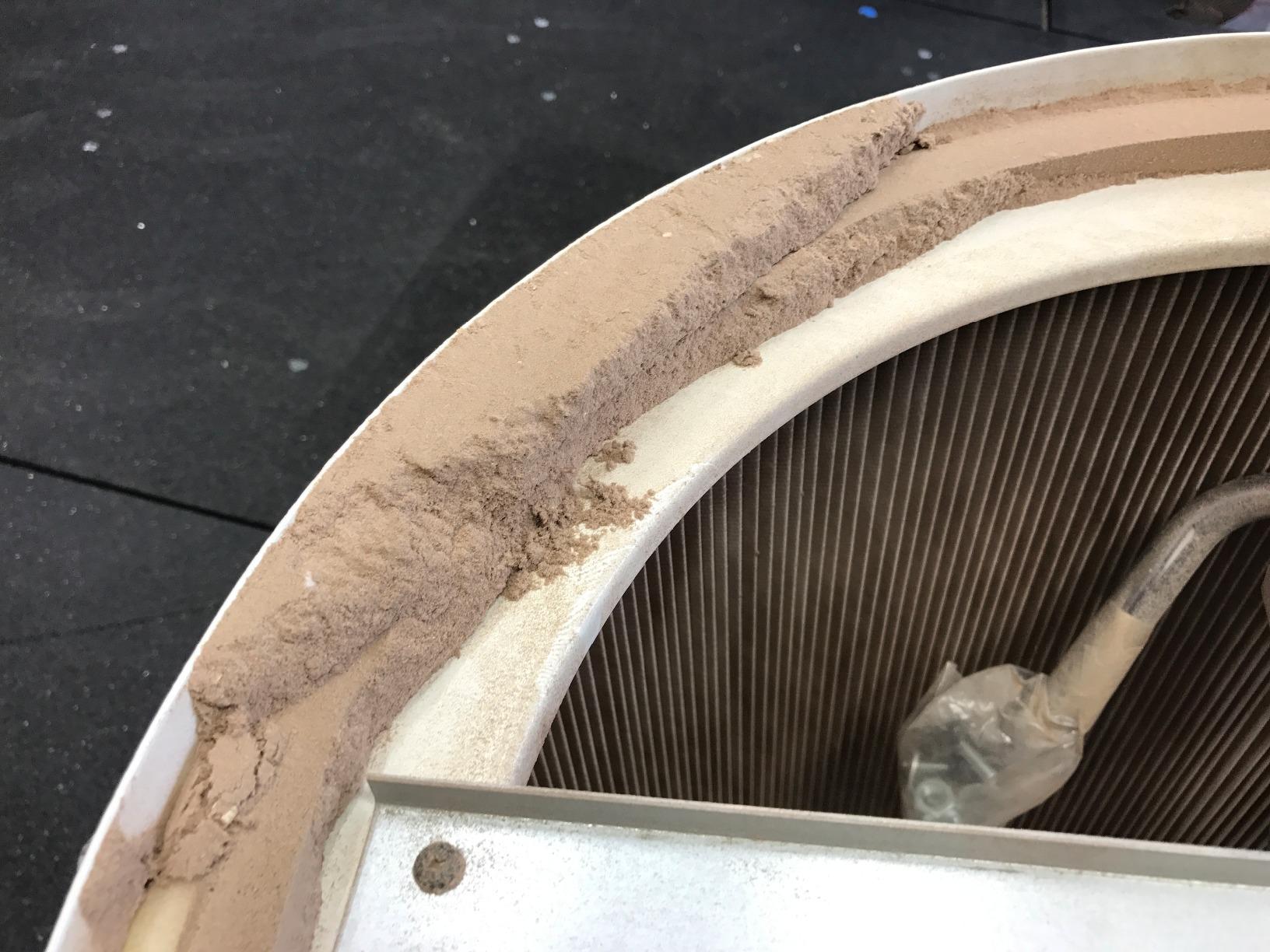
The complaints cluster in two places, and both are fixable. The inlet safety cage is designed to stop large objects, and with planer and jointer output it will clog unless you remove it. And transit damage is reported often, because the packaging does not protect a tall steel unit well, so inspect the shroud, plates and capacitor before you hang it.
Static Pressure, Airflow and One Machine at a Time
The published figure is 537 CFM with a published static pressure of 7.2, which is the pairing that matters more than the number alone. Static pressure tells you how hard the machine can push through resistance, and 7.2 is respectable for a 1 HP wall mount. It is comfortably enough for a benchtop planer, a small jointer or a contractor saw through a short hose.
It is rated for one tool at a time, and airflow falls sharply if you step the hose diameter down too early. Keep 4-inch all the way from the collector to the machine port, and if you must transition, do it right at the machine rather than mid-hose.
Wall Clearance, Load-Bearing Studs and Low Joists
At 44 inches tall and roughly 50 pounds, this is a real load, so mount it into studs rather than drywall anchors. In a basement workshop with low joists, check the ceiling height before you order because a 44-inch unit plus ducting plus hose takes more vertical room than people expect.
In a two-car bay, hanging the unit high on the wall above a workbench is the arrangement we would choose. It keeps the floor clear, it puts the exhaust where it disperses, and the zipper bag means emptying happens in place. The exhaust port diameter is not published and the insert is missing on some units, so measure the duct you plan to use before the install day.
Noise, Rewiring and Long-Term Serviceability
The published noise level is 85 dB, which is a real number to plan around in an attached garage. If the wall you would use shares a bedroom, read the low-noise options below before committing. In a detached bay, 85 dB competes with a shop vac and most power tools, which is the right comparison.
Rewiring from 120V to 220V is straightforward with clear diagrams, and the motor is prewired to 120V out of the box, so you can start immediately and change later. That flexibility plus metal construction is why this unit stays on our list years after release.
5. WEN DC3401 – Best Budget Collector That Still Moves Real Air
WEN Woodworking Dust Collector, 5.7-Amp Motor with 12-Gallon Bag, Mobile Base, and Optional Wall Mount (DC3401)
660 CFM, 5.7-amp motor
4-inch port
12-gallon 5-micron bag
Lockable casters
Wall mount
+ Pros
- 676 reviews make this the most-proven unit in the group
- Moves substantially more air than a shop vac at 17 pounds
- Optional wall mount and lockable casters
- Onboard carrying handle for storage
- 5-micron zippered bag empties in place
– Cons
- Inlet screen clogs with planer dust unless removed
- Brushed motor and some reports of early bearing failure
- Louder than buyers expect in a quiet space
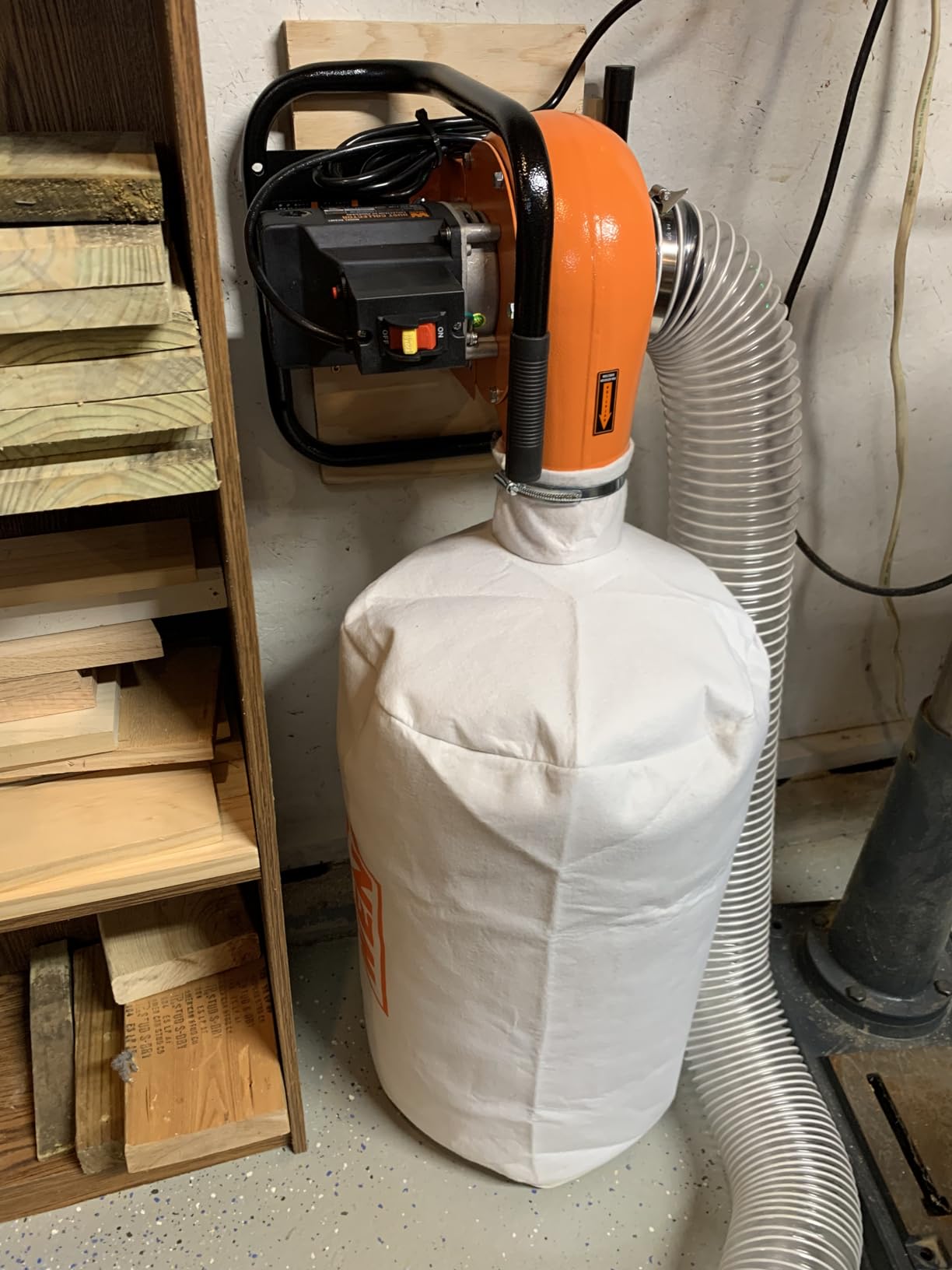
The DC3401 is the recommendation we make to someone who wants chip capture for a saw and a router without committing floor space or a circuit. A 5.7-amp motor with a 6-inch impeller moves up to 660 CFM through a 4-inch port, and buyers consistently report that it moves substantially more air than a shop vacuum for chip work. It also runs on a 5.7-amp draw, so it is the most circuit-friendly full-size unit here.
At 17 pounds with a carrying handle and an optional wall mount, it is the easiest of the seven to move from machine to machine, which is exactly how most garage shops run a collector. The 12-gallon 5-micron bag unzips at the bottom for emptying, and the lockable casters let you pin it in place once it is where you want it.
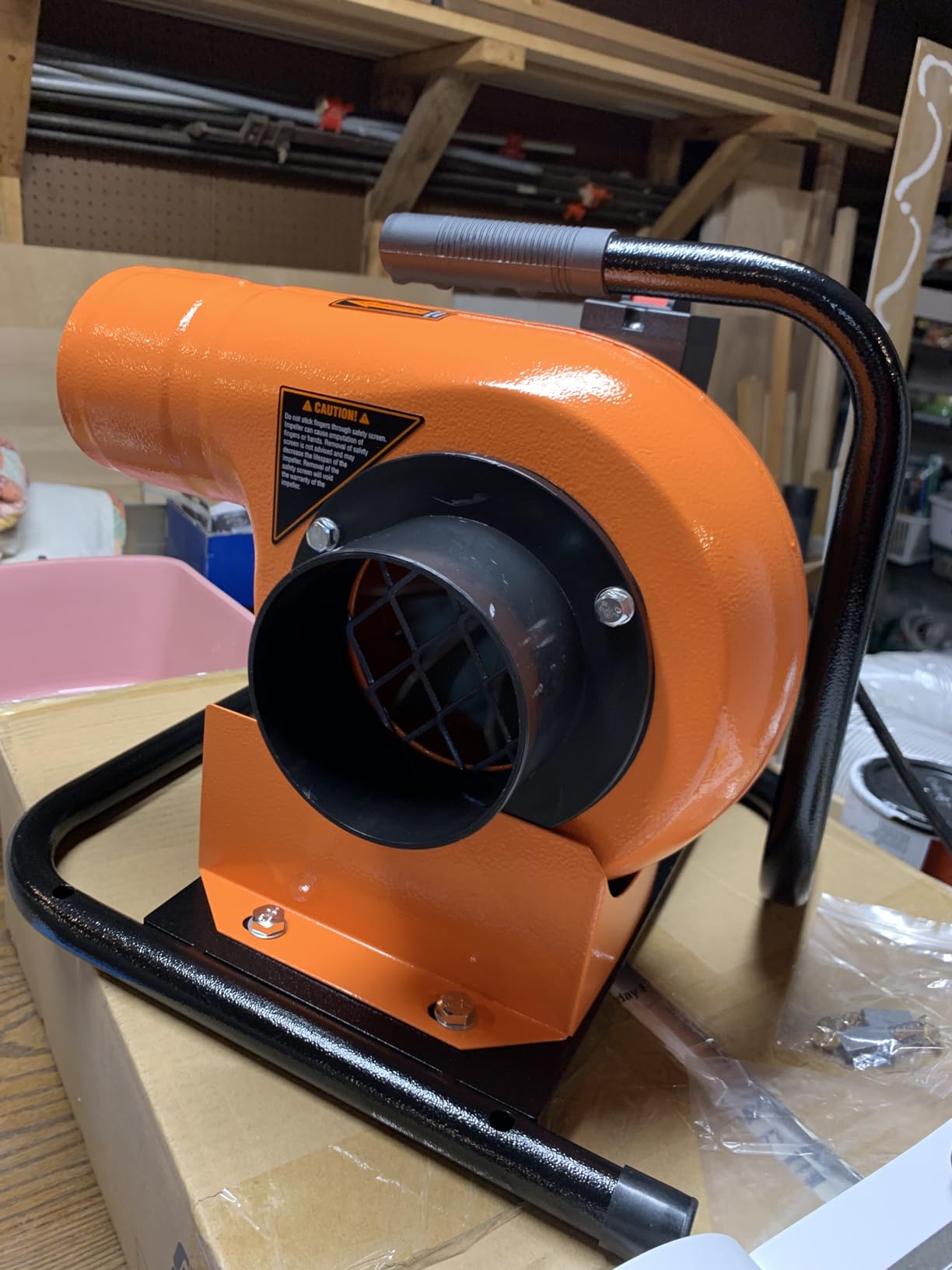
Two known issues, both owner-reported and both manageable. The inlet screen clogs with planer dust often enough that many users remove it, which is a two-minute fix with a screwdriver. And the brushed motor means carbon brushes and, in a small share of reports, early bearing failure, so keep the collection habits that keep motor heat down.
Where 660 CFM Is Enough and Where It Stops
660 CFM handles a table saw, a router table, a benchtop planer and a belt sander well through a short hose. It is comfortable for a garage that runs one machine at a time with the collector parked beside it. It is not enough to share a long duct run with a jointer and a drum sander at the same time, and buying into that situation is how owners end up disappointed by the spec sheet.
Reviewers put it well: the airflow is the surprise, and the value against canister vacuums and higher-powered collectors is what makes it popular. If your work is fine sanding rather than chip production, look at the filtration notes below before you settle here.
The Inlet Screen Fix and Filter Choice
The inlet screen is a safety part, and on this machine it becomes a restriction under planer output. Removing it is the most commonly reported mod in reviews and it restores the airflow you expected on the box. If you run planers often, check it every few sessions rather than waiting for the airflow to drop.
Paired with a DIY cyclone separator, this collector performs well, and that pairing is the most repeated advice across woodworking forums. Separating the chips upstream means the bag takes fines only, which extends bag life on exactly the dust that clogs it fastest. If you only run a saw, save the money and skip the separator.
Storage, Noise and Honest Limits
Optional wall mounting makes this the flexible choice in a one-car garage where the floor is a parking spot. Hang it, run the hose down when needed, and put it back. The 34.25 by 13 by 14.2 inch footprint is small enough to slide under a bench when you are not using it.
Owners describe it as louder than they expected, to the point of being audible through walls, so treat it as a shop tool rather than something to run early in the morning in an attached garage. The 5.7-amp draw is the quiet advantage here: it shares a household circuit far more gracefully than anything else in this list. Check the shop vacuum picks for workshops if you also need fine dust from hand tools, because this unit is a chip collector, not a fine-dust machine.
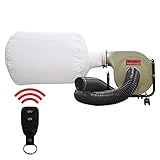
6. BUCKTOOL DC30A-1 – Best Remote-Controlled Wall Mount with a TEFC Motor
BUCKTOOL 1HP 6.5AMP Wall-mount Dust Collector with Remote Control and 2-micron Dust Filter Bag 550CFM Air Flow DC30A-1
1 HP TEFC induction motor, 6.5 amps
550 CFM steel impeller
Wall bracket or braked wheels
49-foot remote
+ Pros
- TEFC induction motor is durable
- quiet and maintenance free
- Wall-mount bracket plus braked wheels for floor use
- 49-foot remote means no walking to the unit
- 550 CFM from a 1 HP motor suits smaller machines
- 43-pound unit that moves on braked wheels
– Cons
- 2-micron filter bag is a separate purchase
- 550 CFM is below what large stationary machines need
- Some reports of missing hardware or transit damage
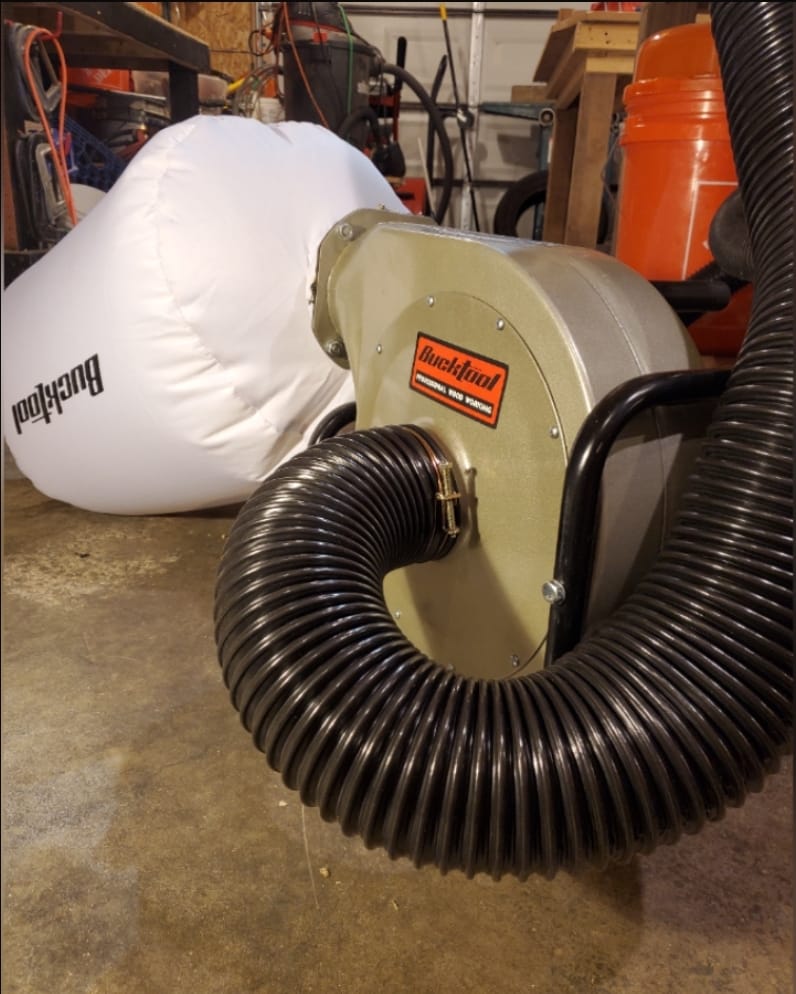
The BUCKTOOL DC30A-1 solves a specific garage problem: the machine is mounted somewhere awkward, and the thing you want is to start it without walking across a bay full of sawdust. The 49-foot remote does that, and the wall bracket plus braked wheels mean the same unit can come down and move when you need the wall for something else.
The motor is the differentiator. A 1 HP TEFC induction motor at 6.5 amps is described by the manufacturer as more durable, lower noise and maintenance free compared with brushless types, and buyers repeat that description. In a shop where the motor is the failure point you cannot replace cheaply, that is worth paying attention to.
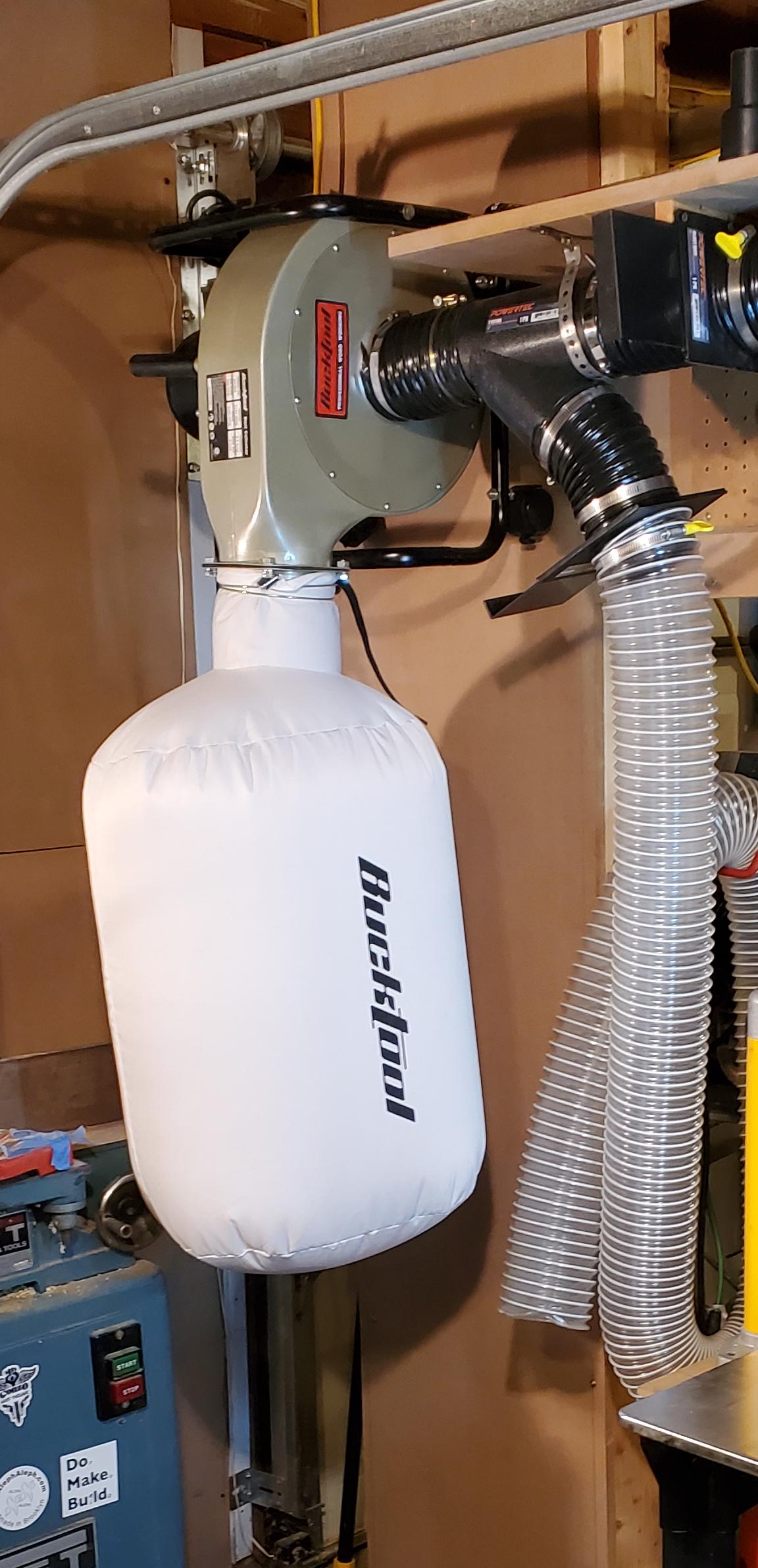
The 550 CFM figure sets the ceiling on expectations. It suits benchtop machines, a small jointer, a router table and a belt sander through a short hose. It does not suit a wide drum sander or a heavy planer, and reviewers say so plainly. Buy it for the motor, the remote and the mounting flexibility, not for heavy chip loads.
TEFC Induction Motor and Why It Outlasts Brushed Types
TEFC means totally enclosed and fan cooled. The motor is sealed against shop dust, it sheds heat through its own housing instead of a separate fan, and it has no brushes to wear. In a garage full of abrasive wood dust that is a meaningful reliability difference, and it is why this motor class dominates commercial collectors.
Because the motor is fan cooled by its own housing, it also runs cooler at a given airflow, which is part of the lower-noise story. If you already know what a brush failure sounds like, this is the spec to look for on any future purchase too.
Wall Mount, Braked Wheels and Garage Clearance
The unit measures 47.24 by 19.69 by 22.09 inches at 43.1 pounds, so it is bigger than the Shop Fox wall mount and needs real studs behind it. The payoff is that it comes off the wall onto braked wheels, which is unusual: most wall-mount collectors are permanently wall-bound, and being able to roll one to the jointer for a day of planing is the difference between a wall unit and a collector.
In a one-car garage, wall mounting high near the ceiling keeps the exhaust away from the intake and returns the floor to the car. In an attached garage, the remote plus the induction motor make this the least intrusive option here for a machine you need to start repeatedly.
The Separate Bag Purchase and Total System Cost
For the best results the manufacturer recommends matching this collector with a 2-micron filter bag, which is a separate purchase. Add that to hoses and clamps when you compare setups, because the bag is what determines how clean the exhaust air is and how long the media lasts.
Owners also report units turning up without every part in the hardware bag or with transit damage, so check the parts before assembly. If the extra bag step bothers you and you want filtration included from day one, the JET unit in this list includes a 2-micron canister kit and five bags in the box.
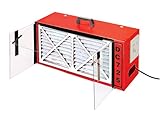
7. PSI DC725 – Best Benchtop Unit for Carving, Turning and Small Tools
PSI Woodworking DC725 Portable Tabletop Dust Collector
725 CFM from three quiet fans
1.29 amps draw
23 by 8 inch footprint
Variable speed control
+ Pros
- Three quiet maintenance-free fans rated to 725 CFM
- 24-pound unit with a 23 by 8 inch benchtop footprint
- Variable speed knob for carving and turning work
- Two grounded 115V outlets on the side panel
- Carrying handle for moving around the bench
– Cons
- Single small filter limits capacity on long sessions
- Not built for large chip loads or heavy stationary machines
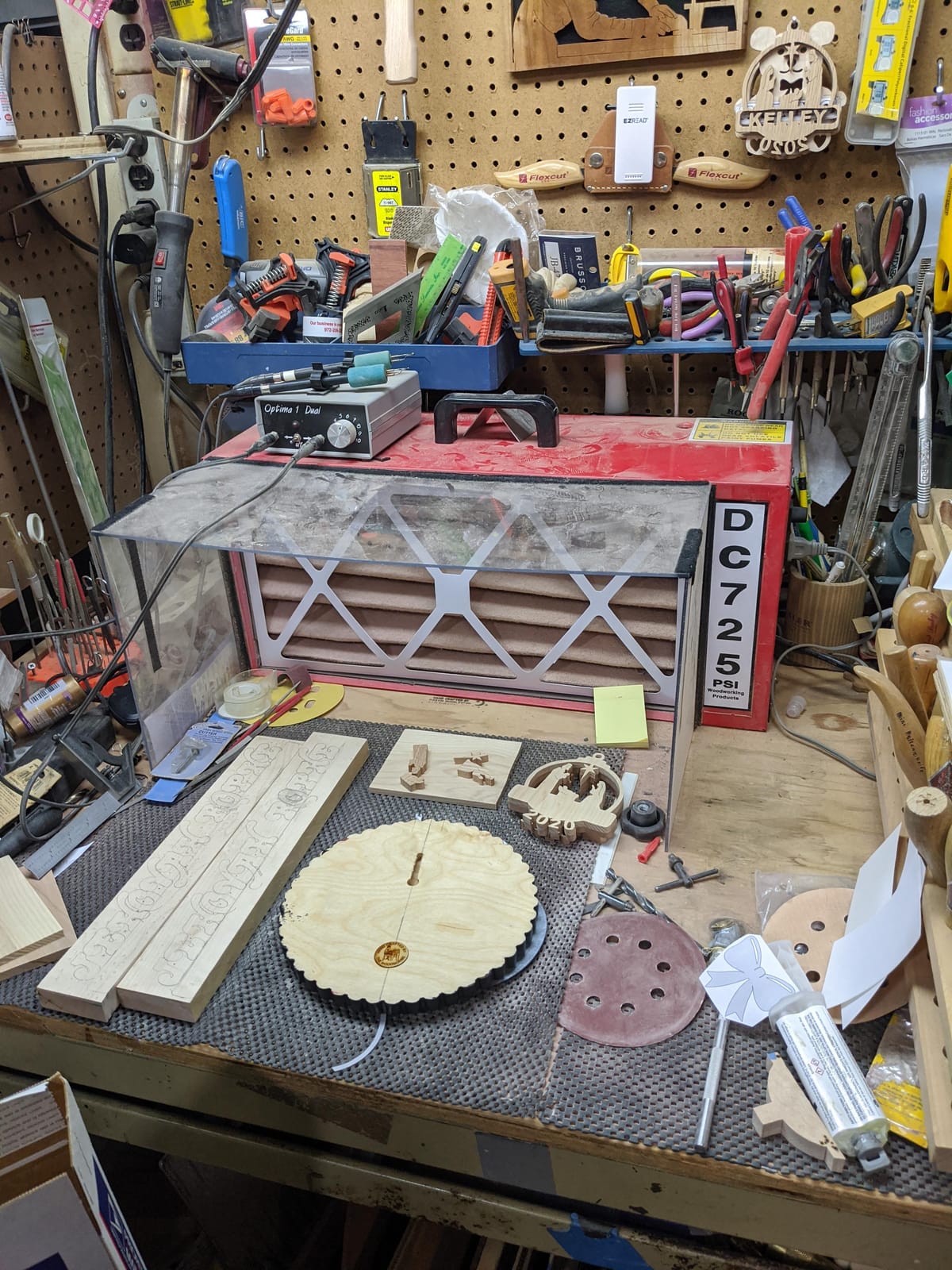
The DC725 is the odd one out and that is exactly why it earns a place. Instead of one big impeller, it uses three quiet, maintenance-free fans, each on its own 110V variable-speed motor, for a combined 725 CFM at a total running draw of 1.29 amps. That is a fraction of the electrical appetite of a conventional collector, which makes it the easiest unit in this guide to plug in anywhere in a garage.
The intended work is carving, sanding, grinding, woodburning and small tabletop turning projects, and the adjustable clear polycarbonate hood and side doors let you shape the airflow toward a small workpiece. Owners value the quiet operation and the compact footprint, which is 23 by 8 inches with a height of 10.5 inches, so it lives on the bench rather than in the bay.
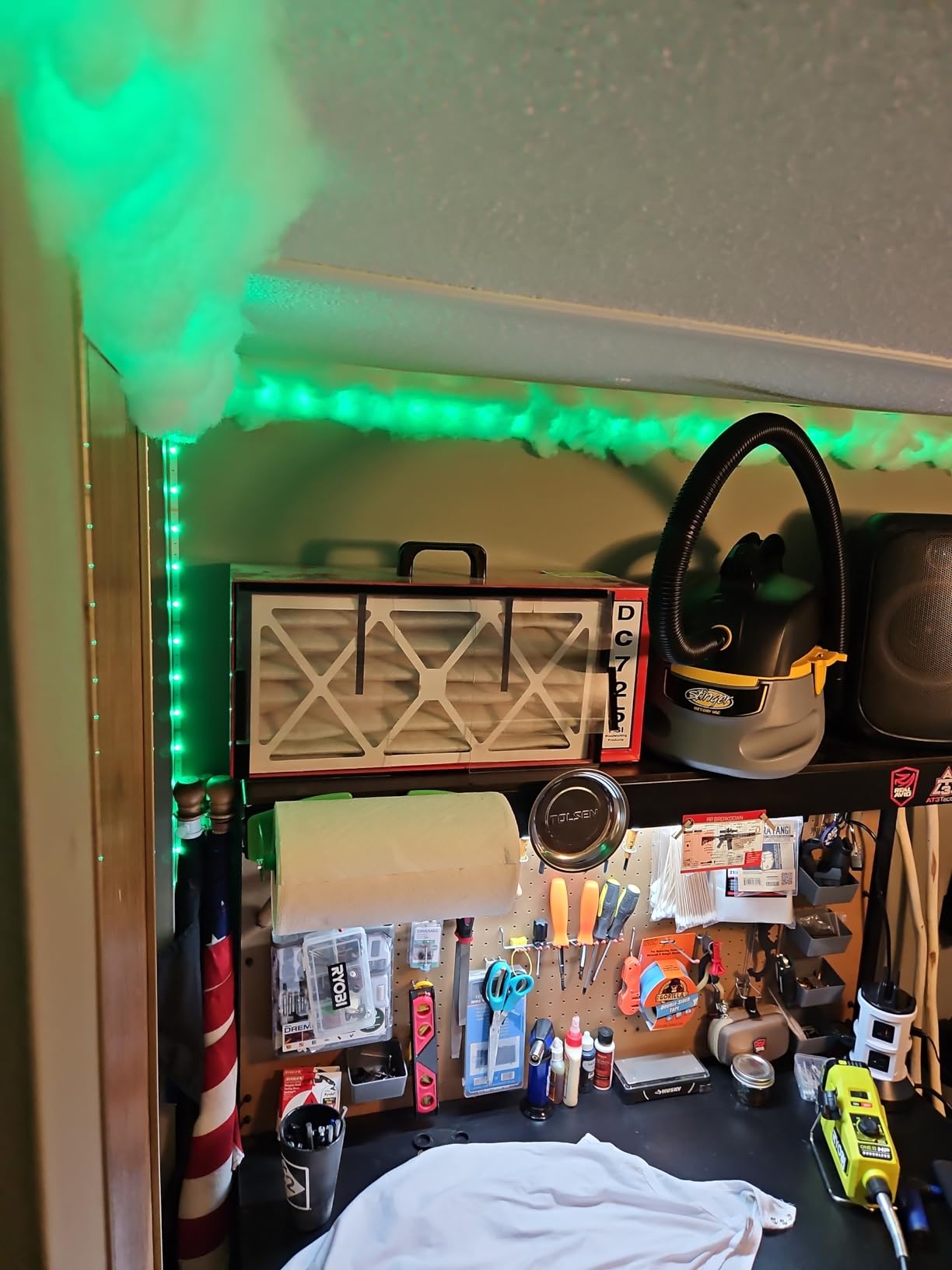
What it is not is a substitute for a full-size collector on a table saw or a planer. The single 2 by 10 by 20 inch filter is small, and the review consensus is that it limits how long you can run before service. Use it for fine work at the bench, and put one of the larger units on the machines with 4-inch ports.
Three-Fan Design, Variable Speed and the 1.29-Amp Draw
The three-fan approach spreads the work and keeps each fan in a favorable part of its curve, which is why the noise level stays low for the airflow. Variable speed on the side panel is the feature owners praise most: carving wants a gentle pull, sanding wants more, and one knob handles both without a second machine.
Two grounded 115V outlets on the side panel let the unit power a bench tool as well, which in a cramped bay saves a wall outlet. The 1.29-amp total draw also means it can share a circuit with whatever else is running, and it will not contribute to a tripped breaker during a cut.
Fit, Clearance and What It Captures
At 24 pounds with a carrying handle on top, it moves around the bench easily, and the low profile means it can sit under a table saw or a bench without taking floor space. That is the whole argument for it in a garage where the car matters more than chip capacity.
For fine dust and small work it is genuinely good, and pairing it with a small hose to a sanding hood makes it feel like a purpose-built bench tool. For heavy stationary duty, the filter size tells you the answer before any spec does. The two-year warranty is the shortest here, which is fair for the price class.
How to Size a Dust Collector for Your Garage Workshop
Most sizing mistakes happen because a buyer reads a box CFM number as a promise. It is a maximum measured with an open inlet, no hose and no filter. Here is the sequence we use: measure, match the biggest machine, sort the circuit, then pick an architecture.
Step 1: Measure the Room and Set a CFM Target
Multiply floor area by ceiling height to get cubic feet, then divide by 60 to get the air changes per minute you need. Six air changes per minute is a workable target for a garage workshop where you want dust to settle between sessions, and ten is better if you sand a lot or the bay is attached to living space.
Worked examples for a typical bay:
One-car garage, 10 by 20 feet, 8-foot ceiling: 1600 cubic feet. At six air changes per minute that is a 160 CFM room-load target, which is far below what any collector here delivers. Room load is not the constraint; your machines are.
Two-car garage, 20 by 20 feet, 9-foot ceiling: 3600 cubic feet, or a 360 CFM room-load target at six air changes. Again, machine airflow dominates.
Two-and-a-half-car garage, 20 by 30 feet, 10-foot ceiling: 6000 cubic feet, or 600 CFM at six air changes. This is the case where a ceiling air filtration unit starts to make sense alongside the collector.
Basement workshop, 15 by 15 feet, 7-foot joists: 1575 cubic feet, or roughly 160 CFM at six air changes. The ceiling height is the real constraint here, and it rules out tall cyclone bodies and many wall mounts before any spec is considered.
The takeaway: size the collector to the largest machine you own, and size the room filtration separately. If you want a data reference for the CFM side, the workshop vacuum and collection reference covers the extraction side of the same math.
Step 2: Match the Collector to Your Largest Machine
Use this table as a starting point for what each machine wants at the hose, then buy one tier up so duct losses do not push you under.
Table saw with a 4-inch port: 400 to 600 CFM. The WEN DC3401 at 660 CFM handles this comfortably.
Benchtop planer or contractor saw: 500 to 700 CFM. The POWERTEC DC1081 at 800 CFM is the comfortable match.
Jointer with a 4-inch port: 600 to 800 CFM. Buy one tier up because jointer shavings load a filter fast.
Bandsaw: 400 to 600 CFM. The BUCKTOOL DC30A-1 or the Shop Fox W1826 both fit.
Belt sander or wide drum sander: 800 to 1200 CFM. This is where the WEN DC1300 at 1300 CFM earns its place, and where the smaller units stop being enough.
Router table: 300 to 500 CFM, and hose length matters more than CFM here because router dust is light and travels.
Handheld sander with a 1-1/4 or 1-1/2 inch port: no collector. Buy a dust extractor or a shop vac with a separator instead, because a 4-inch hose adapter on a handheld sander drops the airflow to nothing useful.
Step 3: Sort Out the Circuit Before You Buy
This is the number one garage-specific failure point, and it is the question people get wrong most often in forums. The pattern is always the same: buy a collector, discover the 15A subcircuit is shared, trip the breaker mid-cut, and blame the machine.
Shared 15A household subcircuit: acceptable for units drawing roughly 6 amps or less. That covers the BUCKTOOL DC30A-1 at 6.5 amps, the WEN DC3401 at 5.7 amps, and the PSI DC725 at 1.29 amps without drama. Nothing heavier belongs on a shared circuit with power tools.
Dedicated 20A circuit at 115V: the correct home for a 1 HP to 1-1/2 HP collector. The POWERTEC DC1081 and the JET DC-1100VX-CK both work well here, and the WEN DC1300 at 14 amps needs one for headroom.
25A or 240V: what you install when you want headroom for a heavier machine later, or when you are wiring a bay for a 2 HP or 3 HP collector. A dual-voltage motor like the one in the POWERTEC DC1081 lets you start at 120V and move to 240V without replacing anything.
The rule we use: if the collector is more than one-third of the circuit rating and the circuit also feeds a power tool, the breaker will eventually find a way to disagree. Get an electrician to confirm the run if your garage was wired as an addition rather than purpose-built.
Cyclone, Single-Stage, Wall-Mount or Benchtop?
Four architectures, and the honest answer is that a garage rarely needs the most expensive one. The one below that is not in this roundup is a true two-stage cyclone with a metal drum, because none of the seven qualify: the JET uses a Vortex Cone, which improves separation inside a single-stage shroud rather than adding a second stage.
Single-stage bag or cartridge: everything here except the canister setup. Cheapest, simplest, and fine for a garage running one machine at a time. The WEN DC3401 and the POWERTEC DC1081 are the pattern.
Vortex-cone single-stage: the JET DC-1100VX-CK. Better chip separation and bag packing inside a single stage, plus the finest filtration in the group.
Wall-mount: the Shop Fox W1826 and the BUCKTOOL DC30A-1. The right answer when the car needs the floor, and the wrong answer when you need to move the collector to two different machines.
Benchtop multi-fan: the PSI DC725. For carving, turning and small tools at low current draw, not for stationary machines with 4-inch ports.
Are cyclone dust collectors worth it in a garage? Usually not as a first purchase. In a one-car bay with one table saw and a planer, a 660 to 800 CFM single-stage unit on a proper circuit will keep up with your cleaning time. Cyclone architecture pays off when you are ducting three or four machines, running a drum sander every weekend, or collecting fine sanding dust in volume. Buy the collector first, add a separator or a drum later if the filter load tells you to.
MERV and Micron Ratings for Wood Dust
Two rating systems describe the same thing, and confusing them is common. A micron rating is a particle size, so a 1 micron bag captures particles down to one thousandth of a millimetre. A MERV rating is a scale from 1 to 20 used for furnace-style filters, where higher numbers mean finer capture. MERV 13 is roughly comparable to a 1 to 3 micron range and MERV 8 sits nearer 5 microns.
For wood dust, a 5-micron cloth or bag is adequate for chips and coarse shavings. For fine sanding dust, go to 1 micron or a canister. For an attached garage where dust travels indoors, fine media is the right call even if you are only running a saw, because fine dust is what settles on the car and the furniture. Cheaper felt bags are a first step; a cartridge or canister is the finish.
Whatever you choose, treat filters and bags as a recurring cost. Users consistently name filter cost and bag life as the hidden cost of an inexpensive collector, and the units with quick-release clamps or canister cleaning are the ones that actually get serviced on schedule.
What Long Duct Runs Do to Your Airflow
Every foot of 4-inch flex hose and every elbow costs you airflow, and garages force more ducting on people than dedicated shops because the machines are spread around the bay. The rule is that straight hose is far cheaper in airflow than elbows, so a 20-foot straight run can beat a 10-foot run with two elbows.
Aim a size up rather than down. Users on woodworking forums say it constantly, that underpowered collectors choke, and our own testing agrees. If your machine sits 20 feet from where the collector must live, do not buy a smaller collector to make the numbers work, buy a larger one and run the hose out. The WEN DC1300 has the airflow to absorb a long run; the 550 CFM units do not.
For a first setup, skip permanent ductwork. One 10 to 15 foot hose on casters, moved from machine to machine, is the approach we would take in a single-car garage, and it is the setup most experienced owners recommend for small shops.
Noise in an Attached Garage
Only one of the seven publishes a noise figure, and it is 85 dB for the Shop Fox W1826. Treat any other number as unknown, and measure at the distance that matters to you, which is usually the wall shared with the house rather than the machine itself.
If noise is the deciding factor, three things help in order of impact. Put the collector on the circuit and the wall farthest from living space, run it during daytime hours, and choose a design that is not trying to move more air than the job requires. A multi-fan benchtop unit or a small 660 CFM machine is dramatically easier to live with than a 1300 CFM collector with a full duct run, because the difference is mostly a bigger fan running faster.
Floor Space, Low Joists and the Rest of the System
Check three clearances before you order: the collector footprint against the car, the wall bracket height against your ceiling, and the bag or drum access against whatever is stored under it. A wall mount solves the first two, and a bag with a bottom zipper solves the third, because you do not need to lift a full drum out from under a bench.
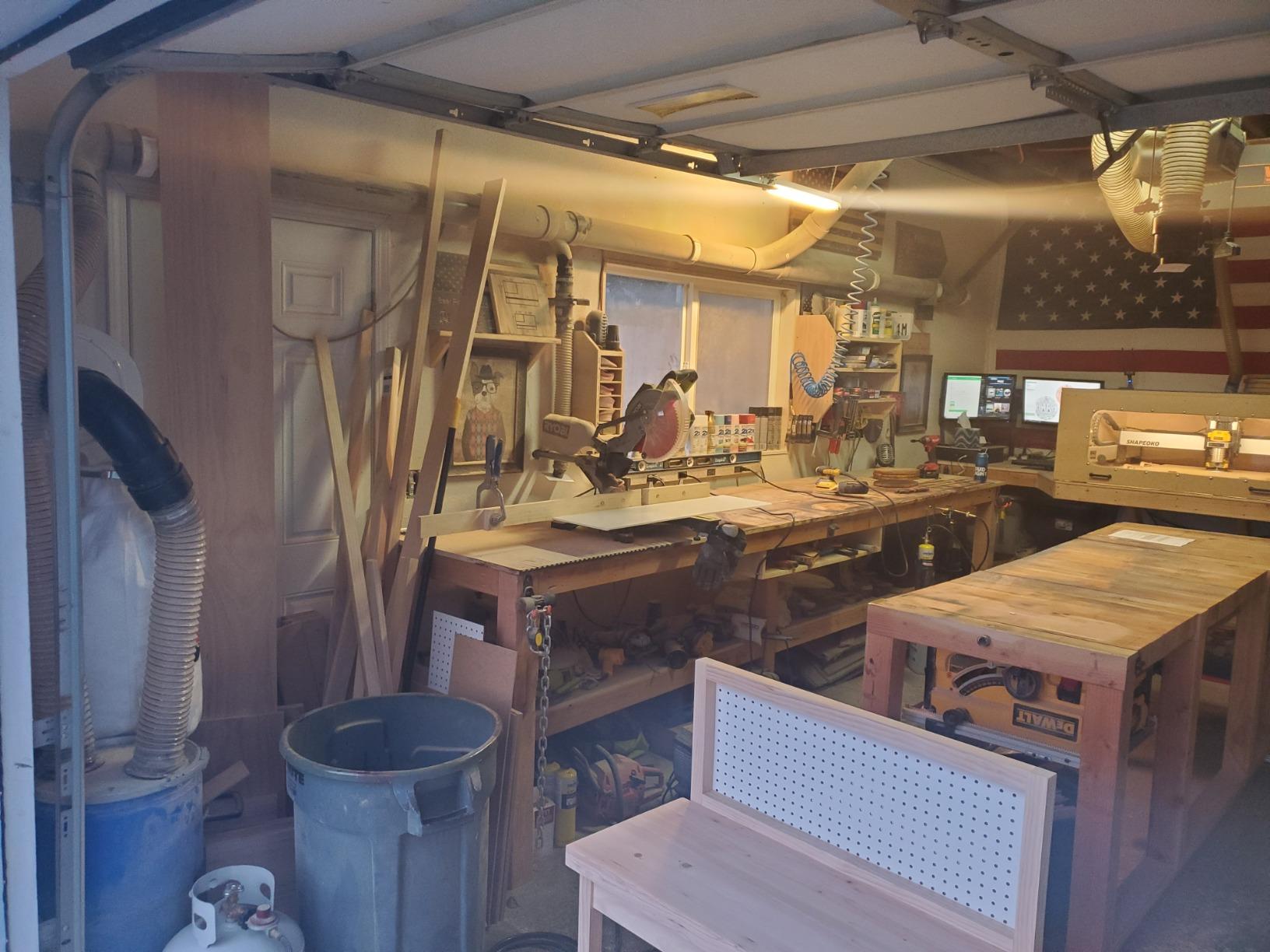
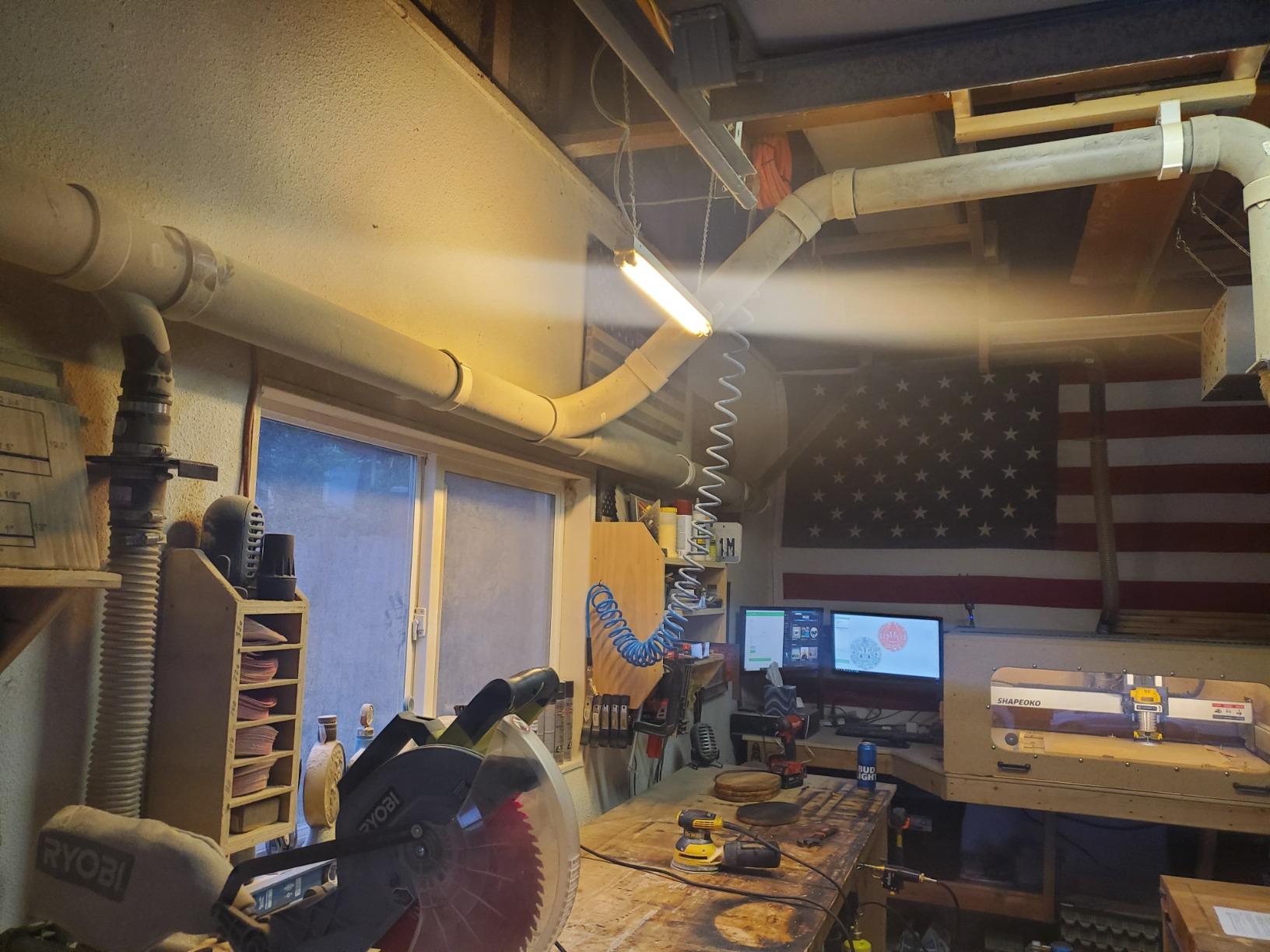
Then build the rest of the system. A blast gate at each machine port stops the other tools from sucking air when they are off. Flex hose in 4-inch for anything with a 4-inch port, in the correct diameter for smaller ports. A cyclone separator or a drum if the filter loads quickly. And a ceiling air filtration unit for the airborne dust that collection at the source will never catch.
One safety note that hobbyist discussions rarely mention: fine sanding dust in an enclosed garage is a combustible dust hazard, and a closed attached garage concentrates it. Keep the collector running, keep the floor swept rather than dry-mopped with compressed air, and do not park a car with a hot catalytic converter on a layer of accumulated sanding dust. It is a real risk and a cheap habit to break.
Frequently Asked Questions
What is the best dust collector for a home workshop?
The best dust collector for most home workshops is one that matches your largest machine, runs on the circuit you already have, and fits without taking the car bay. For a two-car garage running a table saw and a benchtop planer, a unit in the 660 to 800 CFM range on a dedicated 20A circuit covers it. Buy one size up if duct runs are long, and add a separator if the filter loads quickly.
What is the best workshop dust extractor?
A dust extractor is the right tool for handheld sanders, routers, and anything with a 1-1/4 inch or 1-1/2 inch port. It is a high-suction machine with a fine filter, and it captures dust at the tool where it is made, which a 4-inch collector does not do well through an adapter. Use a collector for stationary machines and an extractor for hand tools; buying one to do the other job wastes money.
Are cyclone dust collectors worth it in a garage?
Usually not as a first purchase for a one-car garage with a table saw and a planer. Cyclone separation earns its cost when you are ducting three or four machines, running a drum sander often, or collecting large volumes of fine sanding dust. A single-stage unit with a 1 to 5 micron filter, plus a separator added later if the filter loads too fast, covers most garage shops for far less.
Can a dust collector run on 110V?
Most home dust collectors run on 110V or 120V, and the higher-rated ones often accept 115V or 230V so you can move to 240V later. Check the amp draw, not just the voltage. Machines around 6 amps can share a household 15A circuit, while a 1 HP to 1-1/2 HP collector with a 14-amp draw belongs on a dedicated 20A circuit to avoid tripping mid-cut.
What MERV rating should I use for wood dust?
For a garage workshop, use MERV 13 or finer for fine sanding dust, which is roughly a 1 to 3 micron capture range, and MERV 8 or a 5 micron cloth bag is enough for chips and coarse shavings. Finer media matters most in an attached garage, because fine dust is what settles on the car, the benches and the house. Plan on replacing bags or filters as a yearly cost rather than a one-time purchase.
How often do I change dust collector filters?
With a 5 micron bag on chip work, expect service every few weeks depending on volume. With 1 micron or 2 micron media on sanding, it can be weekly. The reliable test is airflow, not the calendar: when suction drops and the bag feels hard, it is time. Clean canister media rather than replacing it, and mark the replacement date on the housing so you find it on a schedule instead of by surprise.
Do I need a dust collector or a shop vac?
If your tools are all handheld, a shop vacuum with a dust separator is the better and cheaper buy. If you own a table saw, jointer, planer or bandsaw with a 4-inch port, you need a collector, because chip volume and hose diameter overwhelm a shop vacuum. The common garage setup uses both, with the shop vac and separator handling hand tools and a small benchtop unit for fine work.
Which Dust Collector Fits Your Garage
If you run a table saw, a jointer and a wide sander and have a dedicated circuit, the WEN DC1300 is the one to buy, and its dual inlets and 1300 CFM are what keep long duct runs from strangling your suction. If you want the flexibility to stay on 115V now and move to 240V later, the POWERTEC DC1081 gives you that motor and 800 CFM at 55 pounds, which is the best balance in this group.
If the car has to stay in the bay, wall mounting is not a compromise, it is the correct answer, and the Shop Fox W1826 brings all-steel construction and an in-place zippered bag while the BUCKTOOL DC30A-1 adds a remote and a maintenance-free induction motor for a machine you start often. If you mostly carve, turn and sand small pieces at the bench, the PSI DC725 does it quietly at 1.29 amps and never touches your floor space. On a tight budget with a saw and a router, the WEN DC3401 is the proven one, at 17 pounds, with an optional wall mount, and it is the collector we would still recommend to a first-time buyer in 2026.
Whichever you pick, measure the bay, confirm the circuit, and add a separator and a ceiling air filtration unit later. Those two additions do more for a garage workshop than any upgrade to the collector itself.
Leave a Reply