
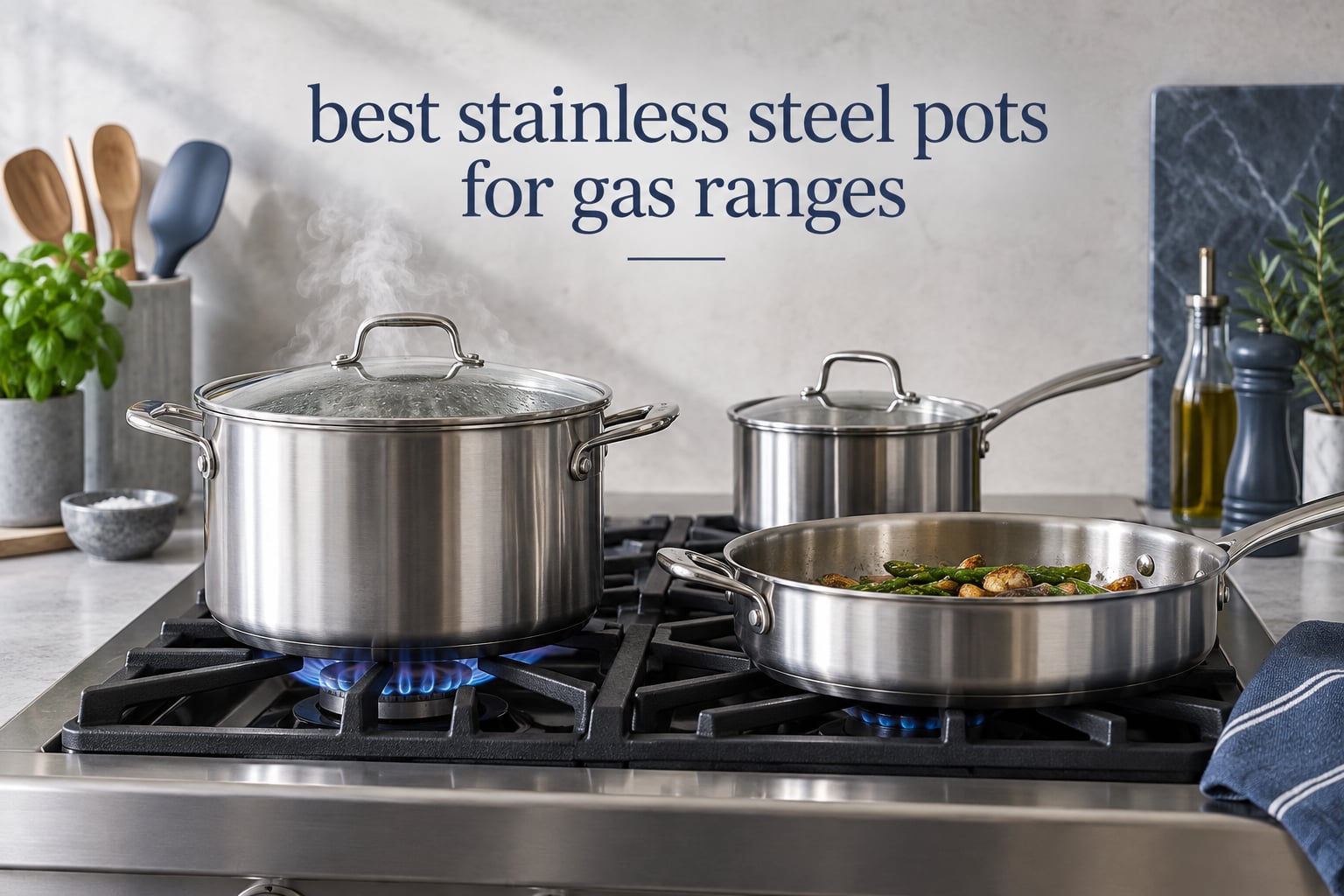
A gas burner does not heat a pot the way an electric element or an induction zone does. The flame throws heat outward in a ring, and the outer edge of the base takes the first and hardest blast of it. That single fact decides nearly everything about the best stainless steel pots for gas ranges: the base has to be heavy enough not to warp, the interior layer has to be good at pulling that ring of heat back toward the center, and the body has to sit flat and stable on a grate that moves as you turn it.
I have been cooking on gas for well over a decade, and I have replaced more stainless pots than I care to admit, most of them because they were thin-gauge with a cheap disc base and a single-wall handle that turned hot enough to need both hands on a pot holder. The ten pots in this roundup are the ones that survived that filter. Every one is a true stainless steel pot, every one is fully usable on a gas range, and I have judged them on the things that actually change your dinner: how the base matches the burner ring, how the walls conduct, whether the handle survives an open flame, and how the pot survives the dishwasher.
One quick note before we start. This guide is about cookware for your gas range, not about buying a gas range appliance itself. We looked at stainless steel pots and stock pots only. No cast iron, no nonstick, no carbon steel sneaked in, because the material is the whole point of the question.
If you came here looking for a welding reference instead, we have guides on MIG welding stainless steel and TIG welding stainless steel, plus deeper dives on flux core welding stainless steel without gas and stick welding stainless steel that cover the same alloy families in a fabrication context. For the kitchen, keep reading.
Our Top 3 Stainless Steel Pots for High-Output Gas Burners (October 2026)
These are the three that did the best in our kitchen across simmering, boiling, searing and stovetop-to-oven work. The CAROTE leads on evenness, the NutriChef on value, and the Cooks Standard on shape and handling.


Quick Picks and Full Specification Comparison
If you want the short version first, this is the list. Each line answers a different cooking need rather than ranking the same three pots ten ways.
CAROTE 8 Qt Tri-Ply – Best for even heating on a gas ring
NutriChef 6-Quart Stockpot – Best value for simmering broth
Cooks Standard 7 Quart Pot – Best wide Dutch oven shape
Ecolution 8-Quart Stockpot – Best for big weekly batches
Tramontina Gourmet 8-Quart – Best heavy pot for cast grates
Ciwete 12-Quart Clad Stockpot – Best for full clad walls
DELARLO 3.5-Quart Stockpot – Best for a small burner
Classic Cuisine 6-Quart Pot – Best budget starter pot
MICHELANGELO 2, 3 and 8 QT Set – Best one-box size range
LEGEND COOKWARE 5-Ply 6-Quart – Best for stovetop to oven
| Product | Details | Action |
|---|---|---|
|
|
Check Latest Price |
|
|
Check Latest Price |
|
|
Check Latest Price |
 |
|
Check Latest Price |
 |
|
Check Latest Price |
 |
|
Check Latest Price |
 |
|
Check Latest Price |
 |
|
Check Latest Price |
 |
|
Check Latest Price |
 |
|
Check Latest Price |
1. CAROTE 8 Qt Tri-Ply Stockpot – Best All-Rounder on a Gas Range
CAROTE 8 Qt Tri-Ply Stainless Steel Stockpot, Non-Toxic Stock Pot with Lid, Soup Pot for Pasta, Even Heating, Oven Safe, Induction, Ceramic and Gas Cooktops Compatible, Sliver, Mothers Day Gifts
8 quart capacity
Tri-ply fully clad
2.93 kg
Oven safe
Dishwasher safe
+ Pros
- Even heating with no hot spots
- Light for its 8 quart size
- Works on gas induction and ceramic
- Engraved quart and liter marks
- See-through vented lid
– Cons
- Loop handles run hot on a long simmer
- Glass lid can crack if dropped
- 10 inch base needs a wide burner
This is the pot I reach for first when I do not know what I am cooking. The whole body is tri-ply clad, meaning the aluminum core runs through the base and up the sidewalls instead of stopping at a disc on the bottom, and that is exactly what a gas flame ring rewards. Heat arrives at the outer edge, gets pulled across the base, and continues up the wall, so nothing scorches in a ring while the middle stays cold.
At 2.93 kg it is far lighter than I expected for a fully clad 8 quart pot, and that matters when you are draining a full pot of pasta water over a sink. It is not so light that it wanders on the grate, which is the real test.
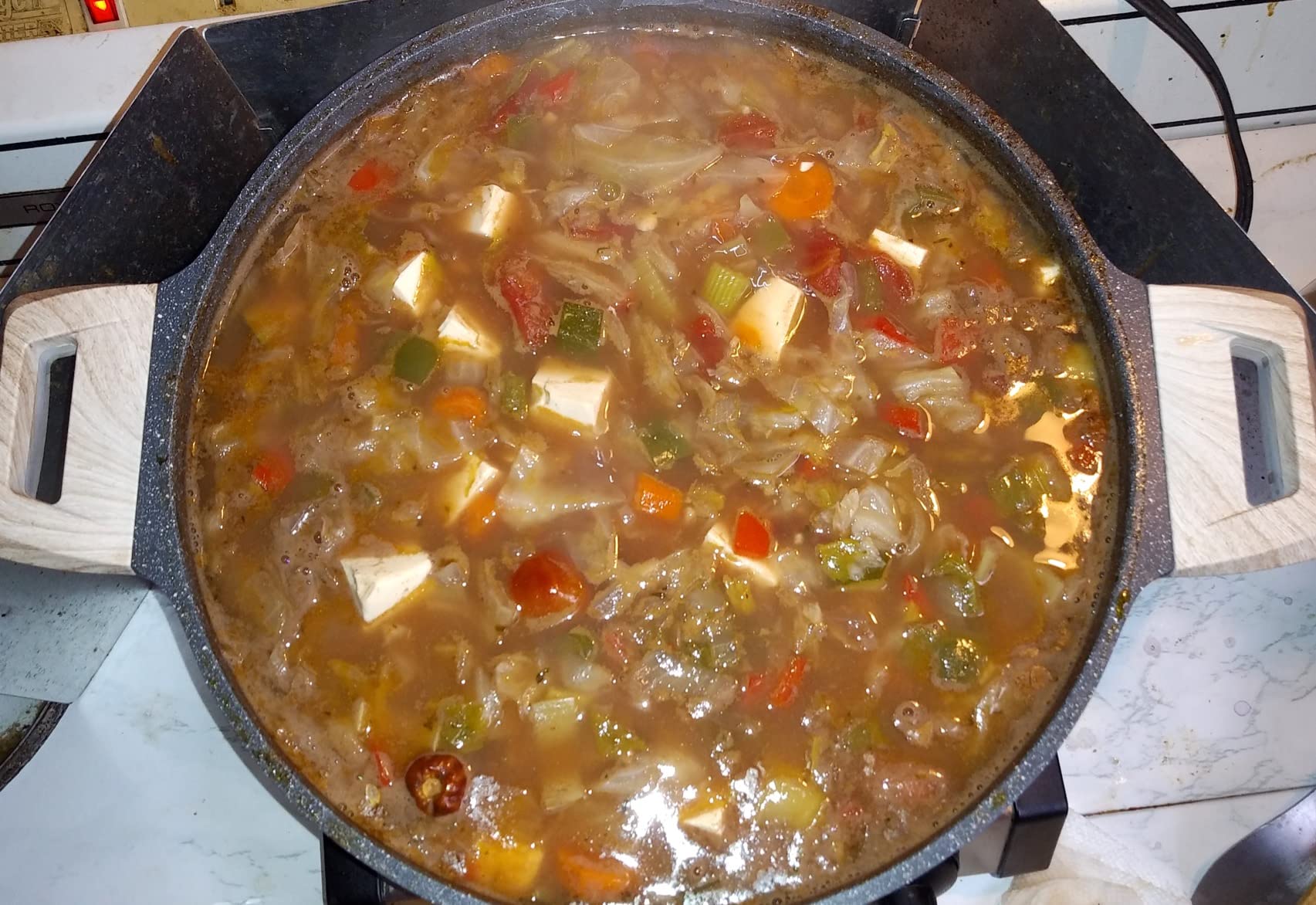
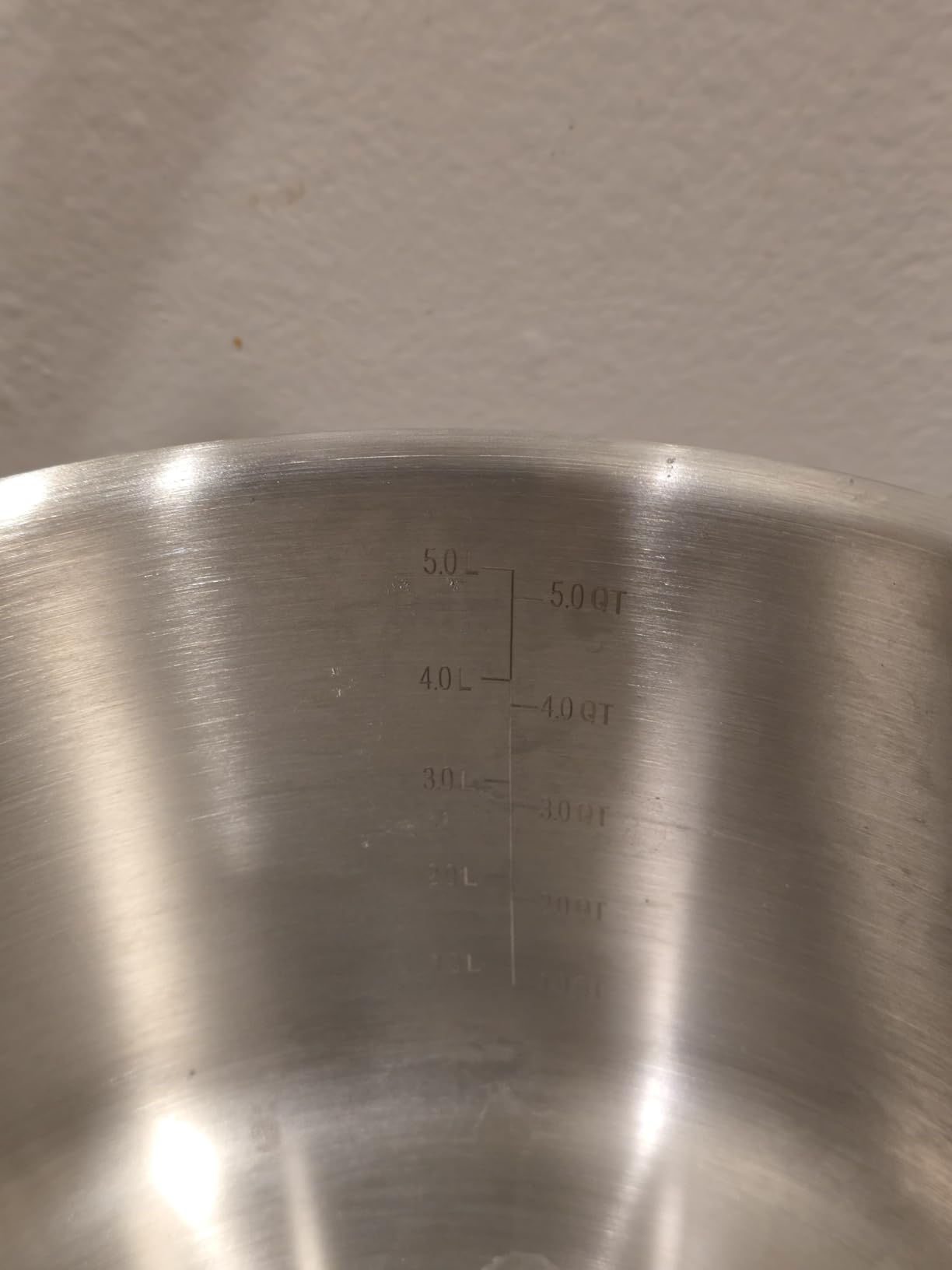
The details are the ones you use daily. Two loop handles give you a two-handed lift without a towel, the angled rim pours without dribbling down the side, and the glass lid has a vent hole so a long braise does not build pressure against the seal. Engraved quart and liter markings sit inside the wall, which saves you hunting for a jug measure every time you make broth.
What tri-ply cladding means over a gas flame
With a clad pot, the core layer is bonded across the entire surface, not just the bottom. On gas that difference shows up in two places: the flame ring where the burner ports actually spit, and the upper wall where condensation runs back down during a simmer. A disc-base pot handles the first reasonably and the second poorly.
The practical effect is control. A water bath stays at a steady bare simmer for an hour without the burner climbing, and a searing pan browns rather than burns. It is not a huge difference on low and medium settings, but it is a large one the first time you cook on high.
Matching 8 quarts to a burner ring
The base here is 10 inches across, and that is the one thing to plan for. On a standard 30-inch gas range, the front and rear burners are usually the small ones and the middle pair are the large ring burners. Put this pot on a small burner and the flame licks up the sides without ever being captured by the base, which wastes gas and scorches the food at the rim.
Match the base to the burner instead. If your large burner is a ring, a wide flat base like this one catches the whole circle of flame. If you only have a small burner available, sit the pot on the adjacent grate with the edge over the flame, the same way you would for a wok.
Lid, handles and the honest drawbacks
The two loop handles are welded or riveted stainless loops, and they do get hot on a long simmer. That is physics, not a defect, and it is the most common complaint in the reviews. Grab a towel, or alternate hands between the two.
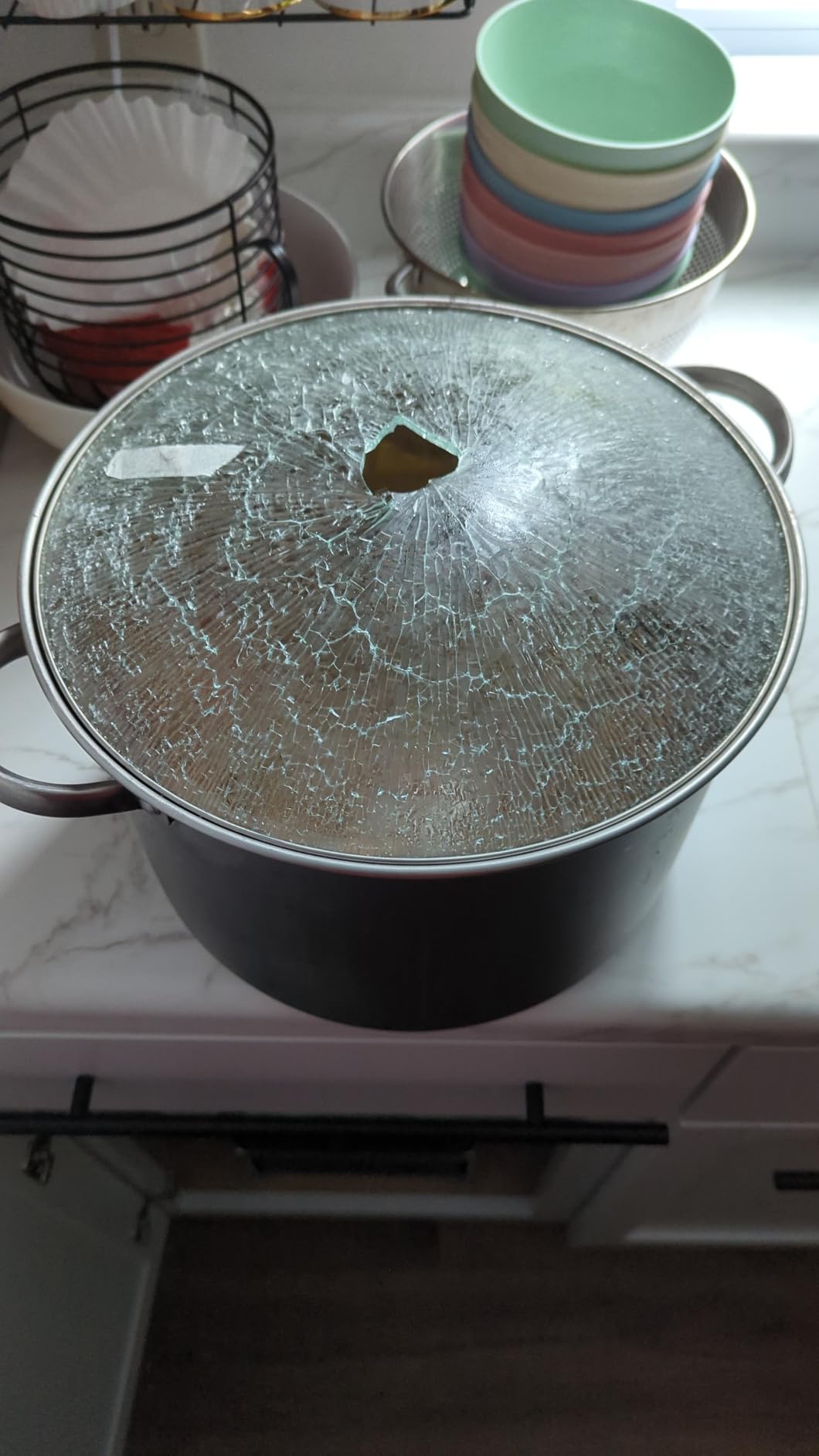
The glass lid is the second weak point. A single owner reported it shattering when dropped, and any tempered glass lid has the same exposure. Treat it as a cooking lid and not as a storage lid you stack with cast iron.
Who it suits and who it does not
Buy this if you want one pot that covers stock, pasta, sauces, vegetables and a Sunday braise, and you want it to work on gas, induction or ceramic without a second purchase later. It is also the pick for anyone moving off nonstick, since the surface is uncoated stainless with nothing to flake.
Pass on it if your cooktop is a small two-burner model with no large ring, or if you regularly lift a full pot overhead to drain. For very heavy lifting, the wider Dutch oven shape further down this list is steadier.
2. NutriChef 6-Quart Stockpot – Best Value for Simmering and Broth
NutriChef 6-Quart Stainless Steel Stockpot – 18/8 Food Grade Heavy-Duty Induction-Compatible Pot with See-Through Lid, Ideal for Stews, Broths, Simmering & Soups, Dishwasher Safe – NCSP6
6 quart capacity
18/8 stainless
0.208 inch base
Oven safe to 500F
+ Pros
- Even heating with no hot spots
- Interior volume markings
- Works on every stovetop type
- Tempered glass lid with vent
- One year warranty
– Cons
- Actual fill is a quart under the label
- Hand washing preserves the shine
- Base can discolor over time
Six quarts is the size I actually use most. It makes a proper batch of stock, holds a family dinner of pasta without crowding, and it is short enough to balance on a medium burner instead of needing the big one every time. For a gas range, that is the sweet spot dimension.
The base is impact-bonded at 0.208 inches, which is a serious piece of steel and aluminum bonded together. It is not full clad like the CAROTE, but for a pot whose job is holding a steady simmer, that distinction matters far less than it does for searing.
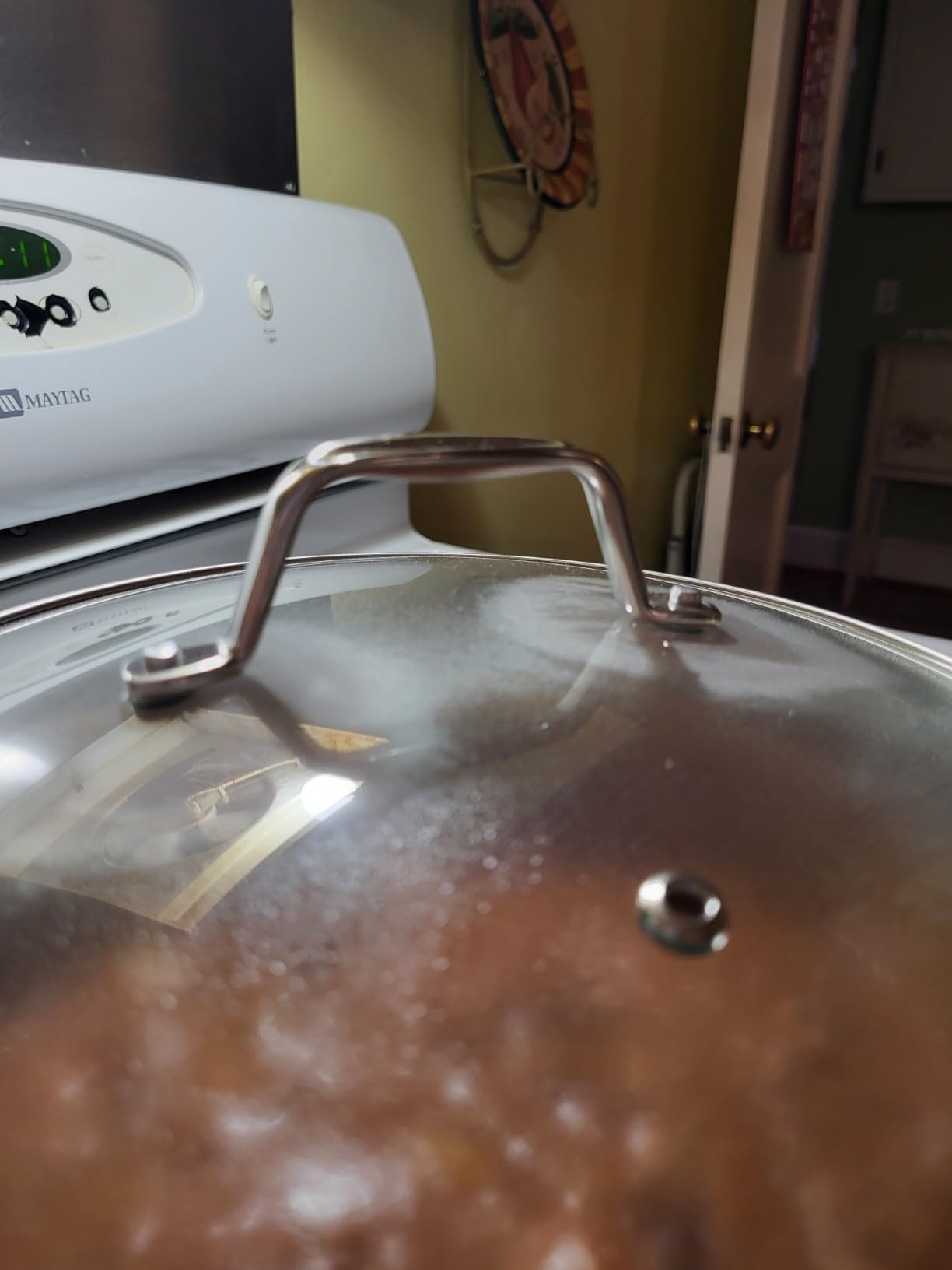
The interior is 18/8 stainless, a grade with a little more nickel than 18/10 and a slightly softer, more scratch-resistant surface. Reviewers consistently describe it as non-reactive, which is the property that lets you simmer a long tomato sauce or a lemon-and-olive reduction overnight without picking up a metallic taste.
What 0.208 inches of bonded base buys you on a burner
Thin pots on high-output sealed burners develop a concave base and then rock on the grate. A bonded base that thick will not. The heat spreads across the full 9.45 inch diameter before it reaches the food, so a pot of stock reaches a rolling boil and then holds it without the burner going to full blast.
It also means the pot settles rather than slides. At 3.2 pounds it is heavy enough to stay put when you stir a thick chili, which is not something you can say for a light single-wall pot.
Acid-heavy cooking and the non-reactive case
Stainless steel does not react with tomatoes, wine, citrus or vinegar the way bare aluminum does. That is the single strongest reason cooks who make a lot of sauce end up with a stainless pot in the first place, and this interior is uncoated, non-toxic and non-allergic by specification.
For deglazing, the surface takes a fond beautifully once you learn the heat sequence. Wine or stock hits the hot pan, the brown bits lift, and the pan goes back on the flame for the reduction. There is no coating to survive the scrub afterwards.
Oven limits, lid limits and the capacity label
The pot body is oven safe to 500F. The tempered glass lid is not, so any braise that finishes under a broiler needs the lid off for the last stretch, or you hold back the stock and reduce it in the pot on the stovetop.
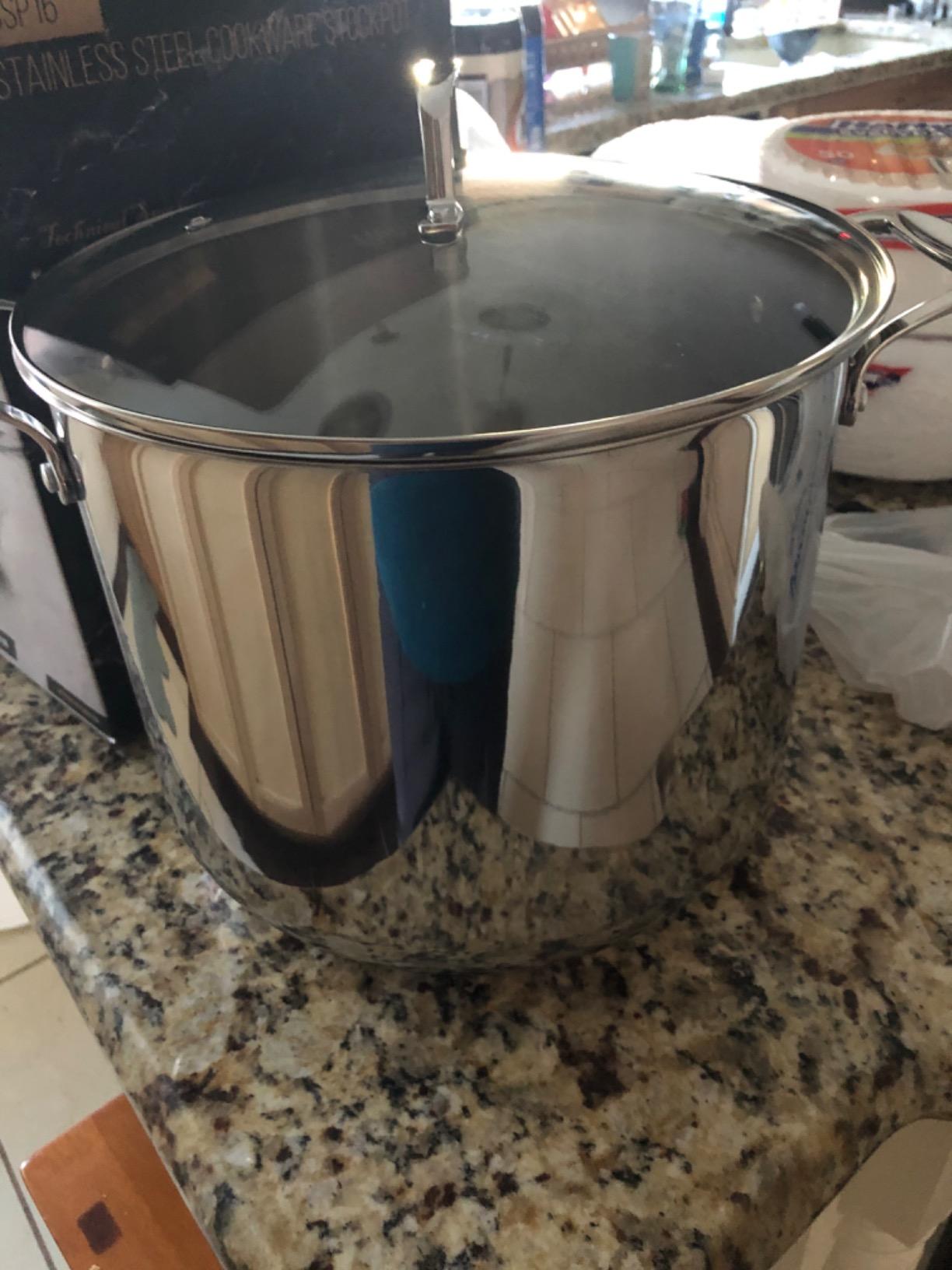
The one thing to know before you buy: the listed 6 quarts is a nominal size. Owners report filling it to roughly 5 quarts before the surface reaches the interior markings, so plan your batch size off the lines inside the pot rather than off the box.
Who it suits and who it does not
This is the pot for a cook who makes stock, beans, chili or large-batch tomato sauce on a weekly basis and wants one vessel that handles the stovetop and the oven. It is dishwasher safe, though the maker suggests hand washing to keep the mirror finish bright.
It is the wrong choice if you sear often and care about a pan surface that recovers temperature in a second, or if you want a fully clad wall. For searing, look at a clad or disc-base wide pan; for acid simmering, this is hard to beat for what it delivers.
3. Cooks Standard 7 Quart Pot – Best Wide Dutch-Oven Shape for a Gas Grate
Cooks Standard 7 Quart Stock Pot, Stainless Steel Cooking Pot with Lid
7 quart capacity
18/10 stainless
6.3 lb weight
11 inch wide
Oven safe to 500F
+ Pros
- Handles stay cool over an open flame
- Very wide and low for a grate
- Broiler safe pot body
- Works on every stovetop
- Great for bread baking and searing
– Cons
- Disc base only
- not fully clad
- Lid not oven safe above 300F
- Interior rivets catch residue
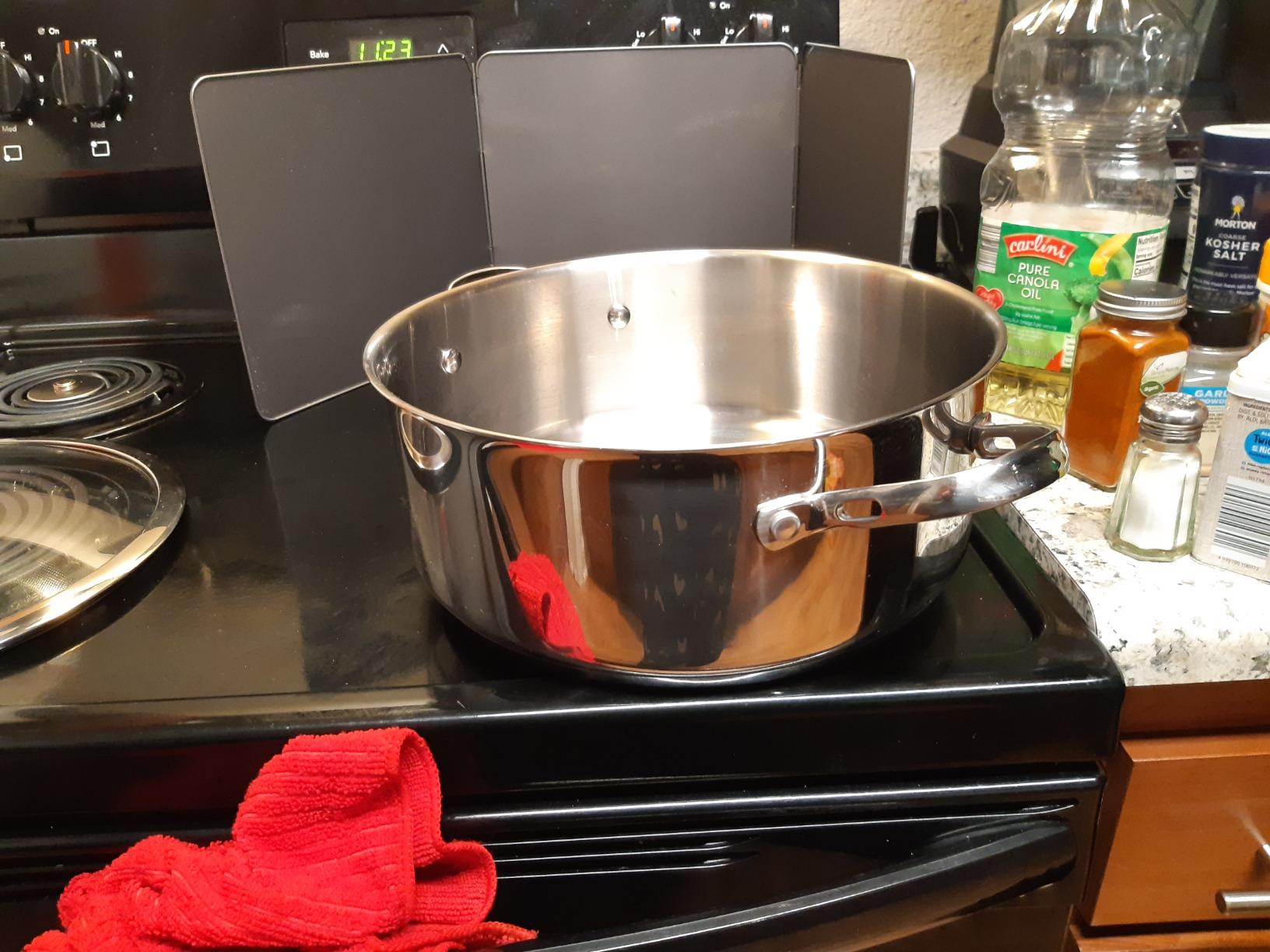
The reason this pot behaves so well on gas is its shape, not just its metal. At 11 inches wide and 4.3 inches tall, it sits low and broad on a grate, covering a ring burner almost completely and resisting the tipping that makes tall pots dangerous when you reach across the range.
That low profile also makes it the best pot here for a Dutch oven style braise. A tall narrow pot radiates heat out of the sides and needs a lower flame, while this one stays in contact with the burner and cooks at a genuine simmer without the lid fogging.
Air-flow handles over an open flame
Gas cooktops throw radiant heat upward as well as conduction into the base, and a solid single-wall handle gets uncomfortably hot within a few minutes. These riveted stainless handles are built with open air channels through the grip, and owners across thousands of reviews specifically call out that they stay cool during long cooking.
Rivets matter here too. A handle attached with a single rivet can rotate and let the pot twist on the grate. A two-rivet handle like this one holds alignment, which is the difference between a pot that stays square to the flame and one that rocks while you stir.
Where the disc base stops
The base is an impact-bonded aluminum disc in 18/10 stainless. That is a real step down from full clad construction, and it shows at the flame ring: the sidewalls above the disc heat more slowly than the bottom, so a very hot sear on the sides of the pot will be slower than the same sear in the center.
For the way most people use a stock pot, that is an acceptable trade. It is not what you want for a hard sear on a thick steak in a shallow pan, and it is not the pot to buy for sous vide precision work.
Oven temperatures and the lid rule
The pot body is oven safe to 500F, which is what you need for a roast, a bake or a finish under the broiler. The glass lid is only rated to 300F, and it collects oil and condensation in the crease where it meets the rim.
Owners use this pot for baking bread, roasting a whole chicken and frying with a shallow layer of oil. Just take the lid off before the oven gets hot and wipe the rim when you are done.
Who it suits and who it does not
Choose this if your cooktop has a large ring burner and you cook with a lot of liquid, bread or braised meat, and you want handles you can grab with bare hands through a long service. Reviewers consistently describe it as feeling like a step up from department store cookware at a similar tier.
Skip it if you need a fully clad wall for even heat from base to rim, or if you hate cleaning around interior rivets. It is heavier than most competitors at 6.3 pounds, which is exactly why it does not move when you stir.
4. Ecolution 8-Quart Encapsulated-Base Stockpot – Best Big-Batch Everyday Pot
Ecolution Stainless Steel Stock Pot, Encapsulated Induction Ready Cooking Pot with Glass Lid, Oven Safe, Dishwasher Safe Soup Pot, 8-Quart
8 quart capacity
Encapsulated base
3.7 lb weight
Oven safe to 350F
+ Pros
- Encapsulated base spreads heat fast
- 8 quarts fits a big crowd
- Steam vents on the glass lid
- Comfortable riveted handles
- Sizes run from 1 to 24 quarts
– Cons
- Lowest oven rating here at 350F
- Handles warm during long cooks
- Finish can discolor over time
Eight quarts is the size most people actually need for a Sunday. Pasta for six with room to stir, a full pot of soup, a batch of stock, or a canner-style run of beans and tomatoes, all without the awkward overflow point that a 12 quart pot creates on a residential range.
This one is built around an encapsulated base, which is the budget answer to a clad wall. Rather than running an aluminum core through the entire pot, the maker bonds a disc of heavy material into the base and leaves the walls single. On gas that is a reasonable trade, because a stock pot spends most of its life at a simmer.
What an encapsulated base actually does
An encapsulated base gives you a large, flat, heavy contact area. On a sealed burner that matters more than on an open one, because the burner dumps a fixed amount of energy onto whatever is sitting above it, and a wide flat disc spreads that energy rather than concentrating it in a ring.
The result is fast time to boil and a base that does not warp after a year of high-heat cooking. The sidewalls run cooler than the base, so stir more often when reducing a sauce in this pot and you will not scorch the sides.
Eight quarts and the reality of a residential range
At 7.68 inches tall and about 10 inches across, this pot needs a burner of similar diameter to work properly. Put it on the small burner and the flame goes up the sides; put it on the ring burner and the whole base sees heat evenly.
It also needs clearance above. With two shelves of pans already on the range, the lid may not clear the underside of the upper rack, so measure before you commit to an 8 quart profile.
The 350F ceiling and what it costs you
At 350F, this is the lowest oven rating in the roundup. That rules out a hot oven roast, a high-heat sear finish and most broiler finishes. It is fine for a covered stovetop braise that finishes at a gentle oven temperature, which is where most stock pot recipes end up anyway.
Cleaning is easy and the pot is dishwasher safe, with hand washing suggested to protect the polish. Owners do report gradual discoloration on the base over long use, which is normal heat tint on stainless and does not affect cooking.
Who it suits and who it does not
Buy this as a first stainless pot, a rental kitchen pot, or a second pot for anyone cooking for a group every week. It is easy to clean, it works on gas, induction, electric and glass, and it comes in sizes from 1 quart to 24 quarts if you decide you need a larger one later.
Do not buy it for high-temperature oven work or for searing, and expect the handles to warm up during a long simmer. If you already own a nonstick set and are adding one stainless workhorse, this is a sound, unpretentious place to start.
5. Tramontina Gourmet 8-Quart Stockpot – Best Heavyweight Base That Stays Put
Tramontina Gourmet Stainless Steel 8-Quart Stock Pot with Lid
8 quart capacity
18/10 stainless
8.5 lb weight
Oven safe to 500F
+ Pros
- Very heavy and stable on a grate
- Impact-bonded tri-ply base
- Precision cast riveted handles
- Oven safe to 500F
- Dishwasher safe
– Cons
- Heaviest pot in the roundup
- Base is tri-ply not fully clad
- Steel lid adds to the weight
At 8.5 pounds, this is the heaviest pot in the roundup, and that is the entire point. A pot that heavy does not slide when you push a wooden spoon across the base, does not walk when the burner is on high, and stays put when you reach over it for a pinch of salt on the far burner.
Stainless steel transfers heat poorly compared with aluminum or copper, and much of a heavy pot’s mass is there to resist flexing. On a gas range, where the flame ring and grate are both hard on a thin base, mass is cheap insurance against warping.
What 8.5 pounds feels like in the kitchen
The weight is genuinely pleasant for a pot that lives on the stove and annoying for one that lives in the cupboard. Filling it near capacity makes it close to 20 pounds, and lifting that from a grate to a sink is a two-hand job.
For an older cook, anyone with limited wrist strength, or a household that stocks a large pot of water on the stove, that stability is worth the effort. For a small kitchen and a smaller burner, it is more pot than you need.
Impact-bonded tri-ply base and 18/10 steel
The base is an impact-bonded tri-ply disc in 18/10 stainless, which is the mid-grade construction in this roundup. It is a step above a single disc in heat spread and a step below a fully clad body, and for a pot that boils and simmers it is close to ideal.
18/10 is the most common kitchen stainless grade, with 10 percent nickel added for corrosion resistance and a harder, brighter surface. It is non-reactive, so tomato, wine and citrus cooking are all fine, and it is magnetic enough to work on induction.
Handles, lid and the weight trade-off
The handles are precision cast and riveted rather than stamped sheet, so they are stiffer and better anchored. The lid is solid 18/10 stainless rather than glass, which means no thermal shock risk, but it adds to the weight and you cannot see inside.
It is oven safe to 500F and dishwasher safe, and the same line runs in 6, 8, 12, 16 and 24 quart sizes if you need a companion pot later.
Who it suits and who it does not
This is the pot for a cook who has strong hands, a solid range, and a preference for buying one heavy piece and keeping it for years. Reviewers describe it as substantial and durable in exactly those terms, and the brand has a long reputation in housewares.
It is the wrong choice for a small kitchen, a lightweight user, or anyone who wants to lift a full pot one-handed to strain it. Check that the base diameter matches your largest burner before committing, since a heavy pot on a small burner wastes a lot of gas.
6. Ciwete 12-Quart Full Clad Stockpot – Best for Entertaining and Big Batches
Ciwete Stock Pot 12 Quart, 18/10 Tri-Ply Stainless Steel Whole Clad Stock Pot with Lid, Seamless 12 QT Cooking Pot with Copper Handle, Healthy Stockpots, Induction, Gas, Oven and Dishwasher Safe
12 quart capacity
Tri-ply whole body
Copper handle
Oven safe to 500F
+ Pros
- Tri-ply runs through the whole body
- Heat spreads base to rim
- Copper handle stays cooler
- Drop-proof glass lid
- Dual quart and liter markings
– Cons
- Newer brand with a shorter history
- Weight is not stated
- Large diameter needs a wide burner
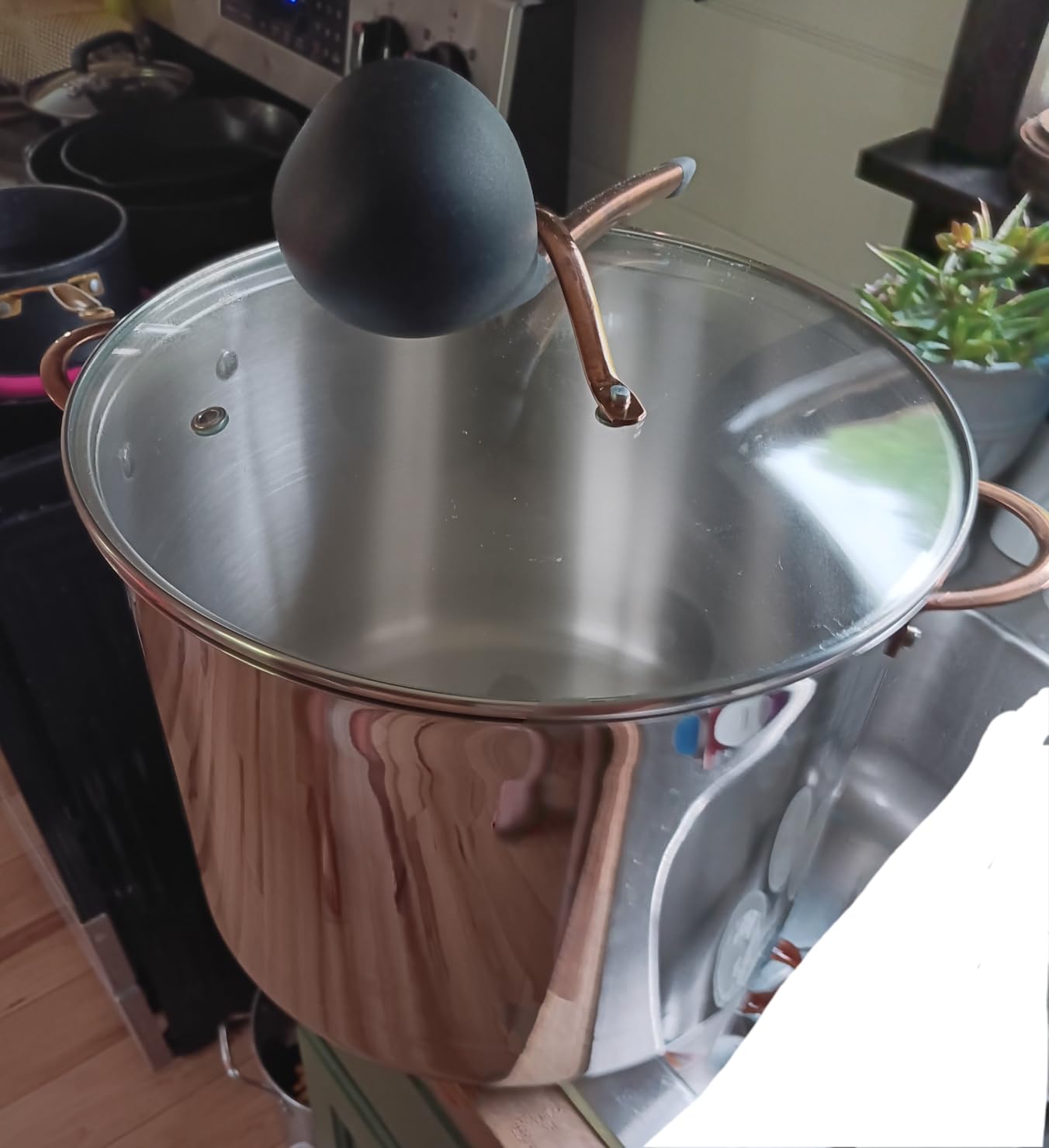
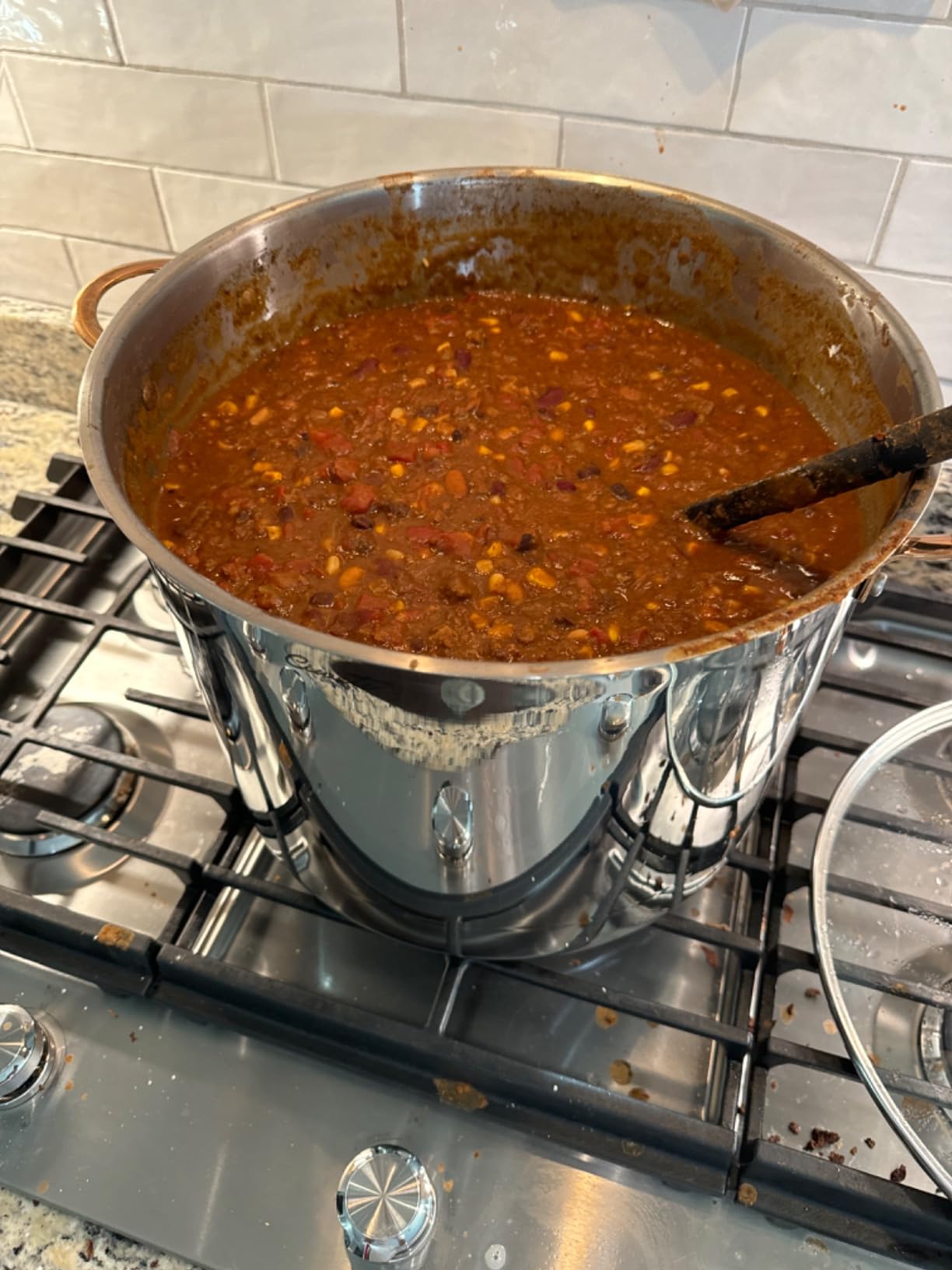
This is the only 12 quart pot in the group built with tri-ply layers through the entire body rather than just the base. When you are cooking a big pot of braised short ribs or a catering-size batch of chili, that difference is not subtle, because the liquid stays at an even simmer from the bottom of the pot to the surface.
The seamless bonding is the other story. There is no seam line where a disc meets a wall, so there is no ring of trapped heat or weak point to worry about after years of use.
Full clad versus tri-ply base in a large pot
In a small pot, the difference between a clad wall and a base disc is a matter of degrees. In a 12 quart pot full of liquid, heat has further to travel and the walls lose more to the kitchen, so the clad body holds temperature noticeably better and the simmer is more forgiving.
That matters on gas because a gas flame is far more powerful and far less forgiving than a simmer setting on an electric hob. Cooks who make large batches on gas are the group that feels full clad construction most clearly.
Copper handles and lid behaviour
The handles are copper, which conducts heat out of the pot faster than a bare stainless loop and stays noticeably cooler to hold. They are also the part of the pot most likely to show wear, since copper changes color in a way stainless does not.
The lid is described as shatterproof glass with a vent, and it is the safer choice than thin tempered glass if you have a busy kitchen. Dual-scale markings on the body let you read a batch in quarts or liters without a separate measure.
Matching a 12 quart pot to a burner
At 11 inches across, this pot needs the widest burner on the range to work properly. On anything smaller, the outer flame ring is outside the base and you will scorch the liquid at the rim while the center barely simmers.
It also needs vertical clearance. Check that the lid clears the shelf above your range, and be honest about whether you will drain 12 quarts of pasta water safely, because that is the moment a very large pot becomes difficult.
Who it suits and who it does not
Buy this if you cook for a crowd, make stock in serious volume, or run a holiday meal where one pot has to do the braise and hold it warm. Full clad construction is exactly right at this size.
Be a little more cautious if you want long service history behind the name, since this is a newer brand with a shorter review record, or if you need a light pot. It is oven safe to 500F and dishwasher safe, and also offered in 8 and 20 quart versions.
7. DELARLO 3.5-Quart Stockpot – Best Small-Pot Workhorse
DELARLO Whole Body Tri-ply Stainless Steel Stock Pot with Lid 3.5QT, Cooking Pot Food Grade Cookware, Durable Soup Pot with Glass Lid,Suitable for All stoves, Dishwasher Safe
3.5 quart capacity
Whole body tri-ply
4.9 lb weight
Oven safe to 500F
+ Pros
- Whole body tri-ply with an aluminum core
- 18/8 food grade interior
- Works on gas induction and open fires
- Runs from 3.5 to 20 quarts
- Dishwasher safe
– Cons
- Small capacity for a large family
- Newer brand
- Base diameter suits only a small burner
A 3.5 quart pot is the one most cooks skip and then wish they had. It is the right size for a two-person pasta dinner, a pot of oatmeal that does not turn to glue in the leftovers, a small batch of stock, and reducing a sauce without it cooling down too fast on the burner.
On gas, a smaller pot is genuinely easier to cook on. A 3.5 quart base heats and responds faster than an 8 quart, and a flame you can turn down to a whisper is easier to manage when there is less food in the way.
Whole body tri-ply at a compact size
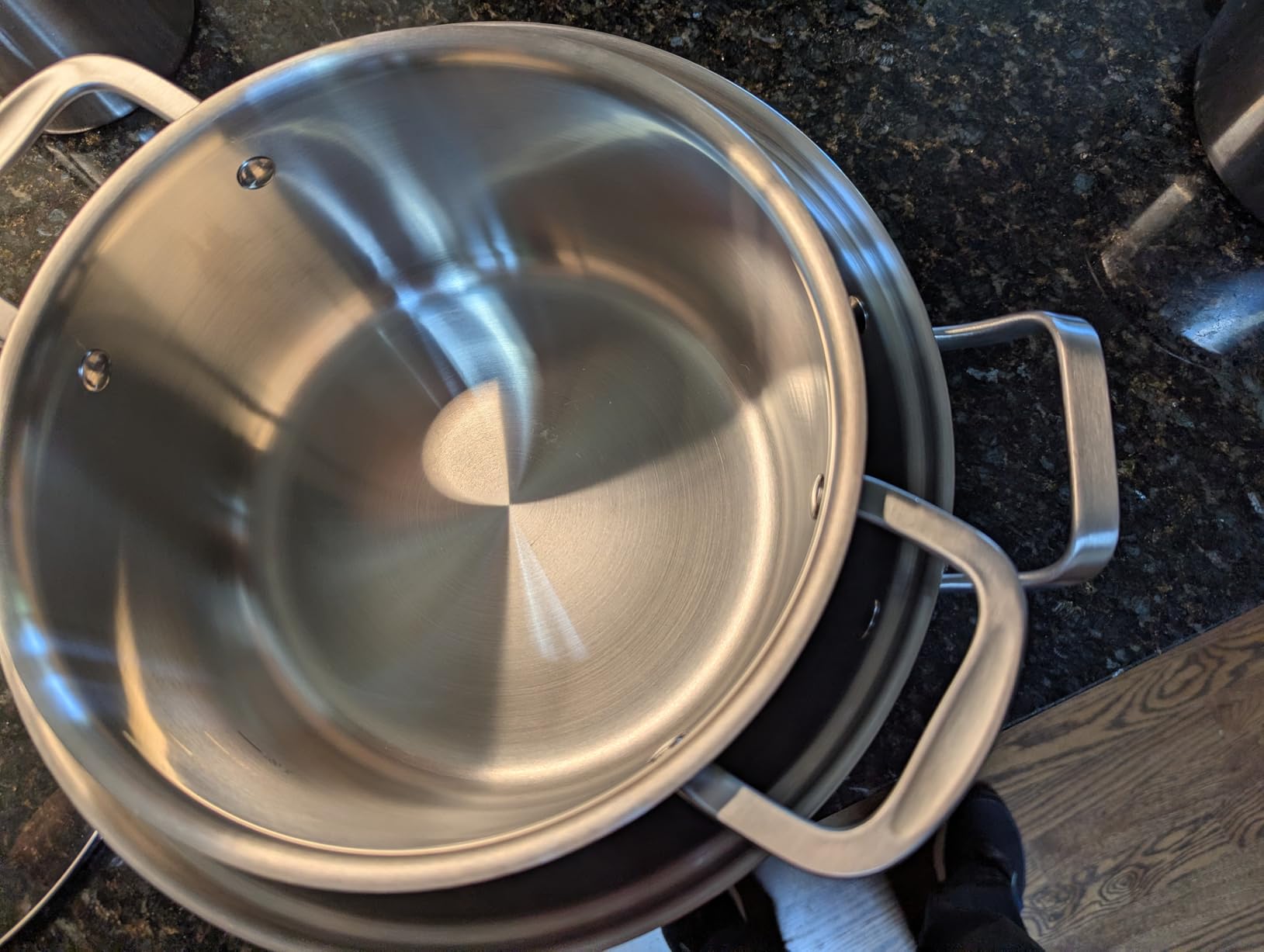
The construction is tri-ply through the entire body, with an 18/8 stainless interior and an aluminum core between the layers. That is better construction than most pots at twice the size, and it is what keeps a small pot from developing a hot spot in the middle while the edges cool.
At 4.9 pounds for 3.5 quarts it feels heavier than you expect, and that is the core plus the base doing their job rather than a cheap heavy gauge.
Why the size matches a small burner
The base is close to 11 inches across, so this pot actually suits a smaller burner better than the large ones in this roundup. The flame ring is captured by the base, the pot sits stable rather than overhanging, and the flame licks up the sides rather than shooting past the edge into the room.
Owners also report it working over an open campfire, which tells you something about the base thickness and the general lack of thin metal in the build.
Where the size catches you out
Three and a half quarts is not a family pasta pot and it is not a stock pot. It is a saucepan and a half, and the honest limitation is capacity, not quality. If you are cooking for four or more most nights, this is a companion piece, not a replacement for a large pot.
The same line runs in 5, 6, 8, 12 and 20 quart versions, so if the shape works for you, sizing up is straightforward. The pot is oven safe to 500F and dishwasher safe.

Who it suits and who it does not
Choose this for a one or two person household, a first apartment kitchen, or as the small pot in a set that already has a big stock pot. It is the pot I use most for weeknight sauce and reheating.
Skip it if you batch cook for a household, since you will outgrow it quickly. It is also a newer brand with a smaller body of owner feedback than the established names in this list, so consider that before making it your only pot.
8. Classic Cuisine 6-Quart Pot – Best Budget Starter Pot
6 Quart Stock Pot-Stainless Steel Pot with Lid-Compatible with Electric, Gas, Induction or Gas Cooktops-Cookware by Classic Cuisine
6 quart capacity
Lightweight body
Quart and liter marks
All cooktops
+ Pros
- Light and easy to lift
- Works on gas induction and glass
- Interior measurement marks
- Includes a tempered glass lid
- Also offered in 12 quart
– Cons
- Thinner metal than the rest
- Lightweight on a grate
- Inner scale reads 5 quarts at the true 6 quart line
Not everyone needs a five layer pot to boil water. This is a straightforward 6 quart stainless stock pot with a mirror finish outside, a satin finish inside, and a tempered glass lid, and for many households it is entirely sufficient.
It is the pot to buy if you are outfitting a first kitchen, a rental, or a dorm-style setup, and if you want to learn stainless technique before committing to a serious clad pan.
What a light single-wall pot gives up
At 1.21 kg, this is the lightest pot here, and that cuts both ways. It is easy to lift one-handed and easy to drain, but it has less thermal mass, so it cycles in temperature faster as the burner moves up and down.
The practical symptom is hot spots at the flame ring. On a high burner, the outer band of the base heats well before the center does, which means a delicate fish or a thin custard can scorch at the edge while the middle is still cool.
Burner matching and grate stability
The base is about 10 inches across, so it wants a large burner to work well, in the same way the CAROTE does. Sit it on a small burner and the flame goes up the sides of the pot instead of into the food.
Because it is light, it will also move more easily on a grate. That is not dangerous with a pot of water, but it is one more reason to keep the handle pointed inward and to lift rather than slide it.
The confusing inner scale and the care story
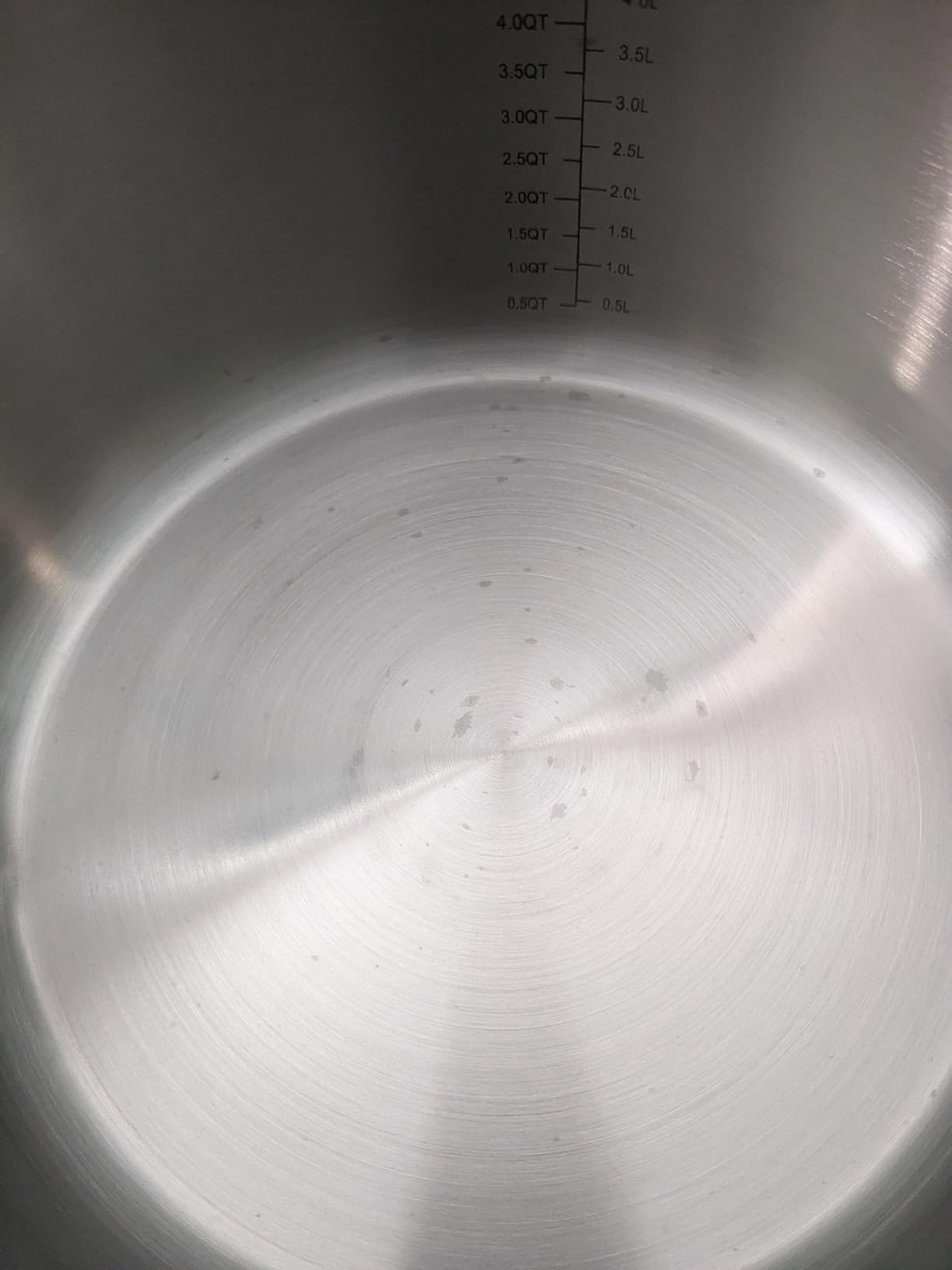
The markings inside show quarts and liters, but owners flag a genuine confusion: the inner scale tops out at 5 quarts while the pot actually holds 6. Plan your batch from the physical pot, not from the printed line, and you will not be caught short.
Cleaning is simple, and there is no coating to worry about. A non-abrasive pad and hot soapy water handle almost anything, and the same pot is also offered in a 12 quart version.
Who it suits and who it does not
Buy this if your cooking is mostly boiling, simmering and steaming, if you are on a tight budget for a first pot, and if you would rather spend on a good pan than on a pot you use to make stock twice a year.
Do not buy it if you sear frequently, cook on very high burners, or want a pot heavy enough to never move on the grate. It is a sensible starting point, not an upgrade piece, and most cooks graduate to a clad pot once technique makes sense to them.
9. MICHELANGELO 2, 3 and 8 Quart Set – Best One Purchase Covering Every Size
MICHELANGELO Stainless Steel Pot Set, 2QT & 3QT Saucepans, 8QT Stock Pot
2 and 3 quart saucepans
8 quart pot
Tri-ply base
Vented glass lids
+ Pros
- Three sizes in one purchase
- Saucepans and a stock pot together
- Vented glass lids
- Side spouts for pouring
- Stackable for storage
– Cons
- Thinner metal than premium brands
- Hollow handles feel light
- Interior rivets are awkward to clean
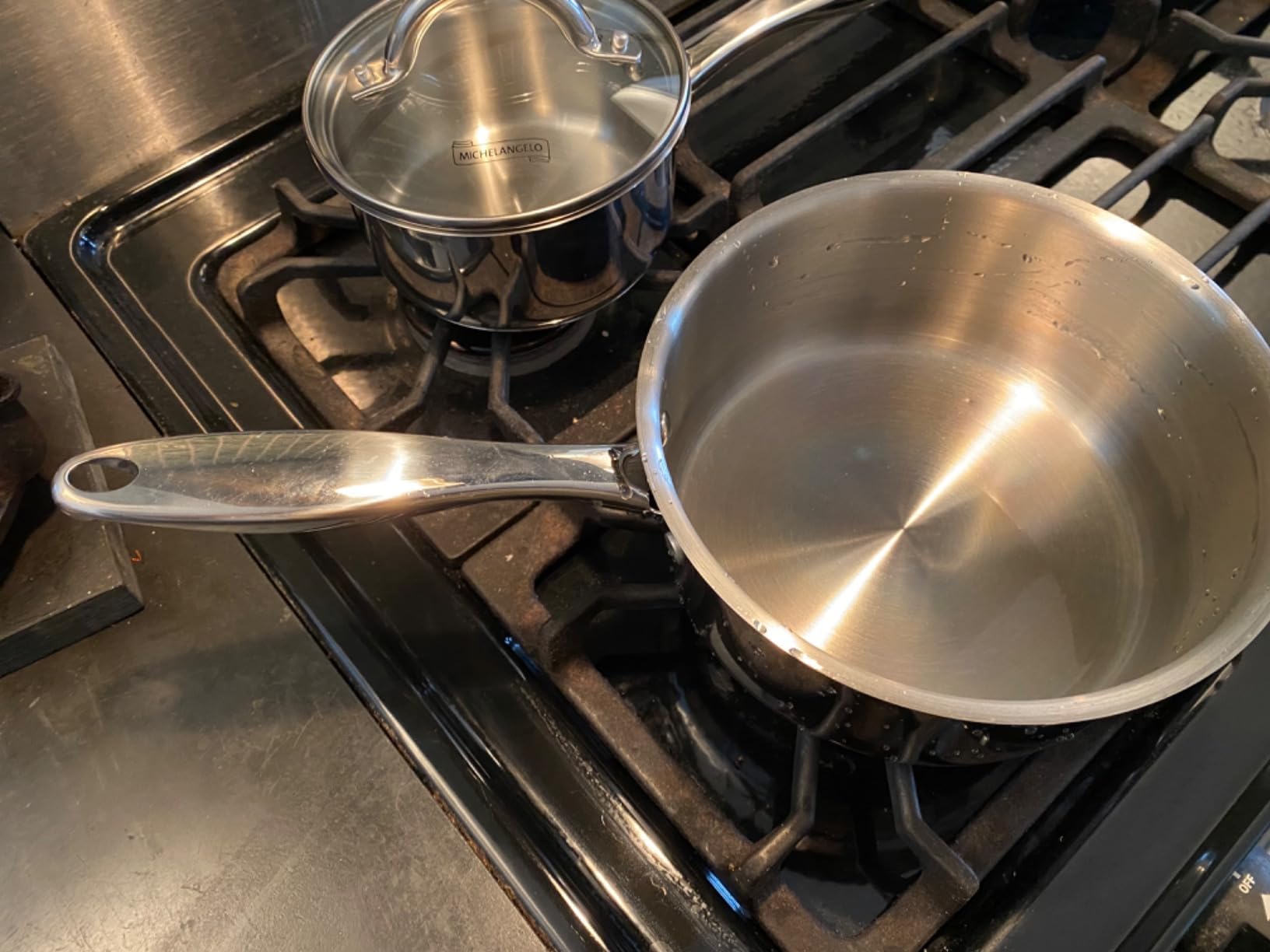
Two saucepans and a stock pot in one box solves the most common complaint in cookware forums, which is that an eleven piece set gives you three pans you use and a pile of lids you do not. This one covers the sizes that get used daily: a 2 quart for sauces and reheating, a 3 quart for one-pot pasta, and an 8 quart for a full pot of soup.
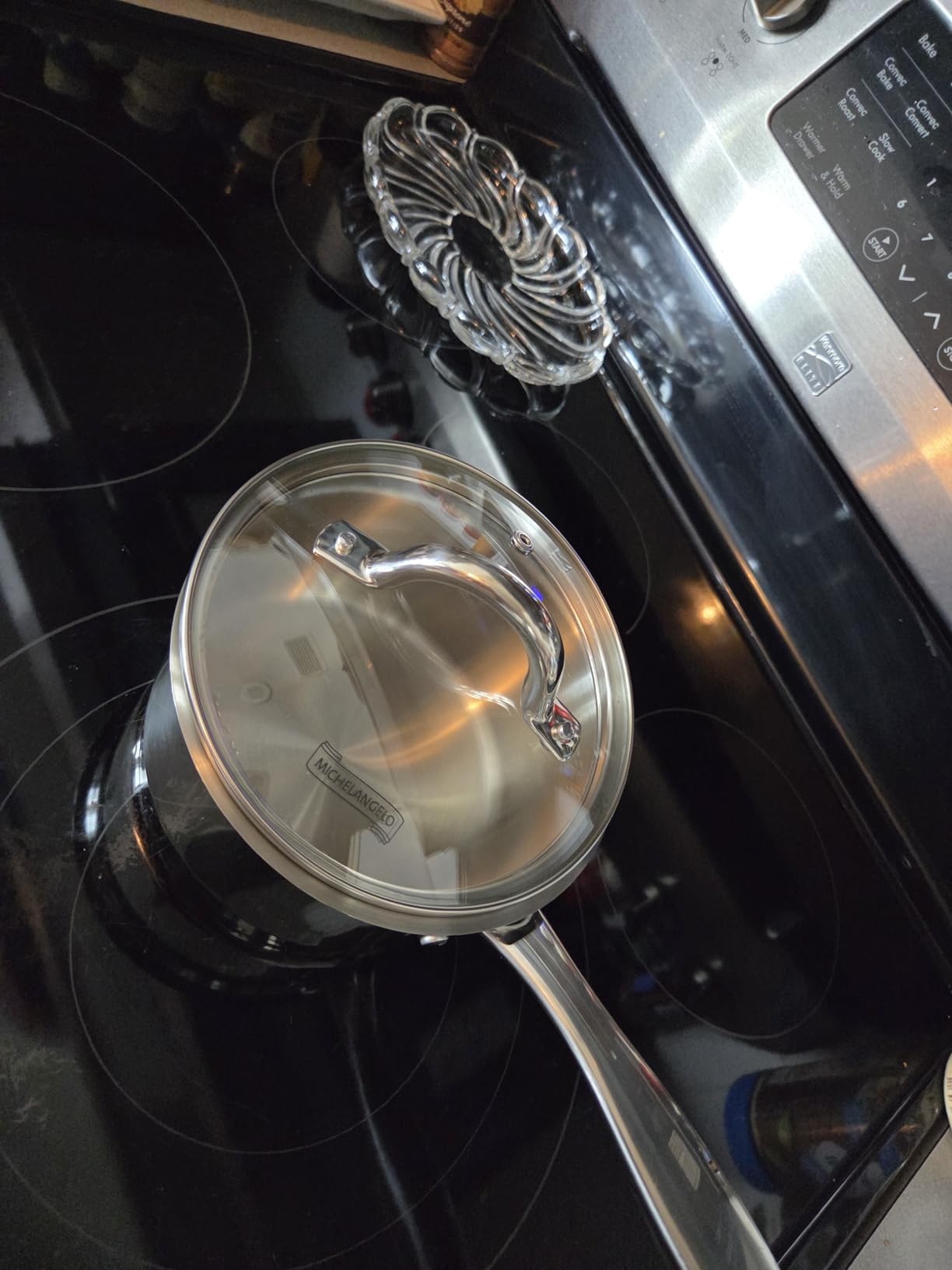
All three come with vented glass lids, and all three are uncoated 18/10 stainless. There is nothing in this set that will need replacing in five years because a coating failed.
Three sizes and what each is for
The 2 quart saucepan is the one that saves you from a scorch. A narrow base hits a small burner cleanly, heats in seconds, and gives you fine control over a butter-based sauce or a reduction that would seize on a wide base.
The 3 quart is the everyday workhorse for a small family, and the 8 quart handles pasta, broth and chili. Having the small and the large in the same material and the same style means your sauces and stocks get made the same way.
Tri-ply base, spouts and stackability
The base is tri-ply impact-bonded, which gives even heat across the cooking surface without the weight of a full clad body. Reviewers report steady heat and no burning, which is what you want for a pot of rice or a thick soup.
Each pot has a side spout, which is far more useful than it sounds when you are moving a strained liquid into a jar. The pots stack for storage, and owners call out that the handles stay cool during normal cooking.
Where the gauge shows
This is thinner metal than the premium builds in this roundup, and the handles are hollow, so it feels lighter in the hand. That is a fair trade for the size range, but if you are particular about heft, expect a different feel from a cast handle.
Interior rivets are the other recurring note, since fond and sauce collect in the crease. Some owners also see white mineral spots on new pots, which come off with a rinse of vinegar, and customer service responds well when they do appear.
Who it suits and who it does not
This is the set for a household starting from zero on a gas range, or for anyone who wants a saucepan and a stock pot without shopping for two separate products. It is induction compatible, stackable, and dishwasher safe.
Pass on it if you already own a good 10 inch skillet and only need saucepans, since the value here is the size range rather than the build. It is also the pick to skip if you cook on very high burners and want maximum mass, as this is the lighter end of the group.
10. LEGEND COOKWARE 5-Ply 6-Quart Stockpot – Best for Stovetop-to-Oven Cooking
LEGEND COOKWARE 5-Ply Stainless Steel 6-Quart Stock Pot with Lid – Induction Compatible, Oven Safe 800°F – Non-Toxic, No Coatings – Even Heating, Won’t Warp – Built to Last Generations
6 quart capacity
5-ply clad
3mm steel
Oven safe to 800F
+ Pros
- Five layers of steel and aluminum
- Highest oven rating here at 800F
- Extra thick 3mm steel resists warping
- Lifetime warranty
- Cast hollow handles stay cooler
– Cons
- Hand wash only
- Not a nonstick surface
- Heavier than the mid tier options
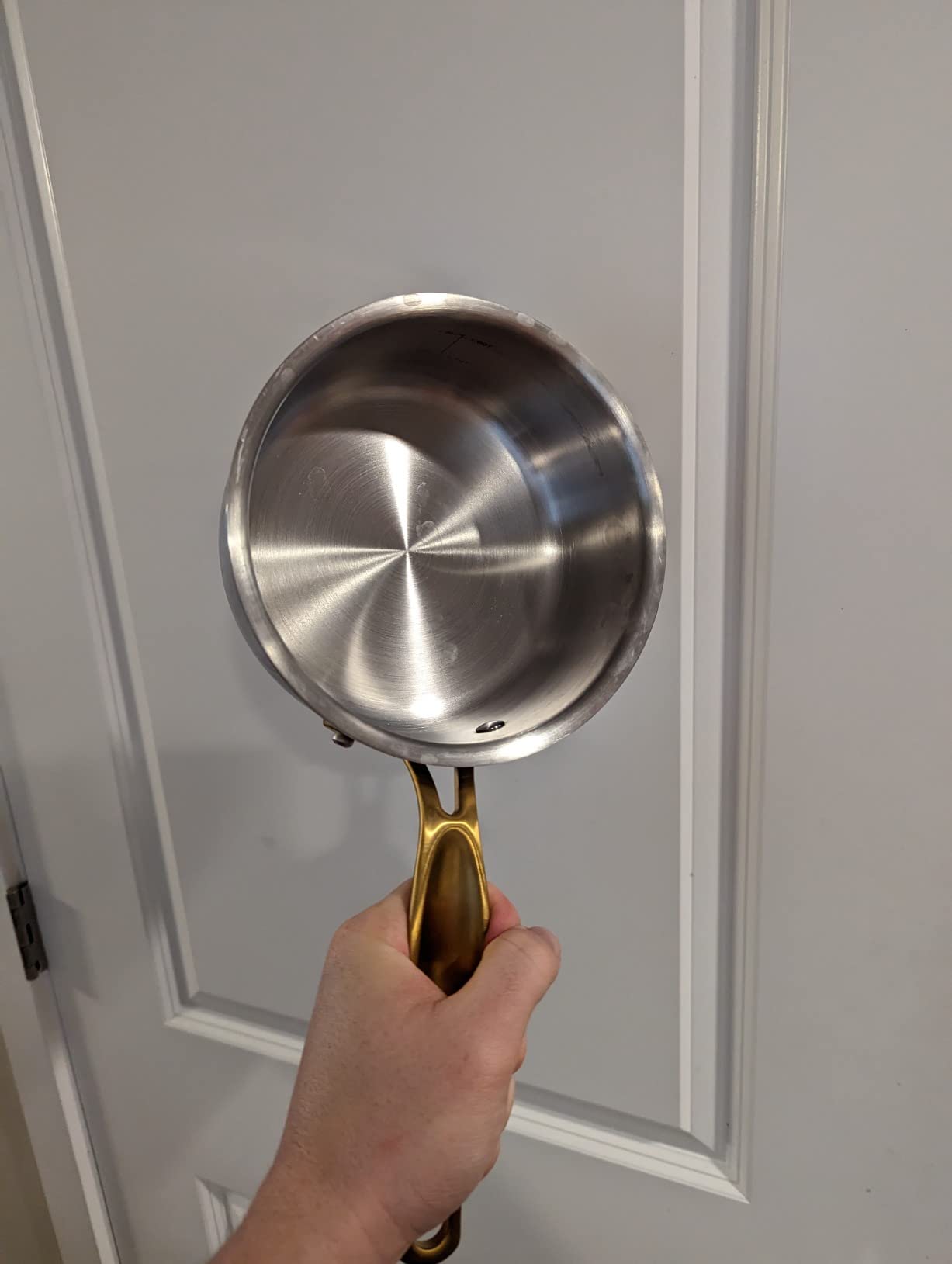
This is the most heavily built pot in the roundup: five layers of steel and aluminum bonded together, with extra thick 3mm steel in the body, and an oven rating of 800F. That rating is the differentiator. Every other pot here tops out between 350F and 500F, which is enough for a braise but not for a hot roast or a broiler finish.
Full clad construction at this thickness is the closest thing in this list to what a serious cook expects from a pot they will keep for a lifetime, and the maker backs it with a lifetime warranty on material and workmanship.
Five layers and 3mm steel on a gas burner
Five layers spread heat across the entire base and up the walls, which is exactly the behavior a gas flame ring produces. There is no hot spot at the perimeter and no cold patch in the center, so a stock that starts at a boil settles into an even simmer without the burner being turned down.
The 3mm steel gauge is the anti-warp measure. On a high-output sealed burner, thin gauge is where the base deforms permanently and starts rocking, and this is the pot in the group least likely to develop that problem.
What an 800F rating changes about cooking
At 800F, you can start a braise on the stovetop and finish it in a hot oven, take a pot of vegetables through a serious roast, or brown under a broiler without a separate dish. That removes a step from a lot of weeknight cooking, and it is the reason this pot exists in the way it does.
Be clear that the rating applies to the pot, not the habit. Nothing in stainless is nonstick, and a pot in an 800F oven still needs a preheat, oil and food in that order or the sugars will bond to the surface.
Warranty, hand washing and who pays for this
The handles are cast hollow riveted stainless, which stays cooler than a solid loop and will not soften the way some plastic-gripped handles do near an open flame. The flared sealed rims pour without running down the side.
Hand washing is recommended rather than the dishwasher, which is a deliberate choice by the maker to protect the finish and the bonded layers. Owners also flag the weight, and the simple fact that a new stainless pot needs technique before it feels easy. If you cook every night, that learning curve is a few meals, not a few months.
Who it suits and who it does not
Buy this if you do a lot of stovetop-to-oven cooking, if you already understand how to cook stainless, and if you want the highest oven rating and the most even heat in a 6 quart format available here. The lifetime warranty is a real signal about how the maker expects it to age.
It is the wrong choice for a first stainless pot, for a dishwasher-only household, or for anyone who wants a forgiving nonstick surface. It is also a newer product with a smaller volume of owner feedback than the established names, which is worth weighing against the build.
How to Choose a Stainless Steel Pot That Works on a Gas Range
Brand matters far less than you would think. A well-built budget pot with a heavy base will outperform a thin premium pan on a gas range, and a premium pot cannot rescue bad technique. Here is what actually decides whether a stainless pot works for you.
Match the base to the burner, not to the brand
A gas burner sends flames out in a ring or a fan, and a pot base wider than the flame catches that heat efficiently. A pot much narrower than the burner leaves the outer flame licking up the sides, wasting gas and scorching the rim of whatever is in the pot.
Before you buy, measure the diameter of your largest burner and compare it to the base of the pot. The best case is a base diameter that roughly matches the burner. The acceptable case is a base slightly smaller than the burner with the outer flame hitting the pot wall. The worst case is a small pot on a large ring burner, which cooks a ring of burnt food around the edge.
Also check the height clearance above your range. An 8 quart pot with a lid is often 8 to 10 inches tall, and many range upper shelves sit at exactly that height. Owners return pots for this reason more often than for any defect.
Ply construction decoded: disc base, tri-ply base, full clad
Encapsulated or impact-bonded disc base means a heavy disc of aluminum or steel is bonded into the bottom of a single-wall pot. It fixes the base, which is where gas heat does the most damage, and it is the cheapest way to get even heat in a pot.
Tri-ply or five-ply base means two or four layers bonded into the base only. It spreads heat further and faster than a disc, and the extra layers help a pot recover temperature after you add cold food.
Fully clad means the layered core runs through the entire body, base to rim. It is the most even construction and the most expensive, and on a gas range it is the one that most directly counters the flame ring. For a pot that only boils and simmers, a good disc base is enough. For a pot that sears, reduces or braises hard, clad is worth the money.
18/10 versus 18/0 and the magnetic base question
18/10 stainless contains 18 percent chromium and 10 percent nickel. The chromium is what makes it rust resistant, and the nickel adds corrosion resistance and a harder, brighter surface. 18/8 has slightly less nickel and is a touch softer, which some owners like because it resists scratching.
The nickel in both grades makes the steel magnetic, which is how induction works. A pot without a magnetic base will not heat on induction, so if you might switch appliances later, check that the base is explicitly listed as induction compatible. Every pot in this roundup is, which means one purchase covers gas today and induction tomorrow.
Handles, lids and steam vents on an open flame
Gas radiates heat upward as well as downward, so handle design is a safety issue rather than a comfort issue. Look for riveted attachment over a single-rivet or welded handle, and for hollow or open air-channel grips that shed heat rather than solid sheet metal.
A plastic or phenolic handle is fine on gas if the pot is not left over a high flame, but a full stainless handle with a stay-cool design is the more predictable choice. A towel over the handle is always an acceptable backup, and a two-handled design is safer for a full pot.
For lids, a steam vent is not optional. A covered pot builds pressure when the vent is blocked, and on a tight-fitting metal lid that pressure can spit hot liquid when you lift it. Glass lids let you watch the food and take the lid off early to reduce.
Size, tall pours and grate clearance
Match capacity to how you cook. Three and a half quarts covers one to two people. Six quarts is the general-purpose size for a family. Eight quarts is a batch cooking pot. Twelve quarts is for entertaining or serious stock, and it is heavy enough that draining it over a sink is a genuine two-person job.
Tall and narrow is worse than wide and low on a gas grate. A tall pot captures less of the flame ring, radiates more heat out of its walls, and is more likely to tip when you stir. Wide and low is more stable, contacts more of the burner, and is easier to handle.
Care, cleaning and heat tint
Stainless is dishwasher safe on most of the pots here, though several manufacturers suggest hand washing to preserve a bright finish. A non-abrasive pad and hot soapy water handle almost anything, and a paste of baking soda with a little water works on stubborn brown residue.
Heat tint, the rainbow or blue band that appears on a base after heavy high-heat cooking, is normal and does not affect cooking. Most of it lifts with a vinegar soak or a stainless cleaner. Never use chlorine bleach on stainless, and avoid letting a stainless pot sit empty on a high flame, which is what causes most of the permanent discoloration and any warping.
Gas range cookware checklist
Before you order, confirm each of these. They are the questions that separate a pot that works on your range from one that fights it.
Base diameter roughly matches your largest burner diameter
Construction is a bonded disc, tri-ply base or fully clad body
Base is magnetic and listed for induction, for future flexibility
Handles are riveted and rated to stay workable near an open flame
Lid has a steam vent hole
Height plus lid clears the shelf above your range
Pot is oven safe to at least 400F if you finish dishes in the oven
Dishwasher safe, or you are willing to hand wash
How to Stop Stainless Steel Sticking on a Gas Hob
Sticking is the most common complaint about stainless cookware, and it is usually technique rather than the pot. The same four steps fix it in almost every case, and they matter even more on gas because a gas flame can overshoot a setting more sharply than an electric hob.
1. Heat the empty pot first. Put the pot on a medium flame and let it sit until you can smell the metal faintly or a drop of water skates across the surface without steaming. A cold pot dropped on a hot burner seizes food instantly.
2. Add oil once the pan is hot. A high smoke point oil like canola, grapeseed or avocado is right for this. Let the oil shimmer and run freely across the base rather than sitting in a thick puddle.
3. Add food and do not move it. Put the food in and leave it alone for two or three minutes. Every tug you give it before a crust forms tears the surface and makes sticking more likely.
4. Lower the flame and let it brown. On gas, a high flame circles the base edge and scorches the food at the perimeter while the center stays pale. Bring the flame down to medium and give the heat time to travel through the clad core or the bonded disc.
If food still sticks, it is usually one of three things: the pot was not hot enough, the oil was not hot enough, or the food was salted and sugared before it went in. Dry the food before it touches the pan, and let a stainless pot go through a few uses before judging it, since the surface takes on a natural seasoning of its own.
Frequently Asked Questions
What is the best stainless steel cookware for gas stoves?
A fully clad or heavy encapsulated stainless steel pot is the best choice for gas stoves, because a gas flame heats the outer edge of a base first and a layered aluminum or copper core pulls that heat back toward the center. Match the pot base diameter to the burner diameter, choose a magnetic base so it also works on induction, and pick riveted stay-cool handles and a lid with a steam vent. Among the picks here, the CAROTE 8 quart tri-ply is the most even overall.
Which brand of stainless steel cookware is the most reliable and trustworthy?
Reliability in stainless cookware comes from construction, not the label on the box. Look for a stated ply count or a stated base thickness, a magnetic base, riveted handles, and a stated oven-safe temperature. Long-established brands such as Tramontina, Cuisinart and All-Clad carry a large body of owner feedback, while newer premium brands compete on thicker steel and lifetime warranties. Check the actual specification list rather than trusting the word stainless alone.
Are stainless steel pots safe to use on a gas range?
Yes, stainless steel pots are safe on a gas range and are among the most durable cookware materials available. The cooking surface is uncoated stainless, so there is no coating to flake into food, and grades such as 18/10 and 18/8 are non-reactive, which means tomato, citrus and wine cooking will not pick up a metallic taste. The only safety points to respect are hot handles and lids, so choose stay-cool grips and never block a lid steam vent.
What size pot should I use for a gas burner?
Choose a pot whose base diameter roughly matches the burner it will sit on, since a gas flame ring heats the outside of a base first. A base much smaller than the burner leaves the outer flame licking up the sides, and a base much larger wastes energy. For most 30 inch ranges, a 6 to 8 quart pot with a base near 10 inches suits the large burners, while a 3.5 quart pot is better on a small burner. Also confirm the pot plus lid clears the shelf above the range.
How do I stop stainless steel pots sticking on a gas hob?
Heat the empty pot on a medium flame until a drop of water skates across the surface, then add a high smoke point oil and let it shimmer. Add dry food and leave it completely alone for two or three minutes so a crust can form, then lower the gas flame to medium so the ring of heat at the base edge does not scorch the food before the center cooks. If food still sticks, the cause is usually a cold pot, cold oil, or food that was salted before it went in.
Do stainless steel pots work on induction as well as gas?
Yes, provided the base is magnetic. Stainless grades such as 18/10 and 18/8 contain nickel, which makes the steel magnetic and therefore induction compatible. Every pot in this roundup is listed for induction as well as gas, so a single purchase covers both. If you are buying without a magnetic base, check the specification before you commit, since induction will simply not heat a non-magnetic base at all.
Which Stainless Steel Pot Should You Buy?
If you want one pot that handles stock, pasta, braises and oven finishing on a gas range, the CAROTE 8 quart tri-ply is where we would start. Its clad core is the most even heat we saw across the group, it is light for its size, and it works on induction if you change appliances later.
If you simmer more than you sear and you want the most pot for the least money, the NutriChef 6 quart is the better value. Cooks who make broth, beans and tomato sauce on a weekly basis will use it constantly, and the 500F oven rating covers finishing a braise.
For a large ring burner and a lot of liquid cooking, the Cooks Standard 7 quart wins on shape and on handles that stay workable over an open flame. For weight and absolute stability on a cast grate, the Tramontina 8 quart is hard to argue with, as long as you can lift it. For stovetop-to-oven work above 500F, the LEGEND COOKWARE 5-ply is the only one here rated for it.
One last thing. Match the base to the burner before you order, give the pot three good meals before you judge it, and learn the preheat-and-oil sequence in the technique section above. Stainless on gas rewards the cook who gives it heat in the right order, and the difference in the finished food is larger than the difference between the brands.
Whichever of these you choose, check the current listing and the spec sheet one more time before checkout. Cookware specifications change between production runs, and the ten picks in this 2026 guide are the ones we would put on our own gas range today.
Leave a Reply